SIF Folio: Why Staffline could recruit me a profit

It’s been about three weeks since I’ve added any new shares to my SIF fund. Over that time a number of new shares have appeared in my screening results.
The company I’ve chosen to look at this week is blue collar recruitment group Staffline. This £350m AIM-listed staffing firm operates in two main areas.
The largest of these is recruitment. The group’s OnSite business plus other specialist staffing agencies supply more than 60,000 staff per day to roughly 1,500 private clients. According to the Staffline website, there’s a 70% weighting towards the food production industry, a fairly defensive business. Other important areas are more cyclical, including the automotive sector, internet retail (warehouse work) and lorry driving.
Inevitably, a significant proportion of the staff supplied by Staffline will be EU nationals from Eastern Europe. So the firm’s business model could be affected by a hard Brexit. Indeed, the group warned in July that Brexit risks and falling unemployment meant that it could become difficult to fulfil contractual staffing obligations.
The firm’s other division, PeoplePlus, runs training and employment programmes for public sector clients. The largest part of this business is the UK government’s Work Programme, which aims to help unemployed people back into employment.
However, this programme is currently being wound down. And although PeoplePlus operates a number of similar programmes, underlying operating profit from this division fell by 24% during the first half of this year. PeoplePlus generated just 44% of group underlying operating profit during H1, down from 54% during the same period in 2017.
Staffline appears to face some challenges. But its main recruitment business is continuing to grow and the firm’s shares have perked up since July, despite the uncertainty surrounding Brexit.
Regular acquisitions (including one this week) suggest that this business could expand through consolidation. Stockopedia’s algorithms also seem to like Staffline. They’ve awarded the firm a StockRank of 91 and a status of Super Stock.
Fair value
When Graham Neary covered Staffline on 4 July, he noted that the stock appeared cheap, “along with many other shares in the recruitment industry”. A confident outlook seems to have encouraged investors to buy the stock, and the share price has risen by 25% since then.
One consequence of this is that the stock’s ValueRank has fallen from 84 on 13 June to today’s level of 64. This still suggests affordability to me, but it’s not quite at the bargain basement level we’ve come to expect from recruiters.
Should this be a concern? Let’s drill down into the ValueRank score to find out more. (You can see these breakdowns for any stock by going to the sector page and clicking on the relevant rank score):
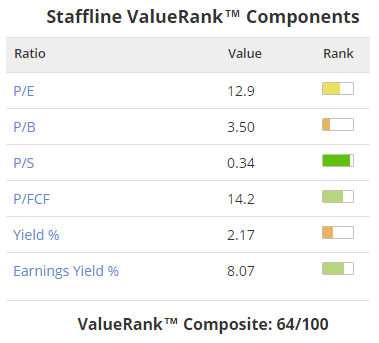
Staffline’s earnings yield of 8.1% is only just ahead of my screening threshold of 8%. But the group’s price/free cash flow ratio of 14 seems reasonably attractive. It also closely matches the trailing P/E of 13. This suggests accounting profits and cash generation are closely matched, which I like to see.
This has been reflected in dividend growth and the payout has tripled since 2013. Although this isn’t a high-yield stock, the 2.2% yield isn’t bad for a small cap.
A high price/book ratio is to be expected from a service business with few assets. So I’m not concerned by this ratio, especially as net debt is low, at c.1x underlying pre-tax profit.
Overall, my impression is that Staffline’s valuation is fair. If the company can continue to grow and maintain its profitability, I think there could be further upside.
Decent quality
The quality score looks a little more reassuring. Cash generation appears to be backed by fairly high returns on capital employed:
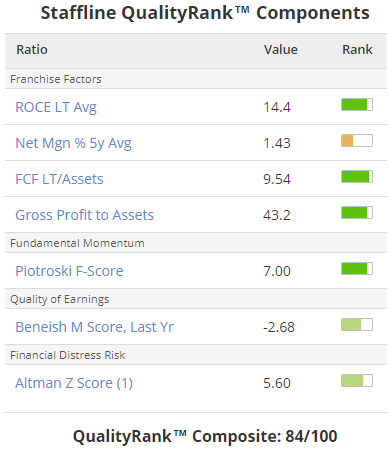
Although Staffline’s five-year average net margin of 1.4% is pretty low, three things mitigate this weak margin in my view:
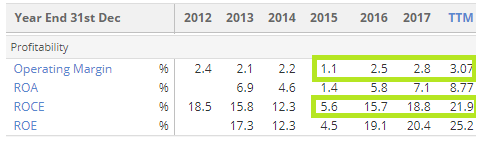
Profit margins appear to be rising, at least at an operating level.
Return on capital employed has recovered from its 2015 slump and is now attractively high.
I think the nature of this business means that a lot of revenue is pass-through (i.e. wages). So low margins are inevitable and don’t necessarily imply a lack of profitability.
To illustrate these points, I’ve circled Staffline’s operating margin and ROCE in this screengrab:
The final highlight of Staffline’s QualityRank is the Piotroski F-Score of 7/9. This useful financial health metric shows a strong picture of improving profitability, balance sheet strength and cash generation.
On balance, I think that if Staffline can maintain current levels of ROCE as it integrates recent acquisitions, the outlook should be fairly positive.
Mixed momentum
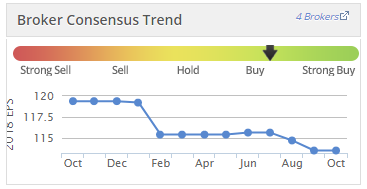
The final element of this jigsaw is momentum. And it’s a slightly mixed picture. The broker consensus trend has been downwards this year:
Despite this Staffline has a pretty strong MomentumRank:
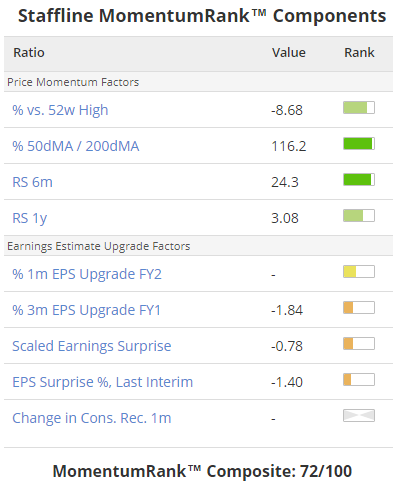
It’s not hard to see why the MomentumRank is quite high. Investors have been bidding up the stock steadily since July, giving Staffline very strong price momentum.
Where things look weaker is earnings momentum. However, it’s worth noting that although the factors listed above are all negative, the actual earnings downgrades and misses have been fairly small in percentage terms.
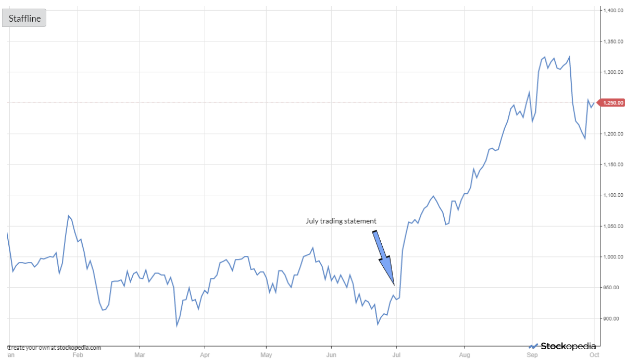
The risk here is obvious. The market has priced in a certain amount of growth following July’s bullish trading statement. The stock now trades on a rolling forecast P/E of 10.2, which isn’t especially cheap for this sector. Any disappointment could send the shares back to the sub-1,000p levels they were trading at earlier this year:
My verdict
I wouldn’t describe Staffline as a conviction buy for me. But it does appear to comply with my SIF purchasing rules. I also believe that the firm’s heavy exposure to the defensive food industry could actually help diversify my heavily cyclical portfolio.
I’m going to add Staffline to the SIF fantasy fund this week, and to my own real-life portfolio after this article has been published.
Disclaimer
This is not financial advice. Our content is intended to be used and must be used for information and education purposes only. Please read our disclaimer and terms and conditions to understand our obligations.

No comments yet
No one has commented here yet! Why not be the first one?