SIF Folio: Why Tesco could be a good defensive buy

This hot, dry weather appears to be affecting my stock market activities, which have also dried up. Just 11 stocks qualify for my SIF screen. And almost 40% of the SIF fantasy fund is now held in cash. The part of my personal portfolio which mirrors the SIF is also running an unusually high cash balance.
I don’t have a problem with this in principle. I’ve written before about my hope that when the market looks overvalued, the SIF screen will detect the warnings signs and move progressively into cash.
So far in 2018, this hasn’t happened. I’ve added 14 stocks to the portfolio and sold 14. But new buying opportunities have become fewer recently, so the next couple of months could see a more decisive shift to cash.
In any case, I’m in no rush to buy stocks, as I think that much of the market is fully priced. What I would welcome is the chance to pick up a couple of defensive dividend payers at sensible valuations. My exposure to defensive companies is pretty minimal at the moment:
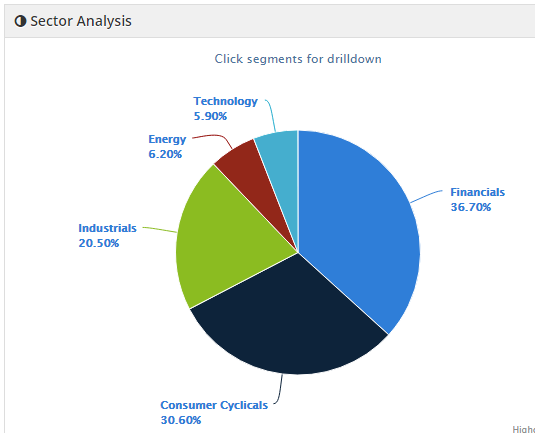
Because of this, I was interested to see that Tesco now qualifies for the relaxed version of my stock screen. (This is a fork of my main screen that accepts stocks with slightly more demanding valuations, as long as they satisfy all of my other rules.)
As the UK’s largest supermarket, Tesco could provide an attractive defensive backstop and a growing dividend income. The shares aren’t obviously cheap, but both the share price and the business appear to be performing well. Stockopedia also likes the shares, awarding them a StockRank of 81. So I thought it would be interesting to take a look at both this week in order to get a better understanding of what’s on offer.
Value lies in the future
Tesco shares are delivering almost indecent levels of earnings growth at the moment. Last year saw headline earnings climb 62.7% to 11.88p per share, as the group’s recovery continued. Further progress is expected this year, some of which has already been priced into the stock. All of this means that value isn’t the stock’s strongest suit:
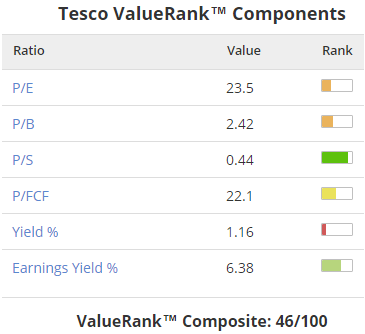
The shares may look pricey, but I don’t think there’s nothing obviously wrong here. One attraction for me is that earnings and free cash flow are broadly matched. This suggests that the group’s recovery is being built on solid foundations.
I should also comment on the earnings yield of 6.4%. This is below my normal screening minimum threshold of 8%, as it’s one of the rules I relax when I’m looking for more expensive stocks. But a figure of 6.4% isn’t bad, and the green bar in the graphic above shows this is enough to put it in the top third of UK companies ranked on Stockopedia.
Turnaround quality
Given Tesco’s turnaround status, I wouldn’t expect too much from its quality metrics. Let’s see what we’ve got:
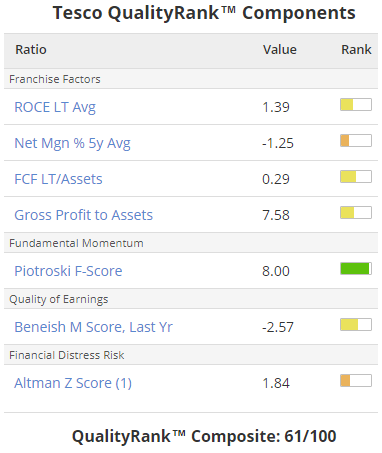
The franchise factors at the top appear to suggest that Tesco is a basket case. Of course, we know this isn't true. I’ve written before about the importance of looking at the trend behind Stockopedia’s five-year average figures. And that’s certainly essential here, given the turmoil and recovery in this business over the last five years.
Here are the numbers we need to consider:
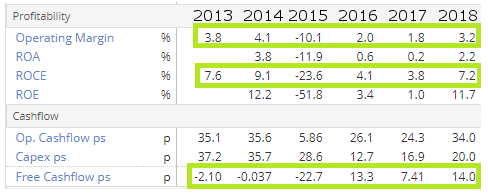
I’ve highlighted the three rows that interest me. It’s not hard to see when Tesco’s fortunes reached a low point in 2015. But what’s interesting is how the group’s operating margin, return on capital employed and free cash flow are making a concerted recovery.
Those pesky 2015 figures are skewing the stock’s five-year average quality figures. But the current situation appears to be much more impressive. And importantly, the trend is improving.
In fact, we probably didn’t need to look at these figures to reach this conclusion. The supermarket’s Piotroski F-Score of 8/9 should have been enough to tell us that this was a good, improving business. I often use this fundamental health score to get a snapshot of how a business is performing. Here’s how Tesco’s F-Score breaks down:
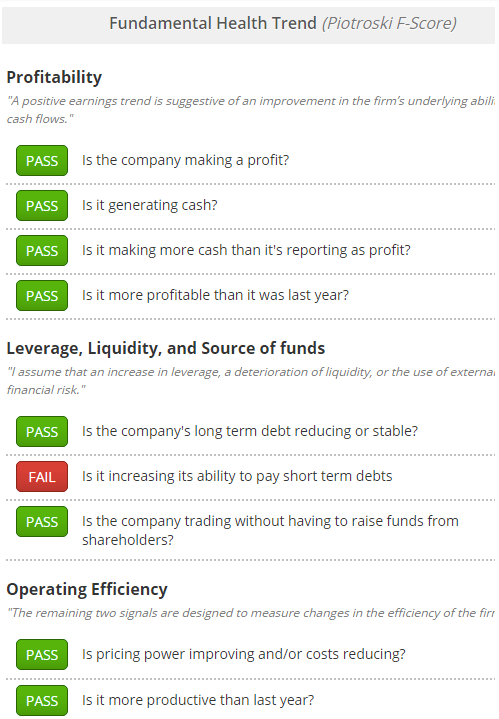
When you see this much green alongside these nine rules, it’s usually a good indicator that a business is firing on all cylinders.
We now know that Tesco’s recovery is going well. What we don’t know is how much further there is to go before this FTSE 100 big cap returns to a comfortable life of low growth and generous dividends.
Momentum overshoot?
The final piece in this jigsaw is momentum. Stockopedia’s computers rank the stock very highly in this department, with a MomentumRank of 95. It’s not hard to see why this might be:
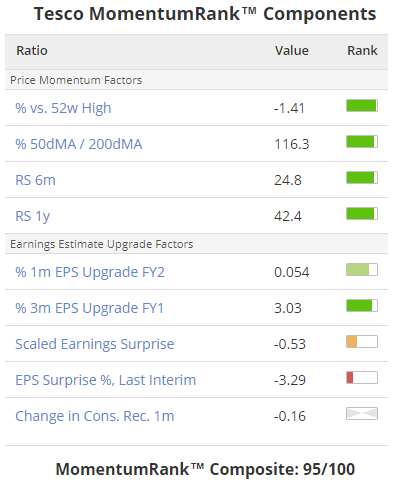
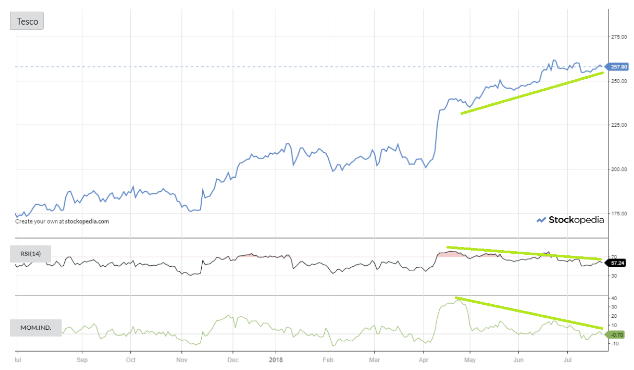
Tesco’s share price momentum is currently very strong. The stock has held onto the rapid gains triggered by the group’s results in April and is currently at a post-2014 high.
However, I wouldn’t be surprised to see a period of consolidation in the near future. Technical traders will notice that the stock’s RSI (relative strength) and momentum have been weakening since May, even as the shares have continued to rise. This divergence could indicate that the shares have got ahead of themselves:
What about earnings momentum? June’s Q1 trading statement doesn’t seem to have triggered any major changes to analysts’ forecasts. Broker upgrades seem to have levelled out, after a period of strong gains.
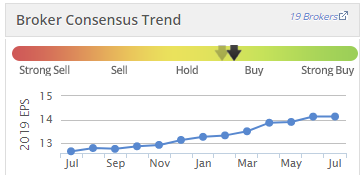
Despite this, the overall picture for earnings growth is very encouraging:
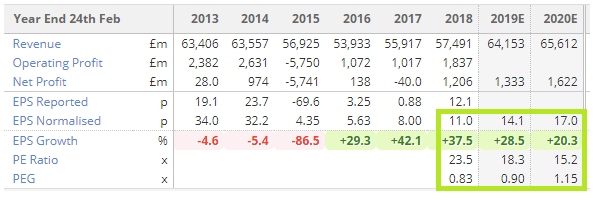
With earnings still expected to grow by around 20% per year, the stock’s forecast valuation starts to look more reasonable.
Tesco is targeting an operating margin of 3.5%-4.0% by 2019/20. Based on that guidance, my estimates suggest there could be a little more upside on the broker forecasts shown above. What I’m less sure about is how much further growth to expect once that target is reached.
My verdict
On balance, I’m tempted to say that Tesco shares look fairly valued at the moment.
In any case, my rules state that I can only buy stocks from the relaxed version of my SIF screen if I’ve had a dry spell of four weeks or more. That’s not the case here, as I added Bovis Homes earlier this month. So I won’t be buying Tesco for SIF this week.
But if the shares fall to around 225p, I may be tempted. And if I was building a long-term income portfolio, I would certainly consider buying some at this level. I expect dividend growth to outpace earnings over the next few years, improving the yield significantly.
What’s your view on Tesco? Has CEO Dave Lewis successfully handled the group’s past problems and returned the group to growth, or is this just a temporary respite for a declining business?
Disclaimer
This is not financial advice. Our content is intended to be used and must be used for information and education purposes only. Please read our disclaimer and terms and conditions to understand our obligations.

10 comments
Roland, BTW, have a look at Cohort Cohort (LON:CHRT) as a possible defensive stock addition to your portfolio. Good stock ranking. Defence/Off-shore Energy/Electronic systems/Cyber Security. OK dividend, with years of steady div growth. Sensible PE and PEG. No debt, has cash. Looks like a good possibility to me. Be interested in your thoughts.
M
Thanks Roland. I only asked as I'm trying to build a strategy for a downturn in the market (for when it inevitably arrives) I've never really shorted individual stocks (once bought a short fund of the S&P 500 for a specific purpose), so I don't know If I would be good or not. Just an alternative (defensive stocks and shorts) to exiting the market altogether, or living with the slide.
Unfortunately I held Tesco a while back and now have a reluctance to hold them (even though the players are different. Not logical, I know).
Cheers,
Mark.
Hi Roland, Only just found, and read, your content on Stockopedia. A good approach and can be conservative (of capital I mean) when markets are getting overvalued. Have you considered shorts, along with defensive stocks to hedge against a possible downturn or even during a bear market?
Hi mmarkkj777,
Shorts are beyond the scope of this portfolio at the moment, and in my experience increase risk as well as creating opportunity. Perhaps I'm just not a very good shorter!
I am keen on defensive stocks but have struggled to find these at reasonable valuations in the 2+ years I've been running SIF. I hope this situation will change in time - Tesco (LON:TSCO) could be a possible example at a slightly lower price.
Regards,
Roland
I could not buy this on simple valuation grounds.
It's currently on a PE of 23.5, which is high for this type of business. That must already be pricing in some recovery.
Even if they double the current margins, the PE is still in double figures and the margin would already be over 4%. Difficult to see it going much beyond that. What am I missing ?
Just made a rare visit to one of their stores. Decided to continue splitting my shopping between Lidl and Sainsburys.
Hi jonesj,
Thanks for your comment. I agree that continued recovery at Tesco (LON:TSCO) is already reflected in the price. But its cash generation and economies of scale (as the UK's largest supermaret) are impressive, in my view. I'm impressed by the quality of management at present.
At current levels, I don't see big capital gains, but I do think it could be a good long-term income buy.
In terms of shopping experience, I split my shopping between Lidl and J Sainsbury (LON:SBRY) too. But that's because they're closest to where I live. If it was Tesco and Aldi nearby, I'd go to them instead.
I'm not sure how many people have powerful brand loyalties to supermarkets anymore, although I'm ready to be proved wrong!
Regards,
Roland
Hi Roland
I just want to add my voice to Jim's above.
I read your post with interest every time and value the research you are documenting and the way you illustrate how you use/interpret Stockopedia.
I do not know why more do not offer comments.
As a suggestion I think you could, on occasions, add into a title of a peice your annualised returns and over what period you have achieved these. These stats I think are enviable and could be broadcast.
I think others have not yet cottoned on to how well the SIF portfolio, your application of rule-based investing and your intelligent coverage are actually doing.
Obviously others have their own investing styles, but yours IMO, has some important messages which can benefit different approaches.
In short, I do not see why you cannot add a bit of 'marketing' into a title or two every once in a while. It just might grab more attention. As your pieces deserve it.
Regards
Howard
Hi Roland,
I follow your musings here quite closely, I'm always a bit disappointed on your behalf at the lack of interested comment from the stockopedia readership as i think what you are doing is using the site as was intended to discover interesting investment opportunities. i think you do it well!!
I like the way you 'get behind the numbers' and this article has for me just re-inforced what a great metric the F-Score really is ! As you point out it tends to reveal trends as opposed to bland averages, which as you point out here regards Tesco (LON:TSCO) can be quite mis-leading. What has become apparent to me over my time investing is that Mr market seems to reward investors who spot companies who's fortunes are improving rather than sustaining. Tesco is a great example of this where its economic fortunes hit rock bottom in 2015, yet it was 2017 roughly before you saw a 'higher low' on the longer term chart ( indicative of a new uptrend). Thus plays out the famous 'bowl' chart which usually makes a good buy! An obvious point here is that the low spot economically is usually a good while before the chart low spot, giving investor an opportunity to joint the party before the drinks cabinet gets locked up! (To misquote Alan Greenspan!)
It would be interesting to see if a way could be found to identify stocks reaching a 'tipping point' on a return to favour, somehow I think the F-Score should find itself included in this method (should it be possible to formulate a 'method'). I think once a company has been identified as returning to favour then the beaten up nature of the price and possibly the yield (divi) should provide some comfort in times like this when valuations vs future growth are generally looking a bit strained, as in like the current situation.
Anyways apologies, I know this isn't strictly what SIF is all about but i like your systematic approach so wondered what your thoughts might be on using your analytical method to tapping into the field of 'returning to favour' stocks.
Regards
Jim
Hi Jim,
Thanks for your comments. Your description of the "bowl chart" is very apt. In my own value investments, I tend to find that the key to success is not to rush in too soon. It takes a while for momentum to turn positive, even when the value opportunity is clearly defined.
It would certainly be interesting to spend some time trying to work out screening rules to pick up turnaround opportunities. I've dabbled with this before, but not reached a satisfactory conclusion. I'll have to try and find some more time for it!
Regards,
Roland
Hi Roland,
When the new charts package was launched here I did try to persuade Ed and Co. the introduce TA screening to allow screening based on MA,RSI,Stochastic etc alongside the fundamental economic indicators. I still think the 'combined' screening approach would be the best as....
1 Its fruitless and frustrating to invest in what you may think 'cheap quality' stocks if the world and his dog doesn't agree with you. You will be rewarded....one day.....soon ....maybe?
2 Its risky and nerve-fraying to invest in 'iffy' stocks just because they are going up.It feels like gambling and you may get wiped out on a whim!
Alas so far as i know the ability to screen for TA hasn't yet been introduced.
What I would like ideally is a screen that could find the value opportunity THEN alert you when the momentum has moved positive. Obviously everyone will have they're own idea on the criteria to use but then at least we have a basis for comparison and discussion. Think you could give Ed a nudge?
Regards
Jim