SIF July review: Gold price provides a welcome boost (CAPD, HAT, BHP)

The end of the month is normally a bit of a relief. Carrying out my monthly SIF portfolio review means that I don’t need to find an interesting new stock to write about. Instead, I’m able to review the folio’s performance and revisit some familiar stocks to see how they’re doing.
I think there’s also a psychological trait at work here. There’s a part of me that’s always keen to take profits on successful positions, even if logic suggests they should be held. Fortunately, my rules prevent such emotional responses. And as I discussed in my stop-loss piece last week, I’m taking steps to try and eliminate losers more effectively so as to maximise the benefit from successful positions.
Incidentally, last week’s piece attracted many excellent comments - thank you for your contributions, I do read them all.
This month doesn’t feel quite as relaxed as usual. I’m blaming this on the gold price, which hit a record high of more than $1,900/oz at the end of last week. The SIF Folio includes two stocks with exposure to gold, so naturally my instinct is that it’s time to sell them. However, as we’ll see, my rules suggest otherwise.
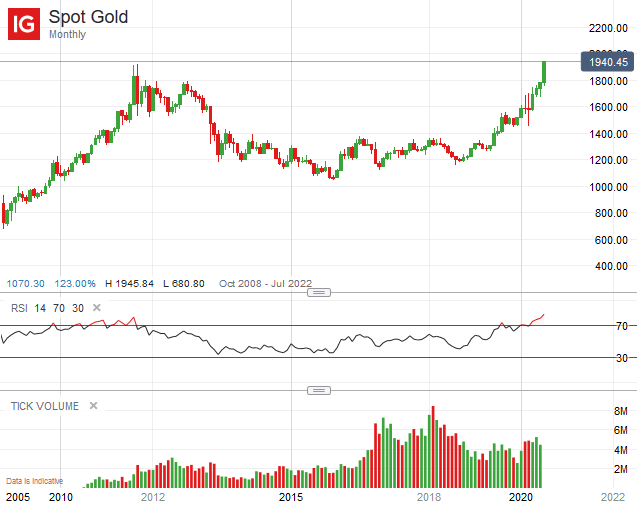
The case for selling seems logical enough to me. The last time gold rose above $1,800 was in 2011, during the previous gold investment boom. You may remember that this coincided with the eurozone crisis.
But despite the existential threat to the EU, the gold price soon started to fall as investors remembered that it’s an unproductive asset that never grows or generates any income (tin hat on).
Source: IG Index
For a gold cynic like me, what we’re seeing now is likely to be a repeat of the 2011 boom. I see that gold is now overbought on RSI for the first time since 2011. However, even if I’m right, there’s no way to predict when the gold price might start to head south.
In any case, momentum is a powerful force. Gold bugs have done very well this year and concerns about the medium-term impact of COVID-19 remain high. As Ed commented in his latest SNAPS review, “there could be a long way to run in precious metal stocks yet”.
SIF folio review
The portfolio currently contains three shares that have been in SIF for at least nine months, my default holding period. These stocks are up for review and possible sale this week:
- FTSE 100 commodities group BHP (LON:BHP)
- Gold mining services group Capital (LON:CAPD)
- Pawnbroker and lender H&T Group (LON:HAT)
Capital has been a big beneficiary of this year’s gold surge. Shares in the firm have risen by more than 50% since I added the stock to SIF last July. They’re up by 200% from March’s 52-week low of 26p.
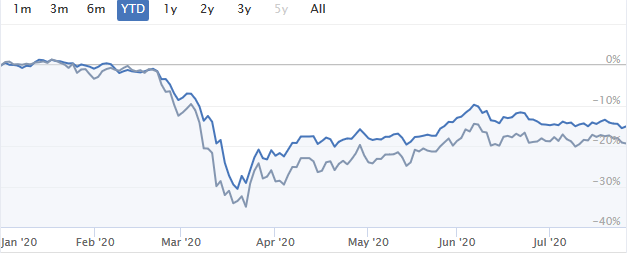
It’s fair to say that this AIM-listed small cap has helped keep SIF ahead of the FTSE All-Share index this year, albeit still in the red:
Here’s how the portfolio looks at a stock-by-stock level at the moment. As you can see, gains are concentrated mainly in Capital and in one of my lockdown buys, German property group Sirius Real Estate:
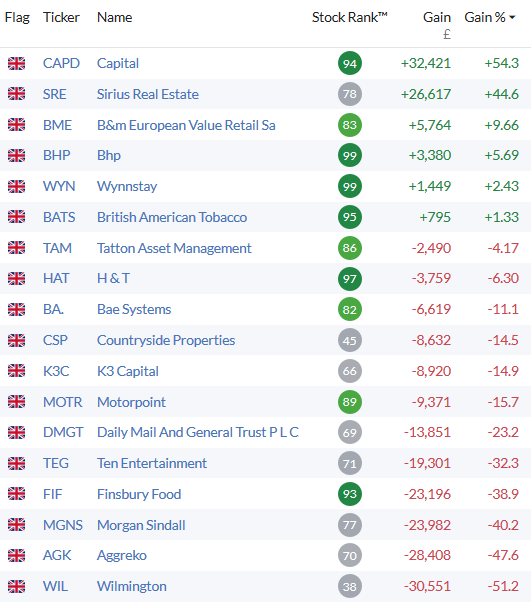
Looking at the remainder of the portfolio, I suspect some stocks will struggle to recover from the pandemic hit before my rules force me to eject them from the portfolio. However, although the outlook is very uncertain, I think some have better prospects than their valuations currently suggest.
I’ll stick my neck out here and say that Morgan Sindall, Finsbury Food and H&T all look good value to me. Perhaps Aggreko, too, although I’m worried about oil market exposure.
I also regard used car supermarket Motorpoint very highly as a business, but operational gearing is high and I’m unsure about the outlook for UK consumer spending. This one could go either way, in my view.
In any case, I’m happy that my rules allow me a little longer to hold these stocks. Hopefully they will be able to provide more convincing evidence of their recovery potential during this time.
Let’s move on now to take a look at the three stocks that are under review this week.
Capital (LON:CAPD)
(Original coverage: 02-Jul-2019)
This is the AIM-listed gold mining services contractor formerly known as Capital Drilling. It’s been in the portfolio for a full year now, and has been covered in several previous monthly reviews (April, May & June).
As I’ve discussed already, I’m having to fight against my instinctive desire to take a profit here. The shares are now at the highest level seen since 2011:
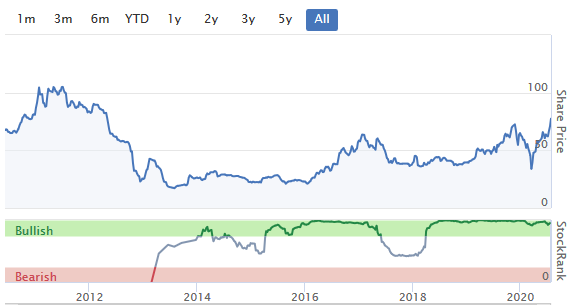
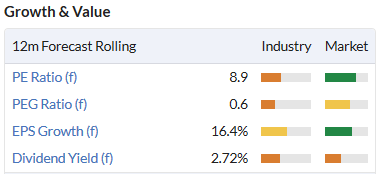
Luckily my rules are on hand to guide me. Capital continues to look affordable, with decent growth prospects.
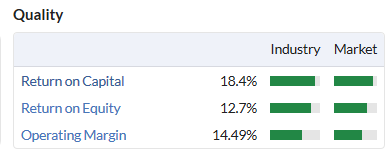
Quality metrics are impressive, too:
The shares still pass all of my screening rules, except for the lumpy spread, which I don’t see as a reason to sell:

So far, this position has delivered a total return of more than 55% including dividends. I’ll continue to hold the shares for another month.
Total return to date: +57%
Verdict: Hold
H&T Group (LON:HAT)
(Original coverage: 16-Jul-2019)
Like Capital, H&T has been in SIF since last July and has featured in several previous monthly reports.
I’m a little more comfortable continuing to hold this stock. Although it’s exposed to the price of gold, the yellow metal isn’t the only source of income for this pawnbroking and loan business.
The latest trading update from the firm suggests a mixed outlook. All of its shops have now reopened and some business has moved online. The balance sheet looks strong and liquidity is good. However, I’d imagine there could be some impact from payment holidays and perhaps an increase in bad debt.
We’ll have to wait for the next trading update to find out more, but the broker consensus trend remains very positive:
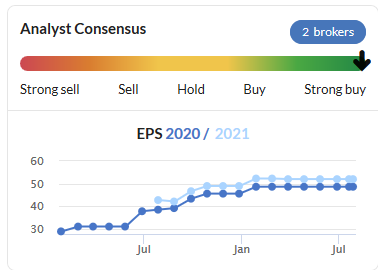
There seems to be an anomaly in the normalised earnings per share data shown in H&T’s StockReport at the moment, but after adjusting for that I find that the shares still pass all of my screening rules.
On that basis I will continue to hold them for a further month.
Total return to date: -3%
Verdict: Hold
BHP Group (LON:BHP)
(Original coverage: 08-Oct-2019)
Despite my comments on gold, I believe most portfolios should have some exposure to commodities. My preference is for those materials which are needed by industry to support modern life - copper, oil and iron ore, for example.
Although you can invest in commodity funds to gain this exposure, I think a simpler option is just to buy shares in FTSE 100 miner BHP. This Anglo-Australian group owns a mix of good quality assets in stable jurisdictions, covering oil, gas and diversified mining.
BHP has a good track record of dividends, too. Forecast yield for the year ahead is 5.1%.
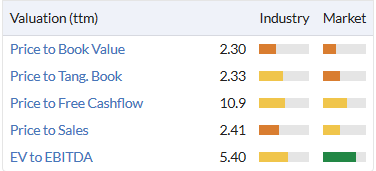
Despite this, I can’t help feeling that the stock is probably at the upper end of its historic valuation range at the moment, trading at 2.3x book value. Fundamentally, I don’t see this as a growth business:
The broker trend suggests falling earnings, too:
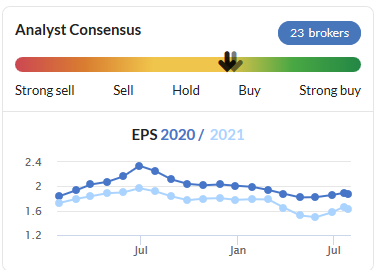
For these reasons, BHP shares no longer pass all of my screening tests. As a result, I’ll sell BHP from SIF and my personal holdings this week for a modest gain.
Total return: +8%
Verdict: Sell
Disclosure: At the time of publication, Roland owned all the shares listed.
Disclaimer
This is not financial advice. Our content is intended to be used and must be used for information and education purposes only. Please read our disclaimer and terms and conditions to understand our obligations.

3 comments
"...the gold price soon started to fall as investors remembered that it’s an unproductive asset that never grows or generates any income (tin hat on)."
The Fed is monetizing a big chunk of the debt through its government bond purchase program. In effect, it is buying up US debt and paying for it with money printed out of thin air.
USD Money supply growth hit a new all-time high for the third month in a row in June. The only time we’ve seen money supply growth anywhere near this level was during the inflationary years of the 1970s. In June, year-over-year growth in the money supply came in at 34.5%. That was up from 29.5% in May.
Assuming gold will fall this time would be the equivalent of assuming that the money printing is about to come to an end. There’s no reason to believe that.
Deutsche Bank chief US economist Matt Luzzetti predicts that the Fed’s balance sheet will continue to explode:
We find that the Fed will need to provide significant accommodation – roughly equal to a fed funds rate of -5% — and that QE and forward guidance could be insufficient. Assuming limited impact from forward guidance given that markets are pricing negative rates, our estimates range from an additional $5tn to $12tn more of balance sheet expansion needed. Our preferred calibration sits towards the high end of that range.”
We may see some profit-taking and corrections in the price of gold in the near-term, but given the economic dynamics and the trajectory of government and central bank policy, it appears gold still has a long way to run up.
Goldman Sachs, by way of its chief commodity strategist Jeffrey Currie recently wrote that "real concerns around the longevity of the US dollar as a reserve currency have started to emerge."
The US government certainly won't 'give up' the dollar's reserve status. That decision will be made for them by the government of some other country and likely one that has been heavily sanctioned and, therefore, has nothing to lose. And whatever that country is, it will certainly have to back its currency in gold, at least initially, before it can become the reserve currency, replacing the dollar.
Hi CP001,
Thanks for such a great comment. You make a good case and you may well be right.
I respect gold's utility as a portable and universal store of value, but I just can't see how it makes sense as a long-term investment.
But I could be wrong. And even if I'm right, my timing might be wrong.
As Maynard Keynes said, "the market can remain irrational longer than you can remain solvent. "
We live in interesting times.
Regards,
Roland
Hi Roland,
I'm more of an Austrian school of economics kind of guy than a Keynesian:-) I believe Keynes said something about houses being a misallocation of capital as well as savings. He is a modern day John Law as far as I'm concerned:-)
Most assets classes look overvalued to me, gold is likely to perform much better than just keeping up with purchasing power. The shortage of physical gold and the failure of the LBMA system and gold futures markets will be major factors (as I posted elsewhere).
It is fascinating that only 0.5% of global financial assets are invested in the only asset that has ever held its purchasing power over time in history. In the next few years investors, from retail to institutional, may all want gold.
Government bonds (previously considered to behave as a hedge in a CAPM-styled portfolio offering the risk free rate of return) no longer perform their portfolio role due to the low yielding bonds’ skewed convexities, this is another reason why the institutions may end up having to hold gold in their portfolios at some point I predict.
Gold is not going up but the dollar and other fiat currencies are collapsing. Just this century the dollar has lost 85% of its value in real terms – gold. If we look at the last 20 years since 2000, all currencies except for the Swiss franc are down 82-88% in real terms or gold (the Swiss franc came off a gold standard in (I believe) 1999).
The central banks hold lots of gold for a reason...it is real money. The fiat that they issue is collapsing before our eyes and most people haven't realised it yet I'm afraid.