SIF July review: staying ahead of the market (TAM, RWA)

July seems to have passed by pretty quickly. We’ve seen a small bout of market volatility, but this has quickly reversed. The only real impact on SIF was the opportunity to add Character (LON:CCT) and Drax (LON:DRX) to the portfolio at what I hope will prove to be attractive valuations.
As it’s the last week of the month, it’s time for my regular monthly review of the portfolio. I’ll start with a look at SIF’s performance. I’ll then review those stocks that have been in the portfolio for at least nine months.
Two companies qualify for review this month:
Tatton Asset Management (LON:TAM) - this financial services firm has now been in SIF for a year, during which it’s delivered a total return of 70%. Does it still pass my screening tests?
Robert Walters (LON:RWA) - it’s been a good year so far for recruitment stocks, including this white-collar specialist. I’ve been taking a look at the latest trading update from the firm.
For new subscribers who aren’t familiar with how SIF works, I included a brief summary of the screen-based system I use to run this portfolio in my June review. I hope this answers most of the obvious questions - if not, please feel free to ask any questions in the comments below.
SIF Folio: July performance update
SIF largely avoided the (minor) volatility seen in the wider market in July:

(SIF = blue, FTSE All-Share Index = grey)
The portfolio has maintained its lead over the market. SIF is up by around 20% for the year-to-date, compared to about 10% for the index:

The portfolio’s cash weighting has risen from 22% to 29% over the last month, as I’ve sold more stocks than I’ve bought:

I prefer to have some cash available, to ensure I’m always able to open new positions without ever being a forced seller. However, the current cash weighting seems higher than necessary to me, so I’m making a change to my position sizing rules.
Position sizing: All SIF holdings are equally sized at purchase and are not normally rebalanced, so I use a fairly simple method to calculate position size.
Default position size = (Current portfolio valuation * 0.8)/20
In other words, I subtract 20% from the value of the portfolio to loosely approximate a market crash. This gives me some margin for error, so I can trade normally even if the market falls.
I then divide the adjusted portfolio value by 20 to calculate the individual position size. I don’t generally intend to hold more than 20 stocks in SIF.
I’ve used this method for a number of years, during which SIF’s default virtual position size has risen from £50k to the new value of £65k. This approach won’t be suitable for all portfolios, but it seems to work for SIF.
Portfolio snapshot: To wrap up this section, here is a snapshot of all 16 of the portfolio’s holdings on 26 July 2021:
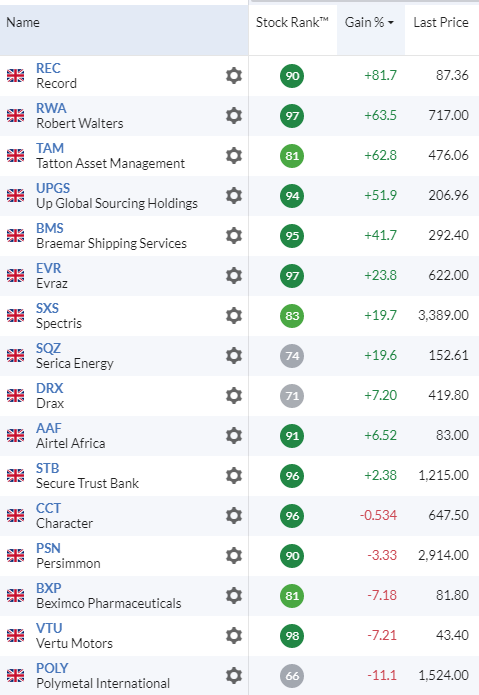
Two of the top three performers are up for review this month. Let’s see if they can remain in the portfolio.
Robert Walters (LON:RWA)
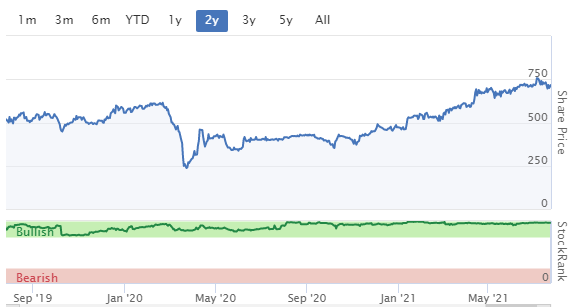
Like a lot of cyclical stocks, recruitment group Robert Walters has enjoyed a pretty rapid recovery since ‘vaccine day’ in November. The firm’s shares are now trading well above pre-Covid levels:
Walters has a market cap of £534m, making it a mid-sized firm among UK-listed peers. The group is run by founder-CEO Robert Walters, who had a 3.5% shareholding at the end of last year.
The company specialises in providing professional services staff and operates in 31 countries, with a strong presence in the Asia Pacific region.This was one of the attractions for me when I bought the stock in October. I expected that an Asian recovery would probably come ahead of a return to normal hiring in Western markets.
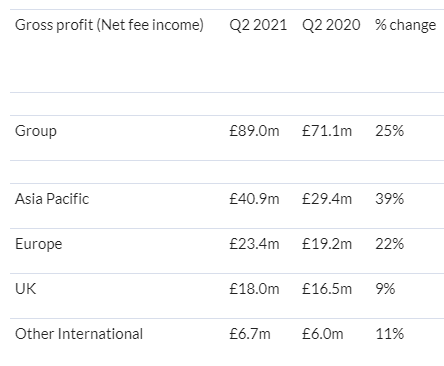
Robert Walters’ latest trading update suggests that this is how things have played out. The company reported a 39% increase in net fee income in the Asia Pacific region during the second quarter, significantly ahead of other major markets:
Outlook: Market conditions appear to be improving rapidly for Robert Walters. The company has upgraded its profit guidance twice in the last two months.
11 June: “profit before taxation for the full year ending 31 December 2021 to be materially ahead of current expectations”
7 July: “trading momentum continued to accelerate through the second quarter” … “profit for the full year is now expected to be significantly ahead of the level signalled in our recent 11 June trading update”
It’s good news for shareholders. But it would have been helpful if the company had put some numbers to these bullish statements. Perhaps we’ll get more detail with the half-year results - these are due shortly after this article is scheduled to be published.
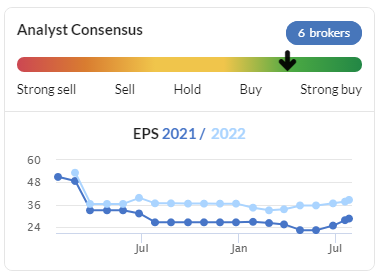
For now, we’ll have to rely on the consensus view, which has been trending higher since the end of May:
My decision: Robert Walters shares pass all of the tests in my selling screen, which means that I can hold the stock for another month.
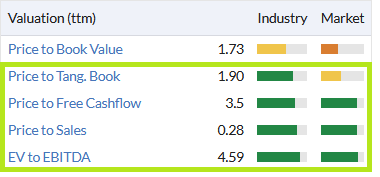
However, I think it’s worth pointing out that the shares are now significantly more expensive than when I added them to the portfolio.
12 October 2020:
26 July 2021:
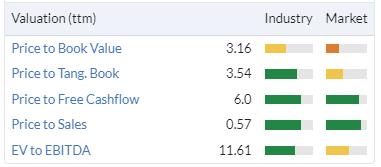
On all the measures listed in the graphics above, Robert Walters’ valuation has nearly doubled. Are the shares now too pricey?
They aren’t cheap, in my view, but I think the forward P/E of 20 times earnings is probably acceptable at the moment.
Stripping out net cash of £113m reduces gives a cash-adjusted P/E of 16 times forecast earnings.
This business is also highly profitable. Return on capital employed has averaged in excess of 20% in recent years -- I expect ROCE to return to this level in 2021:
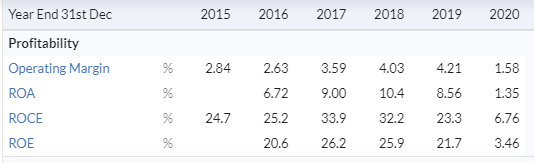
Momentum also remains strong, with a MomentumRank of 94. Assuming the global economy continues to hum along, I don’t think this recruitment stock is necessarily too expensive.
Time will tell. For now, my rules say that I should continue to hold the shares, so Robert Walters will stay for at least one more month.
Total return to date: +61%
Verdict: Hold
Tatton Asset Management (LON:TAM)
Tatton Asset Management offers platform services for financial advisers, including asset management.
This AIM-listed stock has generated a total return of 70% for SIF over the last year. However, there hasn’t been any newsflow since my review last month. So I’m going to restrict this review to a comparison of the start and current valuations of this stock.
Let’s start with the trailing 12-month (ttm) valuation graphic from Tatton’s StockReport:
6 July 2020
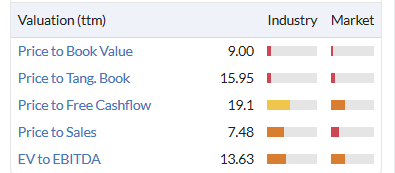
26 July 2021
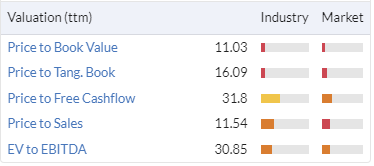
The valuation multiples have increased across the board, significantly so in the case of P/FCF and EV/EBITDA.
However, if we consider more forward-looking growth metrics, the shares are still quite similarly rated, with a rolling PEG ratio of 0.9.
8 July 2020
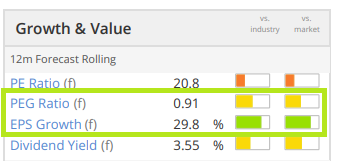
26 July 2021
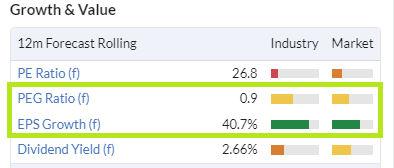
Stockopedia’s view is relatively unchanged too. When I bought the stock in July 2020 it had a StockRank of 86 and a style of High Flyer.
Today, Tatton has a StockRank of 81 and a style of High Flyer.
Although there is some cyclical risk, I don’t think Tatton shares are necessarily overpriced. Earnings growth is expected to remain strong. The company’s five-year average return on equity of 35% suggests to me that it could continue to generate attractive shareholder returns.
My decision: Tatton Asset Management continues to pass all of my screening tests, so will remain in the portfolio for at least one more month.
Total return to date: +70%
Verdict: Hold
Disclosure: At the time of publication, Roland owned shares of all the SIF portfolio stocks.
Disclaimer
This is not financial advice. Our content is intended to be used and must be used for information and education purposes only. Please read our disclaimer and terms and conditions to understand our obligations.

5 comments
Hi Roland,
Can I ask about your process?
You have a screening process that lists a number of companies that meet your criteria. This can obviously be run as and when required. Do you then simply look to see which longer-term holdings have failed your test, to then throw out and replace with one of those on the screening list? Thereby ensuring you have a relatively set number of Co's in your PF
I am slightly confused by how you select your "new" incomers vs those that came into the PF and have stayed there.
Great to read your write-ups each month and I like the results you seem to be getting.
Thanks
Kevin
Hi Kevin,
Good questions. I select stocks to add to the portfolio from a buying screen, which you should be able to see here:
https://www.stockopedia.com/sc...
New holdings stay in SIF for a minimum period of nine months before they are reviewed (unless they are sold following a profit warning or 25% price drop).
At the nine-month mark, I review holdings against a selling screen. This is slightly confusingly named, but in short if a stock passes all of the tests in this screen, then I'll continue to hold it for another month. If not, then it's sold. I repeat this process each month with older holdings.
You can see the selling screen here:
https://www.stockopedia.com/sc...
The main difference between the buying and selling screens is that some valuation and growth criteria have been relaxed in the selling screen. This allows me to continue holding stocks that have become more expensive, if they are still showing positive momentum.
Portfolio size: I don't target a fixed number of holdings, but I do have a soft limit of 20. I don't have a lower limit -- if my rules say sell, then that's what I'll do. In practice, I think I've only managed to get up to 20 stocks for a few short periods. Mostly, it's 12-18 stocks.
I hope this answers your questions - if not, just let me know.
Regards,
Roland
Thanks Roland, much appreciated.
Just out of interest, in the buying screen, how do you choose which of any "new" stocks to buy - I am assuming that multiple stocks could appear in any given month and therefore how do you sort the wheat from the chaff.
Thanks for your answer - this has cleared things up and I look forward to drilling down into your process some more.
Kevin
Kevin,
When I'm looking at the results of the buying screen, I sort the results by StockRank, with the highest at the top.
I then work my way down the list, looking for a stock that does not overlap too heavily with any of my existing holdings. This is really the only area where I use some subjective judgement - I sometimes reject stocks that I don't want to own for cyclical or qualitative reasons. Here's one recent example of this, discussing Severfield (LON:SFR):
https://www.stockopedia.com/co...
Roland
Today's interim results from Robert Walters (LON:RWA) were perfectly timed to miss my editorial deadline for this piece.
No matter - I've had a look through and they do not seem to contain anything which alters the narrative from the latest trading update.
Selected highlights include:
On balance, my view remains that despite cyclical risks, the shares may still be reasonably priced. On the strength of these numbers, I'm happy* to continue holding Robert Walters in SIF.
N.B. Jack has a more detailed write-up in today's SCVR.
Roland
*These comments represent my opinion only, please DYOR
Disclosure: I hold RWA