SIF Portfolio: GKN - plus why Costain could still be a sector pick

I have a new stock to consider for the portfolio this week, but first I’m going to take a quick look at the latest news regarding portfolio stock GKN.
Melrose Industries’ hostile bid for FTSE 100 engineering group GKN has grabbed a lot of attention in recent weeks. I added GKN shares to the SIF portfolio when they qualified for my screen in the wake of Melrose’s original offer in January. The stock has been in a holding position since then, awaiting further events.
The final straight?
This process now seems to have entered its final phase. Melrose made a final offer for GKN on Monday morning, with an acceptance deadline of 29 March. The offer document valued this offer at 467p per share. However, this calculation appears to have included last year’s dividend and to have been based on a higher Melrose share price.
The offer is made up of 1.69 Melrose shares and 81p for each GKN share. Based on Monday’s closing price I estimate this is worth around 442p of new money to GKN shareholders. That’s a 30% premium to GKN’s pre-offer price, but is 61p less than the sum-of-the-parts valuation of 503p suggested by GKN management in their latest defence document.
GKN’s board only took a few hours to reject Melrose’s final offer, but at least one major fund manager has now come out in favour of the Melrose bid. The final outcome seems likely to be based on management credibility, as both teams are suggesting similar measures to turnaround the engineering group.
If Melrose is successful, I’ll sell the portfolio’s virtual shares before the takeover completes. This is because Melrose doesn’t pass my screening tests, so it isn’t eligible for the portfolio.
New screening results
The SIF screen has offered up a number of tempting stocks this week. However, the rules require me to rank the results by StockRank. The top-ranked eligible stock is FTSE SmallCap infrastructure and engineering group Costain.
I came close to ruling out this firm because the portfolio already owns shares of groundworks specialist Keller. However, in the end I decided that Costain’s UK focus meant that its fortunes wouldn’t overlap too heavily with Keller’s global operations.
These diversification decisions are inevitably quite subjective and often difficult. I’ve made a note to see if I can improve my decision-making process in this area as part of the portfolio’s year-end review in April.
Costain still looks good to me
Costain has made good progress since I first wrote about it here nearly three years ago. In May 2015, I suggested that “the shares could do well on a three-five year timescale”. The share price has risen by about 45% since then. Profits have risen by a similar amount.
Last year’s results revealed another strong performance, with revenue up 4% to £1.73bn and underlying operating profit 18% higher, at £48.7m. Margins were stable and the dividend rose by 10% to 14p.
One low point was that management had to wipe £350m from the order book after failing to agree a final contract for marine works at the Hinkley Point C nuclear power station. I’m not too concerned, as this suggests good bidding discipline.
Despite this loss, the overall order book was maintained at £3.9bn. More than 90% of this is repeat business, which I see as a testimony to the group’s high level of service delivery. The question today is whether there’s any more growth left in the tank. Stockopedia’s algorithms seem to suggest that there could be:
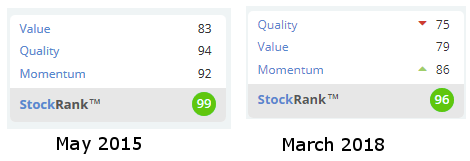
The StockRanks were slightly higher in 2015, but today’s score seems high enough to justify a possible place in the portfolio.
Costain also qualifies for six of Stockopedia’s Guru Screens, including Naked Trader and Jim Slater ZULU Principle. Both of these have delivered annualised returns of 22% since their inception.
A closer look at value
I don’t think that a low-margin, cyclical stock like this deserves a high valuation. The current ValueRank seems to suggest the stock is affordable, but I think some of these metrics need careful interpretation:
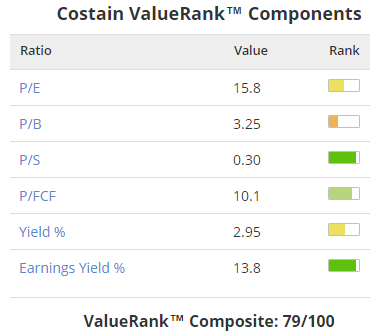
I usually rely heavily on earnings yield (EBIT/EV), which looks impressive here at 13.8%. However, this measurement of enterprise value includes Costain’s year-end net cash balance of £177.7m.
Costain’s large and lumpy contract commitments mean that demands on its cash balance can vary widely through the year. The group’s average month-end net cash was £96.7m in 2017. That’s still a very creditable figure, but using this in the enterprise value calculation reduces the group’s earnings yield to 11%.
I’m still happy with that. It’s above my threshold of 8% and a decent figure by any standards. I’m especially pleased to see this sitting alongside a price/free cash flow ratio of 10.1.
Overall, I’m comfortable that Costain is still generating cash-backed profits and trading at an attractive valuation.
Quality is key
One of Costain’s selling points for customers and potential investors is its focus on higher-value services, where considerable expertise is required. Management steer away from heavily-commoditised work and instead target leadership roles in high-value and complex infrastructure work.
This approach appears to allow the group to generate a surprisingly high return on capital employed. Cash generation is also good. In my opinion, this is about as close to a defensive moat as you’ll find for a company of this kind:
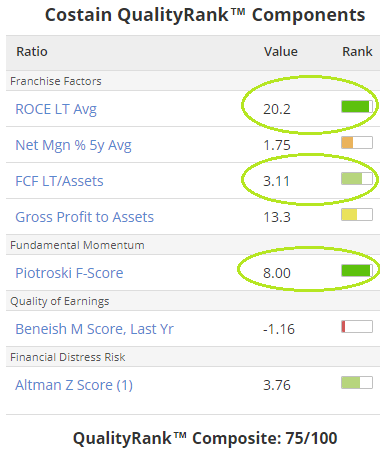
The five-year average ROCE of 20% is one of the highest in this sector. Although rival Morgan Sindall generated a matching ROCE of 18.6% in 2017, this looks more like a cyclical high to me. Costain’s ROCE has been much more consistent.
Costain profitability metrics 2012-2017:

Morgan Sindall profitability metrics 2012-2017:

In my view, these numbers suggest that Costain’s stated strategy is working well by helping to differentiate the group from the wider construction and engineering market:
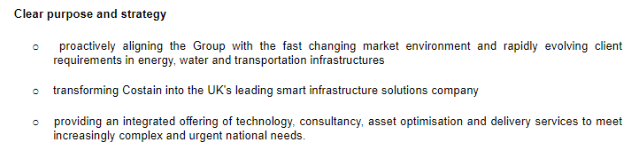
So far, we’ve seen that the firm’s trailing valuation looks reasonable, and that it’s profitable and cash generative. The next question is whether the firm can continue to build on these foundations.
Rising momentum
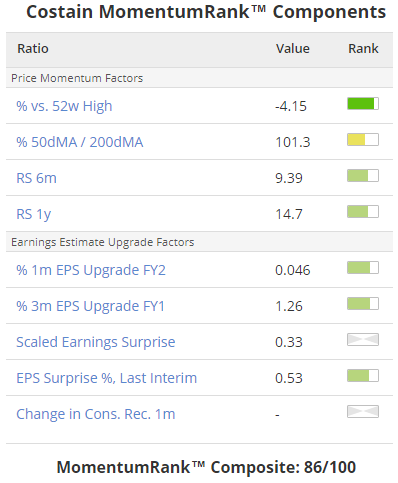
Costain’s strongest suite is its MomentumRank of 86. The overall picture looks positive, with no obvious areas of concern:
Price momentum: Recent price action has been encouraging and the 50-day moving average recently moved above the 200-day average, creating a golden cross: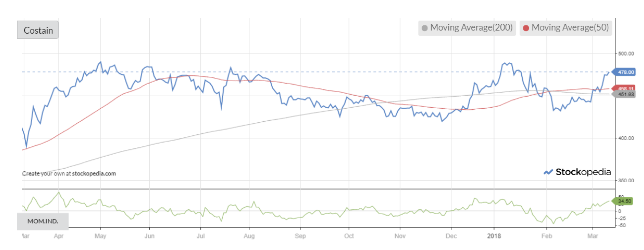
Even if you’re not a technical trader, I think it’s fair to say that the chart looks reasonably supportive, with improving momentum.
Earnings estimates: Earnings forecasts have inched higher following the firm’s recent results. These were marginally ahead of consensus forecasts, according to the Thomson Reuters data used by Stockopedia.
Looking ahead, the stock trades on a rolling forecast P/E of 12.7 with a prospective yield of 3.4%. That’s in line with the sector average, albeit more expensive than rivals such as Morgan Sindall.
Despite this, I believe the group’s consistent high returns mean that these shares deserve a modest premium. I’m happy to buy Costain at current levels and will add the stock to the SIF portfolio this week, and to my own holdings.
Disclosure: Roland owns shares of GKN.
Disclaimer
This is not financial advice. Our content is intended to be used and must be used for information and education purposes only. Please read our disclaimer and terms and conditions to understand our obligations.

6 comments
Roland - I have been looking at this one recently and wonder whether there is more to the drive into the technological end that you highlight as the differentiator. Do Keller or Morgan Sindall who you mention employ 22 PhDs and sponsor a further 21? That and more from the recent presentation:
http://costain.com/media/598410/c-users-donbow-desktop-results-2017-costain-plc-fy-results-presentation-1-march-2018.pdf
This move to the "smart" end (slides 20,21,22) could be what will set Costain (LON:COST) apart from the rest of the sector.
sharw - I share this view that a focus on technology and programme management means that Costain (LON:COST) is able to add much more value to customer projects than many (most?) of its peers.
In my opinion, another example of this forward thinking was the £75m placing and open offer done by the firm in 2014. This didn't appear to be necessary at the time and raised some eyebrows. But the company's argument was that the extra liquidity would improve its ability to win big contracts.
Given the progress made since then (while maintaining a robust net cash balance) I think this decision has been vindicated. Even more so when you consider the troubles that have befallen some sector peers...
Regards,
Roland
Roland
Re GKN - I think the offer also lets the investor get the final dividend of 6.2p - but I may be wrong.
The shares go ex div on 5th April 2018 so if the dividend is not included in the offer consideration, investors should wait to accept the offer (if they so wish) until after 5 April in which case they will get the dividend. While the closing date for the offer is 29 March it is normal practice for the offer to be extended. Offerors typically want to get the largest percentage possible of the target and so there can be several closing dates.
In the GKN example - see Expected Timetable - page 13 of the offer document note 4 : the offer will be kept open for acceptances for at least 14 days following such date ( as the latest date for the offer to be declared unconditional) which is 2 April.
In other words if the offer succeeds then one has at least until 16 April to accept - which very conveniently for private investors, takes the individual into a new tax year (2018-2019) and so tax on the gain is payable in January 2020 instead of January 2019. (A separate important point ).
In reality later dates for final acceptance maywell be allowable but to explain that would be to go into the minutia of the Takeover Code.
Also companies have to give notice of delisting the shares of their acquisition and it is usual to allow dissident investors to accept the offer in order not to be minority investors in an unquoted company.
The above are snapshots of what could be a complex situation.
BTW how did you get the May 2015 Stock Rank ?
Hi Star8,
You're right, the Melrose Industries (LON:MRO) offer for GKN (LON:GKN) does include the dividend. I excluded it from my calculation on the basis that it's already been 'earned'. Shareholders will get the dividend regardless of whether the deal goes ahead.
I agree that the offer may be extended - in a big cap deal like this investors should have plenty of notice and be able to plan accordingly.
I had the screenshot showing the Costain (LON:COST) 2015 StockRank saved in my files from when I wrote the original article!
But you can get this online using the Print history facility. Just click on the arrowhead on the grey 'Print' button below the market cap column at the top of each StockReport:
You can then choose the year and month you want (it's a long scroll to get to May 2015!).
Hope this helps,
Roland
Hi Roland both Costain and Sevenfield come up on my screen would you still pick Costain over Severs given Severs has better operating margin, the sector does seem out of favour at the moment due to Carillion and I do wonder if some of the fall out from that is yet to filter down to the mid size players
Hi clarea,
Severfield (LON:SFR) seems to have performed quite well over the last couple of years, but it doesn't qualify for my screen at the moment, so I wasn't able to consider it.
Regards, Roland