SIF Portfolio: McBride slides but super stock Keller Group shows promise

My SIF screen continues to provide slim pickings in this buoyant market. But one new qualifying stock has emerged this week.
Geotechnical specialist Keller Group is essentially a groundworks contractor. But the firm operates at the top end of this market, delivering large and complex projects in more than 40 countries.
Case studies from the firm’s website include £80m of work on Crossrail, providing support for historic London buildings under which new tunnels were being dug. Keller says that it was able to “control movements at the ground surface to within 1mm”, which sounds impressive. Other examples include providing foundations for power stations, oil refineries - and most recently for Australia’s tallest building.
I missed the chance to buy at under 900p last year, but Stockopedia’s never-sleeping algorithms have picked up on the improving performance of this company. Strong scores across the board have given the firm a StockRank of 98 and a StockRank style of Super Stock.
Keller also passes all 14 of my screening rules. So it’s time to decide whether I should add it to the SIF portfolio.
But before I do that, I’m going to take a quick look at this week’s profit warning from portfolio stock McBride.
A quick word on McBride
McBride produces private label consumer goods products. A bit like Reckitt Benckiser or Unilever, but without the premium brands. It joined the portfolio in April last year, since when performance has been disappointing. And things got worse this week.
Prior to Monday, earnings per share were expected to rise by around 20% during the year to 30 June. But in a profit warning on Monday, the company said it expects full year earnings to be “broadly in line with the prior year”. So a small drop in year-on-year earnings is possible.
The firm has reported two problems. The first is that revenue in its Personal Care & Aerosols (PCA) division fell by 12% during H1. The second problem is general cost inflation, with raw materials, labour and transportation costs all cited.
I suspect there could be a third problem, not yet apparent. The company says that its other division, Household, is taking market share from rivals. But at what cost? To free up resources to satisfy a recent surge of orders, the firm has “decided to defer certain efficiency and rationalisation initiatives planned for the current year”.
Is this an opportunistic decision that will boost profits, or a chaotic decision from a company whose margins are being placed under pressure by its supermarket customers? We don’t yet know. But I’m not entirely optimistic.
Monday’s update left me thinking (belatedly) that consumer goods may not be very attractive or defensive if they don’t come with strong brand names. McBride’s position in the portfolio is up for review at the end of this month. I’m hoping to be able to jettison this stock to avoid further downside risk.
A cyclical high - or not?
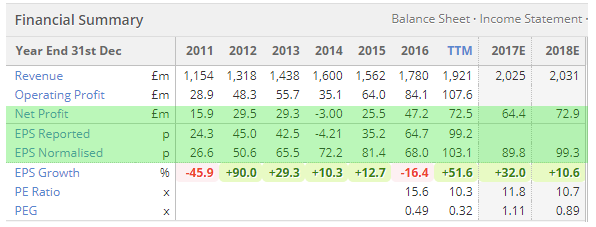
Getting back to Keller, my main concern with this business is that its might be close to a cyclical peak. Stockopedia’s six-year summary certainly seems to suggest that this might be the case:
However, taking a 10-year view provides a slightly different perspective.
Happily, Keller is one of a fairly small number of companies with management who are open enough to provide a detailed 10-year financial summary in its annual report. This has saved me from having to plough through five reports to get this information:

Source: Keller 2016 annual report (p.127)
We can see that earnings from continuing operations are still more than 31% below their 2008 peak. Given that the group’s revenue has nearly doubled since then, it seems reasonable to assume that profits could return to these earlier highs, even at lower margins.
Potential tailwinds include a resurgent oil industry, plus the potential for major infrastructure spending in the US and improving trading in difficult Asian markets.
This could still be cheap
It’s impossible to say just how much further Keller’s profits will rise, before the group encounters a cyclical slowdown or some other headwind. But the firm’s ValueRank of 86 does seem to suggest that the current valuation is attractive:
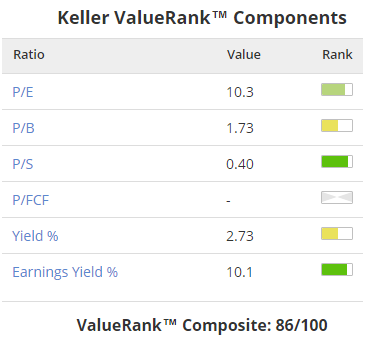
The big highlight here is the firm’s earnings yield (EBIT/EV) of 10.1%, comfortably above my 8% screening threshold. A trailing P/E of 10 is also attractive, but I think it’s also worth commenting on the dividend yield.
Although a yield of 2.7% may not seem high, Keller’s prudent payouts and strong balance sheet enabled the firm to maintain dividend growth throughout the financial crisis. The payout rose from 18p in 2007 to 28.5p in 2016. This year’s forecast payout of 30p per share should still be covered three times by earnings. This track record gives the dividend an extra measure of credibility, in my view.
The only thing that stops Keller scoring a clean sheet is a lack of free cash flow. This appears to be the result of acquisitions and capex. Cash generated from operations has been reasonably good. On that basis I’m prepared to give management the benefit of the doubt.
Improving quality
Keller’s lowest rank is its QualityRank, which was 78 at the time of writing:
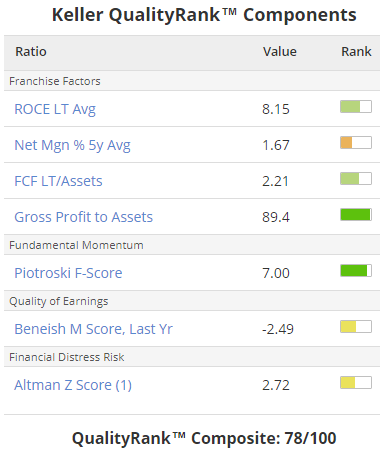
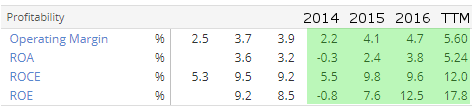
The most obvious weakness here is the five-year average net profit margin of 1.7%. However, I expect this to improve as the less profitable years of 2012-2015 gradually fall out of the calculation. In my view it’s not a concern, given the improving trend in returns seen since 2014:
A Piotroski F-Score of 7 is also a useful confirmation that this business appears to be in good financial health.
One thing that’s not shown by these metrics is how vulnerable Keller is to competitive pressures. Without doing more detailed market research, it’s hard to be sure of this. But the relative stability of its performance during the financial crisis suggests to me that the company probably is one of the top players in this sector, adding to its quality appeal.
Tax cut could add to momentum
Keller shares have risen by about 10% so far this year. This sharp rise came after the company said that US tax reforms should see the group’s effective tax rate fall by around 5%.
Momentum was already strong and improving, but I think this latest news could provide support for an earnings surprise as we head into 2018:
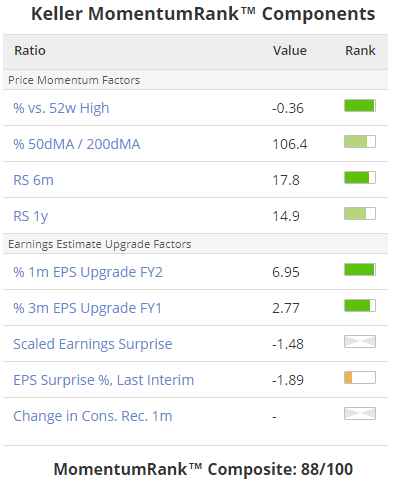
Based on current consensus forecasts, Keller is expected to report earnings of 89.8p per share for 2017. A further 10% increase to 99.3p is pencilled in for 2018. Although I’d expect forecasts for this year to change, we can probably be fairly sure of the 2017 results, which are due on 26 February.
On this basis, the stock trades on a forecast 2017 P/E of 12, with a prospective yield of about 2.8%.
Given the apparent potential for earnings growth, I think this could be a good buy and will add the stock to the SIF portfolio this week. I’ll also buy the shares for my own portfolio once this article has been published.
Disclosure: Roland owns shares of McBride.
Disclaimer
This is not financial advice. Our content is intended to be used and must be used for information and education purposes only. Please read our disclaimer and terms and conditions to understand our obligations.

4 comments
Not a share that generates much enthusiasm Roland, as perhaps noted in one of my posts on SCVR of 5th Jan. I think many investors, including Paul Scott, are put off by the combination of low margins and high "accident" rates in the general construction sector, which now, unlike KLR, isn't solely construction.
KLR, however, remind me of a company I worked for in the past, where conservative contract reporting was encouraged as a way of ensuring reasonably smooth progress - which was well reflected in the share price of the company. I think you missed Europe as one of the causes of their slow progress over the last few years, so the improving situation there, combined with the slow return of work for the commodity producers, should provide a good basis for improvement, with the US infrastructure push as the icing on the cake IF it occurs.
Regards, and thanks for a good write up on KLR.
Hi muckshifter,
Thanks for your comment. I'm guessing from your username and comments that you've some experience in this sector - it's good to have a more informed perspective.
You make a good point about Europe -- here in Brexit UK, it's easy to forget that several large EU economies are on a slightly different trajectory to us, and are enjoying improving economic conditions.
From my outside perspective, I get the impression that Keller (LON:KLR) is a genuine specialist and is one of the best in its sector. That being so, my hope would be that its expertise would be less commoditised than would be the case with more general construction firms. This, coupled with a culture of good engineering, will hopefully provide some protection against "accidents"...
Regards,
Roland
Hello Roland,
Yes Keller is a long standing genuine specialist in ground engineering with a long history of expanding it's repertoire through selected acquisitions, while also often using those acquisitions to expand its geographical footprint. They are not , and imho never will be, part of the "commoditised" construction industry, but they still face competition. The high risk nature of their work, however, largely removes the risk of "cut throat" competition, and their size allows them to smooth out problem jobs which might bankrupt smaller competitors.
Regards.
Beautiful explanation of this company and how it is made up and assessment of its chances for the coming 12 months
Thank you Roland
This share has been on my watch list for about 18 months because it as you say a quality company I will look at it again as I too feel that the coming year should be a good one for Keller because of the hoped for improving if sometimes rocky world economy
Bence