SIF Portfolio: Can I clean up with McBride?

How many own-branded goods end up in your shopping trolley each week? I’m guessing there are a fair number.
If so, there’s a good chance that some of them are produced by this week’s SIF Portfolio candidate, McBride.
This FTSE Smallcap listed stock produces private label household and personal care products. Judging from the pictures on the company’s website, the group’s customers include Sainsbury’s and Morrisons, plus others. McBride also has a few of its own brands, such as Oven Pride, but private label manufacturing is the firm’s main business.
After a troubled few years leading up to 2015, management launched a transformation plan with the slogan Repair, Prepare, Grow. This aimed to improve the profitability and quality of the firm’s manufacturing operations, before targeting fresh growth.
Progress so far has been encouraging. McBride’s return on capital employed rose from 5.4% to 16.5% in 2016 and cash flow has improved significantly. The group’s recent interim results showed a further improvement in profitability, with the company’s measure of return on capital employed rising from 23.6% to 28%.
To me, these figures suggest the firm’s transformation programme is working. The firm’s 2015 target was to reach an ROCE of 25-30% in three-five years. To put this target in context, the equivalent figure at the end of June 2014 was 12.7%.
McBride’s StockRank has risen from 83 to 93 over the last year and the firm has recently qualified for my Stock in Focus screen. The SIF Portfolio’s chronic need for defensive stocks means that McBride is a serious candidate for a buy, unless I find something nasty in the figures.
The right value
Paul Scott commented on McBride’s interim results on 22 February, noting that “that valuation looks about right to me”. The stock has risen by more than 10% since then, so am I too late to join the party?
Stockopedia’s ValueRank uses trailing twelve month (TTM) figures. Based on these figures I’d be tempted to agree with Paul’s view:

A P/E of 16.4 seems reasonable but not cheap. The yield isn’t shown here, possibly because McBride has returned cash to shareholders through a B-share scheme rather than a dividend over the last year.
Shareholders have actually received 3.8p per share over the last twelve months, giving a yield of 1.9%. Again, that’s acceptable but not overly exciting.
The price/free cash flow ratio of 12.5 implies that free cash flow has exceeded earnings over the last year. However, this seems to be due to McBride collecting payments from customers more quickly, so I wouldn’t read too much into this. Falling receivables generated extra cash for the firm during H1:
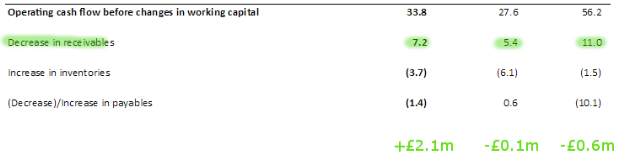 Good news from a management perspective, but I think it’s wise to assume that free cash flow will normalise and move back towards earnings per share at some point.
One final point worth noting is the group’s debt. Net debt fell from £90.9m to £82.9m during the second half of calendar 2016. That’s well within the group’s covenant of 3x EBITDA and below my screening limit of 5x net profit.
Overall, McBride looks fairly priced but not compelling value. Strong momentum and improving quality will be needed to justify a buy, in my view.
Quality: a mixed picture
Luckily McBride does step up to the mark in terms of quality. The group’s QualityRank of 85 reflects its high Piotroski F-Score of 7. Looking below the surface here shows rising profits, improved cash generation and growing margins:
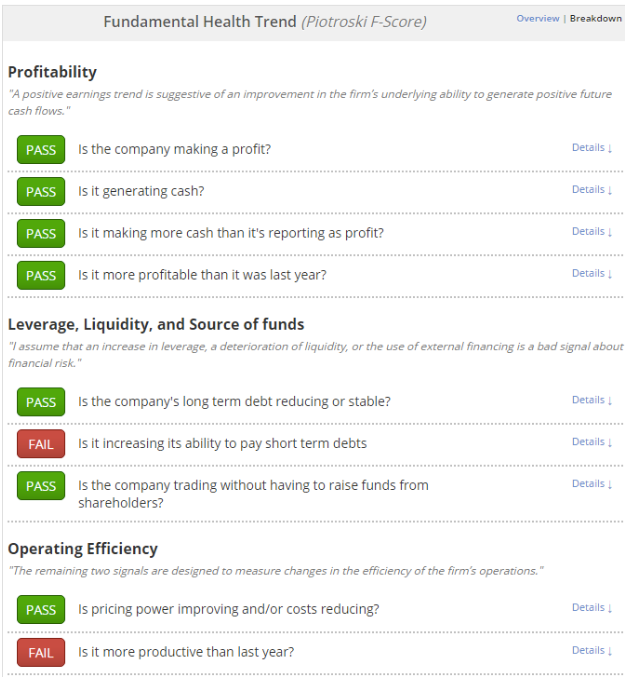
Possible risks: I’ve already commented on the group’s improving profitability -- ROCE rose sharply last year. But there are two negative points worth mentioning.
The first is that in constant currency terms, revenue fell by 1.9% in 2016 and by 7% during H1. Falling sales with rising profits suggest to me that McBride is still working through the Repair, Prepare stages of its transformation plan. I’d hope to see evidence of top-line growth -- the final stage of the plan -- at some point in the next twelve months.
The second concern is that the weaker pound may be flattering these figures. Statutory pre-tax profit rose by 44.6% to £18.8m during the first half. But at constant exchange rates, this increase was just 15.3%. Thus the company’s return on capital employed, which uses statutory figures, is being boosted by the weaker pound.
It’s difficult to know how to look at this. There’s no way of knowing when -- or if -- the pound will regain the ground it lost against the dollar last year.
As a general rule, I usually assume that currency effects will even out over time. I’m prepared to take this view here as I believe McBride’s underlying profitability is improving, albeit at a slower rate than the figures might suggest.
The only question that remains is whether now is the right time to buy. McBride’s share price has doubled over the last two years. Is momentum still strong?
What’s happened to momentum?
McBride’s MomentumRank has fallen by 14 points to 76 over the 30 days. That’s not a promising start, but it’s worth trying to understand why this has happened.
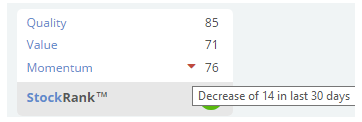
In this case, the cause of this sharp drop in MomentumRank isn’t immediately obvious. The factors behind the MomentumRank don’t flag up any major weaknesses:
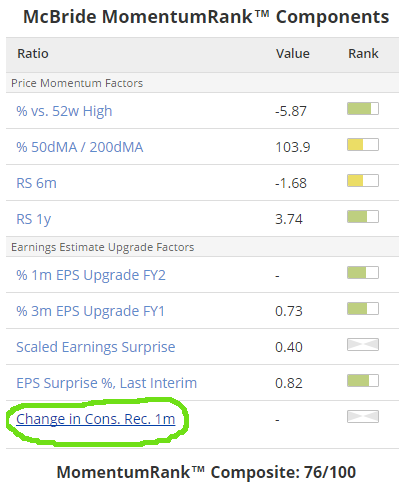
One minor factor is that whereas consensus forecasts were upgraded in March following February’s results, they’ve remained flat in April. This doesn’t concern me, but it is a factor in the MomentumRank calculation (circled).
Another negative factor is McBride’s six-month relative strength (RS 6m), which is now negative. What this indicates is that the stock has underperformed the index over the last six months. The FTSE SmallCap index has gained 9% since October, while McBride stock is unchanged over the same period.
Technical factors such as these can affect a stock’s MomentumRank. But for most investors, I don’t think they’re a reason to stay away from an otherwise attractive stock.
McBride’s adjusted earnings are expected to rise by 40% during the year ending 30 June, and by a further 15% next year. This puts the stock on a forecast P/E of 14.5, falling to 12.6 in 2017/18. Dividend returns are also expected to improve, with a prospective yield of 2.2% on the cards for the current year.
These figures look attractive to me. Assuming the group continues to make progress with its transformation plan, we should see a move into top-line growth over the next year.
I’m buying
I’m going to add McBride to both the SIF portfolio and my personal portfolio on Wednesday this week. This is part of a shift in my own investing that I’ll cover in more detail later this month.
Roland owns shares of McBride, Unilever and J Sainsbury.
Disclaimer
This is not financial advice. Our content is intended to be used and must be used for information and education purposes only. Please read our disclaimer and terms and conditions to understand our obligations.

4 comments
Roland,
" it is likely the second half will see some lag effect between higher input prices and margin recovery."
Is that perhaps a contingent profit warning?
(Edit: That said, their CEO, Rik de Vos was formerly with Huntsman, who manufacture surfactants and who formerly owned the old Albright & Wilson detergent raw materials factories in Italy, France and Spain, so he ought to have the supply angles covered).
Hi Jane,
Thanks for your comment. I agree that buying well and managing exchange rate effects are important for McBride (LON:MCB). Management referred to this in the recent interim results, and also suggested customers might show some flexibility:
"Uncertainty in both the size and timing of raw material inflation and changes to foreign exchange rates is to be expected in the second half of the year. We will work closely with customers to mitigate these but it is likely the second half will see some lag effect between higher input prices and margin recovery."
As a general rule, I'd say that financial engineering of this kind (and others) is essential to the success of most big companies. But visibility of these areas is often poor for outside investors.
Using raw materials as an example, most investors have very limited understanding of the contract structures and timescales involved. In my opinion, there's no accurate way for most investors to judge these detail issues, at least not until after the event.
However, where we probably disagree (!) is that as a general rule, I don't think investors need to form a detailed judgement on this kind of issue.
Input costs and exchange rates vary all the time. Managing these well should be business as usual. In my view, factors such as high, consistent ROCE/margins, strong cash flow and stable growth in volatile markets are clear indicators that companies are getting the financial engineering of their business right.
The only complicating factor is when a business's performance has changed markedly over a short period of time. McBride is an example of this -- returns have improved significantly over the last two years.
Management would obviously like us to believe that this is due to operational improvements and tighter control of working capital. But there is a risk that it's down to some kind of financial tailwind. That could mean that the current valuation and outlook is less favourably than it might appear.
I don't think this is the case at the moment -- I believe the improvements are genuine. But I'll certainly be watching the company's commentary closely over the next six months.
Regards,
Roland
Disclosure: I own shares of McBride.
One element that is quite difficult to quantify with McBride (LON:MCB) is the effect on their profits of changes in both raw material input prices and movements in the US$/£ exchange rate, often happening concurrently. Their main active ingredients in their detergent and foaming products are petrochemical derivatives, usually priced in US$. Their customers, whether own-brand large retailers or branded products sellers. are very unlikely to take on these volatility risks via price variation clauses so McBride (LON:MCB) needs to be very nimble (and to get it right!) in both their buying decisions and their exchange cover decisions, otherwise they could well end up being locked into expensive raw material supply commitments at the same time that customers are opportunistically pressurising them for price reductions as they (the customers) see the oil price going down and/or the exchange rate moving a different way. It's one of those businesses where the skill and nous of a clever and sharp buyer of the raw materials is, imo, at least as important as covering the financial risks and being on the ball at the sales end. From my experience of a similar company, buyers are often under-appreciated. It would be interesting to chart the McBride (LON:MCB) share price against the oil price and the US$ exchange rate over a period of time to see whether there is some kind of relationship, perhaps with a three-month or six-month drag.
I was in McBride from April 2013 till February 2016, it was dog for me and I came out as soon as the share rose sufficiently to provide some compensation. It didn't give a dividend but a return of capital so at least was paid gross.