SIF portfolio October review: AIR, FLO, HYDR and TCS

It’s a big week this week. No fewer than four stocks are due for review and potential eviction from the SIF portfolio:
Aviation services business Air Partner
Hydraulic and pneumatic product distributor Flowtech Fluidpower
Russian electricity producer RusHydro Group
Russian bank TCS Group Holding
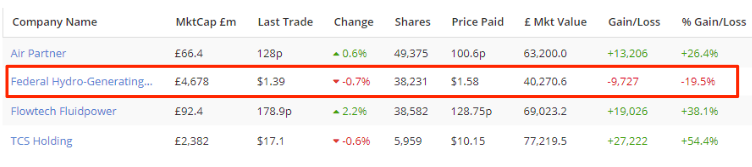
A quick look at the Fantasy Fund page for the SIF portfolio suggests that the performance of these stocks has been pretty good, with one exception:
Let’s take a closer look at what’s been happening.
Air Partner
I covered Air Partner’s performance during its time in the portfolio in last month’s review, so won’t dwell on this one today.
This stock reached its nine-month birthday last month, but still qualified for the Stock in Focus screen, so remained in the portfolio for another month.
I’m pleased to report that Air Partner still passes all of my screening tests, so will stay in the portfolio during November. (Although the spread shown in Stockopedia is sometimes higher than my 4% maximum, live quotes from my broker suggest the true spread is much lower.)
Verdict: Hold
Total return to date: +33.4pc
Flowtech Fluidpower
This firm is a distributor of parts and products needed for hydraulic and pneumatic equipment. Customers include both plant operators and industrial customers, such as factories.
The shares have been on a tear recently, gaining 30% since the start of September. I’m not entirely sure why. Although the group’s H1 results on 12 September were strong, they seem to have been broadly in-line with expectations.
Growth was rapid during the first half, as organic expansion continued and acquisitions kicked in. Revenue rose by 24.8% to £34.2m, while underlying operating profit profit rose by 11% to £4.5m.
However, statutory operating profit only increased by 3.1% to £3.39m, due to a number of “separately disclosed items”:
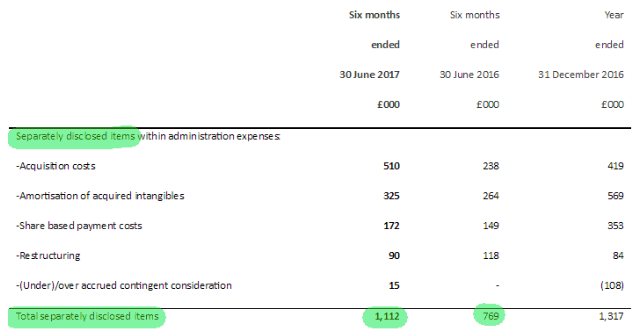
Almost all of these costs relate to acquisitions or remuneration. Together they reduced the group’s operating margin from 12% in 1H16 to 10% during 1H17.
Given Flowtech’s policy of acquisition-led growth, I think it makes sense for investors to include these costs in their assessment of the group’s profitability. As you can see, they aren’t particularly exceptional, having occurred at similar levels last year.
Overall, I’m still quite positive about this business. But margins appear to be falling, and such rapid acquisition-led growth carries the risk of missteps. I don’t think this stock deserves a high valuation multiple, but it’s starting to look more expensive to me.
When I added Flowtech stock to the SIF portfolio in January, the shares traded on 11 times trailing earnings and offered a dividend yield of 4.2%. Today the stock trades on a trailing P/E of 16.4 and offers a yield of 3.2%.
The momentum-fuelled re-rating I suggested nine months ago has been delivered, helped by solid trading performance. But I’m not sure I see a case for driving the shares much higher.
Interestingly, my screen results also suggest a growing valuation risk here. Flowtech fails to pass my screen tests because its earnings yield has dropped below my 8% threshold, to just 6.2%.
I’ll sell Flowtech Fluidpower from the SIF portfolio this week, a decision I’m comfortable with despite this company’s Super Stock status.
Verdict: Sell
Total return: +42.7pc
How have the portfolio’s Russian stocks performed?
Long-time readers will remember my decision to experiment with adding UK-listed Russian stocks to the SIF portfolio back in January.
My goal was to improve diversification, but the obvious risk was that by venturing into a market of which I had little understanding, other problems might occur. It’s now time to review the progress of my Russian experiment.
RusHydro Group
This £4.7bn hydroelectricity group has performed poorly since joining the SIF portfolio. The shares have picked up recently, but are still worth about 20% less than the $1.58 per share paid in January.
The group’s financial performance over the period appears to have been lacklustre, but not disastrous. Half-year revenue fell by 3.7%, but operating expenses were 7% lower. After factoring in government grants, EBITDA rose by 7.3% to RUB 51.5m. Adjusted net profit climbed 8.5% to RUB 32.3m.
From what I can tell, a dividend of RUB 4.66 per GDR went ex-dividend of 7 July and was paid on 4 August. This gives a trailing yield of about 5.1%, which has reduced the portfolio’s loss somewhat.
The reality is that I’ve very little insight into how this business works. Nor do I have any knowledge of the regulatory environment for Russian utilities. So in that sense, adding these shares to the SIF portfolio was a pure rules-based investment. As it happens, it’s not been a success. But as we’ll see in a moment, not all Russian stocks have performed so poorly.
Verdict: Sell
Total return: -16.0pc
TCS Holding
My second foray into the Russian stock market was fast-growing bank and credit card group TCS Holding. TCS operates Russia’s second-largest credit card issuer, Tinkoff Bank. It’s been a star performer during its time in the portfolio, rising by more than 50% and comfortably erasing the losses inflicted by RusHydro.
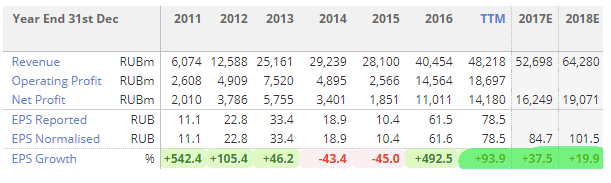
The company’s growth and financial performance has been staggeringly good. So much so that I’ve started to wonder how sustainable it is. For example, the group’s net interest margin was reported as 26.2% last year. Net income was RUB 11bn, up from just RUB 1.9bn in 2015.
According to Stockopedia, earnings per share have risen by an average of 40% per year since 2011. Return on equity has averaged 33% over the same period. The nearest comparison I can find in terms of profitability is pre-crash Provident Financial, where RoE has averaged 36% since 2011. The UK’s high street and challenger banks don’t come anywhere close.
One reason for this outstanding growth is probably that the market for unsecured consumer credit is far less mature in Russia than in the UK. I guess there’s still lots of low-hanging fruit for the bank to pick.
I don’t have any insight into how long TCS and Tinkoff can continue to grow at this rate. But earnings growth is expected to slow to more normal levels over the next 18 months:
I’ve also noticed that the shares’ StockRank has fallen from 93 to 79 since the interim results were published in August. TCS also no longer qualifies for the SIF screen, as the stock’s Piotroski F-Score has fallen below the minimum threshold of six.
As a result, I’m going to sell these shares from the SIF portfolio this week, and book a healthy profit.
Verdict: Sell
Total return: +55pc
I’ll be back next week, hopefully with a new stock for the portfolio.
Roland owns shares of Air Partner.
Disclaimer
This is not financial advice. Our content is intended to be used and must be used for information and education purposes only. Please read our disclaimer and terms and conditions to understand our obligations.

2 comments
Hi Roland
Really interesting as always. I very much like reading your reviews. I have not yet found the time to develop a rules based investing system but it does intrigue me though my own investments are done based on certain rules and I am happy with the way they have performed.
However i do think it is a shame you are so quick to sell winners. I have missed out, in the early days of my investing, on some stellar gains by selling stocks after say 6 months rather than holding for two or three years or longer.
I think time is one of the big advantages that PI's have over the pros/funds etc. For instance I have no insight in to TCS Holding (LON:TCS) but you write:
"...CS also no longer qualifies for the SIF screen, as the stock’s Piotroski F-Score has fallen below the minimum threshold of six...." but could this not be a blip for 1/4 or 1/2? Would it not make sense to make the rule time based i.e. "...CS also no longer qualifies for the SIF screen, as the stock’s Piotroski F-Score has fallen below the minimum threshold of six for a period of x months"
Anyway thanks for a great post. Really interesting.
Michael
Hi Michael,
Thanks for your comment. Adding a time element to the rules for selling is an interesting suggestion that could help avoid selling a stock one week and finding that it qualifies for the screen again next week.
I think it might be more appropriate for some rules than others, but it's definitely food for thought.
Thanks!
Roland