SIF September review: Centamin triggers stop loss (AGK, WIL)

Gold miners are currently popular with investors who want to generate real returns from the yellow metal. But when investing in miners it’s always worth considering what can go wrong. That’s especially true with companies which have just one operating asset.
When I added Egypt-based gold producer Centamin to the SIF Folio in September, I acknowledged this risk, but I didn’t expect things to go wrong quite so quickly.
On Friday, the shares fell 20%+ after the company said it had found signs of instability in one of the pit walls of the open-cast section of its Sukari mine. Fourth-quarter production is expected to fall by around 40% as a result, with an as-yet unknown hit to costs.
This week’s article was scheduled to be my usual month-end review, covering stocks that have been in SIF for at least nine months. Last week’s events mean that I have to add Centamin to the list of stocks under review. The latest news from the firm - and its sharp share price fall - may have triggered one of my sell rules.
Here’s the full list of companies which will be covered in this piece:
Temporary power provider Aggreko (LON: AGK)
Information, education and networking group Wilmington (LON: WIL)
Gold producer Centamin (LON: CEY)
SIF Q3 performance
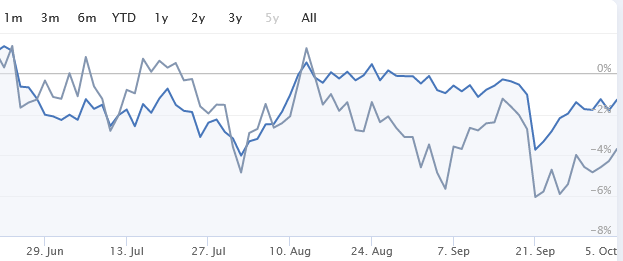
Let’s start with a quick look at the portfolio’s performance versus the market during the third quarter (the blue link is SIF, the grey line is the FTSE All-Share index):
Here’s how the SIF Folio her performanced against the market so far this year:
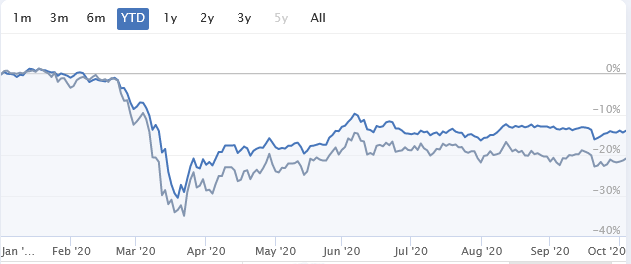
Although SIF is still underwater so far this year, it’s stayed comfortably ahead of the market and did not suffer such a severe drawdown in March. I can live with this.
Finally, here’s a list of the portfolio’s current holdings, as they stood during market hours on 5 October:
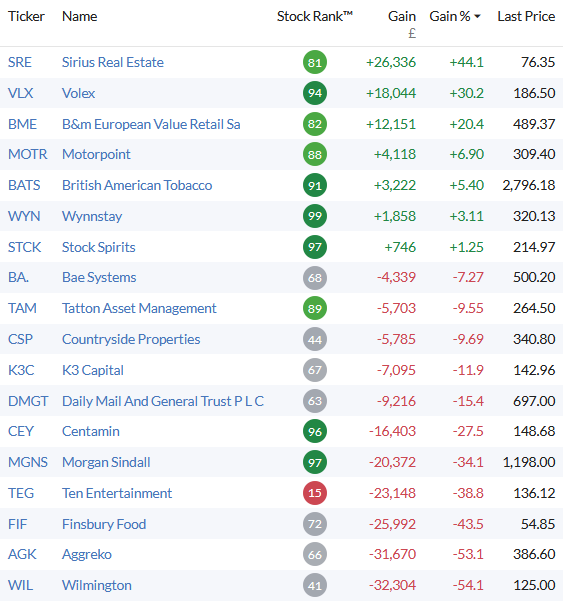
The two oldest stocks in the portfolio - Aggreko and Wilmington - are also its biggest losers. Perhaps this is unsurprising. Both were bought in December 2019, during the market euphoria which followed the Conservative’s decisive election win.
Centamin (LON: CEY)
(Original coverage: 02-Sept-2020)
What are the likely implications of last week’s operating update from the Sukari gold mine? Centamin says that it’s “detected movement in a localised area of waste material” in the Stage 4 West wall of the Sukari open pit mine. To safeguard employees, the firm has deferred planned open pit mining operations in this zone.
As a result, gold production for the final quarter of 2020 is expected to fall by about 40% to around 70,000 ounces. This means full-year production should be about 445,000oz, compared to previous guidance of 510-525,000oz.
The company has initiated a detailed geotechnical assessment, with a view to developing a new plan to safely mine this zone. Management says that an updated plan for future years will be included in the ongoing life of asset review.
The bad news is that the affected section of the mine was a high-grade zone that was scheduled to be mined in Q4 2020 and in 2021. It’s said to contain 90,000 ounces of gold at grades of up to 2.0g/tonne. This compares to <1.0g/tonne for other current open pit zones.
Although it’s disappointing, I suspect Centamin’s engineers will find a way to mine the material in the unstable section of wall. Meanwhile, the underground mine is still operating unaffected, as are lower-grade sections of the open pit mine.
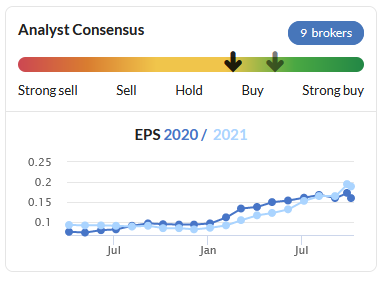
However, although no new financial guidance has yet been provided, I think it’s reasonable to assume that costs will rise and profits will fall as a result of this news. I note that broker forecasts have already edged lower:
I’m not a mining expert and the potential impact of this news is open to debate.
But over the last 18 months I’ve introduced two new rules to try and help me navigate unexpected bad news from SIF portfolio stocks:
I think it’s fair to conclude that last week’s statement from Centamin is effectively a profit warning. The market certainly seems to think so, as Centamin’s share price has fallen by 24% since Thursday at the time of writing.
SIF’s position is now showing a 27% loss. Given this, I have no choice but to sell the stock from the portfolio after just one month.
As always, this is a decision that’s specific to the rules of my SIF folio, which has fairly short timeframes. Please DYOR - personally I wouldn’t sell the shares from a long-term portfolio as a result of this news.
Verdict: Sell
Total return: -27.5%
Aggreko (LON: AGK)
(Original coverage: 10-Dec-2019)
FTSE 250 group Aggreko provides temporary power solutions for events, industrial customers and utilities. I reviewed the latest numbers from the firm in August, so I won’t repeat the numbers here. My conclusion was that Aggreko looked relatively robust financially, with debt down and a welcome return to dividend payments.
However, the group faces several challenges. In the short term, a slump in demand from the events sector and from oil and gas clients is hitting profits. That’s to be expected. What surprised me was the concern the company appears to feel regarding “the energy transition” - the shift to lower-carbon forms of energy.
Perhaps naively, I had assumed that Aggreko was already on a path to switch from heavy fuel oil-powered generators towards a cleaner mix of diesel, gas and perhaps solar/batteries. Now I’m not so sure.
The company has promised a strategy update alongside its Q3 trading statement in November. The trading outlook for H2 is weak and although profits are expected to improve in 2021, they’re still likely to be lower than the average since 2014:
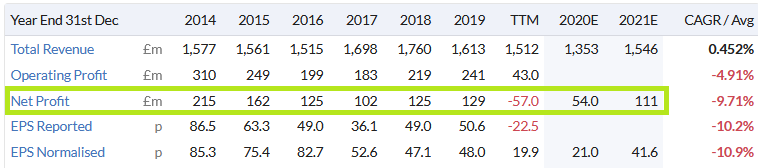
Although I think there’s a risk Aggreko could become a value trap, I’m inclined to share the StockRank’s view that Aggreko is a contrarian buy:
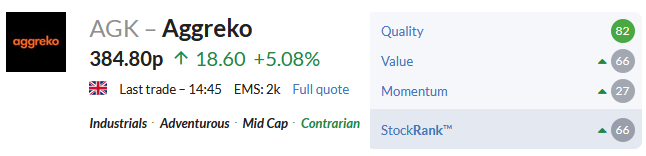
However, my rules don’t allow me to wait any longer for signs of hope. Aggreko fails a number of my screening tests at this time, thanks to this year’s profit slump and share price weakness. As a result, I have no choice but to sell the stock from the portfolio, crystallising a hefty 50% loss.
Verdict: Sell
Total return: -53%
Wilmington (LON: WIL)
(Original coverage: 17-Dec-2019)
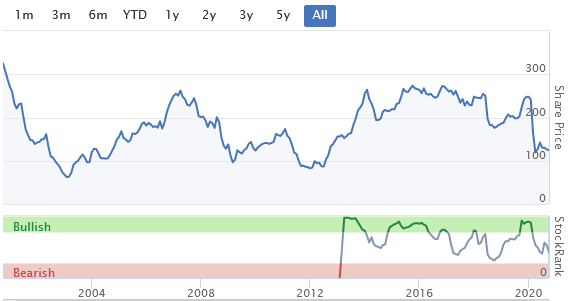
Wilmington is one of those companies that appears to offer a lot of potential but which has delivered inconsistent performance. The group’s share price performance since 2000 has mostly been sideways:
In more recent years, revenue and profit performance has also been inconsistent:
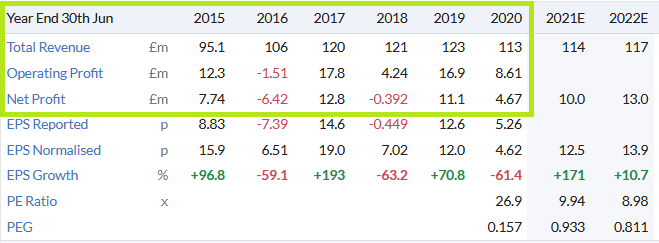
In fairness, last year’s results (for the year ending 30 June) seemed pretty solid to me, given the impact of the pandemic. Cash generation has also been quite good since 2015, supporting some useful dividends:
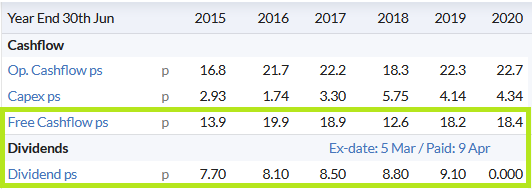
But for whatever reason, the business just doesn’t seem to have gained much momentum. Looking ahead, CEO Mark Milner expects the company to remain profitable even if restrictions on face-to-face events continue into calendar 2021 (as now seems likely). But a return to growth will be more challenging in this scenario.
As with Aggreko, I feel fairly confident that Wilmington’s stock will be worth more in a couple of years’ time than it is today. But the SIF folio’s rules require some evidence of near-term momentum. There’s precious little of that here, as broker downgrades continue:
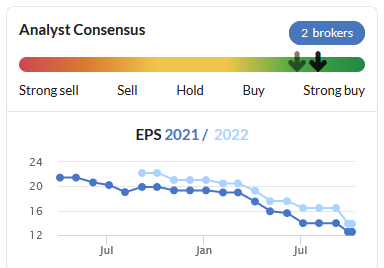
Wilmington fails my screening tests on numerous counts. I have no choice but to drop the shares from the SIF Folio this month, crystallising a second 50%+ loss.
Verdict: Sell
Total return: -54%
Stripping out the biggest losers from this year’s market crash was always going to be a painful process. My hope is that the stop-loss policy I’ve introduced this year will reduce the scale of such losses in the future. It’s also worth remembering that market crashes on this scale generally only happen about once a decade.
As always, I will make the sales detailed above after this piece has been published on Stockopedia.
Let me know what you think - given the exceptional nature of events this year, should I hang onto losers in the hope of a recovery? Or should I have cut sooner, as I intend to do in the future?
Disclosure: At the time of publication Roland owned all the shares listed in the SIF Folio.
Disclaimer
This is not financial advice. Our content is intended to be used and must be used for information and education purposes only. Please read our disclaimer and terms and conditions to understand our obligations.

14 comments
Footnote to the the Aggreko (LON:AGK) story as a putative 880p per share Private Equity backed cash offer surfaced late Friday afternoon. 39% premium to the CSP and roughly 130% up since Roland’s article. Seems to be M&A “open season” for U.K. plc. at the moment.
This has to be quite bad luck.
I personally though would not hold just one small/medium sized gold miner in a portfolio as I see this as being far too risky. I would prefer to hold say 3 or 4 with risks spread across a wider geographical and political landscape.
This of course means smaller positions to achieve the same level of investment, which might have been expensive in the old days of paying 1.6% trade commission, but less so nowadays.
Obviously the above approach interferes with the rules by which you build your portfolio. - so you may decide to exclude a gold miner that passes your rule but would leave you with just that miner in your portfolio.
This theory that it is harder to to recover from a fall because 33 is bigger than 25 or 100 is bigger than 50 is a misunderstanding caused by applying ideas about arithmetic progressions to geometric ones. (i.e. trying to use additive arithmetic to understand multiplicative arithmetic).
Thank-you Nick Ray, well expressed.
The other relevant question on the arithmetic side is: What is your position size?
If it is acceptable to sell 50% of your position when it doubles and continue to hold with 'house' money then why not in the other direction?
If you sell half of a position that has dropped 25% but you think it is oversold, the remainder may increase in value over time. You will lose less, ignoring the time value.
The problem comes if you are wrong and the share continues down.
Position sizing is aimed to protect you from that kind of misjudgement. A 100% loss on half a position can be compensated for by a 100% gain on a full position.
Re £CEY The trouble with a SL is that by the time it triggers its so oft too late to sell - and in this case - probably makes the share a dare I say it - 'value' buy. So, for now I will hold on. On the other side - I am frankly more nervous of the political sitn in Egypt - going from bad to worse but then thats the situation all over the globe..
Taking losses hurts but I've never regretted keeping them small - absolute max 15% on each position but I maintain an overall aggregate stop loss of <5% most of the time (some positions -15%, some +30% etc). I do understand the long term horizon investing thing but if you are getting into 50% underwater territory, I think you need to admit you bought at the wrong time. Imagine you'd had a 15% stop on these big losers - you could now eye up positions in them at prices you never dreamed of (and while you watched it going down you'd have been able to put that capital to work elsewhere).
Hi Roland
I appreciate your honesty, and it is good to see people admitting to losses, and your thoughts about trying to avoid some of these going forward. There are too many this was our wonder share (which you do have) without admitting those that were not so wonderful.
I have tried stop losses this year, but got hit by a bounce on most of them - set too tight with hindsight, so I think that your approach of 25% and/or Profit Warning is good. Thinking that Ed's seminar on Profit Warnings was a wonderful hindsight lesson for my biggest loser last year Card Factory (for some reason the keyboard has changed language today to USofA) so would certainly recommend this approach.
Keep up the good articles.
Tommy
Hey Roland, good as always to read your updates. On the subject of cutting positions, I wish there was an easy answer to this one, but I have never found it - in either direction.
Rules-based is the way ahead for me, so I think your approach is sound.
Personally I find we are in a unique time period as we all wrestle with the impacts and probable future (and deeper) impacts of current government policies. I can see no way of predicting how these may affect the markets, so I am increasingly focussed on recovering and preserving capital rather than just looking at losers.
In April I cut Jupiter Fund Management (LON:JUP) and Lloyds Banking (LON:LLOY) heavy loss making positions (as we discussed here) and used that capital in a high-risk strategy of doubling or trebling up some positions to drag my average down to a point where I can break even (or a little ahead) as results are released and/or sentiments change - thus avoiding the painful holding of too many underwater stocks. Just this week I have cut Craneware (LON:CRW), Scs (LON:SCS), Harworth (LON:HWG) under this new thinking to good effect. I also have a list of others including Wincanton (LON:WIN) and D4t4 Solutions (LON:D4T4) who will update in the next weeks and may go the same way.
I am undergoing a complete shift in rationale for the foreseeable - I am taking positions in funds that hold my favoured stocks rather than direct positions thereby spreading risk (but limiting return of course), focusing on rules-based trading for directs I hold, and picking up or holding a few long-term recovery plays at rock-bottom prices - e.g. Saga (LON:SAGA)
I guess it makes me more of a trader than an investor, but we each need to find the solution that works for us individually, always guided by our own appetite and ability to manage the risk. But I am determined to be more rules-based as we head towards 2021.
Good luck with your plans, and look forward to the updates.
I think introducing the 25% stop loss is sensible Roland allows some wriggle room against normal market movements but you need some protection against holding onto something that could join the -99% club.
Also getting the losses back requires the portfolio to work harder a 25% loss requires a 33% gain to get back to break even not great but doable, where once your in 50% loss territory your looking at 100% gain to break even not so doable.
Regards Andy
Centamin increased by 100% in just over a year.
This theory that it is harder to to recover from a fall because 33 is bigger than 25 or 100 is bigger than 50 is a misunderstanding caused by applying ideas about arithmetic progressions to geometric ones. (i.e. trying to use additive arithmetic to understand multiplicative arithmetic).
If you buy extremely volatile stocks and then start worrying when they move down by 25% you should not be buying extremely volatile stocks in the first place.
Indeed my favourite simile to this is that the average high daytime temperature at the Kew Gardens weather monitor in July is 23.5 Celsius by December it drops by nearly 2/3rds (*) but pretty much without fail it will manage the near 300% increase to get back into the 20s by July.
* Of course you cannot really use percentages on the Celsius scale, but the numbers look far less dramatic when quoted in Kelvin.
Looked at another way, if it really were twice as hard for stocks to rise 100% than it is for them to fall by 50%, then the entire stock market would trend to zero over time. - If you really think that is the case, why would you be investing in stocks?
That said, there would be better times to buy the 'Kew gardens temperature ETF' than after a 50% fall to November.
Thanks Roland for sharing, as always. I saw the RNS at 7:30am and decided it was better to take a small loss rather than risk a large one. I hope Centamin (LON:CEY) SP recovers, but I fear coming back from 20% down could be a long haul. I'll wait for positive news before I buy back in.
I certainly would not write off Centamin at this price. The share drop is for a specific reason. Unfortunately rules are rules for you but I would see this as a buying opportunity not one for taking a loss. shares back to parr within 6-9 months??
Your point about mining risks is well made Roland. Although obviously not in your portfolio Anglo Asian Mining (LON:AAZ) is a recent buy for me only to see war break out in the area and the shares tumble as a result. The mines are some miles from the warzone and it is a regularly contested boarder issue but I guess it will take a while for my shares to recover long after the threat is past.
This makes for some very depressing reading.