Small Cap Value Report (26 Feb 2014) - Bitcoin, SNX, MLIN, IDOX, QRT

Good morning. Lots of results this morning, so I shall crank up a gear and get through as many as I can.
As an aside;
Bitcoin
Is anybody really surprised that things seem to be going badly wrong with Bitcoin? It was only a matter of time before it all went pear-shaped. People who think Bitcoin is a good idea should be sent on a compulsory reading course, to study other financial manias from the tulips, South Sea bubble, technology shares in the 1920's, technology shares in the 1990's, and of course technology shares now! So maybe we should start calling this the Third Technology Shares Boom (& Bust)?
The golden rule in my view is to always remember that anything which creates wealth out of thin air, with nothing of any real value supporting it, is just a speculation that will eventually fail. Some people might flag up fiat currencies, but that's different because they are issued by the State, and hence have the State's revenue raising power behind them. So whilst they can devalue, and become worthless if money printing creates a spiral of hyper-inflation, that's an extreme and rare event, and you can see it coming and get out anyway.
So personally I will always stick to assets where you own something of measurable, and sustainable value - i.e. shares (a part ownership of a business), bonds (a loan), or property (houses, cars, etc.). I will never own Bitcoins.
For people who did want to gamble on Bitcoin, its key selling point was that the whole thing was meant to be secure. It now clearly is not, as an exchange appears to have gone down, along with several hundred million dollars of Bitcoins apparently. That surely will be the death knell of this project? This type of asset is based on confidence, once that's gone you haven't got anything.
Synectics (LON:SNX)
This is a CCTV group that I've been following for years, since the days when it was called Quadnetics, a rather nice name I thought, so it seemed a backward step changing it to the difficult to pronounce Synectics.
Their final results for the year ended 30 Nov 2013 are out today. Whilst the results look OK, the outlook and reduced order book are a concern. The order book was £28.1m at 30 Nov 2013 (2012: £36.9m), which is a material drop of nearly 24%. So the next step is to look for what the current order book is, to see if it has risen in the last (nearly) three months, so I am skim reading the narrative to locate that.
The Chairman's statement gives a pointer;
...We expect the current year to be focused on consolidating these significant organisation and infrastructure investments. Therefore the Board expects results for the current financial year to be at a similar level to 2013. Further details are set out in the Outlook section below.
Unfortunately, the outlook section dodges the issue of what the order book is currently standing at, so I can only assume that there has not been any improvement. If there had, then the company would have mentioned it, surely? They say;
Delays are continuing to some extent, but bid activity for large projects in the oil & gas and gaming sectors remains solid, and an increased pace of sales is anticipated from several new products being launched in the second quarter of 2014...
...The pattern of our current order pipeline suggests that trading will be significantly skewed towards the second half.
Oh dear, there is the dreaded H2-weighted results expected comment. That's not good, as it means a heightened risk of a profit warning if they do not recoup what looks like a gap in the order book.
The market has clearly cottoned on to this, and the shares opened down about 20-30p, but have in the last few minutes really nose-dived down 105p to 435p. Ouch. Nothing to do with me, as I haven't published anything yet, am just about to hit the publish button now.
So this morning's pretty savage market reaction to Synectics wobbly-sounding outlook is a reminder that when shares are priced to perfection, there isn't any scope for disappointment. That's why I am saying no to so many shares which I consider over-priced at the moment - it's all about risk/reward. If you are being asked to pay up-front for good performance over the next year or two, then you have little upside gains to be made, yet you have all the downside risk if something goes wrong. That's just a lousy investment proposition.
What I look for is assymetrical risk/reward the other way around - i.e. where a share is priced with expectations of poor performance, yet there are early signs of them doing well. In that situation you buy at a price where disappointment is already factored in, so you get the upside profit opportunity thrown in for free.
Back to Synectics, it delivered strong underlying diluted EPS of 32.6p for 2013, up 29% on prior year. So if we take the optimistic view, and assume they will deliver the same EPS for 2014, then at the current share price (they've bounced a little to 450p) that puts them on a PER of 13.8. Not exactly a massive bargain, considering that's probably the top end of likely performance for 2014.
Also, by my calculations they are inflating the underlying EPS figure by stripping out amortisation of capitalised development spend, which is not on in my book. So personally I'd feel more comfortable valuing it on the diluted basic EPS of 29.4p, and putting that on a PER of about 10-11, due to the risk of another profit warning.
Note from the cashflow statement that under investing activities, £1m of development costs was capitalised. It's always worth checking for this, as those are cash costs that have by-passed the P&L, hence increasing adjusted profit (which excludes the amortisation charge) by that amount.
On the positive side of things, Synectics passes my Balance Sheet testing, and had net cash of just over £1m at 30 Nov 2013. The total year's dividends are up from 7.5p to 8.5p, so at today's reduced 450p level that gives a dividend yield of 1.9%, which is nothing to get excited about, but better than nothing.
Remember that this type of business is lumpy, as it's project driven, and as far as I'm aware there isn't much in the way of recurring revenue. That makes it higher risk, and shouldn't be on a high PER, unless it has developed some blockbuster product that will drive rapid growth. I'm not aware of that here, so suggest that the rating should be modest. Something like a PER of say 10-12 is about the right price in my view for this type of business.
Therefore I think a price in the 300p ballpark is the sort of level that would get me interested. Even after this morning's drop, it's 50% above that price, so I'm not interested. Risk/reward is still unattractive at the current price, despite the now 16% fall (it's a moving target!) this morning, in my opinion.
Remember that sentiment drives share prices in the short term, but its cashflow & dividends that ultimately determine the long term value. I think sentiment is taking a lot of share prices too high at the moment, and that means heavy losses eventually for people who over-pay.
Molins (LON:MLIN)
I last reported on Molins here on 24 Oct 2013, and was positive about it until I found the pension deficit! Although casting my mind back, I remember almost buying a few as a starting position at 182p, but decided against it due to the pension deficit. Those comments are worth reading, as they cover the background, which I won't repeat now.
After skim-reading this morning's results for the year ended 31 Dec 2013, I've taken the plunge and bought a few at the open. Just a starter size position, as I generally like to start small, and then build a bigger position if and when my confidence grows after doing more in-depth research. Also that way you don't lose much money if it turns out not to be good, after doing more research.
2013 results look good. Sales increased 13% to £105.2m, and underlying profit before tax rose 10% to £5.4m, as did underlying EPS also up 10% to 23.9p. That seems to be comfortably ahead of broker consensus forecast of 21.2p EPS.
Setting aside the pension deficit for the moment, in other respects Molins Balance Sheet looks alright - the working capital position is strong, with current assets at 179% of current liabilities, well above my usual comfort level of around 120-150%.
They had net funds of £5.2m at the year end, and maintained the 5.5p full year dividend (for a useful yield of 3.0% on this morning's higher share price of 183p).
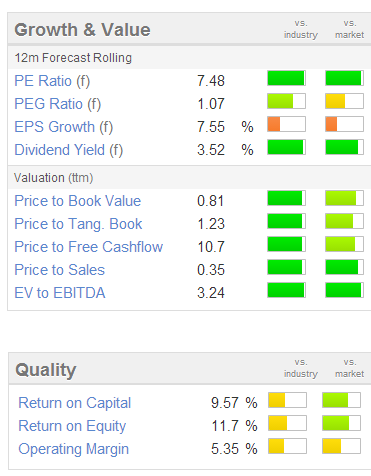
Moreover, the valuation is cheap on a PER basis, at 182p the shares are trading at just 7.6 times the reported EPS for 2013.
Stockopedia figures are based on 12-months forward PER, so the already cheap PER on the right is likely to get even cheaper, as analysts revise up forecasts for 2014 in the next few days.
At present the 2014 EPS broker consensus is 22.8p, but I would imagine that has scope to rise to say 25-26p shortly?
Some analysis tries to gloss over the issue of the pension deficit, which I think is wrong. All factors should be taken into account, and the pension problem is clearly the biggest reason why the shares are cheap.
The ludicrous accounting treatment under IAS19 of pension deficits means that a liability of only £5.6m is disclosed on the Balance Sheet. When the actuarial deficit was last calculated on 30 Jun 2012, and showed a huge £53m deficit! That's more than the entire market cap of the company.
The litmus test is how much cash is the company required to put into the pension fund, to deal with the deficit? In this case it is £1.7m p.a. from July 2013, rising by 2.1% p.a. (or more, if dividends are increased more), for seventeen years!
Therefore it's utter nonsense to only disclose a Balance Sheet liability of £5.6m, when the true liability in cash payments terms is actually nearer £27m, and that's before adding on the 2.1% p.a. increases. It's not the fault of Molins, as they are just reporting as required to under IAS19. Of all the accounting standards though, IAS19 has to be one most urgently in need of being scrapped, as it's just presenting wildly inaccurate financial positions of companies that use it.
In this case it also effectively puts a cap on the dividend too.
The way I look at things, any additional pension payments which are not put through the P&L need to be adjusted for, as if they were a cost. In this case I need to do a bit more digging to work out exactly how the pension costs are treated through the P&L. I can see the £1.8m pension cost on the cashflow statement, near the top. The way it's presented, it looks as if that IS going through the P&L, which is good news, Although I need to double check whether that is the whole of the pension cash payments, or whether it's just part of it?
Another quick way of looking at it, is that you adjust the PER by whatever you think is reasonable, to allow for the pension deficit recovery payments. More work on this is needed, so I shall report back later in the comments section below. Any readers who are clear on the pension situation here, please feel free to comment.
The counter-argument is that as corporate bond yields rise, as QE ends & the economy recovers, then pension deficits should fall, since the bond rate is used to calculate the present value of scheme liabilities. The higher the bond rate, the lower the liabilities become, so pension liabilities have been exaggerated in one of the unintended consequences of QE.
Anyway, nothing has changed today in respect of the pension fund, but what has changed today is that the company reported EPS nearly 13% ahead of forecast, so that probably deserves a re-rating of say 15-25% (since it will also flow through to improved forecasts for this year & beyond).
The outlook statement lacks specifics, and sounds a bit hesitant, so probably not one to get too excited about in the short term. They say;
We remain mindful of the uncertain economic and regulatory environment, but are cautiously optimistic the Group will continue to demonstrate progress.
Equity Development have today put out an excellent commissioned research note on the company, written by a superb analyst who I know & very much admire, Paul Hill. It's well worth a read. People sometimes disparage commissioned notes, but they can be very good research, as the analyst has more time to spend on them, and contain excellent background information. Paul Hill's notes usually also contain very informative sector analysis, as this does too. Highly recommended, especially as he is also an accomplished investor, not just an analyst.
Idox (LON:IDOX)
My good friend David Stredder has asked me to point out that the Board of IDOX have agreed to do an investor presentation at their AGM tomorrow. David is tirelessly campaigning to get companies to broaden their AGMs into an opportunity to communicate with private investors in the same way they do with institutions, so if more companies do this too, then AGMs will become a lot more worthwhile and more people will attend.
Also, companies holding AGMs, please schedule them for around lunchtime, so that people can travel to them from further afield, and avoiding rush hour traffic. Little things like that differentiate companies that have consideration for their shareholders, and all too often other companies that treat us with haughty contempt.
The game is changing. With the internet, and private investors now dominating the small caps space, creating the liquidity, narrowing the spreads, etc, we are the key audience that companies need to communicate with, and it's easy in the internet age. Hence why I am supportive of companies like BRR Media, who put out regular CEO audio & video interviews, which all helps disseminate the information that private investors need to make better informed decisions.
Quarto Inc (LON:QRT)
Normally I don't cover overseas companies Listed in the UK, as so many of them turn out to be disasters. However, if they've been around for a few years, and pay dividends, then I will look at them.
Quarto is a book publishing group in the US, but operating internationally. They supply coffee table books, with long lifespans.
The shares appear cheap, on a low PER and with a good dividend yield, but after reading their last Annual Report last weekend, I was unconvinced. There are two problems here. Firstly debt is very high. Today's results show some progress on that front, with net debt reduced from $81m to $71m. Although I suspect from looking at the Balance Sheet, this has been achieved by squeezing other things down, such as reduced stock, and some property appears to have been sold (therefore a one-off benefit in reducing debt, but increasing costs as at least one transaction seems to have been a sale & leaseback).
I think debt is still much too high here - just look at the large proportion (nearly half) of operating profit that is consumed by interest payments.
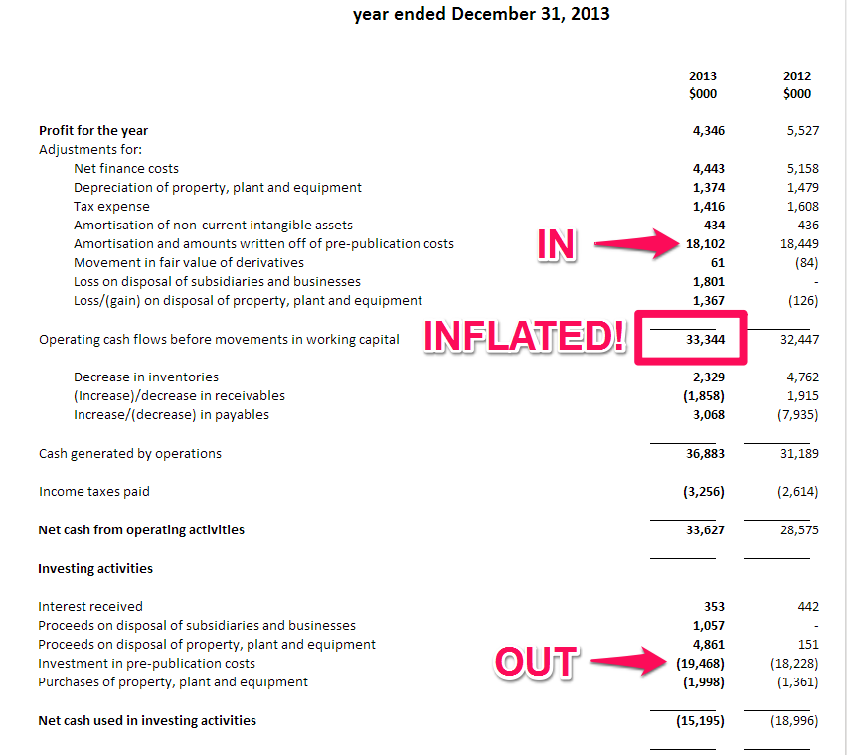
Your attention is also drawn to the Balance Sheet, where a very large debit of $56.2m is sitting in current assets, being pre-publication costs. So these are cash costs that have left the business, but are being temporarily delayed on the Balance Sheet before being reflected as a cost in next year's profit & loss account. That's very different to an asset with a resale value, and arguably should be adjusted out & written off by investors in my view.
This accounting treatment of pre-publication costs also means that cashflow is wildly exaggerated. So the $33.6m net cashflow from operating activities reported in the financial highlights is just nonsense, and does not in any way reflect the real performance of the business, in my opinion.
It may be a perfectly allowable accounting treatment, but it greatly exaggerates the real cashflow in my opinion, as shown on the excerpt below of their cashflow statement, which I have annotated;
So overall I think the high level of debt puts me off investing in Quarto.
Although the counter-argument is that they have valuable titles in the books themselves, which are not reflected on the Balance Sheet. So it's a question of how you see it really.
Personally I don't like chasing dividend yield at companies with high levels of debt, as the dividend could easily be cut at any point. If they make progress though, then the low PER could rise over time, who knows? It's risky, but might be of interest to people who like low PER stocks, and are prepared to take a sanguine view on the debt.
Run out of time today, so I'll stop now.
Thank you for reading, and your comments, which are usually very interesting.
Back tomorrow at the usual time, around 8am.
Regards, Paul.
(of the companies mentioned today, Paul has a long position in MLIN, and no short positions)
Disclaimer
This is not financial advice. Our content is intended to be used and must be used for information and education purposes only. Please read our disclaimer and terms and conditions to understand our obligations.

25 comments
BitCoin is something that has zero value, that is then chased up to a high valuation - so it's a classic bubble/ponzi scheme, however people dress it up. Also the supposed safeguards have started to fail. Again, classic signs of a meltdown that will eventually reach zero in value. Just IMHO.
Fiat currencies differ in that they have the backing of the State, and hence the taxpayer's future deep pockets to support their valuation, allowing for the fact that they will scrub off 3% p.a. roughly. When hyperinflation kicks in, then different rules apply, obviously.
I took one look at the bitcoin valuation graph, decided it was a bubble and stopped my research right there.
Seems like a waste of time even researching it.
Perfect thanks for the info - i'll check those out!
Not a book as such but a video and he does e-mail updates if you want to sign up for them.
http://moneyweek.com/spread-betting/spread-betting-video-tutorial-putting-it-all-together-14900/
Malcolm Pryor spreadbetting books, Martin Pring's Intro to TA book also very good. For candlesticks take as look at The Candlestick Course by Steve Nison.
Hello, Can anyone recommend a good book for a Technical Analysis beginner - with a view to learning spread betting using chart signals and strategies. Thanks.
I too spoke to Molins directors after the Equity Development seminar (27.11.2013)and found them very open and positive about the pension deficit problem which was described in documents as a "Key Risk". " UK funding valuation at 30th June 2012 close to being completed-expected deficit recovery payments to be £1.7m. p.a. plus annual inflation increases (currently £1.2m p.a. resulting in a 17 year recovery period". Scheme is now closed and member numbers much lower.
.
Paul or anyone else, where is the best site to find broker notes, and is a subscrition required?
Cheers
Hederz
Hi Paul,
I'm hoping that you might get round to avingtrans IMS, according to some of the other boards, numbers are not quite right, but i'm not fullys understanding and hoping you might be able to explain.
many thanks for your helpful information and enjoyable reads.
David
Always thought that Bitcoin would end in tears, a bit like some speculative shares with no earnings, or hope of earnings.
However, it could also be said that the value of ANY type of asset is based on confidence. Once that's gone you haven't got anything. So whilst shares, bonds, or property are tangible, they are only as good as the level of confidence we place in them at the time. We found this out in the financial crisis e.g. Bank shares, Emerging market bonds, even house prices (US in particular).
Whilst a select few tech shares seem to be overvalued I'm not sure this is anywhere near either a late 1990's or 1929 bubble.
One word - Invensys
Hi Paul,
I remember seeing Molins (LON:MLIN) directors giving a presentation at an investor seminar (Equity Development I think) last year. They were very 'cagey' when questioned regarding the pension deficit and seemed almost embarrassed by it.
Not a company that interested me but good luck with your investment.
Steve
More the tractors owner and I don't know a poor farmer. In reality down to my last tenner is poor, for someone else down to their last £100k or £1m is poor!
this whole bitcoin this is a most bizzare phenomena, someone creates something that has no value, no one has to take, and says this is a currency, value it as you will. it goes up and down by 1000's % but no one knows what it's really worth.
I really think that there is a market for such a thing, but why can't it be denominated in dollars or pounds ? so you can have an electronic wallet, and pass this currency around and the exchanges change it for real currency at a small margin ? but all the dealing within the currency is free or very very cheap ? I know what I'm describing is like pay pal, but the fees for that can be quiet steep. What I'm saying is why is it not possible to do a paypal like system, engineered like bitcoin without the huge speculative effect of people buying bitcoins ?
this whole thing of mining bitcoins ? whats the point in that ? that just creates money from nothing , why not have a system where you buy the currency, with money which is stored, the system is funded by interest on that money, in higher interest enviroments perhaps you even get a little interest on what's in you wallet ?
Would this fall foul of some rules, or be classified as a bank causing a lot of administrative overhead ?
what we really need is a system for micropayments, in perhaps dollars/cents, so you can easily pay a few cents for some useful information and it all goes to the reciever. Currently this is done via web advertising I suppose which is fine if it works and you can get paid, but when you need a bit more revenue to fund a service than a page impression can provide the next step seems to be to ask for a disproportionate amount of money for things like an old manual or updated driver (which in my mind should always be free but for example hp has recently said they will only provide files for some of their machines if you take out a service contract).
Anyway rant over,
cheers K
A peer-to-peer currency at some sort of parity with fiat would be interesting, but it requires inventing new technology. It may be possible, but it's currently an unsolved problem with a solution yet to be invented, and then you also need to invent a way to bootstrap adoption.
Paypal is primarily a fraud regulation network, that's what the fees pay for (the actual money transfer problem is relatively trivial). You pay a fee so that they kick out rogue vendors (and customers) from the network and refund you if you get hit by one before they get kicked out. In Bitcoin-type systems, as used for transactions, theft is the dominant business model: it's always going to be more profitable to sell stuff and keep the money than bothering delivering products or services. It's only moderated by external trust systems which cost something (be it your time to research the vendors) so "fees" of some form come back. If you can run a fraud prevention system better and for less than paypal does, just do it and take their market away from them.
On micropayments the core problem is that the decision cost easily overwhelms the benefits. Nobody wants to spend their day making thousands of 1p decisions (they value their time). Imagine people could pay 1p for your comment, and that it takes 10 seconds to make your mind if you pay or not (assuming actual comment reading for granted). If 1000 people assess your comment, 100 of which decide to pay 1p, you get £1 but people have spent collectively 10000 seconds. Assuming people's time is worth say a modest £20/hour, people would have spent collectively £50+ in opportunity cost so that you get £1. Any payment that is worth making a decision for is working fine through the current infrastructure (the practical minimum for paypal/cards is like £1 or £2).
Surely all paper money is created from nothing? It is little more than a confidence game with a promise, the banking system essentially being backed by the state. When that confidence and trust collapses 2008 is the result or much worse. Alternative money like gold and silver has to be found and dug out of the ground and therefore there are limits to it, but also a perceived value from the activity required to get it. Bitcoin mining seems to be based on similar principles in that it is supposedly hard to do - hard to create a Bitcoin and therefore would have some value to those that do it. There is a limit to the number of Bitcoins that can exist, so you can see why it might appeal to Libertarians who oppose the continued creation of out of thin air money by the banking system, backed by a state. Of course, the interesting thing about alternative money, at least psychologically, is that their value is measured by fiat currencies. In other words, everyone who had a Bitcoin would have been delighted when it reached $1000 dollars, not so happy now. Same with gold and silver, accept for those few that completely ignore the fiat value placed against it.
It seems to me that Bitcoin's problem is mainly one of legitimacy and how it is policed or whether it should be. I would have thought that any totally free currency is open to abuse from criminal elements. As with paper money, trust has to be there somewhere.
Agriterra reported today. This is a cocoa/cattle/maize agricultural business based in Africa. This is very much a macro investment - demand for food should increase quite rapidly with population growth. Jim Rogers was interviewed on The Today programme this week and he said: "if you want to become rich, learn to drive a tractor" The global population is expected to be over 9 billion people by 2050 and we have to feed them all. Rogers is factoring the expected rise of the agriculture industry into his investing thesis. "Recently, I've been looking at agriculture stocks," Rogers said. "I've been excited about looking for things to buy in agriculture." This bodes well for Agriculture companies and the food industry. Agriterra are in the 'investment phase' of their growth but are close to being able to make a profit. For all the value seekers out there AGRI have net assets of $57.5 million and cash of $8.7million against a market cap of $36.7 million. This seems like quite a discount even when factoring in the 'risk' of operating in Africa.
You say Jim Rogers said "if you want to become rich, learn to drive a tractor". I'm sure tractor drivers don't get paid that much and farmers are alway bleeting about how poor they are as they nearly run you over in their 4 x 4's or hold you up on the road in their massive tractors. I have a different take on "The best way to get rich."
Hi, He was making the point that the Agricultural sector will be extremely important in the future as demand increases and supply cannot keep up. Farmers will be able to command higher prices and increased margins. Profits will go to the person in the tractor (farm owners and managers)/ or the person selling the tractors....
I know my reply was slightly tongue in cheek and the piece I have suggested is along the same lines - the link should work now.
Molins is also a tobacco share making machinery for and offering a lot of services to the tobacco industry. It is hence uninvestable for me.
Hi Fegger
I hesitated over this (I have know of the firm for decades as they have a factory near Princes Risborough where I used to live) before I bought Molins but decided that if I decided my investments based on ethical type criteria I restrict my sphere of investment too much. If you say a supplier to the companies that are deemed or could be deemed unethetical (tobacco (this would exclude super markets as they are one of the major purveyors of cigs and what about trucking companies who ship them etc), alcohol producers/sellers, weapons, fast food, processed food, high sugar beveragaes, airlines (polution/climate change), customers and suppliers of all the foregoing), where do you stop? I don't necessarily subscribe to all of the list but am trying to make a point.
Yes I would not invest, even as an ex 40 a dayer (20 years ago now thank god) in tobacco companies directly and I am not sure I would invest in armaments companies but I think I have to draw the line there.
I would be interested in your thoughts or anybody else's.
You have highlighted a dilemma that many conscientious people have - where to draw the line. In the end, most people will pick and choose based on their own priorities: no to tobacco and munitions, ok with supermarkets, alcohol, defence, airlines etc. I would say no to anything related to tobacco myself, including no to Molins.
I found it ironic that the Equity Development research report (well researched and written otherwise) said "Looking ahead, there is a healthy slate of innovative new products coming
on stream." I think he should truthfully have said the exact opposite.
Hi Paul. A bit if a frivolous observation from me: I too hate random name changes. I was particularly annoyed when my SIPP provider recently changed its sensible, short, memorable name of SIPPDeal to AJ Bell YouInvest — yes, that's now six syllables.
But I'm puzzled as to why you liked Quadnetics, with its awkward 'dn' juxtaposition, but you think Synectics is hard to pronounce. Surely you don't have trouble with 'electric' or 'elected' or 'effect', or the myriad other words with 'ct' in them?
Best, Kevan
Paul
I'm tempted to agree with you about Bitcoin. Libertarians have jumped on this as a free currency, but with anything that is supposedly free there will be a dark side. It does seem to me that Bitcoin is a Godsend for criminal types.
However, I'm not sure I would agree with you on fiat currencies either. The problem here is that most "legitimate" money in circulation isn't really fiat as such, i.e paper money, but electronic credit and debt created by the banks, around 98% I believe. What backs that up? It would appear that it is the taxpayer when things go wrong as in 2008. Fiat paper money, that created by Central Banks and supported by the state is only around 2-3% of real money in circulation. The state seems to back up this private printing of credit and debt by default, because the alternative is what? Control of it and the supposedly free market? That's why banks got away with what they did.
Most of the money "printing" that has gone on since 2008 has not gone to us, the people, because there would have been a massive inflation threat from Helicopter drops of that size as Bernanke once said. Instead, QE has gone to reflate the system and to the very people that caused the 2008 crisis in the first place. I think this is why Bitcoin and other "free" currencies do have a degree of attraction for some.