Small Cap Value Report (28 Oct 2016) - ENTU

Good morning!
It's very quiet for results today. I'm travelling back to Hove later this morning, so once back home will try to catch up on a few companies that I missed yesterday.
Bond yields
I don't follow bond markets in particular, because it strikes me that risk:reward on bonds could hardly be worse. You get no inflation protection (apart from index-linked gilts) on most bonds, yet the yield is derisory in most cases. So the risk is all to the downside (as the value of a bond will fall when inflation & interest rates rise), in return for a pathetic reward (yields are extremely low). Who in their right mind would want to buy that sort of asset? Pension funds seem to think they are matching their assets and liabilities by buying bonds, but what happens if there's a surge in inflation? Then a gap would open up. UK inflation is likely to rise to 3-5% in 2017, due to imports costing more after sterling's devaluation.
My Twitter feed is filling up with comments and articles about bond yields rising. It strikes me that this could be good news for UK companies which have significant pension deficits. These deficits have swollen in recent years due to very low bond yields - because the liabilities are measured with reference to bond yields. Liabilities increase when bond yields reduce, and vice versa.
So it occurs to me that pension deficits may benefit from rising bond yields. Mind you, presumably there would be an offsetting effect from higher inflation - meaning that the annual inflationary rise for pension payments would increase the liability. I'm not sure how the 2 factors would combine. Do we have any actuaries in the house, who could comment on the situation?
I hold over 40 positions in my family portfolios, and from memory can only think of one position that has a significant pension deficit (relative to market cap), which is Norcros (LON:NXR) (in which I hold a long position). I'm considering topping up there, as the valuation looks remarkably low - it's not often where you see the PER the same as the divi yield (both 5.2 in this case). Sure its pension fund is huge, but the overpayments are modest. So instead of seeing a huge liability, I see a manageable cash outflow for maybe the next 20-30 years. It hasn't prevented the company from paying generous divis, nor making several decent acquisitions, so why is it such a big deal to investors? I think the fears are overdone, presenting a nice value opportunity perhaps.
Do readers see any other good value shares, beaten down too low due to pension deficits? Alumasc (LON:ALU) might be one? I haven't done the sums on it, but noted yesterday that its PER is very low, and the trading update was solid.
Entu (UK) (LON:ENTU)
Share price: 19p (down 6.4% today)
No. shares: 65.6m
Market cap: £12.5m
Strategic disposal of Astley - this car crash stock, floated in Oct 2014 by Zeus Capital, at 100p per share, just gets worse & worse. It's obvious now that the market was sold a pup. It was floated on the back of an apparently enticing high dividend yield. The trouble is, profits have since collapsed, so the big divis can no longer be paid. I'm now very wary about any other new floats which hinge on a supposedly generous divi yield.
Anyway, ENTU has decided that one of its subsidiaries, called Astley, is non-core, so it's being sold for £0.2m, which after working capital movements reduces down to just £1. Yes, one pound.
Yet apparently, Astley makes a significant profit;
On 11 October 2016, the Group issued a trading update stating that EBITDA from continuing operations before exceptional items was expected to be in the range of £3.6 million to £4.0 million.
Astley's EBITDA up to the point of sale is expected to be £1.1 million and, as this will now be reported within discontinued operations, the Group now expects EBITDA from continuing operations and before exceptional items to be in the range of £2.5 million to £2.9 million.
Why on earth would you sell a subsidiary for £1, if it's just made £1.1m in profit for the year? There is mention of its order book becoming more low margin work, so perhaps the outlook for profitability is not so good?
Looking back at the original RNS for when Astley was acquired, it only cost ENTU £0.2m to buy, and had historically been loss-making, only reaching breakeven at the time of acquisition. So in the light of that, it looks to be a poor quality business, that perhaps just had one good year under ENTU's ownership? Or at least perhaps benefited from their EBITDA accounting - which has a tendency to create artificial profits out of thin air.
My opinion - I completely lost confidence in this company some time ago, and wouldn't touch this share now at any price. It's been a value trap from day one.
Also, I met a former employee of ENTU some time ago, who warned me away from the company - saying that he left because of concerns he had over the company's ethics in dealing with customers.
Zotefoams (LON:ZTF)
Share price: 260p (up 0.7% today)
No. shares: 44.4m
Market cap: £115.4m
Q3 trading update - in line with expectations. The outlook sounds positive (with a couple of caveats included, to cover themselves);
Zotefoams saw third quarter sales grow ahead of the comparative period last year, buoyed by continued favourable currency and particularly good growth in HPP and North American polyolefin foams.
This was offset somewhat by lower polyolefin foam sales in the UK and continental Europe. The Company has entered the fourth quarter with a very strong order book.
The Company's investment at its facility in Walton, Kentucky, USA, which will increase Zotefoams' global capacity, remains on target to be operational in H1 2017.
Whilst being mindful of the operational risk to delivery of the very strong order book in the final quarter and the potential consequences of currency volatility, Zotefoams continues to expect another year of positive progress, with performance in line with management expectations.
The Company also remains confident about the long-term prospects for the business.
Valuation - the share price, and broker EPS forecasts, have been gradually falling over the last year. Even so, the valuation metrics don't look particularly appealing to me;
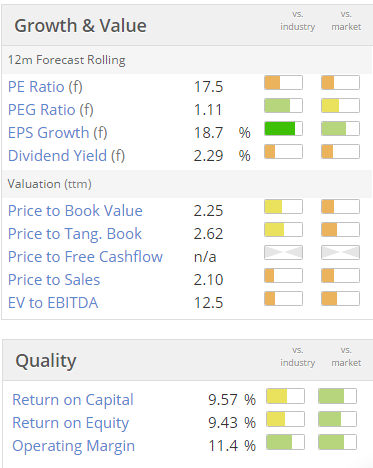
Bear in mind that the forward PER on Stockopedia is calculated on a rolling 12-month forwards basis - so it's mainly relying on the 2017 earnings forecast. That forecast assumes a decent rise in earnings from 2016.
Overall then, the price looks probably about right, to me.
However, with a strong order book, and new capacity coming online next year, there could be upside on this perhaps? Potentially worthy of doing more research then.
Disclaimer
This is not financial advice. Our content is intended to be used and must be used for information and education purposes only. Please read our disclaimer and terms and conditions to understand our obligations.

31 comments
Big post from Paul today on G4M on the Adfvn board,well worth reading.
Can anyone tell me whether in the event of deflation pension payments would be reduced ? I know in the one period it did happen a few years ago mine wasnt, but times are different now and presumably they would be entitled to ?
Will depend on the terms of the pension scheme.
Most, I suspect, don't have terms that allow reductions if there is deflation, just rises with inflation.
What TMFMayn’s method shows is that the Norcros pension scheme is more mature than all the other schemes (except Renold).
The Norcros pension payroll is close to its peak (there are various semi-public sources which verify this), and will decline from here. This is baked into the demographics of the scheme (which is closed to future accrual).
It therefore isn’t true to say that Norcros fund “needs” 6%pa per annum if no contributions were made.
That statement would be true if the pensions needed to be paid in perpetuity. But they don’t – they only need to be paid for the remaining lifetimes of the membership.
In other words: the pensions will be paid from a mix of interest and principal.This isn't a problem, it's the plan!
And if the plan works exactly (which of course it never does), the fund reaches zero on the day the last pensioner dies.
Hello Dale
Thanks for the comment.
What TMFMayn’s method shows is that the Norcros pension scheme is more mature than all the other schemes (except Renold).
You can't really conclude that NXR's pension scheme is more mature simply from my method.
To determine whether it really is more mature, you would actually have to compare NXR's scheme -- average age of member, etc -- with those of the other 18 companies.
You never know, maybe some of those other 18 companies also have mature schemes -- and yet they are currently paying much more relatively into their schemes than NXR is paying into its scheme.
Overall, it would be useful for NXR shareholders to demonstrate that the NXR scheme really is more mature than those of other companies -- and so justify NXR's apparently low level of contributions -- rather than just rely on management claims in a results presentation.
It therefore isn’t true to say that Norcros fund “needs” 6%pa per annum if no contributions were made.
That statement would be true if the pensions needed to be paid in perpetuity. But they don’t – they only need to be paid for the remaining lifetimes of the membership.
In other words: the pensions will be paid from a mix of interest and principal.This isn't a problem, it's the plan!
And if the plan works exactly (which of course it never does), the fund reaches zero on the day the last pensioner dies.
Well, that is exactly the same situation for all the other 18 pension schemes on that list.
And yet all but RNO have greater assets/contributions in relation to benefits currently being paid.
Paul
Don't profess to understand the legal complications requiring pension fund shortfalls to be given preference over dividends in relation to distributable surplus in trading accounts but if Carclo were 'forced' to withhold announced dividend (poor management) then why does this not apply also to all other companies including Norcros as identified on the Stockopedia list? Surely it is now imperative that the legal restrictions being applied should be amended as this shortfall is entirely a short-term consequence of low interest rates and becomes relatively insignificant when looking at the long-term obligations of pension funds.
"Pension funds seem to think they are matching their assets and liabilities by buying bonds"
I think the logic is that it's "risk free", but as Howard Marks notes, nothing creates more risk than the notion that something is risk-free. Basically, pension funds are behaving utterly mindlessly. They're supposedly professionals. All this is sure to end in tears.
A year or so ago, when compulsory enrollment of pensions was being introduced, I was automatically signed up for a pension. Of course, it was for something that invested in bonds. Anyway, I scrubbed it, realising what a waste of time it was.
In June 2016, the FT reported that the 10-year gilt yield fell below 1%.
According to Stockopedia, Unilever offers a dividend yield of 3.3%. Br Amer Tobacco offers a yield near 3.9%. These are big, safe, companies that offer a superior return and will likely be a hedge against inflation.
What leads us to this utter insanity? It's the thinking that stocks are somehow "risky", and gilts are "risk free".
Another scandal in the making, and all the talking heads will be wondering how they got themselves into this mess, and what regulations should be put in place to ensure it doesn't happen again.
Rant over.
On Pensions, Bond Yields & Norcros. In the short term not sure the reversal of bond yields will help that much as it is only unwinding the falls seem since about May / June this year and against that Inflation is expected to rise in the short term too. From Note 23 of Norcros R & and the sensitivities it seems that longevity risk is bigger and that interest rate / inflation moves may just about offset each other whereas a 1 year rise or fall in life expectancy has about twice as much impact. Worth noting that NXR's is quite a mature scheme with 61% of members pensioners and the weighted obligation therefore around 16 years.
I hold over 40 positions in my family portfolios, and from memory can only think of one position that has a significant pension deficit (relative to market cap), which is Norcros (LON:NXR) (in which I hold a long position). I'm considering topping up there, as the valuation looks remarkably low - it's not often where you see the PER the same as the divi yield (both 5.2 in this case). Sure its pension fund is huge, but the overpayments are modest. So instead of seeing a huge liability, I see a manageable cash outflow for maybe the next 20-30 years. It hasn't prevented the company from paying generous divis, nor making several decent acquisitions, so why is it such a big deal to investors? I think the fears are overdone, presenting a nice value opportunity perhaps.
I reckon the remarkably low PER is because the overpayments are far too modest, and more needs to be pumped into NXR’s scheme.
Rather than speculate about a pension scheme’s future liabilities and what assumptions underpin their calculations, another way of evaluating a scheme is to simply take the plan’s assets and compare them with: i) the contributions made by the employer and employees; and ii) the annual benefits paid to the scheme’s members.
Shareholders can then assess whether the assets and contributions look sufficient enough to produce the required benefits every year.
It’s a bit like assessing your own retirement plans…i.e. I have X in my pot, I need Y to live on every year, and so I need Z% a year from my pot to make ends meet.
For NXR, its pension scheme had year-end assets of GBP 365.9m, while contributions were £2.1m and benefits paid were £24.1m.
So you could say the plan needs 6.6% a year to cover its benefits payments without contributions (24.1/365.9)… or 6.0% if you factor in the contributions ((24.1-2.1)/365.9).
So, 6% a year — sounds easy enough for us smart stock-pickers :-), although as we all know if the fund has a bad year then the required Z% return soon ratchets higher. Benefit payments from pension funds just can’t be deferred as you can with withdrawals from your own portfolio.
Anyway, how does NXR’s required 6% compare to other quoted companies with pension funds?
I have taken the other 18 names from the list Ramridge provided above, to arrive at some idea of relative funding from a decent mix of companies. Here are the required returns in descending order (the negative figure for TSCO is due to its contributions exceeding the scheme benefits paid):
RNO - 7.0%?
NXR - 6.0%?
CAR - 5.2%
?CFYN - 4.5%
?DVO - 4.3%?
GKN - 3.4%
?TATE - 2.8% ?
BT - 2.7%
?GNC - 2.1%?
MNZS - 1.6%?
MGAM - 1.4%?
MACF - 1.3% ?
BAE - 1.2%?
WTB - 1.1%?
MCB - 1.1%?
SYNT - 0.8%
?BRAM - 0.2%
?TCG - 0.0%
?TSCO - (3.1%)??
From this small study, I would say NXR’s contributions are far too modest and more needs to be pumped into the scheme on an annual basis. It is notable perhaps that of the top three, RNO does not pay dividends at present and CAR recently suspended its dividend due to pension accounting technicalities.
I calculate NXR’s contributions would have to rise from £2.1m to £9.5m a year to lower the required plan return down to 4% (assuming benefits stay at £24m a year) and come closer to matching the funding efforts of this sample. ?
BONDS - I tend to think of Corporate bonds which I think should be part of a balanced portfolio. I aim to buy bonds on issue & current returns are 6/6.5% with bonds now trrading @ above face value - better than holding cash IMO
I suspect the circumstances of most pension funds will be pretty variable, depending on their make-up, size etc. On a defined contribution scheme that has been closed to new entrants, maybe if interest rates go up, perhaps there will be decreasing strain on contributions required by companies.
However, the complexity of pension schemes make-up, plus the regulatory requirements to make Minimum Funding Requirements reviews every three years, may make the outcome less predictable than merely just assuming because interest rates have gone up there will be a quick across- the-board drop in contribution levels required by most pension-bound companies.
Paul, I have recently bought into Trinity Mirror for the reasons you suggest, plus that from the late 90's onwards many pension schemes introduced a cap on annual increases; ie lower of RPI / CPI or 2.5%. Althought this only applied to future accruals, high inflation will reduce the real cost of pensions / pension liabilities. Surely there is no bigger bet on this strategy than Trinity Mirror!
RNS at 1:55pm Luke Johnson has built a 10%+ stake in Elegant Hotels.
Presumably that is the other side of the trade that saw Vision Capital take their holding down from 22% to 12% as per the RNS this morning. Nice and neat way of selling a large stake without bombing the price out.
Gus.
It's potentially very interesting -- never been to Barbados myself (sadly), but Risk Capital have had some big wins over the years and Leisure is the sector they tend to specialise in.
I had a quick check and EHG seems to be on a 9% dividend yield (if it sticks by its 7p per share guidance) and has come off the boil since its IPO, from 100p to 75p.
Would love to hear anyone else's thoughts on the development; will try to free up some time at the weekend to do a bit more digging. Gus 1065 looks to be right re. Vision -- can't say I've come across them before.
I am no expert but surely when interest rates rise the value of many of the bonds currently held by pension funds fall?
I believe it is a widely held view that bonds were a one way winning bet with falling rates and quantitative easing but presumably the reverse is true with rising rates?
yes indeed that would be my observation, low yields may be bad, but it means capital increases, when this reverses won't it create a massive whole in the capital value ? I wonder what % of pension funds is in bonds rather than shares ?
K
I think we need a pensions actuary, or someone who is an experienced pensions trustee to comment, as to quite how the revaluation of pension contributions is calculated. Time was when some company's took a pension contributions holiday. Possibly pre-history!
Re Entu (UK) (LON:ENTU)
This comment seems pretty cynical about Entu
http://www.theconstructionindex.co.uk/news/view/entu-sheds-astley-facades-already
Pension scheme deficits: I'd sound a note of caution. Those companies running into their triennial valuations this year will find their contribution rates factoring in these very low interest rates and seeing some very hefty hikes.
I agree shipoffrogs. Triennual valuations usually throw up upward revisions to liability estimates - I would look at the longevity assumptions disclosed in the annual report of any pension deficit company - do they look reasonable - or are they likely to rise again in the next triennual review. Remember that most companies would love to get rid of their defined benefit liabilities - why don't they - the insurers (eg PIC, JRP who offer to "buy-out the fund") are quoting a valuation of the liability generally significantly in excess of how the company is valuing it. In reality companies are mostly not prepared to bite the bullet and so keep playing the long game.
Rambridge offers a good screen - other companies that may be worth looking at are Communisis (LON:CMS) (div yield> P/E), Carclo (LON:CAR) (recently had to cancel an already declared div, because of an increase in pension deficit and more recently did an equity raise, partly to fund a small acquisition), £ TNI.
Also remember while Philip Green may not be on the front pages - any parliamentary investigation into BHS is more likely to lead to greater security being given to pension beneficiaries.
I think in these extraordinary times you are too early on this trade. The Bank of England will keep interests rates low as long as they can and allow some inflation to handle the debt still out there. Just as compound interest works so does inflation. IMHO the pension funds approach to liability matching could be disastrous over the longer term.
Here is a very quick and dirty Screen to identify some big pension deficits in reasonably highly geared companies. A 2 minute job so needs refinement.
2 simple balance sheet variables (gross gearing greater than 25% and gross gearing including pension deficit greater than 25%) and a simple formula gross gearing inc pension > 1.5x gross gearing). The 1.5x is an easily changed variable (as is the 25% gearing threshold).
http://www.stockopedia.com/screens/pension-defecit...
A ratio of 1.5x throws up 60 companies to look at. A ratio of 2.0x 36 companies and 2.5x 26 companies. Some interesting names in there - GKN (LON:GKN) , Renishaw (LON:RSW) , AVEVA (LON:AVV) , Trinity Mirror (LON:TNI) , James Latham (LON:LTHM) etc..
Best,
Gus.
Re. Pension Deficits. The recent excellent piece of data provided by Stockopedia concerning gearing incl pension deficit allows us to make further useful analyses.
Here a tabulation showing the top 20 stocks with highest ratios of (gearing + pension deficit)/ (gearing). Last column headed Ratio.
The premise is that if inflation kicks in next year and interest rates rise, then these stocks will benefit most from reduced gearing, of course * other things being equal * .
It is interesting that Wincanton (WIN) does not make the Pension Deficit list. It may be that with negative net worth the calculation becomes confused.
Although it has taken tremendous strides in reducing it,the pension deficit remains substantial. With the stock report showing 98% gearing after including the pension and that £184 million of negative book value WIN usually makes these lists
Hi Aislabie - Yes, you are right. I filtered out negative Gearings thinking that it effectively means that the co. is cash positive. But actually you can have a negative Gearing by the numerator being positive , i.e. net debt, and denominator being -ve, i.e. a negative asset value, as is the case with WIN.
You can see that by looking at the StockReport in the Other Ratios box. By using this data, the Ratio (per my tabulation) becomes, (-78.7/ -21.4 = ) 3.7 . It definitely qualifies for the rogues gallery.
Regarding defined benefit pension scheme holes, I have been thinking along the same lines. I am not expert at all, but if companies are required to pour money into schemes as rates comes down, then surely they can reduce contributions as rates start to rise? Given the inflation worries, I suspect that a further BOE rate cut is off the table, and if inflation does start spiking next year, then rate hikes are inevitable. Are there any actuarial experts here who have thoughts on this?
Can anyone think of any companies that are especially impacted by great big dirty pension deficits? Molins (LON:MLIN) is of course one, Johnston Press (LON:JPR) is another. It might be worth keeping a couple of these on the radar and buying when the BOE start signalling that a rate hike may be on the table.
I wouldnt describe Alumasc (LON:ALU) statement as solid. The strong order book as described in June, which was going to make the 2nd half oh so much better, hasnt actually translated into any more revenue, but of course the 2nd half weighting is staill going to mean that full year will be in line with management expectations - or desperate hopes !
I would agree with you Eric about ALU. Overall it looks pretty low growth - only one, small division ('Housebuilding & Ancillary Products') looks to be doing well, while the largest 'Roofing & Walling' division saw quite a drop in turnover due to the completion of a large contract, thus it's revenue stream looks quite lumpy.
Is an order book of around £30m not actually rather small compared to an annual turnover of approx £90m?
Entu was a jigsaw puzzle of loss making acquisitions at IPO, packaged up to flog in the capital markets - this is a group that is very, very low quality. Terrible buy & build strategy that has been badly executed
Yes, you're right. I was completely taken in by Entu (UK) (LON:ENTU) originally - beguiled by its big divis, and history of high profits & cashflow. I still don't really understand why its profits have collapsed, there hasn't really been a satisfactory explanation. I do wonder if the profits have been hived off into Epwin, which supplies the product?
I was chatting to some brokers & fund managers in the City last week, and they told me that some people are regarding Zeus floats with a lot more suspicion now, or avoiding them altogether.
Regards, Paul.