Small Cap Value Report (Mon 2 Nov 2020) - PURP, HMSO, SEE, PIER, KBT, ACRL, NWF, PPH, STU

Good morning, it's Paul & Jack here with the SCVR for Monday.
We could have a bit of volatility to deal with this week, with a new lockdown for England having been announced, and of course the US Presidential election taking place on Tuesday.
Timing - Jack's kindly done most of the work this morning, but I'll (Paul) be adding bits this afternoon until about 3pm. Update at 19:20 - lots more sections added, and today's report is now finished.
Agenda - as follows;
Purplebricks (LON:PURP) - Half year trading update (Jack)
Hammerson (LON:HMSO) - Completion of disposal (Jack)
Seeing Machines (LON:SEE) - Year end results FY 06/2020 (Jack)
Brighton Pier (LON:PIER) - Final results FY 06/2020 (Paul)
K3 Business Technology (LON:KBT) - Trading update (Paul)
Accrol Group (LON:ACRL) - Covid-19 business update (Paul)
Nwf (LON:NWF) - Cyber incident, suspension of shares (Paul)
Pphe Hotel (LON:PPH) - Q3 trading update (Paul)
Studio Retail (LON:STU) - brief comment on blocking its disposal (Paul)
Lidco (LON:LID) & Horizon Discovery (LON:HZD) - very brief comment on US takeover bids for these 2 companies (Paul)
.
Purplebricks (LON:PURP)
Share price: 62.5p (+8.9%)
Shares in issue: 306,806,039
Market cap: £191.8m
(Jack)
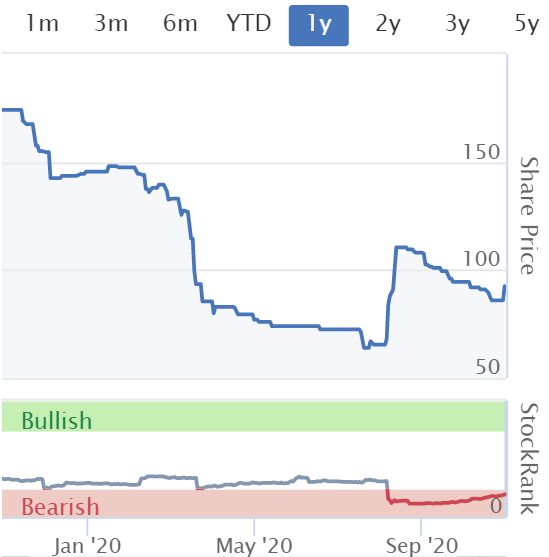
I wonder if there’s a post-Woodford bounce coming for certain stocks? Take Purplebricks (LON:PURP) for example - that’s a heck of a fall in share price since 2018:

The group continues to burn through cash and makes some punchy, double-digit net losses though:
- FY18 -£30.1m
- FY19 -54.9m
- FY20 -19.2m
Looking at the falling net cash balance, another equity fundraising isn’t out of the question. But see below - today the group reports an improved cash figure, which is encouraging.

Stockopedia rates Purplebricks as a Momentum Trap but shares are up 8.9% on today’s Half year trading update so let’s see if the tide is turning. If it is, then let’s not forget the share price was approaching 500p in 2017…
It’s actually a very brief update, with much more detail to come on 15 December 2020. Some highlights for now:
- Strong levels of new instructions during the last five months,
- An 8% increase in instructions for the six month period to 35,387 (H1 FY20: 32,850), and a 20% increase for the 5 months since June,
- First half adjusted EBITDA to be comfortably ahead of company consensus of £3.5m,
- Improved cash position since 30 April, with cash at the end of October in excess of £75m compared to £66m on 15 July 2020.
Vic Darvey, CEO, commented:
We expect to deliver a pleasing profit performance in the first half, but it is too early to extrapolate this out to the second half of the year given the expected end to the stamp duty holiday and the potential impact of increased COVID-19 restrictions on the housing market. As a result, we are planning cautiously around the outlook for the full year.
Conclusion
There could be something here, but I’d need to take a much closer look before committing to a view. I’m open to a turnaround though and the tone here is better than feared.
In fact I already have Purplebricks in a ‘Turnaround’ watchlist, so this update probably shunts it further to the front of the queue.
The Property Franchise Group recently noted floundering competition in the hybrid space, but it seems as though Purplebricks is rebounding from lockdown in decent shape. Reported activity, on balance, is stronger than I would have expected and appears to have positively surprised the market.
No doubt there has been a lot of operational activity, right-sizing, and cost-cutting going on here in recent years after its overly ambitious expansion into overseas markets.
What is hard to get over is the colossal operating losses and cash burn Purplebricks has achieved to date. But this latest update shows an impressive increase in cash position and a company well placed to outperform existing market forecasts.
Last year Purplebricks reduced its marketing cost as a % of revenue from 29.6% to 25.6%. There must be quite strong brand recognition there, so perhaps costs could be cut a little further in the short term.
Certainly the next month and beyond could be bumpy for a host of companies, with lockdown making its return. How will the UK housing market fare on a two year view? That’s a big question. On the whole though, this update bumps Purplebricks much higher up the watchlist.
Hammerson (LON:HMSO)
Share price: 15.8p (-3.13%)
Shares in issue: 3,831,468,050
Market cap: £605m
It’s a bit too big for the SCVR strictly speaking, but there is interesting readacross we can all take from this brief RNS from Hammerson (LON:HMSO) .
Fulham Shore’s chairman recently sounded an ominous warning sign for retail landlords:
Landlords prior to COVID-19 were facing falling retail and restaurant demand for their sites, due to the continued shift to online shopping, the contraction of some large restaurant chains, and the challenging economic backdrop over the past three years. The bottom has now truly fallen out of their world.
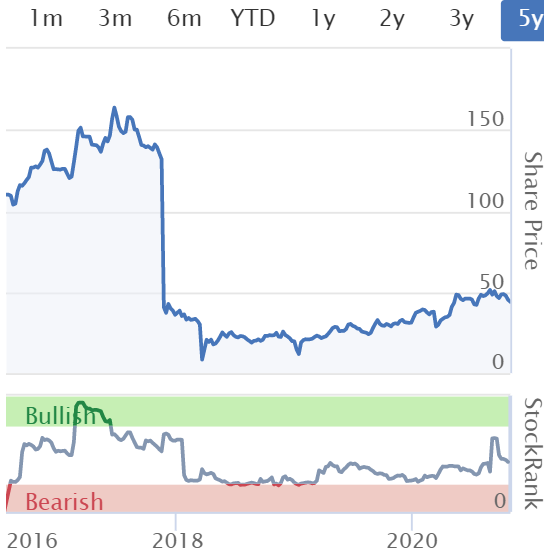
And looking at the Hammerson share price chart is truly sobering. It’s a stunning collapse in equity value. There are winners and losers in this market, and here we have a reminder of the risks we face if we get it wrong IMO.

The heavy selling continues even at these levels. The latest update (here) is the disposal of its 50% interest in VIA Outlets for £277m, representing an 18.3% discount to gross asset value as at 30 June 2020.
Perhaps there are some super contrarians out there that see value here. Institutions and directors have been buying. But I view this latest news as a timely reminder of where not to be investing right now.
Seeing Machines (LON:SEE)
Share price: 4.4p (-5.45%)
Shares in issue: 3,737,214,374
Market cap: £164.4m
Seeing Machines (LON:SEE) designs AI-powered operator monitoring systems to improve transport safety. It has been heavily loss making for a long time and it’s more of the same for this year.
Highlights:
- Revenue up 25% to AUD40m,
- OEM revenue up 32% to AUD27m despite COVID disruption
- Annual recurring revenue up 17% to AUD14m
- Cash down from AUD54.8m in 2019 to AUD 38.1m, currently at AUD35m
- Loss after tax of AUD46m (note this is buried way down in the statement).
Current trading looks reasonably positive, with Q1 21 revenue ahead of budget and 20% up year-on-year to AUD9.5m
Paul McGlone, CEO of Seeing Machines, commented:
I am pleased that our solid progress in FY2020 has continued into the first quarter of FY2021, with both revenue and cash ahead of budget. I am confident that we are on track for a successful year ahead with a strong strategic focus, foundational partnerships and a well established team to deliver.
Conclusion
The tone sounds positive but the historic trading figures are awful and the FY20 loss is similarly huge at AUD46m.
It’s the type of Financial Summary that wants to make me run for the hills as an investor.

Those are some pretty substantial and consistent losses for a £174m company. There’s been some extreme shareholder dilution as a result:

Cash is falling - from $54.8m in 2019 to $38.1m at 30 June 2020 and to $35m at 30 September 2020. Seeing Machines generated $40m in revenue in 2020, but it also spent $36m in research & development in FY19 and a further $31m in FY20.
At some point SEE’s technology might reach that all-important inflection point and see mass market adoption. But how much cash does it have to burn through to get to that point? Without knowing this company in detail, the track record suggests a cash raise might come before reaching sustainable profitability.
The most recent broker note is forecasting profitability by FY23. Given the macro environment facing us, it’s more likely this forecast will be extended rather than brought forward in my opinion.
The company’s loss after tax is buried way down in the update: a loss after tax of AUD46m. This is up from the FY19 loss after tax of AUD42m.
I’ll leave it to others to fund this heavily loss-making venture for now, but good luck to holders.
.
Brighton Pier (LON:PIER)
Share price: 30p (down 2% today, at 11:50)
No. shares: 37.3m
Market cap: £11.2m
The Brighton Pier Group PLC (the Group) owns and trades Brighton Palace Pier, as well as eight indoor mini golf sites and twelve premium bars nationwide ...
These trading results for the 52 weeks ended 28 June 2020 (2019: 52 weeks ended 30 June 2019), a period which, since Spring 2020, has been defined by the COVID-19 pandemic.
All sites were closed from 20 March 2020 until just after the 30 June year end. Unfortunately, with the new lockdown measures recently announced, then presumably all sites will be closing again later this week, for who knows, maybe 4-6 weeks seems likely. Then in the worst case scenario, maybe another lockdown in the spring, if the virus once again picks up steam when the new lockdown is lifted? We seem to be in a vicious circle at the moment, although 2021 should see better treatments, better testing, and vaccines.
Therefore the end is in sight, even if it doesn’t feel like that right now. The biggest question is whether companies can survive until then, hence balance sheets and cash burn levels are the key issues in vulnerable sectors like leisure, travel, hospitality, and retailing. Some shares in these sectors could be multibaggers if they recover, whilst others could wither away or end up going bust. For anyone brave enough to search through the wreckage of the above sectors looking for the future winners, this focus on cash & cash burn is vital.
Revenue is down 29% to £22.6m. I imagine revenues in FY 06/2021 are likely to be down considerably more again, as the covid/lockdown impact continues (the bars division are late night venues, so not able to trade normally, if at all). I think PIER’s bars division might be a write-off actually, because they weren’t good sites to begin with.
Revenues had been up 5% at the half year stage, before covid.
EBITDA was still positive, at £2.5m, but that’s meaningless because there’s so much maintenance capex required, especially for the pier. Although we are told that no new maintenance issues were found in the annual survey of the pier’s structure.
After large write-offs, the loss before tax is awful, at £(10.2)m
Liquidity - the group has borrowed £5.0m under the CBILS, and the bank has been co-operative by waiving covenants & relaxing repayments for 2020.
Total bank debt of £16.8m is high, but no repayments are due for 6-12 months, so immediate crisis.
Outlook - with only one bar trading currently, the new lockdown doesn’t impact that division much. The pier is in its quiet seasonal period, so again closure there for a month or so, probably won’t have a huge impact. Re-opening trade was better than expected;
Like-for-like sales (excluding closed sites) for the Group as a whole were at 81% compared to the same 13 weeks last year. The Pier division has traded at 83%, the Golf division at 87% and the Bars division at 65% compared to the same 13 weeks last year. This trading was ahead of the Group's expectations at the time of the reopening....
The announcement from the Prime Minister on 31 October indicating a return to a four week lockdown was not unexpected. Whilst disappointing, with only 'Lowlander' now trading in the Bars division and the Pier in its traditionally quiet period as we head into the winter months, the impact in all three divisions will be mitigated to a large degree by the extension of the furlough scheme to the end of November. This limited closure period was part of our considerations at the time we performed our stress testing of the business and does not in any way change the conclusions we reached.
Balance sheet - looks a bit wobbly to me. NAV is £15.0m, less intangibles of £9.5m, leaves £5.5m in NTAV - not much, when compared with the bank debt. Therefore, once this crisis is over, I imagine an equity fundraising would be needed to repair the balance sheet, and remedy the creditor stretch.
The downside scenario would be if the company is forced to raise fresh equity during this crisis, at a deep discount.
My opinion - I cannot see any reason as to why this share would trade above NTAV, which is currently 15p. That’s half the current share price of 30p.
With the risk of dilution at some stage, and uncertainty over when the bars can re-open at any time, if at all, then it’s difficult to see why anyone would find this share attractive at the current price. The only upside case I can think of, is if you reckon Brighton Pier is worth substantially more than book value. Then maybe it could be sold, at a premium to book, and money returned to shareholders, or the company's listing re-purposed. This venture doesn't seem to have really got off the ground, therefore it's difficult to see what could be achieved by making more acquisitions.
There has to be some de-listing risk too. Note that Luke Johnson is the chairman, and he's experienced & well connected, so might come up with a better strategy for the future. Although obviously after the Patisserie Valerie debacle, his star is somewhat dimmer than it was.
.
.
K3 Business Technology (LON:KBT)
Share price: 97p (up 5% today, at 13:30)
No. shares: 42.9m
Market cap: £41.6m
K3, which provides mission‐critical business software, cloud solutions and managed services, is pleased to provide the following trading update.
This looks to be a reassuring update;
Trading in the second half of the financial year to 30 November 2020, seasonally the Company's stronger half, has continued to be in line with the second quarter and management expectations, with the own IP and Global Accounts businesses showing particular resilience. October is an important month for annual software licence and maintenance contract renewals, and these have progressed well with renewal rates tracking at normal high levels.
Restructuring? - it’s a pity we’re not given more specifics on this, but it sounds interesting -
Management continues to focus strategically on the significant opportunity to expand own IP sales, particularly of the K3|imagine platform and has made a number of new appointments to strengthen the senior team. The Board is also actively exploring a range of options to simplify the Group structure.
Several commentators have made the excellent point that the covid/lockdown crisis has forced many companies to restructure in drastic ways which would have been unthinkable in the good times. This is because companies often tolerate under-performance from people, or subsidiaries, in the good times. Yet when future survival is under serious threat, then very tough decisions are forced on companies, to address these issues.
The other, unique, aspect of covid, is that many companies have been forced to change their business practices. For example, if staff can work from home, then why do we need an office at all? Although my feeling on WFH (work from home) is that it’s fine as a stop-gap, but over time, I think it loosens ties between people and companies, and levels of customer service can decline markedly (maybe without management being aware). I’ve witnessed friends & family battling with companies over the phone, with appallingly long waiting times, calls cut off, etc, probably because staff are working from home, and are hence less efficient.
Several companies have reported that they have moved to installing and maintaining systems remotely for their customers, whereas in the past a team of people would have flown out, stayed in hotels, suffered from jetlag for a week or two, which is costly and disruptive. Whereas now, it can all be done over Zoom/Teams, and through other internet-connected software.
The point I’m making is that there are opportunities to buy into companies today which are going to emerge from covid as much better, more profitable businesses. Hence maybe we shouldn’t be just looking at companies returning to 2019 peak earnings, but possibly better than that?
Therefore, I’ll be interested to find out subsequently, what KBT intends to do, in terms of restructuring.
Liquidity - sounds OK;
As previously announced, management expected net bank debt (drawdown plus cash balances net of overdrafts) to be £6.0m at the end of September, historically the point of peak borrowing for the Company. Actual net bank debt at 30 September 2020 was £6.2m, and cash balances since then have grown strongly with annual renewal receipts.
My opinion - the above all sounds quite good, but checking back through my previous notes, the picture looked quite wobbly when I reported here on 27 July covering its (late) results for FY 11/2019. There was an important going concern note which the auditors drew attention to in their audit report. Plus a weak balance sheet, with negative NTAV, and a subsidiary had been placed into administration. I’m flagging these issues again, as this share does look financially weak. Although software companies can often operate fine, with a weak balance sheet, because they get fees up-front from customers.
Overall, I don’t like its weak balance sheet, and erratic financial performance in recent years.
Another issue which has long bugged me, is that banks currently lend on EBITDA multiples to software companies. I think this is a big potential problem, because at some point, the penny is likely to drop with the banks, that EBITDA is absolutely not a good proxy for cash generation in this sector, due to capitalising a lot of payroll costs into intangible assets, as development spending. It’s fine to do that of course, but it renders EBITDA as a meaningless measure, which in some cases greatly overstates the level of cash generation. A good example was seen last week, with Proactis Holdings (LON:PHD) which has a lot of bank debt, and trumpets a large EBITDA profit, but in fact doesn’t generate any free cashflow at all! Sooner or later, I reckon banks are likely to realise this, and withdraw the overly generous facilities they give to software companies.
That said, with KBT, the bank debt sounds quite modest, so maybe not a problem here?
.
.
Accrol Group (LON:ACRL)
Share price: 44.5p (unchanged, at 14:38)
No. shares: 195.2m
Market cap: £86.9m
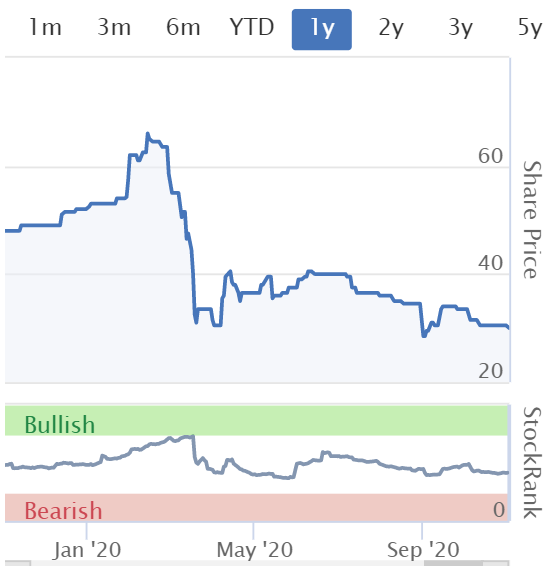
Accrol buys large rolls of tissue paper, and turns them into toilet rolls. It’s a capital-intensive, and low returns business model - i.e. the opposite of what I would want to invest in. Although looking at the chart below, the market seems to believe its turnaround story, and likes it.
There’s also the bizarre stockpiling mentality of the UK public, who seem to rush out and buy toilet paper when lockdowns are announced. Although one commentator did point out that as a bulky item, the supermarkets tend to only keep a smallish supply on the shelves, and operate on a daily delivery, just-in-time stockholding basis. Therefore, it doesn’t take much additional demand to apparently strip the shelves bare. Then of course people buy less in future, as they work their way through their stockpile at home (Acrol says today that Q1 of FY 04/2021 saw a slowdown for this reason). Averaged out over the long term, demand & supply should even out, in theory. Maybe people are more liberal in their usage of loo paper, if they know their utility room is groaning with plenty more?
Today Accrol says;
Following the Government's announcement over the weekend that a second lockdown is being initiated from 5 November 2020, Accrol (AIM: ACRL) confirms that, as an essential service provider, it expects to operate normally throughout the lockdown period.
During the first nationwide lockdown in the Spring, Accrol operated at full capacity to supply the heightened consumer demand for its toilet roll and other tissue products and remained fully operational across its three sites, successfully protecting the health and safety of its employees throughout and subsequently through the period of regional restrictions.
The business prepared for a second national lockdown and heightened restrictions and is ready to satisfy additional demand, should it materialise.
My opinion - that sounds fine, and I think it’s very helpful for Accrol to inform the stock market in this way. I’m hoping to see lots more companies let us know how this new lockdown might impact them. Although with a bit of our own work, we can ascertain from RNSs over the last 8 months, how individual companies are likely to be affected. Probably like many of you, I did a quick mental checklist of how my larger holdings will probably be impacted, along the lines of:
Boohoo (LON:BOO) - should benefit from another lockdown, as physical competition is once again forced to close the doors, But, fewer seasonal parties might reduce demand somewhat.
Revolution Bars (LON:RBG) - negative impact, but it was probably trading at a loss anyway (revenue down 50% due to 10pm curfew), and furlough scheme should help retain staff. Bad news already in the price anyway?
Intercede (LON:IGP) - traded fine through first lockdown, strong recurring revenues & blue chip clients, so little impact (if any) likely.
Volex (LON:VLX) - probably little impact & trading strongly. Got a very bullish tip from a respected tip sheet over the weekend, hence strength today. I'm also very bullish on this one, see the archive for why.
Redde Northgate (LON:REDD) - probably little impact. Van hire division likely to benefit from increased online ordering/deliveries, offset somewhat by accident management division likely to see some downturn due to fewer journeys & hence fewer crashes.
Quiz (LON:QUIZ) & French Connection (LON:FCCN) - unhelpful, and likely to increase losses in retail divisions, and harm wholesale customers further. Also likely to cause inventories headaches & write-downs. Both should be funded adequately to survive.
Saga (LON:SAGA) - not much difference, if any, as holidays division wasn’t likely to be able to re-start until the spring of 2021 anyway. Insurance division should be unaffected, or even a net beneficiary due to fewer claims against motor & household policies (fewer road accidents, and burglaries)
Etc. etc. for all holdings.
Because we already know how covid lockdowns impact different sectors, then there was no reason at all for a broader market sell-off this morning, so I wasn’t worried about this morning’s market movements, and had a lie-in, to ride out any early volatility in blissful ignorance!
It’s very difficult to make money from shares, if you panic sell every time there’s some bad news, then buy back once confidence has returned (and hence prices have gone back up again). It’s better to do the opposite - selectively buying the dips where panic sellers are offering you a bargain in an excellent company, something we discussed the other day. Then top-slicing on strong moves up, to provide some cash to deploy on the irrational dips. Easier said than done of course. Hence why these days I tend to just ignore short term volatility, and hold my best positions throughout. I only need 1 or 2 big winners each year, to mop up all the losses from the things that go wrong (this year BOTB has been my star, and also done well on a few other things, partially offest by RBG being a disaster). But everyone has their own style, and many different approaches can work well.
To conclude on Accrol, I could be wrong, but just don’t see any appeal to its business model. For completeness, I’ve just had a quick look at last reported figures for FY 04/2020, and it does look like a decent turnaround is underway, with a move back into (adjusted) profitability. Gross margin has improved, but is still extremely low at just 21.9%. A huge amount of costs have been removed, hence the move back into profits. Product innovation could drive margins higher perhaps?
The balance sheet is not too bad, although there’s quite a lot of debt on there, which will need to be reduced before decent divis can be safely paid.
I can see the turnaround here does appear to be working, which has been reflected in a stronger share price. Overall, I think it’s probably priced about right, and the business model doesn’t appeal to me at all. As we saw in the past, volatility of input prices, versus inflexibility of selling prices, caused profits to spike up, then suddenly evaporate in a downturn. The challenge is to somehow link input and output prices over the long term, to make profit/losses less volatile.
.
.
Nwf (LON:NWF)
Share price: suspended (at 200p previously)
No. shares: 49.0m
Market cap: £98.0m
Temporary suspension of trading on AIM
At the request of the Company, trading on AIM for the under-mentioned securities has been temporarily suspended from 02/11/2020 7:30am, pending an announcement.
This is the text in full, which is self-explanatory;
NWF Group plc ('NWF' or the Group), the specialist distributor of fuel, food and feed across the UK, announces that it has experienced an unauthorised access to the IT systems in two of its divisions (Feeds and Fuels) and at Group level. There has been no unauthorised access at the Group's Food division.
The Group has engaged external specialists and has taken precautionary measures with its IT infrastructure, including taking systems offline whilst it continues to investigate the nature and extent of the incident, the recoverability of any compromised data and any effects on the operability of its systems.
The Group's businesses remain operational; the customer service teams in Feeds and Fuels are using alternative systems and procedures to fulfil and deliver orders.
In light of the complex and evolving nature of this situation, the Board has requested that trading in the Company's ordinary shares be suspended until it is in a position to provide more definitive information.
My opinion - I think the company is absolutely right to have suspended its shares. That should happen more often actually, when unquantified problems emerge. It’s impossible to value the shares, until we know the extent of the problem, and how it might impact trading.
This is a reminder that unforeseen problems can occur at literally any company. From discussions with management of Intercede (LON:IGP) (I hold) they say that weak or compromised passwords are often the way that hackers find a back door into a company’s system, and they can then wreak havoc once in it, especially if user permissions are not properly set up, to restrict access to sensitive parts of the system. Whereas 2-factor authentication is much more secure. Intercede's software manages 2-factor authentication.
Proper cyber security is something that companies of all sizes have to take really seriously, and spend proper money to protect themselves. So when we’re talking to management of all companies, good questions will be to ask how secure are their systems against outside hackers? Have they experienced any hacking, or attempted hacking? Do you use two-factor authentication to log in to your computer system?
I think the level of detail & confidence/knowledge of this issue from their replies, could be revealing. I'd want to hear management reply that it's a constant threat, and sound paranoid about it, and rattle off numerous measures that they have taken to prevent hacking, etc. Whereas a super confident reply that their systems are safe, with nothing of substance to back up that view, is probably an amber flag.
I’ll cover this story as it unfolds. Keeping my fingers crossed for shareholders that hopefully it won’t be too bad. This type of thing should be something the company can recover from, without too much damage being done. But it depends on whether the IT controller took proper backups every day or not. Then there are likely to be exceptional costs to restore the system, fix security weaknesses, and have no doubt very expensive experts work out what’s happened, and how to fix it.
In the context of a £98m market cap company, what could the damage be? Possibly a couple of million quid in extra costs, at a guess? I’d be surprised if that did significant, or permanent damage to the share price, but we don’t know yet.
.
Pphe Hotel (LON:PPH)
Share price: 934p (down c.7% today)
No. shares: 42.46m
Market cap: £396.6m
I thought it would be interesting to take a look at this upscale hotels group, as it’s obviously been hit today by the renewed lockdown that I imagine requires hotels to shut their doors again.
I recall back in the original covid-driven market meltdown back in March, I looked at this share, and thought it seemed oversold, and looked safe with a solid balance sheet. Trying to buy some at the time proved elusive, as there wasn’t really any stock available - the market makers were just marking down prices to deter sellers, but then when people like me tried to buy, they just moved the price straight back up again, vertically!
Historically, this share floated just before the financial crisis in 2008-9, and then sold off heavily. From that point onwards, it had an incredible bull run until covid struck this year.
.

.
So my starting point, is that I think this is a very good company, and am wondering if the recent sell-off could be a fresh buying opportunity? Let’s have a look.
Today’s update - edited highlights;
PPHE Hotel Group, the international hospitality real estate group which develops, owns and operates hotels and resorts, announces an update on the Group's trading for the three months and nine months ended 30 September 2020.
- ... most of the Group's properties were closed or partially closed between March and July
- By early July, 84% of the Group's 45 properties had reopened with many outperforming their local markets in July and August
- As a result, the Group was able to achieve an average occupancy of 29.8% across its estate at an average rate of £96.60 and total revenue of £31.2 million. This trading result, paired with the government support measures, resulted in modest positive operational cash flow in the third quarter (before debt service and lease expenses)
- The second half of August and September saw reduced demand in some markets due to the introduction of travel restrictions in some regions
- · Since the period end, the trading environment continues to be equally volatile. Demand has reduced further due to the significant impact of the recent local lockdown restrictions in most territories
- The Group's financial liquidity position remains strong, with a cash position as at 30 September 2020 of £132.4 million (30 June 2020 £137.0 million), and further access to undrawn facilities amounting to £63.0 million (30 June 2020: £63.0 million)
Unfortunately, the update today focuses on revenues, and doesn’t tell us anything about profitability, which is more important.
Next step, is there any broker research available? I can’t find anything up to date. Instead, let’s have a look at the last interim results for 6 months to 30 June 2020. That should be a good template, as it’s about a quarter of normal trading, and a quarter of lockdown, which looks like this;
H1 revenues down 60% to £61.9m
H1 normalised profit before tax was a £(44.6)m loss, down from a profit of £5.5m in H1 2019
(for reference, in the last normal year, 2019, normalised PBT was £40.7m. Therefore, it looks as if there’s an H2 seasonal bias to profitability)
Balance sheet - this is where it gets complicated! NAV is shown (at end June 2020) as £381.2m, or 898p per share. But the company then says its properties are worth far more than book value, and at the last independent valuation, the revaluation surplus was a massive £699.2m, taking the EPRA NAV up to a remarkable 2530p per share. That’s a very large surplus over the share price of 934p. So if you think hotels are likely to fully recover, post covid, in a reasonable timescale, then this share could be really cheap.
The downside scenario is that the hotels may not now be worth anywhere near the last EPRA NAV. The company said in its interim results commentary that there’s a lack of transactional evidence for how much hotels are currently worth. So nobody really knows. The likelihood is that values must have gone down somewhat, and if fire sales of assets start, that drop in valuation could be substantial, at least in the short term. But does that matter? If you’re buying this share on the basis that it should recover back to pre-covid normal in say the next couple of years, then this could be a bargain maybe?
Also, I wonder what capacity might come out of the market? Smaller, independent hotels must be at risk of failure, with the buildings possibly re-purposed as residential property, maybe? That's happened with several old eyesore, run down hotels in Bournemouth, which have been boarded up, pending demolition, for new build flats. Hence when things are more normal, PPHE might have less competition, and hence be able to achieve better occupancy & prices?
Another complicating factor is that PPHE has a new hotel building project underway, in Hoxton. Maybe not the best place to be building a new hotel, if London takes years, or maybe never, fully recovers?
Borrowings - again, rather complicated. There’s a lot of debt, but interims show that this is;
- Cheap - average interest charge of only 3.1% p.a.
- Long - average duration 7.1 years
- Covenants waived until summer 2021
Therefore I don’t see evidence of any financial crisis.
To complicate things further, the group seems to have sold some individual hotel rooms to outside investors. Note the large minority interest figures, showing the partial ownership of outside investors.
Liquidity - there seems plenty of cash/debt headroom, so again it doesn’t seem that the group faces any existential threat.
The Group's financial liquidity position remains strong, with a cash position as at 30 September 2020 of £132.4 million (30 June 2020 £137.0 million), and further access to undrawn facilities amounting to £63.0 million (30 June 2020: £63.0 million)
My opinion - this is much too complicated for me to assess to any high level of conviction. However, it seems to me that the group looks financially secure for now. Lenders having waived covenants until summer 2021 is highly significant, and I cannot see any reason why lenders would not be helpful again if covid continues to depress hotels in 2021. After all, lenders just want their money back eventually. They don’t generally want to repossess assets and sell them for a song in a crisis. In a low interest rate environment, it therefore makes sense to relax the covenants & repayments, if necessary, and wait for covid to recede, and business to return to normal, probably at some point in 2021.
It looks like PPHE will have to close down again for this latest lockdown (although it’s waiting for guidance from the Govt), which is bound to hurt trading due to lost revenues, against a cost base much of which is fixed.
In cashflow terms, remember that depreciation is non-cash, so once you add that back, then cashflow should be less bad than profits. Capex can be reduced to maintenance only, thus saving more cash. The Hoxton new build hotel needs looking into in more detail, as it could be problematic, I haven’t got time to delve into that level of detail.
Better broker coverage would be useful here, the company should get its house broker to make research notes available on Research Tree. Or commission some research from someone else.
In conclusion, it looks financially secure enough to get through the crisis, and therefore seems a nice recovery situation, for brave investors who are prepared to be patient, and ride out any further short term downside. On balance I’ll probably sit on the sidelines for now.
.
A few quick comments before I sign off;
Studio Retail (LON:STU)
The competition watchdog investigation into the proposed sale of its education division has blocked it;
Further to the announcement on 16 October 2020 by the CMA of its Provisional Findings into the potential sale of Findel Education to YPO, the parties do not believe that there is a reasonable prospect of the transaction being cleared despite the dynamism and highly competitive nature of the market, and the benefits arising from the proposed transaction for schools and nurseries. The transaction will not now proceed to completion.
It's quite reassuring that the CMA does have teeth, and is prepared to block deals that it doesn't believe are in the public's interests. It also blocked the takeover of ASDA by Sainsburys last year.
The stock market doesn't seem bothered about the failure of the STU deal, as the share price is barely changed today.
I didn't get round to writing up anything about STU's last trading update on 30 Sept 2020, but it looks rather good - therefore readers might want to check out this share yourselves. Online sales are showing very good growth, and now make up 90% of total sales.
.
Lidco (LON:LID) - this share has been around for nearly 20 years on the stock market, and never seems to get anywhere.
A cash offer of 12p is a healthy 78% premium, from a $12bn NASDAQ listed corporation called Masimo. It strikes me as quite surprising that they would be interested in such a small UK company, but there we go.
Horizon Discovery (LON:HZD) shareholders will be battling with Lidco shareholders for control of the bunting today, as this company has also received an agreed cash takeover bid, at a whacking 108% premium! The buyer is also a US listed company called PerkinElmer, via its UK subsidiary.
Many thanks to subscriber donald pond who pointed out the above in the comments below. As he says, to get 2 premium-priced takeover bids from the US, for UK listed companies on the same day, and there have been others recently (e.g. Mccarthy & Stone (LON:MCS) ) does seem to be telling us that the yanks are running their slide rules over our companies, and snapping up the ones they like the look of. Could there be more to come? Does it tell us that (selectively) our valuations here could be too low?
I'll wrap things up there. Thanks for reading & contributing, and see you tomorrow.
Best wishes, Paul and Jack.
Disclaimer
This is not financial advice. Our content is intended to be used and must be used for information and education purposes only. Please read our disclaimer and terms and conditions to understand our obligations.

81 comments
£STU
The blocking of the sale of Findel Education to YPO is disappointing but will hopefully not distract from the excellent trading results in the main brand Studio Retail. H1 (Apr-Sept) results will be formally released on December 8th but they have already announced a 39% increase in product revenue and a 5.5% increase in financial services revenue in H1.
Not only that, but because the impact of Covid 19 hit the UK in March, the directors were obliged, under IFRS9, to assess the macro economic impact of Covid on debtors. A £20m bad debt IFRS 9 Covid provision was included in the March 2020 accounts, even though the directors reports confirm that "the business is yet to see any material indications of this increased provision being converted into cash loss." This provision should therefore be reversed at some time in the future, but the commentary implies there will be no need to increase the provision in H1.
How tragic that the clothes are not reused, when clearly many could be and would be appreciated. Instead all that labour to turn them into blankets.
But wonderful and fascinating film, the women involved come across with such dignity, cheerfulness and positive attitude to life.
It's great that both Paul & Jack contribute so much good work. However, it will become necessary for both to keep saying who has posted every single part of the SCVR. Otherwise no one will know who to reply to / agree with / disagree with.
That's why I put in a list at the top, to say who had written each section. Maybe we should put that in each individual section too. Or just reply about the company generally.
Hey Paul & Jack, I think it might be a good idea to share the SCVR between you. And I think that both of your contributions are extremely valuable in different ways. Thank you both!
With you both being very forward looking, I suppose that you have both already thought of a similar proposal before. But there is a possibility that you haven't . So Here it is.
Share the SCVR for the most part. If Paul has a company / sector that he is really interested in it then he should do that bit. If jack has a company / sector that he is really interested in it then he should do that bit.
Apart from that, maybe it could be that on days that are expected to be very busy then you both contribute & carve it up according to your particular interests.
And for all the more quite days, just one of you should do it. And maybe you could find a way to do that that fits in with both your holidays and other plans.
I expect that you both would like to keep your creative ideas flowing, And neither of you would be at your best if you feel under some pressure to contribute too much. So let's keep it to what you enjoy and what most of us will benefit from.
Whatever happens, thank you for your contributions and please keep them coming!
Excellent info. Look forward to reading future posts.
Hi Paul.
V interesting piece.
I only need 1 or 2 big winners each year, to mop up all the losses from the things that go wrong (this year BOTB has been my star, and also done well on a few other things, partially offest by RBG being a disaster). But everyone has their own style, and many different approaches can work well.
I have previously subscribed to Stocko and then had a break, now I am back. But I have net lost money on shares over the years.....especially small caps. I own RBG and that is a 90+club loser. I am back to the stock market as peer to peer lending looks even worse!!
So pls explain how your comment above works. This comment is not a dig, I am someone trying to get educated so they don't lose more money.....
I tend to run a concentrated portfolio, so only have about 5 big holdings. If 1 or 2 of them do well (e.g. BOTB went up about 15 times from my original purchase price a few years ago) then that comfortably pays for my mistakes. Since even a big loss, like RBG can only lose up to 100% of the money originally invested. Whereas a big winner can go up multiples of the original price.
Also, casting our minds back to Jan-Mar 2020, I wrote about how to handle the crisis. My approach was to sit tight on my main shares, but hedge by shorting the indices. That worked well, and allowed me to buy heavily just before the market lows (all covered in previous SCVRs at the time, so not something I'm making up now!)
So until about April-May, things were looking good for my portfolio. Although it's been a gradually grind down since then unfortunately, as the index short hedges then lost me money, and the second wave did dreadful damage to my long positions.
There again, the bid for Mccarthy & Stone (LON:MCS) recently gave things a nice boost.
With hindsight, I was much too optimistic about the 2nd wave covid risk. But we're operating in uncharted waters.
Regards, and welcome back to Stockopedia!
Best wishes, Paul.
Paul, well done its clearly working for you so keep it up. I just wondered how big you tend to go on your large positions when you have a high conviction. Do you have any rules in place regarding initial position sizing on your large positions? I've been looking to do some work on this aspect as whilst I have had some good winners over the last few months, unfortunately the big multibagger winners have come from what were initially small holdings in my portfolio. Frustratingly the winners were not low conviction holdings but I just didnt size them to properly and as such feel like I have missed out on potentially portfolio game changing returns, purely down to neglecting this aspect.
Any comments from others regarding how they approach position sizing would be much appreciated.
George - my advice is:
1 only buy companies that are profitable - then you may get dividends, rather than suffer from being diluted as the company raises cash to continue trading
2 'cut your losers' and 'run your winners'. I will sell if I am 25% down - I then need to make 33% on that money to get back to break even. At 90% down, you need to make 1000% to break even - a 10 bagger!
3 never ever add to losing positions - but definitely add to winners.
Follow those 3 rules religiously based on a balanced portfolio of say 10 -20 stocks .... and you will make money in the medium / long term.
Thanks Paul and Mikex. I think i do need to trade more not just buy and hold.......
Also I can't afford to lose more bc I lost my job in August and I am not covered by any Govt assistance......
George, I don’t want to sound like I’m any great knowledge on the stock market. However in my younger days, I did play semi professional poker for a long time. I’ve never seen anyone on the poker table who needed the money or who can’t afford to lose it be successful.
It’s too difficult to gamble successfully when you add the pressure of need to the psychology or mindset. I only mention this because of your plan to trade more, rather than a traditional investing plan. Especially in a volatile market like this, that is going to require some rigid discipline to pull off and I’d be extremely wary...
George honestly if you cant afford to lose the money stay out of it.
Hi George, It's very important to recognize that you can't afford to lose money at the moment. My advice would be to stop trading completely for the time being. Cut your outgoings & try to find away of maximising your regular income. If you keep trading, then the emotional pressure to gain will become too much and you might make too many mistakes as a result. Please don't invest with money that you can't afford to lose because you could end up making the situation worse. I would suggest that you stop investing / trading for the moment & come back to it a bit later on when you have some money left over after paying your bills.
Thanks guys, I save so paying bills not a problem. This is my capital and that is why I can't afford to lose it.... When I say trade more, what I mean is sell when companies are in black and cut losses as suggested by Mikex. Trouble with buy and hold is they go in and out of profit eg look at my oil stocks. Should have sold when in profit.... Cheers all
Oh and stay out of oil and gas!Too risky. You might like to look at these for long term holds EKF CDM KETL but pls DYOR. Good luck!
George , you need to trade LESS and INVEST more . Investment definition ; 3-5 year timeframe. Define your own attitude to risk and capacity for loss
Purplebricks (LON:PURP)
A few thoughts on a rather large holding of mine:
Now it is only the UK business that remains.
FY20 (which ended in April) was a bit of a write-off, so we need to go back to FY19 where the UK subsidiary produced an EBITDA of £10.2m to fully appreciate how profitable the company can be.
(note that capitalised development spend has been c£3.0m per year for each of the past years, so UK cash generation was closer to £7.0m)
It's obviously good that "instructions" are up, but there should have been a deferred revenue boost from FY20 into H1FY21 (highlighted in the Annual Report) and I was expecting marketing spend to be lower vs last year.
And yet with EBITDA in H1 last year of £5.5m, being "comfortably ahead" of the £3.5m consensus this H1 (so perhaps £4.0m?) seems pretty crappy.
I'm wondering whether there are more central costs included in the figures now that all other businesses have been sold off, thereby depressing my expected EBITDA expectations?
Holding for now and waiting with trepidation for interims on December 15th.
A
As regards Seeing Machines (LON:SEE) I considered this a couple of years ago but concluded the world was moving too fast to give their Fovio(?) chip-based Driver Monitoring System any sustainable moat. Surely any competent app developer should be able to use a modern smartphone's front-facing camera (while stuck on the dashboard being used for Waze) and a bit of AI/gesture recognition (also built into vcsel-equiped phones) to detect when the driver is nodding their head, struggling to keep their eyes open, yawning etc and emit a shrill warning? Then sell the app at £2.99 a pop. My ancient phone already runs PlantSnap pretty effectively without any modern technology - just point the phone at leaves or petals and a few seconds later it identifies the species, like wizardry!
OK, things may have to move up a notch when DMS is mandated by Europe but I can't believe Seeing Machines (LON:SEE) will have anything other than first-mover advantage and hence no strong pricing pwer.
Perhaps I see the negatives too clearly.......
By the time Seeing Machines cracks the market, computers will be driving the trucks anyway.
Paul, slightly off topic, but you have always kept up an interest in Boohoo. Presumably you read the Sunday Times article yesterday.. Are you not concerned about the Kamani comment that he regards it as his own business and when he loses interest that is the time for shareholders to leave. By the time they become aware of that price will have been significantly trashed and he will have had first mover advantage. The comment strikes me as being a breach of fiduciary duty.
I've not seen the Sunday Times article. We're currently in a position where the newspapers are trying to dredge up something on Boohoo (LON:BOO) (I hold) every weekend. It's clearly a desperate attempt to get page impressions. The Telegraph ran a story about trying to link fashion retailers with production overseas using possibly forced labour. It didn't seem to have anything to do with BOO (which has been criticised for having its garments made in Leicester!), yet the paper still used BooHoo's logo in the picture with the article.
The problem (which I've told him!) is that the Chairman talks to anyone who calls him, often being very passionate & outspoken! I think this has fuelled the vendetta by the press against BooHoo, as he keeps giving them fresh quotes! I've advised him to stop talking to the press altogether, as it only seems to fan the flames.
One of the reasons that shareholders want him to stay, is because with his team, he's created a fantastic growth business. Therefore one of the biggest risks, were if he was hounded out, and then set up in competition! Although he's told me that he would never do that, because BOO is "his baby", and you cannot under-estimate the passion (even "love") he has for the business. I don't think he'll ever lose interest in BooHoo, although I know he's taken the press coverage very badly, feels it's largely unfair, and sees it mostly as a personal attack against him.
I see all this as growing pains. When BOO was small, it was fine for it to ignore supply chain issues, which after all are all outsourced (BOO doesn't operate any factories). But now it's a rapidly growing, larger group, it has to move up to better ethical standards, governance, etc.. They know that, and have already taken extensive action to deal with these things. Also you cannot fault them for being so open about the issues, and publishing the QC's independent report in full. It makes for fascinating reading actually.
The whole of the fast fashion sector has got away scot-free, with BOO seemingly being the lightning conductor for press attention, for sector-wide issues.
I don't know if you saw the special report from the BBC news recently, about the Bangladeshi garment manufacturing sector? It was fascinating. Low cost garment makers there have been hugely successful, and now employ over 4 million people on very low wages (about 50p per hour), who live in slums. Yet this activity has greatly boosted the economy of Bangladesh, and as we know, history shows that these low wage economies benefit in the long run from this type of trade, and that's how their economies grow, and ultimately wages & living conditions rise over time.
So while BOO is castigated for using UK suppliers that, in some cases apparently, fiddle their VAT and pay wages below the legal minimum, BOO's competitors are widely using factories in Bangladesh paying workers only 50p and hour, and ignoring the reality that those people live in slums, have to share a stove with 12 households, and only have one communal washing facility (an open air shower). Which is worse? That's pretty obvious to me!
The newish CEO of BOO is more modern in his thinking, and is taking all the right steps to make BOO squeaky clean in future. Also, I think it's fair to say that BOO is now so big, with so many people, that I think the Chairman's eventual exit shouldn't have much impact. It's inevitable he'll want to retire at some point. The succession planning has largely been dealt with, in my view.
The new lockdown announced recently will of course help boost BOO trading further. There doesn't seem to be any impact on trading at all from the constantly re-hashed press articles. How many 15-25 year old females read the Guardian or the Sunday Times anyway?! So they're shouting into an empty room, in my view. Young people on modest incomes want fashionable, modestly priced clothing. They always will.
The press witch hunt against the Chairman doesn't seem to have had any impact on trading, in fact BOO has reported stunningly good figures this year to date, with brokers upgrading it constantly. That's what matters. It amazes me that some investors are so easily knocked off course by (largely irrelevant) press commentary. It's just background noise, because the issues have been admitted to, and are being addressed by the company. They are sector-wide issues too, not specific to BOO.
Therefore, throughout this period, I've been buying more BOO, and it's now (by far) my biggest holding. Good trading always overcomes short term negative chat in the press. Always. It's just a matter of being patient, and waiting for the press pack to move on to something else.
Regards, Paul.
Afternoon Paul re Boohoo (LON:BOO)
A slight off topic, or do I mean a180 view.
Panipat India - Blankets from discarded Western Clothing on an industrial scale
The workers comments on Western People and their attitude to their own position in life is wonderful and worth watching the whole thing
Hi ezlifeme,
Thanks for posting that video, I found it very interesting indeed, and had always wondered what happened to discarded clothing that is recycled. I just assumed it would be worn again as is, not recycled into thread & then re-woven into becoming blankets.
As you say, it's a fascinating insight into how the workers who handle discarded clothing in India, view the West, & themselves. The most striking thing is that they seem so happy, constantly smiling whilst talking to the camera, and accepting of their position in life.
The shortage of water comment made me laugh too!
Best wishes, Paul.
I wonder whether Boohoo (LON:BOO) could look to introduce their own clothes recycling scheme. I know that H&M have something in place where customers can present a bag of old clothes in return for a £5 voucher to redeem against future purchases. Given that one of the criticisms of Boohoo (LON:BOO) is the throwaway fast fashion nature of their business, perhaps introducing something similar could show they are trying to do their bit to create a sustainable fashion future.
Brighton Pier (LON:PIER) I love the pier but wouldn't invest in it. Anyone talking a walk on Brighton beach near the pier would soon see that it needs £M's spending on it sooner rather than later.
Are you sure you're looking at the right pier?(Palace Pier) It's not this one (West Pier), which has a few maintenance issues & backlog of its own, as you can see ;-)
Good point ... an insurance job might make the company a good investment.
re Hammerson (LON:HMSO)
there are other real estate options that can be considered which have far less exposure to legacy retail and/or are conveniently invested in other property areas;
Real Estate Investors (LON:RLE) - recent trading update stated "No material exposure to indoor shopping centres, out of town retail, department stores or prime retail/fashion locations", comes with a large dividend (8% at current covid level, 12% forecasted), trades at 44% of NAV.
(plus lots of recent institutional and significant director buying)
Regional Reit (LON:RGL) - recent disposal of £32.7m at 3.9% above NAV, comes with a large dividend (10.2% at current covid level, 10.3% forecasted) and trades at 62% of NAV. Recent half-year report stated "We have constructed a resilient business, with high quality assets in excellent locations, financially strong occupiers and a robust balance sheet, making us well placed to weather any ongoing economic disruption from Covid-19 and Brexit."
(and eg Urban Logistics Reit (LON:SHED) [though IIRC not paying a dividend currently?] etc)
just a word of caution as I have some commercial property investments. When you measure Price to Book you have to allow for the level of debt. That can be a major factor why some of these look cheap relative to others. that’s because the impairment may be coming hits the equity not the debt. It’s worth looking very closely at the balance sheet.
Not sure I would invest in real estate, but Simon Thompson in the Investors Chronicle today, highlights 5 smalls caps value and Alternative Income REIT (LON:AIRE) is one of them.
Other caps getting a mention are Sylvania Platinum (LON:SLP), Chariot Oil and Gas (LON:CHAR), Driver (LON:DRV) and Bloomsbury Publishing (LON:BMY)
https://www.investorschronicle.co.uk/comment/2020/11/02/five-small-caps-for-value-and-more/
broken link given
I think the "broken" link is down to the IC website. Probably that article is behind their paywall. But I had the same issue with a link I posted last week that was to a public part of their site.
Hmmm, I'm not an IC subscriber and just clicked on my original link and it works.
I'm using chrome if that makes a difference.
The link you describe as "broken" works OK on my laptop and I am not a subscriber.
Ah - GloucesterBob beat me to it. Mine is on Firefox.
Purplebricks (LON:PURP) a picture tells a thousand words. I'm actually on the brink of signing up with them as a customer, I can't fault their aspiration, and historically they did try to run before they could walk, I just can't bring myself to consider it a reliable investment.
<snip> wrong threading, sorry
Avacta (LON:AVCT) is on the cusp of releasing its rapid consumer COVID test, it’s a “have I got it now or not” saliva test, very similar tech to a pregnancy test, results in minutes, relatively low cost. It would unlock the aviation, travel, and many other sectors I believe.
Avacta (LON:AVCT) Properly implemented, a rapid, accurate, point of care, self administered saliva antigen test would be revolutionary. The devil is in the timing, I don't think it will be available in the market before December at best. However, I'm going to put a few in my SIPP for two reasons. Firstly if they do get to market before a vaccine is widely available then the sky's the limit. Secondly if they don't they have an exceptional pipeline of drugs albeit in early stages of testing (hence SIPP). An early placing has given them plenty of cash too.
Dear Zolberg. Not questioning your choice of investment but wonder if , as you expect, the price shoots up whether the SIPP is the best place for it. The reason is that SIPPs are subject to a cap so you might be limiting the opportunity to put more money into the SIPP for which the government makes a contribution.. If possible the ISA is a better vehicle for shielding capital gains. I run a SIPP for my wife and concluded that its broadly better to run 'steady Eddie' type investments in it.
On the other hand if you think this is speculative better to run it outside both ISA and SIPP as you would be able to utilise any CGT losses.
Its all about how close you are to the Life Time Allowance. I think it is £1073000 this year. If you shoot over that you will pay 55% on any money you take from your SIPP.
Not quite true - you don't pay 55% on any money taken.
Generally, there is an additional tax charge on the excess (only) when taken as a lump sum or income (or transferred overseas, or reached age 75 with unused benefits and so on - as with anything to do with pensions, devil is in the detail). The excess can be paid as a lump sum with a 55% charge.
Seems a bit odd to advise people to to invest on the basis of choosing investments that you think won't do as well just to save paying tax on additional profits. But each to their own.
I didn't.
Dear Nigem it was me. I was suggesting to be careful about which wrapper - SIPP, ISA or investment account to put in a speculative investment. In my opinion its better to put an investment that you believe will make a large gain into an ISA or an investment account given that SIPP investment accounts are capped and you should try to maximise tax relief on contributions. Also if the investment makes a loss then that is bad news for the SIPP or ISA because you cant utilise the losses.
I have tended to prefer ISA over SIPP as that way there is no tax to pay. Anyone know what the tax position is is on SIPP withdrawals? There is a lump sum which is tax free. Not sure about the taxable element after that though.
My understanding is that (after the tax free lump sum), income from a SIPP is taxed the same as any other taxable income.
Eg. if your only income is from the SIPP, if you withdrawal £60,000 in one year
£12,500 is included in your personal allowance 0% tax
£12,051-£50,000 is taxed at 20%
£50,000 -£60,000 is taxed at 40%
Total tax to pay £11,500
If you have a job with £50,000 taxable income, and SIPP income of £10,000, total income is £60,000
Overall tax is the same at £11,500
So the tax rate you pay on your SIPP withdrawals depends on your existing taxable income and how much you withdrawal in a year. If you decide to withdrawal all your SIPP in one year to buy a lambo its likely a significant proportion will end up being taxed at the top 45% rates!
Yes, but money going into the SIPP is effectively tax free. So pre-tax I have £1000 to invest: under a SIPP that means a £1,000 starts working for me straight away. Under an ISA, it is only an £800. However, you can only access the pension at 55 going up to 56 and then 57, so lSAs give you more flexibity, so a balanced approach (given your needs) is best.
BUT, if you have enough ISA investments and other savings, yet are approaching the age when you want to start drawing income from your SIPP, then with the 25% tax-free drawdown, you could argue that putting all your spare money into the SIPP gives you the best of both worlds: tax-free before you put it in and tax-free when you take it out.
Even if you are not paying income tax, the tax man will put money into your SIPP. I came quite late to SIPPs as I thought you had to be working to have one but even retired people can open one.
There are some tax advantages with SIPPs on overseas dividends, they can reclaim all the tax in certain countries, this may depend on which broker you use though.
also worth considering is Deepverge (LON:DVRG) who recently announced a 'breathalyser' style covid test was being tested this quarter.
I agree that for both Avacta (LON:AVCT) and Deepverge (LON:DVRG) (and any other 'instant' test companies), the potential could be significant re travel, bars etc reopening
I believe that Deltic was once Luminar in a previous life?
The investment problem with this sector is that there are few barriers to entry. Bars come and go all the time. The whole sector could retreat to next to nothing and reappear in a different form when normal life resumes.
No position – all IMHO.
A macro driver of markets this week is expectations of the US election results vs outcome. Anything that points to a decisive electoral result will be well received - bit of an optimism rally maybe. Markets won't like a near tied results followed by weeks of litigation, civil unrest and grandstanding by Trump.
There's been a fairly muted response in UK marketsto England's 4 week latest lockdown, and parallel new lockdowns across Europe. Maybe it is seen as the new normal, and sounds like every chance that the 4 weeks will be extended.
Important to remember there are currently several vaccine trials in phase 3. At any time in thenext few weeks news could suddenly emerge of a successful trail result. This would result in a huge relief rally in shares most affected by Covid.
If there were a negative vaccine trial result announced,this would be very sad and disappointing on a humanitarian level. I'd expect relatively muted market response at the disappointment, whilst there are alternative vaccines still in the advanced trial pipeline.
If there was something added to SCVR for US or indeed a new page created for it I would be interested too. Historically my knowledge is UK market and overseas I have used funds but I could be persuaded to upgrade my subscription to US if there was a support net by way of SCVR.
For US news I use:
seekingalpha.com - some quality articles amongst the generally low standard of comments. But they give an idea of the current sentiment. I have a portfolio set up there that feeds me news alerts to my email.
I have a subscription to Bloomberg News
cnbc.com - I usually read the previous evening's Cramer Mad Money comments - quicker and better for my blood pressure than staying up to listen to him. e.g. https://www.cnbc.com/2020/10/3...
Motley Fool and Investors Business Daily podcasts. I like the Motley Fool Industry focus podcasts. IBD also useful but gets a bit repetitive with the sales pitches for their services. Podcasts available from their websites or your preferred podcast platform.
I'm sure there are many other sources I haven't mentioned that other people here use?
Thankyou JohnEustace. That is what I like about this board there is a genuine attempt to help each other out.
Just topped up on some more Revolution Bars (LON:RBG), either very shrewd or throwing good money after bad, but what has really changed for them that justified the 12% drop this morning, in fact with the furlough scheme back, has their chances of survival actually gone up.
Report in the Telegraph say the largest nightclub owner in the UK Deltic group (they operate Oceana and Pryzm brands, I've never heard of them either) has put itself up for sale and also looking at a CVA. If Revolution Bars (LON:RBG) can survive, there may not be too much competition going forward.
Interesting I'm sure Deltic were trying to either buy £rbg or merge with them a couple of years back.
Market has been told its armageddon^2 (bug lock down in Europe and civil war in the US) and the rescue cavalry has been held at the pass (US stimulus bill stuck in Congress slap fest) and yet its holds on decently to date...
Smells like a bull market to me...but in what?...
Or it is a bear market for the cash we think is safe?
That is perhaps the most cogent position. I read some analysis at weekend making this point
Nice update from Purplebricks (LON:PURP) today:
We have continued to focus on operational efficiency and as a consequence our adjusted EBITDA1 for the first half is expected to be comfortably ahead of the Company
consensus for the full year of £3.5m. Our cash position remains strong and has improved since 30 April, with cash at the end of October in excess of £75m (15 July 2020: £66m including proceeds of £35m from the sale of the Canadian business).
Although lockdown #2 will presumably slow things down you'd expect a continuation of the flow of people from inner-cities to a more rural life over the next twelve months or so.
On a broader note, the stocks immediately most impacted by the news today are those directly impacted by the lockdown - Marston's (LON:MARS), Cineworld (LON:CINE), Hollywood Bowl (LON:BOWL), Tui Ag (LON:TUI) etc. Given that this turn of events has been obvious for weeks you wonder about how markets are processing information.
But, as noted elsewhere, there's zero chance of R being driven below zero in four weeks with schools and universities remaining open. With university returns and inter-generational mingling presumably going to happen at Christmas we can reasonably anticipate a rolling set of restrictions for some time to come.
timarr
unsurprisingly the drops led by hospitality and non-essential retail with the FTSE 250 taking the brunt.
Plot below includes short interest in blue.... another good example of why short interest analysis can give great insights when one can get over the visceral repugnance borne of a long-only bias
Supermarkets, pharm, online and the likes of Ocado (LON:OCDO) showing the direction of travel for Lockdown 2.0
These rotations have been rich in trading opportunities
More generally, I tend to take a more mechanistic approach to news analysis and track the market reaction to RNS on a cause-effect basis
The problem is that it is a balancing act. Bad news causes a share price to fall. But very bad news like this can cause share prices to rise because it materially increases the chances of government intervention in the form of fiscal and monetary stimulus and the market loves this sort of new money.
Take a look at Intercontinental Hotels (LON:IHG) for example (I hold). The price has actually risen this morning because I believe their franchise model protects them directly from most of the losses coming from the lockdown (they fall on their franchisees) but their business should benefit if the government is forced to support the tourism sector or the general economy further. It’s a very weird effect.
The problem this week is the US elections. Governments want to do this in unison to disguise the currency depreciation effects of stimulus. But the possibility of a contested result in the US is making the timing difficult to figure for the markets and therefore price it in correctly.
by mechanistic I should have also added systematic
Strength tends to beget strength and weakness weakness: it's a basic principle behind momentum trading/investing
Short interest correlates well with weakness and is often causative when those shorters produce the research to induce the price weakness they have positioned for (see table of price drops below and the number with high open interest)
Table below are from the past few months: most of the price changes had catalysts released by RNS (those tables have links to the RNS's and to charts)
Aggregating these daily, analysing over time and linking back to price action via charts give a lot of insights
On the cheerier side
I'll be launching this kind of daily analysis of RNS price response in the next couple of weeks
Hi Dscollard,
Quite fascinating to see the actual magnitude of the resultant moves, although I have a few questions please :
You suggest that these were not all triggered by an RNS, so I guess candidates are harvested via a general daily sweep of the market regardless of formal news ?
Are the % gaps on open, or the final position at the end of the day ?
Given that the elapsed days between the trigger date and today are quite large in some cases, I presume that movement hasn't been consistent and could have actually moved into a negative/positive position throughout that period, so how do you determine when to "close" the observation ?
Thanks
Mike
Some insightful questions...
those grabs are visual slices from a database that draws in numerous feeds including RNS, market data, news and a few other sources.
Price change is linked to RNS using a few simple rules in the database but not exclusively as the objective is to find major moves and make money
Those labeled as Gaps in the above are opening gaps within the first 30 mins max of daily liquidity but most occur within the first 5 minutes (depending on uncrossing). I also sample through the trading day as price moves especially during times of liquidity (noon auction, pre close)
The historical tables are constructed using filter rules so data gets screened out based on those: the principle is more to find big movers, multi-gappers and to build rules-based setups based on observables and cause-effect relationships. in essence many of those gaps are proxies for fundamental analysis. When there is a very significant change in a business or its underlying market then the truth plays out in the price and tends to persist
I am above all else a chartist and a trader : I tend to focus on opportunities with high potential aligned to good catalysts and execution parameters: these can be fairly short lived. The market post the Covid Crash V1 has been pretty ideal for this
The big news to me are Lidco (LON:LID), Horizon Discovery (LON:HZD) and Kiadis in the Netherlands all being taken over for premia between 70-260% above last share price. It shows that big pharma is looking at listed pharma and diagnostic stocks in Europe and seeing they are failing to reflect the clear value in the sector. Three takeovers in a day though is quite something.
Nwf (LON:NWF) trading suspended while they assess the impact of a cyber attack on the Feeds and Fuel parts of their business. The business remains operational.
My morning smallcap tweet: Big premiums for LID and HZD.
Studio Retail (LON:STU) Lamprell (LON:LAM) Lidco (LON:LID) Horizon Discovery (LON:HZD) Kromek (LON:KMK) Creo Medical (LON:CREO) Gresham House (LON:GHE) Northern Bear (LON:NTBR) Dev Clever Holdings (LON:DEV) Watchstone (LON:WTG) ADES International Holding (LON:ADES) River and Mercantile (LON:RIV) Zaim Credit Systems (LON:ZAIM) McBride (LON:MCB) Fulcrum Utility Services (LON:FCRM) Seeing Machines (LON:SEE), K3 Business Technology (LON:KBT)
Studio Retail (STU) potential sale of Findel Education to YPO is off due to no reasonable prospect of competition clearance. "Board will be assessing all options with a view to maximising value for its stakeholders." [SP=240 Cap=207m]
Lamprell (LAM) wins medium-sized ($6m-50m) contract for design services. [SP=30.1 Cap=103m]
LiDCO (LID) rec offer of 12p, a 78% premium. [SP=6.6 Cap=16m]
Horizon Discovery (HZD) rec offer of 185p, a 108% premium. [SP=88.8 Cap=140m]
Kromek (KMK) development agreement, worth up to $660k, with a US-based, sector-leading industrial OEM. Majority delivered in this FY and expected to transition to a multi-year supply contract. [SP=11.79 Cap=41m]
Creo Medical (CREO) FDA clearance for MicroBlate™ Fine device. "With regulatory clearance in the UK and Europe and US clearances coming through, we are gearing up for first clinical use of these product." [SP=148 Cap=233m]
Gresham House (GHE) sold another battery storage project to Gresham House Energy Storage Fund for an EV of £32.5m + £0.75m contingent. Initial net gain of £1,8m net. [SP=732 Cap=235m]
Northern Bear (NTBR) guides small H1(Sep) trading profit after 'solid' Sept. Lockdown: "clear that the Group will be working with widespread restrictions over the coming months." [SP=50.1 Cap=10m]
Dev Clever (DEV) agreed with ICJL, subject to Dev Clever publishing a prospectus by end Nov, to extend the deadline in for second tranche of its subscription rights to invest in new shares (at 10p) in Dev Clever to end Nov. [SP=7.9 Cap=37m]
Watchstone (WTG) disposal of Ingenie has now completed. [SP=58.44 Cap=27m]
ADES (ADES) wins two-year early production facility contract in Egypt. No $$$. [SP=9.6 Cap=396m]
River and Mercantile (RIV) Fee earning AUM up 2.7% 'in the quarter'. Is that YoY or over the Q? [SP=148.5 Cap=127m]
Zaim Credit Systems (ZAIM) Online operation now largest portion of business, a 'result beyond our expectations'. [SP=2.52 Cap=11m]
McBride (MCB) share buy-back of up to £12m. [SP=61.4 Cap=112m]
Fulcrum Utility Services (FCRM) future transfers of domestic customer gas connection assets and associated meters to E.S. Pipelines will now happen twice yearly. Due to delays to house building. [SP=40.51 Cap=90m]
Seeing Machines (SEE) FY (June) rev up 25%. Trading: Q1 ahead of budget with rev up 20%. [SP=4.65 Cap=174m]
In line: K3 Business Technology (LON:KBT)
Today and this week will be interesting when looking at how individual stocks react to the government's decision for Englands “2nd lockdown”. Is there any insight to be gained from the known previous movement earlier in the year? Are we likely to know a Brexit decision before the lockdown is lifted? Are there any takeover targets in the near future?
Questions to ponder.
Anyways, onto today's regulatory and potentially price-sensitive announcements.
// Ocado continues to see high demand as consumers migrate to online grocery in record numbers and expects full year EBITDA for the group to be over £60m, versus previous guidance of over £40m.
20% under its all time highs and same price as it was 5 months ago - so sounds like a base is forming on the charts - but this funda'mental's vs market cap could be an offput.
// As of today, all Primark stores in the Republic of Ireland, France, Belgium, Wales, Catalonia in Spain and Slovenia are temporarily closed, which represent 19% of our total retail selling space. And now with the government announcment, 57% of our total selling space will be temporarily closed from 5 November.
Primark is popular store - and im sure they will create more queues from people wanting their fix of retail therapy in the lead up to the holidays. But there share price has not come close to recoving from the "lockdown" at the start of the year. Popular products at a famously low price - but without a website its impossible to operate their business model effectively.
// GVC Holdings PLC (LSE: GVC), the global sports betting and gaming group, today provides an update regarding the impact of enforced store closures across UK and European retail as a result of further restrictions due to Covid-19.
// As previously announced, Howdens results for the first half were impacted significantly by the disruption caused by lockdown in the second quarter. However, by Period 6 all sites were open and operating safely and in Period 7 Howden UK sales were 2.2% ahead of Period 7 sales in 2019.Since then, trading has improved significantly. Howdens UK depots' total revenue for Periods 7 to 11 increased by 12.3% and by 10.1% on a same depot basis, on Periods 7 to 11 in 2019, with gross margin ahead of the first half of 2020 but lower than the same period in 2019.
// In a world of constant turbulence where events keep happening that seem incomprehensible and out of control, many see insurance as a safety net, which puts hiscox in the position as risk taker.
Today's results are complex due to their large operations, but headlines are that gross written premiums grew by 2% and in Q3 grew by 15%. Severity of individual catastrophe events has not reached the levels of the preceding three years but Q3 high frequency of natural catastrophes mostly in the North America.
Overall claims in line with expectations. Let’s see how the share price reacts to this information, with the mix of “lockdown” news. £9.50 price alert set - If this happens after a 50/200d golden cross, a somewhat bottom indented cup and handle chart pattern may have appeared which would then be analysed.
// In total, the Portfolio's 42 Catalogues include over 33,000 Songs written by over 1,500 Songwriters across a broad range of genres including Pop, Rock, EDM, Hip Hop, Jazz and Country. The Portfolio will generate a highly stable and predictable income stream, which grew by 6% to $18 million in 2019 as well as increase the Company's diversification.
Has been trading side ways from a few months now - and not to be a spiritual hippy, but music for most of the population is one of the few drugs which fights COVID - the internal mindset side of it. 7% from recent highs. I am watching this one!
// Update on the Acquisition of the Architas UK Investment Business. Liontrust further announces that the Acquisition completed on 30 October 2020, adding £5,691 million to assets under management and advice. Trading sideways - slightly downwards - low volatility - but 16% down from the highs. One to watch,
// Hammerson today announces that it has completed the sale of substantially all of its 50% interest in VIA Outlets to the APG Strategic Real Estate Pool, a mutual fund managed by APG Asset Management N.V., for €307 million. Moving on....
// As a result, in the three months to 30 September 2020, the Group achieved total revenue of £31.2 million, a reduction of 74.2% compared to the same quarter in 2019. RevPAR was £28.80, down 75.2% year-on-year, and occupancy for the Group was 29.8%.
// announce that the Group has completed the acquisition of a portfolio of five properties, comprising 74 individual units (the "Portfolio"). In addition, the Group has acquired a further six properties, comprising 59 individual units in total. Undecided on this one.
// The Vares project's captivating economics and impressive resource inventory have attracted Adriatic's highly experienced team, which is expediting exploration efforts to expand the current JORC resource.
// provides an update on two contracts in Egypt and KSA.
// announce that it acquired 100% of the share capital of E Recycling. Downwards trading.
// Marlowe currently provides services to over 15% of Britain's commercial premises. Very interesting and the chart is aswell. May break all times high soon.
// Initiation of a collaborative clinical study investigating nasally administered Foralumab either alone or in combination with orally administered dexamethasone in COVID-19 patients in Brazil. In view of the importance and urgency, scientific teams at the Harvard Medical School, Santa Casa de Misericórdia de Santos Hospital (Jabaquara, Santos, Brazil) and at Tiziana are closely collaborating to facilitate initiation of this study in expedited time frames.
All these COVID plays are interesting - eirther focusing on testing or a "cure". As traders we can chose to fund eirther or neither. Its the hottest sector to play right now so stay warm but dont get burnt. I will watch how the price react here.
// ACC Limited is one of the leading cement companies in India with a presence across all regional markets.
// announce that it has sold a further battery storage project to Gresham House Energy Storage Fund plc (LSE: GRID) on 30 October 2020.
// We have seen strong levels of new instructions during the last five months, despite a slow start arising from the lockdown in May, and we now expect to report an 8% increase in instructions for the six month period to 35,387 (H1 FY20: 32,850), and a 20% increase for the 5 months since June.
// The Aftermarket business continues to steadily improve its ARR as connections increase month-on-month and customer churn remains very low at less than 2%, building a core and growing base of annuity revenue for the Company. Very interesting product - with a great company name to match. When i have looked at this in the past - the spread was impossible to trade on my short time frame - but its currently lowish and the chart is looking interesting to me. Are the 2018 highs on the horizon?
// Superdry announces that it has appointed Benedict Smith as Interim Chief Financial Officer.
// Fee earning AUM increased in the quarter by 2.7% to £45.4 billion
// Lamprell is pleased to announce that it has been awarded a medium-sized* contract by International Maritime Industries (IMI) to undertake engineering design services.
// Lower lows, lower highs nucleus announces acquisition of certain assets of OpenWealthNucleus of £1.5m.
// Following the Government's announcement over the weekend that a second lockdown is being initiated from 5 November 2020, Accrol (AIM: ACRL) confirms that, as an essential service provider, it expects to operate normally throughout the lockdown period.
Which means they are running full capacity to supply the country with toilet roll and other tissue products. This should be BBC breaking news to avoid any panic buying. Boring company - but if it breaks 50p then might have a wipe here.
// Oxford BioDynamics announces strategic partnership with Boca Biolistics in order to advance EpiSwitch™ disease severity program for COVID-19. Lets see if the market likes this.
// announce a preliminary unaudited net asset value of 393.1p per share as at 30 September 2020.
// trading has continued to be in line with the second quarter and management expectations, with the own IP and Global Accounts businesses showing particular resilience. October is an important month for annual software licence and maintenance contract renewals, and these have progressed well with renewal rates tracking at normal high levels.
// New agreement worth up to $660k for development of customised detectors for industrial
Finished here! Have a happy monday everyone!
p.s.
I know I'm not able to spend these thumbs up, but they are really personally valuable, so hopefully, your finger can click once after mine have typed a thousand. Cheers
Hi Jack,
Thank you for our conversation last week. A true gentleman who's passion and intellect not only shines with the words written but in conversation as well.
Jack has picked up on my attempts to bring you guys my early morning news clippings to Stockopedia, and asked if I have a secret burning ambition to turn these into actual analysed pieces. I may have hummed and hawed, as I know my main USP is the speedy manner in which I publish. But having a moment to reflect, I think I could be able to achieve a middle ground where adding a little more content to some of these clippings wouldn't be too time-consuming.
Just so people are aware of my trading style, I would say more fast-paced than Jack and Paul, paying more attention to the chart in the first instance than creative words of misdirection sometimes found in the RNS.
I'm looking for "the beyond obvious positive news" which usually allows the price to float north for the next 50 days, so expect quick and obvious opinions about these releases.
Cheers again Jack
Dan
Great to see the innovation and development on the blogs, looking forward to seeing your updated approach Dan. Thanks for the work you do, hope Ed will look after you too ;)
Just to put it out there, would there be any scope to bring about a blog specialising in US markets along the same lines as the SCVR, but perhaps dedicated to USTECH 100 & S&P500 stocks only to limit the breadth of cover required?
I would second this request. If we had a regular US dedicated blog I would certainly upgrade my subscription to include the US markets
I second that.
There's a lot of action on US stocks, particularly for my style of trading (Growth / momentum breakouts). I do have the US subscription, which allows me to filter stocks - but having an informed blog would be a welcome addition.
I like your inclusion of mid and large caps as that is of interest to lots of us.
Thanks for the kind words Dan, brought a smile to my face!
It was great to chat - you've packed a lot of stock market experience into the past few years and I'm pretty sure the best is yet to come for you. Impressive stuff.
Talk soon - and keep up the morning round ups. They continue to be one of the day's highlights.
Cheers,
Jack