Small Cap Value Report - Tue 2 July 2019 - DIA, HAT, FCH, SOLI, IMO, MLVN

Good morning, it's Paul here.
Graham has asked me to point out that he added a big section on Creightons (LON:CRL) to yesterday's report, later than usual. In case you missed it, here is the link to yesterday's completed SCVR.
Also, Graham is intending to write some sections for today's report too, on NAR and HAT, which i will incorporate into this report when he sends his work over to me.
So it should be a bumper report by the close of play!
Please see the header for which companies I'll be looking at today. I think this also incorporates all the reader requests in the comments section, at the time of writing.
Dialight (LON:DIA)
Share price: 346p (down c.30% today, at 10:42)
No. shares: 32.5m
Market cap: £112.5m
Trading update & Directorate changes
Dialight plc (LSE: DIA.L), the global leader in LED lighting for heavy industrial applications today publishes a trading update for the year ending 31 December 2019, ahead of its half year results to be published on 5 August 2019.
There's a nice clear summary of the key points, which saves me time in having to summarise a load of narrative!
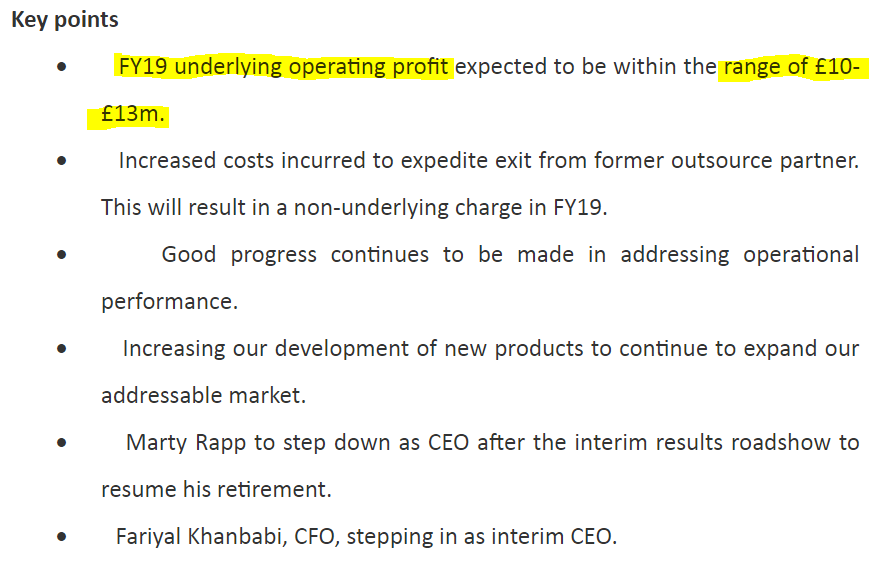
The key question then, is how does the £10-13m range for profit guidance in 2019 compare with previous guidance & broker forecasts? Since the share price is down 30% (a standard profit warning price movement), then I'm guessing it must be well below previous forecasts.
Unfortunately, I cannot find any recent broker research, so am in the dark here. Stockopedia shows a 2019 forecast for net (i.e. after tax) profit of £10.8m, before today's profit warning, which seems fairly close to the revised guidance given today, if we were to take off say 20% for tax, then £10-13m range before tax, becomes £8-10.4m profit after tax revised guidance. Compared with the £10.8m previous post-tax forecast, it doesn't look to be too bad a profit warning (although I'm working on incomplete information).
Balance sheet - I always carefully check the balance sheet of any company which has warned on profits, to see if there might be any solvency issues. We've recently seen how problems at Staffline (LON:STAF) crashed the share price down about 90% from its highs. This was because management stretched the balance sheet, took on too much debt, and hence had no room for manoeuvre when they ran into problems.
Why is it that so many companies make this simple & easily avoidable mistake? Maybe I should run seminars on the importance of a strong balance sheet, for listed company Directors, as so many seem unaware of the unnecessary risks they are taking, by taking on too much bank debt. This is more important than ever at the moment, when it looks like we could be nearing the end of the economic & stock market recovery, which are both very long in the tooth now (10 years).
Back to Dialight. Checking its last balance sheet as at 31 Dec 2018, it looks excellent, with only a small scrap of debt. Hence the downturn in performance reported today should not present any difficulties re solvency.
Although there was a very large build up of inventories last year, which consumed cash. Some work would be needed to ascertain why that happened, and what's being done to fix it, before considering buying any shares in Dialight.
High inventories sounds like an ongoing issue, this issue is mentioned today;
To facilitate our exit from Sanmina we have taken more inventory than we had previously anticipated which has impacted the group in three ways. Firstly, our current inventory levels are higher than expected. Secondly, we have incurred c£4m of additional costs relating to these items in the form of markup, freight and handling charges. These costs will be treated as non-underlying. Thirdly, we expect to have a small net debt position at year end to reflect these additional inventory and non-underlying costs.
Because the balance sheet is strong, the excess inventories don't present any solvency problem. Although I would like to know how the company plans to reduce these inventories in future. Also, excess inventories often require a provision to write-down the valuation, if they're obsolete or slow-moving. So there's an increased risk of another hit to profits from that, in future. Looking back at previous results statements, Dialight has a history of making large provisions against inventories - e.g. £4.7m in 2018 (10% of inventories), and £7.3m in 2017 (a whopping 30% of inventories).
Current trading & outlook - this is baked into the revised profit guidance of £10-13m;
We have seen a weakening in order intake in the second quarter. These trends may continue for the remainder of the year.
After a very strong year in 2018, our Signals & Components business has weakened due to market uncertainty and high levels of inventory in the distribution channel.
Given the potential impact on order intake, referred to above, we now expect our underlying operating profit for the year ending 31 December 2019 to be within the range of £10-£13m. This is before incurring c£4m of non-underlying costs.
The Board believes the Group is increasingly well positioned for FY20, with a stronger operational base, expanded product offering and a wider addressable market.
Again, that doesn't sound too bad to me. The risk is that conditions continue to deteriorate, and another profit warning might come along later this year.
It seems to me that generally, business conditions look to be worsening at the moment. Hence this is probably a time to be seeing the glass half empty, rather than half full (as I would in an economic recovery).
My opinion - this actually looks quite interesting, on a valuation basis.
It sounds like the considerable operational problems are being resolved gradually.
The downturn in current trading doesn't seem to bad, and leaves the group still solidly profitable.
I'm concerned about the excess inventories. Another concern is whether trading is likely to continue deteriorating? There was a sharp fall in UK construction PMI (confidence) data today, here. Actually, that may not be relevant to Dialight, as note 2 in last year's accounts shows that 73% of its sales were in N.America. Only 12% were in Europe, so forget that. It's the health of the US economy which matters most to Dialight, and that seems OK at the moment.
Overall, I think this one looks worthy of a closer look. Today might be an opportunity to pick up some shares in a fundamentally sound company, at a reasonable price, perhaps? Although it has been very accident-prone in the past, so maybe not? I can't make up my mind on this one!
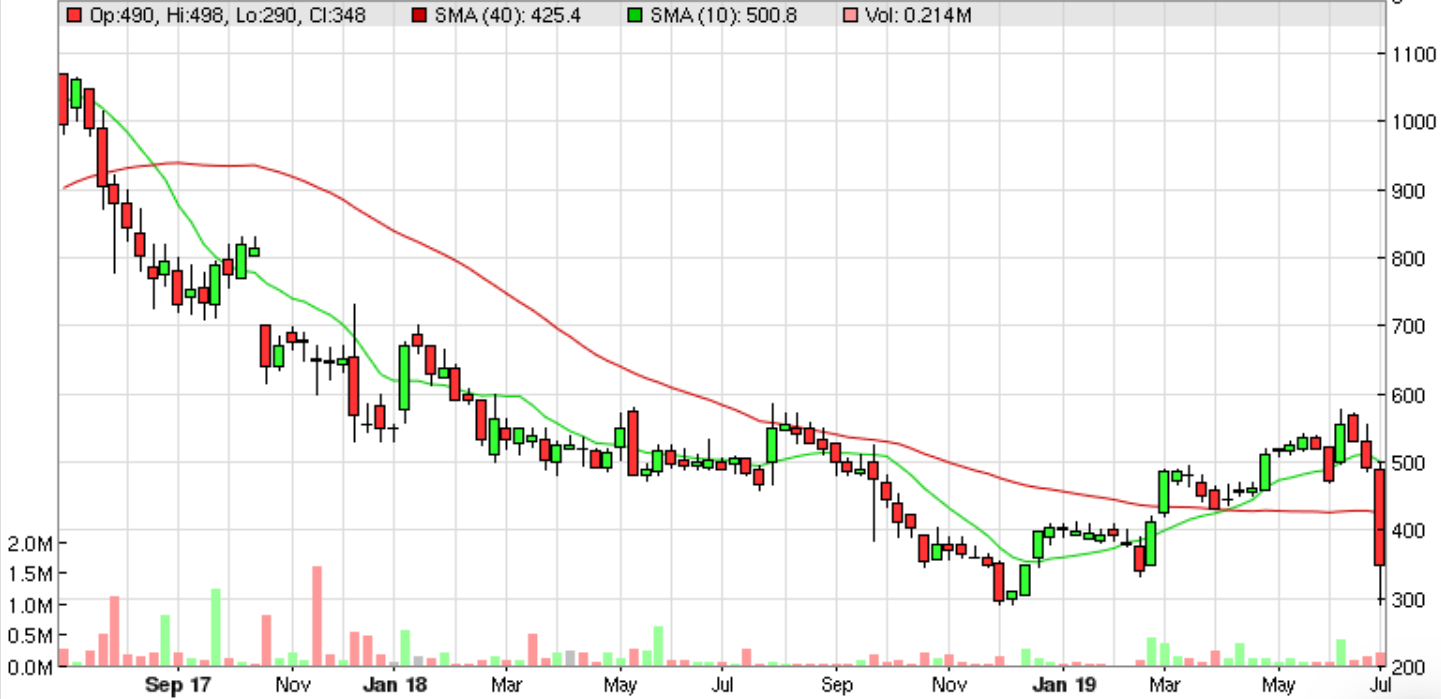
Looking at the chart, 300p seems to be a key support area;
Graham has kindly just emailed me this section;
H & T (LON:HAT)
Share price: 323p (+2%)
No. of shares: 39.7 million (after Placing)
Market cap: £128 million
(Please note that Graham has a long position in HAT)
Graham writes - Quite big news as H&T adds 65 stores to its estate for a cash consideration of £10.6 million. It's big news not just for shareholders of H&T but also for Money Shop employees, many of whom will hopefully be able to keep their jobs.
Money Shop has been shutting down and selling up after a period in which it suffered "an unprecedented number of customer complaints", with the result that trading was no longer viable. It was forced to pay out very large refunds to cheque cashing and payday loan customers.
Ramsdens Holdings (LON:RFX) has been buying Money Shop stores, too, but now H&T has entered the fray with a much larger deal.
Note that H&T does not offer "payday loans"; it offers unsecured personal loans which are paid back in monthly installments over a period of time. See the FAQ on its website. Most of H&T's personal lending does not qualify as "high-cost short-term credit", as defined by the FCA.
So we can expect that the acquired Money Shop stores will, in future, face a lower regulatory risk than they did historically. H&T says that Money Shop stores offer an "almost identical product offering" - pawnbroking, FX, cheque cashing and jewellery retail. But they do not currently offer unsecured lending. They stopped making new loans last year.
Details of the deal
In total, H&T needs £14.6 million for this deal: £10.6 million to buy the stores, and £4 million for working capital.
It is going to come up with these funds by borrowing £8.6 million, and has raised the remaining £6 million via a placing at 316p. The placing is at a discount of 0% to yesterday's closing price. Well done to everyone involved for doing a fair placing!
The share count increases by 5%, i.e. the dilution is very modest even though the total no. of stores has increased by over a third. H&T is also acquiring pawn pledge books from some of the closed Money Shop stores.
Rationale
H&T says it is a "rare and significant opportunity to acquire a complementary portfolio of stores". If I can quote myself for a moment, this is what i said last November when comparing H&T and Ramsdens:
H&T's store count, by contrast, is basically flat. I prefer the strategy of sweating its existing estate. That makes sense to me in a mature industry. H&T can always swoop in and buy up failed rivals whenever the sector goes through another rough patch.
While the sector as a whole is not doing badly, the collapse of Money Shop is indeed one of those unusual opportunities to pick up a failed rival.
Ramsdens has been buying Money Shop stores and opening new stores of its own, in a double-pronged growth strategy, while H&T's existing estate has been unchanged for years, until today.
The expected benefits of this large acquisition are plentiful, and in line with what you would expect. In simple terms, the H&T model and H&T's resources will be applied to what was previously a cash-strapped, less resourced and more limited customer offering. Money Shop stores should improve and be capable of much more, under H&T's ownership.
H&T forecasts a rapid deleveraging with Money Shop stores exceeding H&T's return of capital hurdle rate in the first year (I would like more detail on this point).
My view (Graham)
I'm leaning towards optimism about this deal, though I am anxious to see that the promises are fulfilled.
From a risk point of view, it's great news that just over half of the leases at the acquired stores will expire or be up for re-negotiation within 18 months. As has already been pointed out by others, this could generate an uplift in profitability, if any underperforming stores are closed and rents are reduced in line with market rates.
PBT at the acquired stores in the year to February 2019 was £2.6 million. If that was repeated, it would make for a strong return on the total investment of £14.6 million. This does not include the profits from the acquired pledge loans. I do expect that H&T's infrastructure, being best-in-class, will lead to big upgrades in customer service and product sets at Money Shop stores. Assuming that they are renamed as H&T stores, it will also mean that the brand becomes even more widely recognised across the regions in which it operates.
My primary concern is that there could be an element of cannibalisation versus H&T's existing estate, or needless competition versus Ramsdens. The CEO (who I trust) says that the acquired stores "fill geographical gaps in our UK coverage". It would be good to see this being clearly demonstrated.
Debt: at year-end 2018, H&T had spare capacity of just £10 million on its £35 million borrowing facilities. It is borrowing almost another £9 million for this deal. I do believe that it will succeed in deleveraging, but I can't stress enough how important this is! Its debt levels expanded in line with the growth of its lending activities, and now it needs to start generating some free cash flow to de-risk and be in a strong position to withstand any downturn in trading.
Update - we also get an update that trading is currently in line with expectations at H&T, year-to-date. That's fine.
Overall, I'm happy with this cheap-looking transaction and excited about the potential growth it may enable, while also cautious that the risk levels associated with this stock are currently higher than they have been in recent years.
(back to Paul now)
Funding Circle Holdings (LON:FCH)
Share price: 122.8p (down c.24% today, at 12:39)
No. shares: 347.8m
Market cap: £427.1m
Funding Circle Holdings plc ("Funding Circle" or the "Company"), the leading small and medium enterprise ("SME") loans platform in the UK, US, Germany and the Netherlands, is today providing an update to its Outlook for 2019, as well as H1 2019 financial results and updates to its statistics pages for the three months ending 30 June 2019 (the "Quarter").
Note that this company operates a lending platform - i.e. it acts as an intermediary, and does not take loans onto its own balance sheet.
A friend asked me to look at this share back in April 2019, when it had recently fallen from 400p to 320p. He was waiting for it to go back up to 400p, with a view to shorting it, and wanted my opinion.
After reviewing the figures, I quickly came to the view that FCH has a terrible business model, and is not a viable business. Its only saving grace was a cash pile on the balance sheet - although even that was being burned at an alarming rate. Although we live in strange times, where some tech investors are not concerned about cash burn or profitability. It reminds me very much of 1998-2000, where a similar gung-ho attitude towards risk prevailed. That didn't end well, and nor is the current euphoria likely to end well either, in my opinion. It very much feels like a late-stage bull market in some sectors, especially tech.
Trading update today, summarised by me;
- Revenue growth in H1 was 30%, expected to be 20% for FY - implying a sharp slowdown to c.10% in H2, assuming no seasonal weighting
- Segment adjusted EBITDA at breakeven, whatever that means?
- Adjusted EBITDA loss margin of 25%, which sounds awful
- Reduced demand for loans, and the company has tightened lending risk criteria - hence the slowdown in growth expected in H2
My opinion - when i reviewed the last results, it was clear that Funding Circle has got wildly excessive costs, plus it spends a large amount on marketing too. Hence the cost base is so high, it requires very considerable growth to get anywhere near breakeven, let alone profits.
Hence today's update that growth is slowing to a crawl, is a major problem.
FCH has enough cash for the time being, to continue operating as it is. However, at some point I imagine shareholders are likely to demand a change in strategy, including a radical reduction in costs & cash burn.
I'm kicking myself for not having shorted this share earlier this year.
As you can imagine, the conservative Stockopedia algorithms don't like it one bit, with a StockRank of 8, and "Sucker stock" classification.
Solid State (LON:SOLI)
Share price: 445p (down c.10% yesterday, at market close)
No. shares: 8.5m
Market cap: £37.8m
Solid State plc (AIM: SOLI), the AIM listed manufacturer of computing, power and communications products, and value added distributor of electronic components, is pleased to announce its Final Results for the year ended 31 March 2019.
Key points, which all strike me as positive;
- Adjusted profit before tax up 18% to £3.5m
- Adjusted diluted EPS 16% to 35.9p
- PER of 12.4 - which looks quite good value
- Revenue growth of 22% splits into 10% organic, and 12% from acquisitions
- Order book recently (31 May 2019) is £35.9m, up 56% on prior year. An acquisition (Pacer) contributed most of the increase, but organic growth was still 20%. Impressive.
So why the share price fall? Is there something untoward in the outlook comments?
Outlook - this all sounds positive to me.
Macroeconomic headwinds "continue to be a challenge", but everything else sounds upbeat. It concludes with;
Over the next three years of our five year plan, we will remain focused on securing quality orders as we drive to achieve our goal we set at the beginning of 2017 to double the size of the business through a combination of organic growth and strategic acquisitions.
The Board is confident that the achievements of the last year and the growth in our open order book demonstrate that Solid State is making good progress towards achieving its goals and that the prospects for the Group remain very positive.
Current trading - a slight glitch here, with Q1 (Apr - Jun 2019) has seen a softer than expected order intake. Despite this, the group is still on track to deliver in line with expectations results for 2019/20.
Balance sheet - looks fine to me. Positive NTAV, decent working capital position, and net debt of only £2.0m - I'm happy with this.
My opinion - this looks a good value share, with management seemingly executing well.
It's done 10 acquisitions to date, which usually puts me off, but in this case the balance sheet remains sound, and diversification spreads risk.
I'm not entirely sure why the share dropped 10% on these results, given that they produced EPS slightly ahead of forecast (35.9p vs 35.0p forecast). Maybe I've missed something?
Overall then, this looks quite a nice GARP (growth at reasonable price) share, in my view, although it's not a sector that particularly interests me.
Stockopedia - loves it, a StockRank of 97, and Super Stock classification.
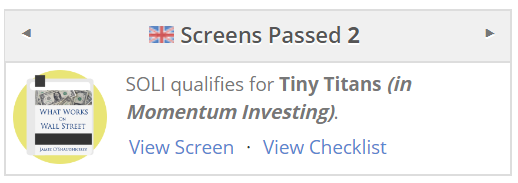
Also, note that this share qualifies for the "Tiny Titans" stock screen, which I've found to be historically a very good screen, picking up some excellent small caps. That screen has a very good long term track record too, so is worth checking.
IMImobile (LON:IMO)
Share price: 324p (unchanged yesterday)
No. shares: 66.9m
Market cap: £216.8m
IMImobile PLC (AIM:IMO), a cloud communications software and solutions provider, today announces its Unaudited Preliminary Results ("Preliminary Results") for the year ended 31 March 2019.
The headlines read well for this international group, e.g.
- Revenue up 28% to £142.7m, of which 17% is organic - impressive
- Adjusted profit after tax up 39% to £10.8m. Whenever PAT is quoted, I always check to see if there's been a favourable tax reduction! Only slightly in this case, as adjusted PBT is up 36% - so it looks like the company cherry-picked the better number for the highlights section
- Adjusted diluted EPS up 35% to 15.1p giving a PER of 21.5 - not cheap, but if growth continues apace, then it could soon grow into the valuation
Outlook comments sounds upbeat;
very exciting stage of development with technology developments creating momentum in the customer communications sector for more automation and use of digital channels. We are ideally placed to capitalise on this momentum and we believe there is no clear category leader in this market and that, due to our leading position in the advanced UK market, we have an opportunity to play a leading role globally.
The financial year has started well with trading in line with expectations. We continue to have good earnings visibility due to our established client relationships and healthy pipeline of new deployments and high proportion of recurring customer revenues.
We are confident in delivering continued organic growth across all parts of the business.
Lots of positives above. I think management has a lot of credibility here, having established a good track record. I've mentioned here in previous SCVRs, that I've met the CEO, Jay Patel, several times and been briefed on the business by him. Each time I came away highly impressed.
Other points;
Note the massive share based payment charge of £8.9m (versus £4.6m last year)
Balance sheet - not great, with negative NTAV - also receivables look extremely high, which would need looking into.
Cashflow - heavy capitalisation of intangibles (probably development spend) of £6.6m. Nearly £20m spent on acquisitions, part-funded by new bank loan. No divis paid.
My opinion - I like management, and the company. I'm less keen on the balance sheet & cashflow statement. So overall, probably not one for me, although it does look interesting in other ways, e.g. revenue & profit growth, sticky recurring revenues, etc.
Stockopedia's view is middling, with a StockRank of 53, but a positive "High Flyer" classification.
Malvern International (LON:MLVN)
Share price: 3.15p
No. shares: 258.6m
Market cap: £8.1m
(at the time of writing, I hold a long position in this share)
This is an education group, with operations in the UK & Far East. It operates language schools, accountancy training, and various similar activities. The story here is all about a turnaround under new management.
These 2018 results were issued in the nick of time, just before close of play on 28 June 2019. Any later, and the share would have been temporarily suspended. I see that as clearly unsatisfactory, and embarrassing for the company, highlighting gaps in the skill set of management. That's been addressed with the recent appointment of an experienced NED.
Apparently, the accounts had been prepared months earlier, but the various international auditors delayed things, and raised queries at the last minute. So the problem was more about the auditors not being well managed by the company, as opposed to the company itself being in a muddle with its figures, which it doesn't seem to be. Even so it's not good enough, and management realise that, so I don't expect this problem to recur, which is really all that matters. Mistakes happen, people have to learn how to do things at micro caps.
I'm philosophical about these things. At an £8m market cap company, you're going to get a few things going wrong from time to time. The more important thing for me, is that management seems focused on the turnaround. The attraction of which is the operational gearing.
To save me time explaining the business model, this video from our friends Tamzin & Tim at PIWorld is a useful introduction to Malvern (filmed at Mello London, in May 2019).
Outlook - sounds positive to me. Although the implication seems to be that the company was ahead of budget up to end April, and then slowed down to be just in line with expectations now. It's not the most clear wording, and could have been better explained, I think. Note the 2nd half weighting is normal, due to summer schools falling into H2;
"Trading in the current financial year has started satisfactorily and is in line with the Board's expectations for the year as a whole.
Trading up to the end of April was ahead of budget. Sales to the end of April plus sales booked for delivery in the remainder of the year stood at £6.9 million (2018: £3.9 million). As in 2018, trading in 2019 as a whole will be second half weighted as revenue in the second half will benefit from summer enrolments in London and Singapore, enrolment of the universities in the second half, and chartered accountants' courses in more demand through the second half of the year in Singapore."
My opinion - there's not really any point in me delving into the 2018 figures, as it was a turnaround year, with restructuring costs, etc.
The interesting numbers should be in 2019, with new contract wins, better focused sales, and restructuring largely done.
I bought at 4p in a placing some time ago, and see this as a 2-3 year turnaround. The current year is forecast to produce £1.1m adjusted profit before tax. If that's achieved, then the share could re-rate upwards, being seen as a successful turnaround.
There have been a few bumps in the road so far, so I'm probably about 50% confident in this share.
That's it for today. Sorry the last 3 sections were late. I've duplicated them in the next day's report, so that everyone sees them.
Best wishes, Paul.
Disclaimer
This is not financial advice. Our content is intended to be used and must be used for information and education purposes only. Please read our disclaimer and terms and conditions to understand our obligations.

41 comments
Re Dialight (https://www.stockopedia.com/share-prices/dialight-LON:DIA/ ) I did some work for a major UK construction company a few years ago and they were using LED lighting buildings and motorways. This is a growing market and Dialight should have been a good bet to capture that demand. But my share value has dropped to 25% since buying them in 2017.
Looking at employee comments on Glassdoor.com, it's clear the supply chain issues are hampering the business - no one would order for a major construction project if they were not assured of suppliers meeting delivery dates, quantities and quality. Looking at the current board (http://www.ir.dialight.com/about-us/board/) none of them appear to have an engineering qualification so how well do they understand their business?
A simple solution for the delay in loading results would be for Reuters to recruit a few more staff. Seems remarkably penny pinching of them to put a few quid above providing a tolerably reasonable service to all the companies that use its data.
Further to above, I've had confirmation that the only way to check on whether a stock report has been updated with the latest results is to trawl through the accounts section manually to check.
Roll on the new site/features! Until then need to be wary of Stock Ranks/metrics data for recently reporting stocks and check which data set is being used as momentum rank/RS and the like will be updated immediately with post result price movement while Q and V will be lagging.
Thinking about it, I wonder if this is impacting the observed performance of high QV low M stocks, especially when screened during busy reporting periods.
Re. Solid State (LON:SOLI)
I thought the results today were excellent and I am minded to top up. Some notes:
The Negatives
On a similar note, the actual overall order book is up significantly.
The Positives
Why the company didn't focus on this and sell themselves more, I have no idea as it took quite a bit of back-reading to work that out and they could have, and should have, highlighted it.
Operating cash flow before working capital movements was £4.7m.
Capex over the last couple of years was £0.6m per year.
Comparing those figures to a company with a market cap of around £40m and reasonable growth + growing gross margins makes it look cheap to me.
Thoughts from any other holders appreciated.
A
Funding Circle Holdings (LON:FCH) - yet ANOTHER recent dud IPO with shockingly awful performance! I think one really does have to wonder about the notice for many IPOs...
If its any consolation,Paul,Funding Circle is very hard to short !
Funding Circle Holdings (LON:FCH)
Invariably the cycle tends to reveal rapid scaling in either new forms of lending or new financial institutions 'taking business' off of established players just to be vehicles that don't price risk very well. Put the two together and you have double jeopardy. High 'organic' growth from low base in loans is very unlikely to be good. Even if initial intentions are good the conflict of interest between growth and credit assessment is acute and the latter will always lose out (there's no hot hands movers and shakers in the latter...and you'll never punt an equity issuance putting your risk team and its rejection rate in front of moonbeam chasing investors)
I haven't looked at funding circle or any crowd funders sorts as its obviously a bad idea akin to originators of mortgages up to the 2008 crisis who securitised and passed on those mortgages. Those were 'efficient platform' operations too...very good at growth. After all, there's a lot of people take a loan if you're offering it particularly a 'competitive' rate.
If Funding Circle is finding that its having notifiable credit deterioration today (and not just pushing up bad debt allowances) then this suggests that the lending standards were very weak. The schtick that they were competing against the slow and old banks more efficiently and effectively can be seen to be just that the banks had some credit standards.
Hi Graham,
Re H & T (LON:HAT), do you have any knowledge on the impact of the gold price on profits, this quote from the board was from 5 years ago but I don’t know current figures, but likely that cash & profit will be positively affected & give more opportunity for deleveraging:
The Board estimates that a 10% movement in the gold price will impact profit before tax by approximately £2m"
As a lender at Funding Circle , I grew very suspicious at the very high loan default rate. I would also question the figures from the HY report out today: 'investor returns on a net basis are expected to deliver 4.4-8.4% in 2018 and 5.0-8.5% in 2019.'
My investment has actually made a loss over the last 2 years due to the high default rate - so I'm very curious to know how there are deriving those expected return figures.
The other big red flag for me is the large delays in processing withdrawal requests. It took a couple of months to withdraw the bulk of my funds, and I'm still waiting for the remaining 25%.
I am also kicking myself that I didn't short back in March when I realised all of this!
That headline figure I am sure also includes projected recoveries for Funding Circle Holdings (LON:FCH), which gives rise to such a wide range.
The loan withdrawal times are a relatively recent thing. At the start of this year, cashing out was instant. Now, we are up to around 60 days to get your money out.
I do wonder if worse is to come. 4.5% headline figure is not worth the risk considering that figure may only be accurate once recoveries kick in, so investors may wise up that this is not worth an investment. What then? The trading update mentions institutional funds but considering they are writing £1bn+ a year that isn't enough.
I think the interest rate would have to be bigger to entice more big instis. For instance, a lot of bonds are paying more than Funding Circle, ie Thames Water 5.875%. A basket of these might give a better return for less risk.
Their staff costs seem extremely high. 1,000 employees = £79k a year average, a big bulk of them must be in loans administration or sales. There must be some people there on some serious money, and undeserved at the moment, should be aligned with the business.
With the macro picture looking like it might get worse, I do think it'll be a case of the Emperors New Clothes. Banks could pick off their best clients, and send them the worst ones.
I am also kicking myself that I didn't short back in March when I realised all of this!
I tried around this time also but there was no borrow available with my provider i.e. I could not short Funding Circle Holdings (LON:FCH).
Regards,
Asagi (no position)
Hi there - I may as well step in (if you don't know me - I'm the founder here). You do raise some very good priority points and it's important that I chat this through with you.
Firstly - Thomson Reuters (upon whom we depend for fundamentals) do slow down in their reporting of complete, validated fundamentals as the volume of stocks reporting increases - this gets worse in heavily congested reporting periods. There are more likely to be delays in small caps as large caps are prioritised. We currently publish as soon as we get complette fundamentals - so we're dependent on the upstream provider.
On the other hand - Thomson Reuters do provide automated snapshot reports that are scanned from results asap - usually within 24 hours. Unfortunately, these have a tendency to be very incomplete and inconsistent across the market. We've tried in the past to incorporate these, and to provide snapshot fundamentals as a result, but the quality was poor and we were under-resourced to create a good solution.
But our ambition is growing here, as is our team, and for the last 20 months, we've been working on a massive data project to facilitate a lot more timeliness, breadth and depth across all our data.
Here's some areas I'm looking to improve re. timeliness:
Rome wasn't built in a day... so I hope you can be patient while we improve this. As mentioned - it's been a 20 month project, and will need more time.
Some crowd sourcing may help with the data. I suggest a bounty (probably free days) for error reports that meet certain quality standards (including correctness and a source for the correct info). It may also help to let people vote individual figures as correct or suspect. Really Reuters should be giving you a discount each time you point out errors in their data too...
Hi Ed
Thank you for replying re the data delays in Stockopedia and your efforts to improve matters.
As well as the point I made in post 2 of this thread, I must say I strongly agree with the points raised by Julianh re the normalising of results, so that results and forecasts generated in completely different ways are presented on the same row of Stock reports in a way that (seemingly) facilitates analysis whilst in actual fact being highly misleading and leading to numbers such as PEG being incorrectly calculated.
For consensus broker forecasts to be useful we really need historic results to both be generated as is currently the case and ALSO to be generated in the same adjusted way as the forecasts. In that way, like for like comparisons are possible.
As it is, I often reject investing in companies purely because after investigating I become aware that the numbers on Stockreports are highly misleading. Of course, this does mean I tend to reject investing in companies where confusing adjustments are the order of the day which may be a good thing.
Unfortunately this stuff is not simple.
Best Regards, Martin
There is good news on the accounting basis for earnings. We’ve recently moved to IBES estimates as our primary source to resolve the discrepancy between historic and forecast eps for high amortisation companies. It’s in the pipeline as an improvement for the new app - we’re waiting for our new data pipeline to come online to fully resolve this / which may be several months. At that point it will be reflected on stock reports. There’s a small chance we’ll get it done earlier.
Ed
As usual glad that you seem to be on the ball ( yes i’m watching the Lionesses as I write) with your forward thinking / planning of the Stocko subscribers experience
Looking forward to seeing the reality of your ideas
Hi Ed
"There is good news on the accounting basis for earnings. We’ve recently moved to IBES estimates as our primary source to resolve the discrepancy between historic and forecast eps for high amortisation companies. It’s in the pipeline as an improvement for the new app - we’re waiting for our new data pipeline to come online to fully resolve this / which may be several months. At that point it will be reflected on stock reports. There’s a small chance we’ll get it done earlier."
Excellent, thank you.
Best Regards, Martin
Trackwise Designs (LON:TWD) now published, and updated on the Mello company presentations page - where there are 21 companies who appeared at Mello:
https://www.stockopedia.com/content/company-presentations-from-mello-may-2019-mello-trusts-and-funds-video-480006/
TWD look to be in an interesting market.
I'd be interested in your views on Funding Circle Holdings (LON:FCH) - also Solid State (LON:SOLI)
Funding Circle Holdings (LON:FCH) is newsworthy and not been covered on here before. IPO'd and crashed due to a lack of growth.
Sadly, I think it is a busted flush, and as a (former) lender on that platform the due diligence is absolutely terrible.
Their business model I think is wide open to disruption. I can definitely see fintech providing small business with 'social' business loans, and I don't think genuine borrowers would mind that as these people may be customers.
Innovaderma (LON:IDP) somewhat obscure but trading update today looks pretty good and shares appear cheap.
cash has improved to £1.7m, profit has doubled from a year ago and trading is very strong. Impact from the massive increase in retail outlets Boots has only really had 3 months contribution too so feels like lots more to come.
Extrapolating todays results out we are (after the 7p rise) sitting on circa 12% of market cap in cash with no debt and a PE of sub 10 with strong forward growth predicted......hmm feels on the low side and somewhat overlooked.
Innovaderma (LON:IDP)
Graham covered it last time. After poor first half results (rev £3.9m) attributed to difficulties with dtc sales and facebook the second half seems very promising (rev £9.1m) although the company is second half weighted. Full results of rev £13m (up 21% from fy18) and profit before tax doubling (fy18 0.67m). Improved gross margin and cash position should help dispel any suggestion of a cash raise. New products going well at boots. Has it turned a corner? Disappointment seemed baked in to the share price.
Good morning Paul,
It would be great to get your views on Malvern International (LON:MLVN) results from last Friday if you can fit them in.
cheers
Francis
Might be slightly too big, but Plus500 (LON:PLUS) announced half-year update. Not another bloodbath, and some good signs.
Level of client spreads and charges is bigger than revenues, I infer the difference to be profit on client positions (a loss for them as they are taking the other side of the trade).
Surprising no comment from them on cryptocurrencies, something that has performed very well for them in the past and has seen a renewed interest in the quarter and most likely this one. ESMA perhaps taking most of the speculators out?
Not really any clearer on whether they are completely trustwortthy but I would expect IG/CMC to benefit today.
On the slow update of the data following results, does anyone know if there is a way to screen/identify this without having to check each company individually?
If not, do people think a "not updated" screenable flag would be a useful feature? If the Reuters speed issue is relatively intractable personally I think it would be incredibly helpful for Stockopedia to identify this for its users, especially given that the metrics led Stock Ranks are one of biggest features and used by many in decision making.
dmjram
"On the slow update of the data following results, does anyone know if there is a way to screen/identify this without having to check each company individually?
If not, do people think a "not updated" screenable flag would be a useful feature? If the Reuters speed issue is relatively intractable personally I think it would be incredibly helpful for Stockopedia to identify this for its users, especially given that the metrics led Stock Ranks are one of biggest features and used by many in decision making."
Two new data fields would seem sensible to me:
- A binary latest results not yet loaded flag, set to 1 if results have not been loaded (say) two business days after the results were announced
- For companies where the first flag is set to 1, a count in business days of the delay to date in entering results
Obviously, the first of the above is somewhat redundant if we have the second one.
I look forward to the meeting where Stockopedia ask Reuters to provide the above data and explain to them that Stockopedia users want them to partially address Reuters deficiencies.
Cheers, Martin
I don't think it even needs Reuters input, all doable internally by Stockopedia.
e.g,
Company announces results.
Stockopedia set flag/zero counter identifying new data isn't loaded.
Stockpedia increments counter at midnight each day
Stockopedia clear flag/counter when new Reuters data is loaded.
You could easily automate this by just comparing the latest results date with the last data update.
Failing that, just giving the date when the data was last updated would be a great improvement.
I'll ask formally via the query button and will report back with the response.
Please can you comment on Solid State (LON:SOLI) results? They look pretty good, with revenue up 22%, profit up 18-19%, and adjusted diluted eps +16%. The outlook is very promising, with the order book up 56% (20% increase like-for-like excluding Pacer acquisition)... though share price has collapsed (at least temporarily) 10%, presumably on soft-Q1 order intake comments.
Although it's disappointing for private investors not to take part in the £HAT placing it's reassuring that it was achieved at a price close to the current share price.
My morning smallcap tweet: Dialight suffers low visibility again
BigDish (LON:DISH), CAP XX (LON:CPX), Funding Circle Holdings (LON:FCH), Associated British Engineering (LON:ASBE), Argo Blockchain (LON:ARB), Dialight (LON:DIA), Fastjet (LON:FJET)
BigDish (DISH) shuffles board: founder moves frm exec chmn to Executive Director. Hires Brand Ambassadors, the only ambassador title that dimishes your status.
CAP-XX (CPX) wins patent action against Cornell-Dubilier, the large US capacitor mfr. Cornell-Dubilier will pay licence fees.
Funding Circle (FCH) warns FY rev growth 20% vs 40% previous guidance but improved adj EBITDA loss margin YoY - though some or all of that is due to IFRS 16. "The uncertain economic environment has reduced demand from small businesses and led us to proactively tighten lending criteria."
Associated British Engineering (ASBE) considering all options for operating subsidiary BPE, including a possible sale of BPE or its business due to inability to pay pension deficit recovery payments.
Argo Blockchain (ARB) now coining it after jump in Bitcoin. Guides June generation £1.38m of cryptoassets, double May's.
Dialight (DIA) warns of weak H1. Guides FY U/L op profit £10-£13m. Blames market uncertainty and high levels of inventory in the distribution channel. Also: Increased costs incurred to exit from former outsource partner. CEO steps down to resume his retirement. Outlook: "The Board believes the Group is increasingly well positioned for FY20." Huh?
Fastjet (FJET) CEO resigns, leaves Sept. He is thanked.
I think Dialight (LON:DIA) have looked weak for a considerable time... and this is no surprise.
The Fastjet (LON:FJET) CEO is thanked? For what, exactly?? Completely eroding shareholder value? Thankfully I was sensible enough to sell years ago before things got completely dire... but stupid enough to buy in the first place I suppose :-/
You may wish to comment on the Avast (LON:AVST) RNS this morning. The CEO waiving his salary and donating his director's fee to charity. No doubt his equity options will compensate but still a worthy gesture. At the very least it will attract commentary that could stimulate a debate leading to similar gestures?
Completely irrelevant in terms of today's news, after more than three weeks, Stockopedia is finally showing the 2018 results for Mountfield (LON:MOGP). Stock ranking up from 60 to 83.
Whatever service agreement Stockopedia has with Reuters, it certainly does not require them to be anything other than tardy in terms of small Mkt Cap companies.Given much of Stockopedia's usefulness derives from the metrics it provides, this is rather disappointing.
Whatever service agreement Stockopedia has with Reuters, it certainly does not require them to be anything other than tardy in terms of small Mkt Cap companies.Given much of Stockopedia's usefulness derives from the metrics it provides, this is rather disappointing.
I agree. It's something I've complained about a few times. Apart from anything else, these delays in updating SR's after results announcements invalidate the output of any filters using the data - one of the key features of Stockopedia. So I share your frustration.
Having specifically complained about it taking 4 weeks to update the SR for Bloomsbury Publishing (LON:BMY) after results, I am not convinced the delay is entirely down to Reuters...
All the best, Si
I also agree. And whilst I do feel a little bad for mentioning it here, I think it is time Stockopedia improved this critical part of their offering.
Hi Bryan’s,
And whilst I do feel a little bad for mentioning it here, I think it is time Stockopedia improved this critical part of their offering.
Dont feel bad, I didn’t realise there were such delays, this is a paid for service and stockopedia needs to address this, at least flag the pending update as posters have suggested. I think this is extremely poor as I have to figure out if the data is current or out of date. Quite unacceptable really.
Apologies for a long post. This topic is (unfortunately) complicated
I agree completely with Shanklin and Si
I love Stockopedia and would not consider investing without the Stock Report by my side. But the guru screens, ranks and filters are a major part of Stocko's value. And out of date results can mean that these filters give seriously misleading results.
It is possible that one of the reasons for the slow update of small cap data is that (if I understand it right) Reuters normalise the results provided by companies, adjusting for exceptional and one off events. This normalising process should (at least in theory) be better than the 'adjusted' figures provided by many companies that often try to show their results in the most favourable light. If this is a manual process then we would expect it to take time.
However, this normalising process also creates another data problem that can also seriously impact Stock Ranks, guru screens and all the Stockopedia filters and forecasts:
* actual results (in these filters) are based on the reported accounts as normalised by Reuters
* forecasts are based on the figures provided by analysts who
- make their own assessments (often guided by management) of expected future results
- adjust these assessments to create their own versions of the 'underlying' position.
- the adjustment bases used by the analysts can at times be very different from those used by Reuters
The result of all this is that forecasts (e.g most obviously forecast eps) are often calculated on a very different basis to normalised actual eps.
E.g. I did some research on a small cap that was showing (on the stock report) expected eps growth of >50%. When I got to the analysts reports (on Research Tree) I found that the analysts were forecasting eps growth of 8%. The difference was purely in the different reporting bases used. That could have been a very bad investment. Instead it was a few hours wasted time. But unless we have access to the analysts reports private investors don't have the data to check up on these problems. And conclusions based on
* out of date results
* different reporting bases for actuals and forecasts
can result in poor investment decisions.
I have asked the Stocko boffins to look in to this several times over the last few years but with, as far as I know, no resolution to the problem.
As I say, I would not be without Stockopedia but surely they could spend a bit less time creating new and exciting information summaries and a bit more time on ensuring that the data used in calculating these summaries is accurate enough to allow us to use them with confidence.
Re: tardy updates. This is nothing to do with Reuters. It is Stocko's fault. I have talked to them about this in the past and been told that Stocko prioritise large cap updates, so small caps take time (a lot of time). The data is there, they just don't update it.
I have seen many data accuracy issues with Reuters, but this isn't one of them.
Would be great if either Paul or (perhaps more likely given his interest in it) Graham could comment on the late announcement yesterday from H&T H & T (LON:HAT). The trading update part of the announcement is a solid 'in line', but the acquisition is the big news - it's quite a large one - 65 stores.
An acquisition of this number of additional stores is a big leap for them. Over-expansion in this industry in the past has led to competition between operators and a blood bath (remember Albemarle & Bond...?) so this initially made me nervous, but on looking at the sites, it appears there is little to no overlap between the Money Shop sites with H&T and Ramsdens which is nice to see. Also interesting that H&T are not buying all of the Money Shop stores and quite a number are to be closed down entirely - this is great news as essentially the customers from those stores are now up for grabs to potentially increase market size for H&T for its acquired stores.
H&T look like they've negotiated themselves a very good price too - paying less than £10m for trading stores creating annual PBT of £2.6m looks like a very astute piece of business buying from a distressed seller. On top of that they've also acquired pledge books of £1.6m growing their book nicely and opening up potential to cross sell other H&T services to those pledge book customers too.
My main reservation was the debt. They have (sensibly) opted to fund some of this from equity, but that still leaves an additional debt load to be added to the balance sheet of about £8.6m. Net Debt as at the last reckoning was just over £13m, so if cash accrual were neutral this year (this is v.conservative - last year they added nearly £3m in additional spare cash, but we don't know how much of this they've already allocated for this year to the new store costs in order to arrive at their required new equity of 6m figure, so let's look at worst case that all of that will be used up for the current year) - we'd then be looking at Net Debt of around £22m after the acquisition. Profits and revenue will also be up of course and it's a comfort that H&T say they expect fast integration and for the acquired sites to be earnings enhancing in the first year. If we say that the 2.6m profit from new stores were to be repeated this coming year (but, again conservatively, that there is no growth) then H&T's overall PBT figure jumps to £16.1m (simplifying it by ignoring part-year performance of course) giving us an after-tax figure of around 13m. Now, let's say they get the placing done at say 300p (a bit of a discount) raising 6m would add 2m shares giving a total of 39m shares in issue - that works out to be EPS of 33.3p - a very nice jump from last year. Assuming cash conversion is in line with the rest of H&T's operations, this ought to give them a good amount of extra firepower to reduce the debt load quite quickly in the next couple of years. We could easily see that net debt figure down to £14m or less in 2 years which then looks very comfortable. Indeed, I was very glad to see more that one reference in the announcement that H&T are aiming for "cash generation of the enlarged group deliver[ing] rapid deleveraging".
This makes me feel much better. I bought into this as a conservatively managed business with no grand plans and a 'steady as she goes' outlook. I would not want this to change substantially nor for risk and leverage to be cranked up too much in these uncertain times. It seems there is no danger of that - H&T say in the announcement that "H&T expects to integrate the Assets quickly into its business model to accelerate its growth trajectory. After which, H&T's conservative expansionary capex for estate growth and development is expected continue". So it looks as though this was an opportunistic acquisition of the 'unexpected, but too good to turn down' kind rather than a change in growth strategy.
Overall I am very happy with this and think it looks to be a clever piece of business, assuming they manage to get the placing away at a decent price. With H&T acting as a hedge in times of turmoil (it's business being largely unaffected (if not improved!) by problems in the wider economy, and its strong correlation to the gold price (which has been on a surge of late and should only add to their profitability) - they look to have timed this well too. I continue to be happy holder and look forward to years of steady returns ahead once the enlarged store portfolio is integrated and with the enhanced revenue and profit that this ought to bring.
There - I've stuck my neck out with my two pennies' worth. Let's see what the market makes of it today... (probably the opposite to me, as usual!). All depends if people decide to focus more on the share dilution from the placing (which is only about 5 or 6% if it goes for 300p) or the enhancements to be gained from the acquired assets. To me the earnings jump, additional customers, new (non-competing) territories, added pledge book and cross selling opportunities, combined with the very modest multiple paid for all this makes it a clear positive that I'd have been happy for them to have paid even a bit more for (but very glad they didn't have to).
BIACS
post script: I just remembered - more than half of the acquired stores (34 to be exact) only have 18 months or less left on the lease - this generates a huge opportunity to increase profits still further by rent renegotiation given that commercial rents have been plummeting of late. More to smile about.
UPDATE on H & T (LON:HAT) : RNS this morning subsequent to my post above confirms placing successful at a price of 316p per share. This is better than my conservative calculations as this is a zero discount - nice to see.
BIACS,
I agree this was a great (if not unexpected) buy by H & T (LON:HAT) of Money Shop assets. However, on a debt/risk basis, I do not see their gross debt de-leveraging occurring.
In their existing stores, H&T have been quite aggressively adding personal loans to their business model of late. It is too soon to see whether their experience in sub-prime lending in pawn has given them the skills and systems in unsecured cash lending to support this. If they expand this in the new shops, then the debt book will rise rapidly (albeit creating debt "assets") which will suffer from high impairment. You need a view on that - I think they will do OK but it is riskier than their old pawn business..
(Relatedly, FWIW this is another blow for my (formerly biggest !!) holding Non-Standard Finance (LON:NSF) whose Everyday Loans was prized (by me!) as the only national player for branch based face-2-face granted mid term, mid-priced, mid-sized loans (eg APR>50%, term >1yr, value over £1000). H & T (LON:HAT) will now have many more stores in that space and a better known brand with a chance to become a national leader. Great for them. Not for me.
In last 3 months, Non-Standard Finance (LON:NSF) shareprice has nearly halved having been hit by shocks arising from i) failure to complete takeover of Provident Financial (LON:PFG) with costs of +/-£10Mn ii) disclosure PFG are going to a hybrid unsecured loan product at EDL area iii) nasty words from FCA about the guarantor lending sector (where they are clear no 2 to Amigo) that was formerly seen as regulator friendly (due to lower int rates than standalone lending to risky individuals) iv) further signs cash is going to largely disappear (eg facebook's Libra) affecting Loans@Home home credit (no 3 to Provident/Morses) plus of course v) risk of 'no deal' turbulence.
Non-Standard Finance (LON:NSF) Price to Book is now around 0.54 (PTB 2.00) for businesses still showing rapid organic growth and operational leverage to move into strong underlying profit. Loss is in for me but great risk/reward for new buyers I think at +/- 35p, albeit with high risk of going bust or more likely a balance sheet strengthening placing or opportunistic takeover (by Provident Financial (LON:PFG) ?).
I certainly intend to hold Non-Standard Finance (LON:NSF) and am considering an inadvisable super-high conviction all-in bet by buying more Non-Standard Finance (LON:NSF) despite the portfolio risk !!. )
Hi Zipmanpeter - fair enough to point out the distinction between the bank debt and their own loan book - though I had taken a view that anyone interested in H & T (LON:HAT) would already have got comfortable with that aspect of their business given that the loan book (even prior to the acquisition) is in excess of £20m and a sizeable (and growing) part of their business. Clearly anyone not happy with the loans business (and the resulting effect on the company's accounts and reported balance sheet debt) would not want to get involved here. I view this as very different from their bank debt for obvious reasons and was excluding it from my assessment of what I consider a reasonable debt position on that basis - but perhaps I should have been more specific in my terminology and you're right that the figures given excluded any potential growth in their loan book (which will almost certainly increase from last year). In terms of whether this is good or bad - So far they are managing the loan book side of the business very well and the reason they are growing it so rapidly is that it is proving rather profitable and thusfar bad debts are being well-controlled. Best of luck with NSF and I hope this turns a corner for you.