Many years ago we opened a 332-page bank prospectus that nobody wanted to read. The TSB float of June 2014 was unloved, unfashionable and - once you did the sums - really rather cheap. The shares popped up 11% on day one and the company was bought out at a 27% premium within nine months. I’d been an IPO skeptic for some time, but in this case, the crowd's lack of enthusiasm was quite a reliable contrarian guide to profits.
This week we've been reading a more popular dossier. SpaceX filed its S1 for its IPO on 20th May, and today it lists on Nasdaq under the ticker SPCX at a fixed $135 a share. That’s roughly a $1.75 trillion valuation, the largest IPO in history.
Where TSB was the IPO nobody wanted, SpaceX is the one everybody wants. The deal is apparently over two times subscribed, with demand double its $75 billion fresh capital raise.
Up to 30% of the offer is going to retail investors - which is multiples of the normal allocation and just shows the demand that the fame of Elon Musk brings. My own son came back from a post-university trip reporting that all his friends have an investment thesis to pile into the “SpaceX, Anthropic and OpenAI” IPOs "because they will all rocket." That, for what it's worth, is about as pure a sentiment signal as we’ll ever get.
So let me do with SpaceX what we did with TSB - open the prospectus, run the numbers, and let our ranking framework do the talking.
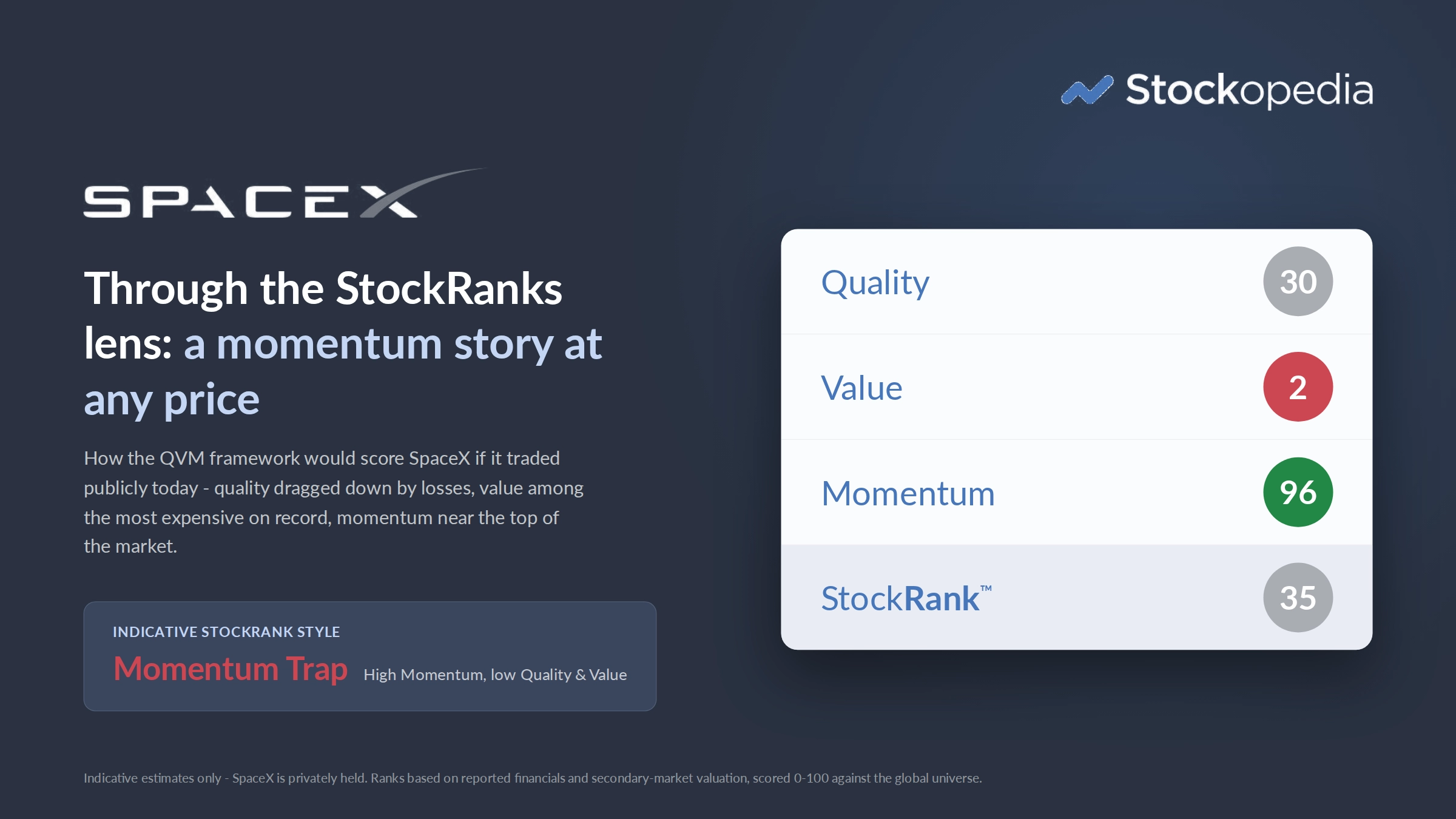
We might as well start with the punch. I'm afraid, it's predictable news. By our StockRanks methodology, SpaceX looks like a textbook Momentum Trap.
SpaceX is a genuinely great company
I want to be fair here. SpaceX is, plausibly, the finest engineering company of its generation. The published numbers on the operating business are really rather impressive.
Starlink - its Connectivity segment - booked over $11 billion in revenue in 2025, up 50% year on year, with operating income of nearly $4.5bn growing 120%. That's a seriously profitable, fast-growing business with more than 10 million subscribers and a 63% EBITDA margin.
Its Space (rockets/launch) business is a near-monopoly: more than 80% of all global mass to orbit since 2023, a more than 99% Falcon mission success rate, and roughly 9,600…