Stock in Focus 2015 review: Did I beat the market?

Since I started writing the Stock in Focus column in May 2015, I’ve covered 31 different stocks. These selections were not buy or sell tips and were not intended to form a portfolio. But if they were, would I have beaten the market?
I’ll reveal the answer in a moment, after I’ve taken a look at the lessons from this year’s big winners and losers.
Stanley Gibbons: -66%
In my original article, I suggested that shares in stamp and collectible dealer Stanley Gibbons were overvalued and heading for a fall.
Roaring cash consumption, rising debt and falling sales all played their part in proving me right. A profit warning on October 6 was followed by a dire set of interim results.
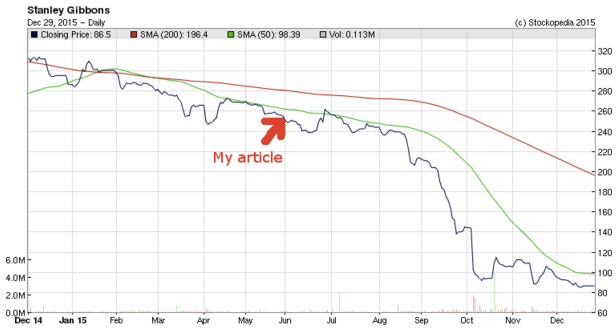
The stock now trades at its tangible book value and could be a value buy. However, I have concerns about how effectively Stanley Gibbons will be able to convert its stock into cash.
TalkTalk: -29%
My second-biggest success of 2015 was also a stock on which I had a bearish view.
At the start of August, I commented on the sudden change of tone in the TalkTalk’s trading statements. I questioned the firm’s rising debt, demanding valuation and falling profit margins and suggested this stock might be a falling star.
Earnings forecasts have since been slashed and I still think a dividend cut is likely. TalkTalk’s StockRank has fallen from 33 at the time of my article to just 11. In my view, this remains one to avoid.
Plus500: +22%
After Playtech’s attempt to acquire Plus500 was abandoned in November, I noted how cheap the stock looked relative to free cash flow and earnings. I put forward the view that Plus500 shares might deliver a useful profit.
Plus500 stock has since risen by 22% in just over one month and now trades above Playtech’s offer at 428p. Plus500 still has a StockRank of 90 and looks reasonably cheap. However, this is an AIM-listed Israeli stock with considerable regulatory risk. Personally, I’d tread carefully from here.
Costain: +18%
My very first Stock in Focus selection has turned out to be one of the most successful. Is that because it’s had the longest to deliver?
Perhaps, but engineering services provider Costain has been delivering steady returns since 2012.
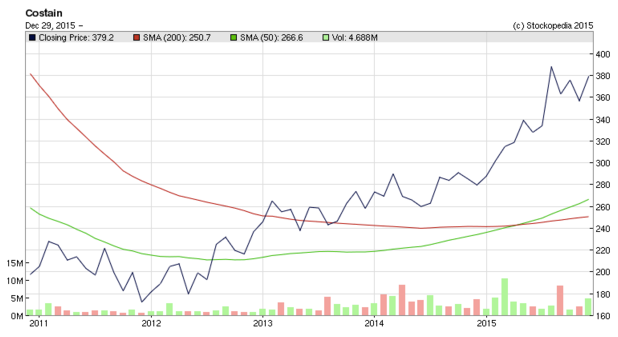
When I wrote about Costain originally, its StockRank was 99. Today’s it’s 96 but the firm’s attractions appear unchanged: net cash, a reasonable yield, and steady earnings growth. This is a stock I would still be happy to buy and own.
Runners up
Honourable mentions should also go to the following companies, all of which delivered gains of 10% or more after I wrote about them:
- Imperial Tobacco: +16%
- Inmarsat: +14%
- SkyePharma: +14%
- NWF: +13%
- Shoe Zone: +13%
- Computacenter: +12%
What about the losers?
My two big mistakes were to form a positive view of DX (Group) and to massively underestimate the scale of the commodity downturn. These accounted for the vast majority of my notional losses.
DX (Group): -78%
A blanket policy of avoiding recent IPOs would have enabled me to avoid this year’s biggest loser.
DX shares collapsed in November, after the group issued a profit warning and slashed the dividend by 58%. Unusually, the shares have failed to bounce back at all.
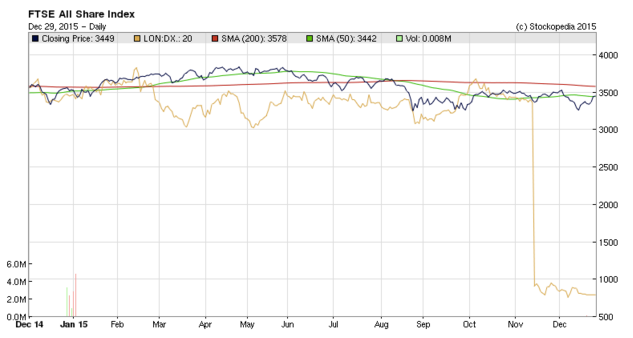
DX versus the FTSE All-Share -- diversification is important.
DX now trades on 4 times forecast earnings, despite a c.60% cut in forecast earnings per share. This rating, plus a 12% prospective yield, means DX shares are either a value trap or a spectacular contrarian opportunity...
Lamprell -38%
Dubai-based oil rig builder Lamprell boasts recently refurbished dockyard facilities and a hefty net cash pile. At the end of June, net cash was about 65p per share. The share price today is just 99p.
One possible reason for this is that Lamprell’s order pipeline could be drying up. The firm recently warned that the conversion of prospects to orders was slowing. The impact of spending cuts by oil majors and the firm’s Middle Eastern clients may be about to hit home.
I own the stock and think there’s an opportunity here, but I’m not sure about the timing.
Drax Group: -32%
Shares in Drax experienced a savage 28% one-day drop in July, a month after I commented that the shares might be worth a look. The fall was triggered by the government’s unexpected decision to remove renewable power generators’ exemption from the climate change levy. This decision is expected to cost Drax £30m in 2015 and £60m in 2016.
It’s not clear to me whether Drax will ever regain its historic earning power. Although the firm’s strong historic value and decent balance sheet are currently earning Drax a StockRank of 88, in my view it’s not a compelling buy.
Boohoo: +28%
Boohoo stock has gone up by 28% since I published a bearish article on the firm in August. So far, Paul Scott’s view that this is an outstanding growth stock at a reasonable price has proved correct.
I’m happy to defer to Paul’s expert understanding of the fashion business. However, my editorial brief when writing these articles is to focus on how the StockRank system can improve investors’ chances of beating the market.
Boohoo didn’t tick enough of these boxes to score well in August. It still doesn’t today, but the picture may be starting to change. If this year’s results match expectations, Boohoo’s decent balance sheet, strong cash generation and high momentum could make it a High Flyer (high quality and momentum).
Also rans
Other stocks which delivered double-digit losses after I commented positively were coal firm Hargreaves Services (-26%), iron ore giant Rio Tinto (-20%) and Reckitt Benckiser pharma spin-off Indivior (-17%).
So how did I do?
To get an idea of the overall returns from the 31 companies I’ve written about this year, I put each one into an equally-weighted fictional portfolio. Companies about which I was positive were represented by long positions, while those on which I was negative were represented by short positions.
Dealing costs and dividends were ignored. The stock’s performance was tracked from the publication date of the relevant article.
On average, the stocks I’ve written about are down by 2.1% so far in 2015. That’s pretty much level with the FTSE All-Share, which is down by 2.0%.
However, stripping out the four commodity stocks (RIO, HSP, DRX and LAM) brings the portfolio up to break even. Removing DX (Group) as well gives a 4.2% profit, 6.2% above the All-Share.
This seems to prove Warren Buffett’s adage that rule number one in investing is to avoid losing money. The profits will then take care of themselves.
However, perhaps the biggest lesson for me this year is the help the StockRank system can provide with entry and exit timing. Stocks with high QV ranks but poor momentum (e.g. Rio Tinto) have disappointed. Those with a more rounded QVM package have collectively delivered better results, more quickly.
In 2016, I will try to give more weight to momentum, and rein in my instinctive preference for value and quality.
In the meantime, I’d like to wish you a happy new year and all the best for 2016.
Disclosure: Roland has long positions in Lamprell, Rio Tinto and Hargreaves Services.
Disclaimer
This is not financial advice. Our content is intended to be used and must be used for information and education purposes only. Please read our disclaimer and terms and conditions to understand our obligations.

22 comments
"Buying during a period of poor momentum can lead to a long period of poor/negative returns before things start to improve. Although the eventual outcome might appear satisfactory, there is an opportunity cost to having money tied up in unproductive investments when it might have been invested elsewhere."
I know what you mean but some investors watch to see a change in momentum and then buy, for instance, Robbie Burns does this and he is very successful, I will be picking his book later so I will see how he does it.
"But I do think ignoring poor momentum can harm returns, even on long-term holdings."
Roland, I agree with that.
If one is an investor with a preference to buy and hold for long periods, in order to minimise transaction costs, perhaps a good approach might be to select a portfolio of stocks with high QVM StockRanks, and combine that with rules designed to ensure a reasonably diversified portfolio, such as those described by Ed Croft in some of his recent posts. One might end up with a diversified portfolio of stocks in different stock market sectors and industry groups, and with each stock in the portfolio having an initial QVM StockRank greater than some high value such as 80. In order to minimise transaction costs, one would then hold each stock in that portfolio until its QVM StockRank falls below some lower threshold, for example 40, at which time one would sell that particular stock and reinvest the proceeds with a new stock that has a high QVM StockRank but still satisfies the rules one is using for diversifying one's portfolio. One would choose the level of that lower threshold to give one a long enough average holding period for each stock to keep average transaction costs over a long period reasonably low, but it should still be a high enough level to be able to weed out any stocks whose future prospects had signficantly deteriorated (at least as implied by its current QVM StockRank value, if one assumes that has some predictive power). One might also rebalance this portfolio occasionally (perhaps once ever 2 or 3 years) by cutting the holding in a particular stock and reinvesting the proceeds in other stocks, but only if one's holding in that particular stock has grown to a much higher percentage value than those of the other stocks in the portfolio.
Roland,
Thanks for another interesting article. On the subject of momentum I understand that it is of most benefit in enhancing performance over the short-term and is less beneficial for stocks to be bought and held for many years - I am sure Ed Page-Croft has made comments to this effect in the recent past [he was discussing the influence of relative strength on shares to be held for more than two years]. If I were constructing a competition fantasy portfolio to be run over the course of, say, one year I would insist on good 6-month (and 3-month) relative strength; if I were buying to hold for [hopefully] five-plus years I would be less concerned about relative strength, except for an asset play in absence of any other good 'catalyst'. What's your view on this please? Do you or your Stockopedia colleagues know of any academic studies on the effect of relative strength of stocks subsequently held for many years?
To all those dusting off their favourite Latin phrases I would appeal that when you quote Latin would you please give the English translations also for those of us who did not benefit from Latin at school. Yes, I could use Google Translate, but I'm more likely not to bother [given the late hour I took the latter course] and hence have not appreciated your wit. I may even have missed a chance or two to learn something useful.
Regards to all,
Ed Miller
Ed,
I do agree that momentum is less important over longer holding periods, but I think it can still be relevant.
Buying during a period of poor momentum can lead to a long period of poor/negative returns before things start to improve. Although the eventual outcome might appear satisfactory, there is an opportunity cost to having money tied up in unproductive investments when it might have been invested elsewhere.
For example, making a 50% profit on a stock over three years is not as impressive as doing so over two years.
Of course, taking this to its ultimate extreme means trying to trade in and out of stocks all the time, which isn't investing at all. But I do think ignoring poor momentum can harm returns, even on long-term holdings.
Regards,
Roland
I wish I'd learnt Latin at school!
ere decum dere dego
forti loris in arow
demant loris dem ar trux
fulov gis an ens an dux
Good warts and all article Roland, keep them coming. With reference to Novice Investor, as Latin phrases appear to be in vogue, I suggest `nil iligitemo carborundum`.
Seasons greetings.
Bill.
hmm.... so if you ignore the losers you didn't do too badly! I'm not sure that's an argument which would go down well in most advisory situations. Always good to have your input though.
Hi Caulkhead,
I take your point about ignoring the losers, but my point was that the losers were not randomly distributed -- they were the result of misjudging the commodity sector downturn and of 'trusting' a recent IPO.
My big losers last year were not the random mishaps you have to expect with investing -- all could have been avoided with a more rigourous and momentum-focused selection process.
Regards,
Roland
Losers are losers, we can all find reasons with hindsight, what is concerning is your highest performer is only 18%. Stockranks has throw up many shares that have increased over 50%, some 100% last year. Yes Costain share price has done well last year, not sure why, if I held I would be selling now.
herbie47,
My point is that my mistake was to get involved with the commodity sector at all, when a market-wide decline was still taking place. This is something I might have avoided and hope to avoid in the future. I'm not trying to excuse the poor performance of some stocks, although in any case these were not tips or recommendations!
Re. the top performer being only +18%, that's not strictly correct. Plus500 was up 22% and two stocks on which I was negative (Stanley Gibbons (LON:SGI) and £TALK) were down by 66% and 29% respectively. Selling these stocks after my articles were published would have avoided big losses.
It's also worth point out that I only started writing the Stock in Focus colum in May. The companies under discussion have all been featured at some point between May and December. Thus they have not had a full year to perform.
Many of the big gains seen in small and mid caps this year were during the first half of the year, so took place before I wrote about them -- e.g. Character Group.
Regards,
Roland
The only Latin I know is "Romanes eunt domus".
I have respect for the StockRanks. As Ed Croft stresses, it's all about probabilities. StockRanks will make plenty of mistakes - just like every other system or person on the planet - but the real question is: does it shift the odds in your favour?
The most absurd comment by Roland, caused by him subjugating experience and relying on Stockopedia ratings and their classification of companies based on their QVM metrics, was that BOO was a falling star!
Good God, is it still 2015 or 1984?
NI
Res tantum valet quantum vendi potest.
Perhaps Novice Investor you might want to read the article as it doesn't suggest BOO was a falling star but rather a High Flyer!
Of course Roland might have also corrected a typo since NI's comment ... but to call it absurd seems a little disingenuous to me. Perhaps Novice Investor might want to publish some of his/her own thoughts on stocks rather than labelling others comments in such a manner?
Seasons Greetings!
Phil
NI,
As I tried to explain above, while BOO may prove to be an exceptional success, many such growth stocks are not. Thus investing in them at an early stage can be riskier than average.
The StockRanks system is designed to improve the statistical likelihood of a profitable investment. Thus investing in BOO at an early stage might not be compatible with the StockRanks ethos. That was the point of my original article, earlier this year.
So far I agree that Boohoo.Com (LON:BOO) is performing well and as I comment above, it could prove to be a big success. However, the acid test will be the firm's full-year figures and next week's trading update. The shares are still priced for a significant amount of growth, so any failure to deliver on earnings or margin guidance could see the valuation slip.
Regards,
Roland
Trading statement is out today, revenue is up 45%, ROW sales seem to be taking off, Europe is lagging behind. Margins are down about 3%. So its still growing, shares are up 7%. Yes I agree there share price is geared for significant growth but compared to ASOS (LON:ASC), they still look reasonable value?
Good article, Roland.
Presumably Momentum effectively measures the market's expectations of the future, ie if the market increasingly likes the story then momentum should be good, whilst Quality and Value metrics are essentially backward looking? This would explain the importance of momentum in the QVM metrics.
Hello Roland, Thanks for your interesting articles, although I don't always agree with you, for example Boohoo.Com (LON:BOO).
How do you choose which companies to focus on?
Well done for yiur excellent analyses. I think you are right to have more faith in the total stock rank system, but sod'slaw will dictate that as soon as you move awayfrom your gutfell of qv rankings they will start yo perform better,particular if the market climate deteriorates
Happy New Year ti yiu and all tge excellent Stockopedia team!
Rob
ps New Years Resolution / challenge .analyse some European in same way as UK stocks!!
Cheers