Stock in Focus: Can housebuilders keep Super Stock status as insiders sell?

This week I’m going to take a look at news from SIF portfolio stock Redrow, as well as the wider housing sector. After a week of insider selling, is the tide about to change?
But before I delve into the murky world of UK housing, I’d like to flag up a ShareSoc investor seminar in Leeds next week, at 5.30pm on 19 September.
This event is free for anyone to attend and the venue is only five minutes’ walk from Leeds station. The following companies will be presenting, after which there will be a buffet and drinks, with a chance to chat to directors:
PrimaryBid (online platform allowing private investors to participate in placings)
I’ve been to several ShareSoc seminars in Leeds and would recommend them. The presentations are interesting and it’s rare for small investors to get a chance to chat freely with company directors.
The event will be hosted by ShareSoc director and respected private investor David Stredder, so you’ll also get a chance to chat with him. These events aren’t viable without a certain level of attendance, so they’re worth supporting. For more details and to register, go to: https://www.sharesoc.org/events/sharesoc-growth-company-seminar-leeds-19-september-2017/
Straws in the wind?
Let’s get back to business. Stockopedia currently ranks most of the big UK housebuilders as Super Stocks. They’ve certainly been excellent investments in recent years. But I’m becoming increasingly concerned that this situation may soon start to change. My concerns haven’t been helped by a wave of insider selling.
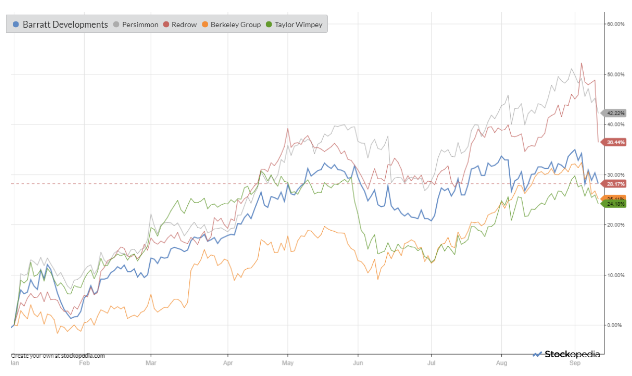
Housebuilders have performed well this year, but is progress faltering?
The latest firm to hit the headlines is Redrow, which is a SIF portfolio stock. Last week saw the shares bounce higher after a record set of full-year results. Pre-tax profit rose by 26%, and the order book ended the year up by 14% at £1.1bn, a new record.
However, these gains were reversed when the stock closed down by 9% on Tuesday. The trigger for this sharp drop was the news that two entities associated with company founder Steve Morgan had sold about 7% of his holding in the firm, collecting around £153m.
Mr Morgan remains the largest shareholder, with a stake of about 33%. According to the placing announcement, the proceeds will be used to diversify his investment portfolio.
That’s fair enough. After selling out of the firm in 2000, Mr Morgan took back control of the business in 2009. He’s successfully turned it around and is now planning to step back to a non-executive director role this year. So taking some money off the table makes sense.
But the timing of this stock sale is interesting. The founders of Irish housebuilder Cairn Homes also sold €26m of shares on Tuesday. Just last week, Berkeley Group Holdings founder and chairman Tony Pidgley sold shares worth £26m. At the same time, a person associated with Berkeley’s chief executive, Robert Perrins, sold shares worth £18m.
Pidgeley and Morgan are both self-made men who have built large companies from scratch over several decades. They have a reputation for good market timing. So are we approaching the market peak for housing stocks?
One classic signal that a stock’s valuation may have peaked comes when excellent results are met with a falling share price. That’s happened to Berkeley and Barratt Developments over the last week.
I’m not suggesting that the market is about to collapse. But I do believe that it might be worth taking a closer look at these stocks. Are warning signals emerging from the financial data?
Nothing obvious
All four of the companies which qualify for 10 or more GuruScreens are housebuilders. Persimmon, Redrow, Taylor Wimpey and Berkeley also boast StockRanks of 97 or higher. All four have a StockRank Style of Super Stock.
So if problems are showing up in the data, they must still be quite subtle.
One approach I find useful sometimes is to focus on the change in a company’s StockRank over a period of time, rather than the rank itself. Housebuilding stocks were on a tear until May this year, since when performance has been more mixed.
So have the StockRanks changed since April? Not really. Although the individual QVM ranks have shifted slightly, I can’t see any obvious pattern of change. However, I have identified one potentially worrying trend.
A peak valuation signal?
What are housebuilders worth? They buy land, build houses, and then sell them. Profits come from the mark-up on the cost of building the house, and from maximising the value you add to the land by building on it.
A simple proxy for the market’s view on a housebuilder’s build-out value is its price/book ratio:
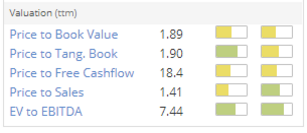
During the financial crisis, you could buy housebuilders at a discount to their book value. It was a good trade, because today they trade at a big premium to book value.
In some cases, this premium has risen sharply over the last year, especially since April:
Company | P/B @ 4 Sept 2016 | P/B @ 1 April 2017 | P/B @ 12 Sept 2017 |
Persimmon | 2.45 | 2.58 | 2.91 |
Redrow | 1.56 | 1.72 | 1.89 |
Taylor Wimpey | 2.07 | 2.18 | 2.31 |
Berkeley | 2.08 | 2.25 | 2.29 |
Barratt Developments | 1.34 | 1.38 | 1.42 |
(The difference between each company’s figures is mostly a reflection of the varying levels of return on capital employed they generate. What matters, in my view, is the rate of change of each company’s own P/B ratio.)
All of these stocks are valued at a bigger premium to book value than they were one year ago. This may partly be as a result of the rebound which followed the Brexit vote. But by April this year, I think everyone knew that housing sales had remained buoyant following the referendum. So the increase in P/B since April suggests the market has priced in additional house price growth over the next few years.
Is this realistic? I’ve no idea. But in my opinion, a high price/book ratio for a housebuilder is the equivalent of a high price/sales ratio for a loss-making internet stock like Purplebricks. As the ratio goes higher, the risks of investing increase.
Putting this in perspective
I’m not suggesting that housebuilders are the speculative equivalent of Purplebricks. Building houses is a government-subsidised business that’s hugely profitable and pays generous dividends. I’d much rather own housebuilding stocks than Purplebricks.
However, the stock market is usually a leading indicator of the real economy. Factors such as the future of Help to Buy and falling secondhand house sales could become significant. I expect housebuilders’ share prices to turn south before new home sales start to slow. In my view, rising price/book ratios are a sign that valuations may be getting a little warm.
How does this affect the SIF portfolio? The Redrow holding isn’t due to be reviewed or sold until December. So the portfolio will stay exposed to the housing market for a little while longer yet.
Disclosure: Roland owns shares of Redrow.
Disclaimer
This is not financial advice. Our content is intended to be used and must be used for information and education purposes only. Please read our disclaimer and terms and conditions to understand our obligations.

14 comments
He may be bucking the trend but I noticed that earlier today Stephen Wicks, CEO of Inland Homes, bought 50,000 ordinary shares in the company. This follows on from share buy backs in the stock in recent days. That said, it does trade at a P/B of 0.98, considerably less than its peers mentioned in the article. And it's also a bit of a hybrid with multiple income sources from the property industry. Incidentally, I hold stock in Inland Homes.
I've just bought back into Redrow today (a 1/4 position) on high volume up-day. The whole sector seems to have regained its mojo after recent political statements.
While the interest rate may provide some danger, I like the look of Redrow's chart with a potential cup and handle developing. I'll look to move to a full position if it breaks through £6.20 with high volume.
M.
Housebuilders have been fabulous investments in recent years. Just wish I had bought near the bottom of the 2008 bear market when Taylor Wimpey could be bought for just 2p when fears they were going bust,. Now 90 times higher and back in the FTSE 100. After gains like that it seems far too late for anyone to buying in to the sector now. But while dividends remain so good, for now at least, perhaps best to reduce now rather than sell out completely.
Wish I had bought then instead of waiting until next excellent buying opportunity immediately after Brexit, with best choices posted by Paul Scott then.
OK thanks I will consider it. Problem with US shares is the 15% tax, also forex costs.
The potential rise of interest rates will be a major factor with regard housebuilders. The Bank of England clearly should be raising rates to counteract inflation and the market's now indicate that this will soon force their hand.
As a %age now of the share price that is 34.4/590 = 5.83%. The lower the purchase price paid for the share before the XD the higher the percentage return.
This information of the best dividends can be found on dividenddata.co.uk.
No doubt the share price will fall when it goes XD as with all dividends, but given a bit of time should recover again.
Working out a decent dividend picked up each month like that for a year is about 70% return.
I still prefer the US market for double digit dividends
34.4p/share in total (final + special)
ex-div date is 26/10/17 and payment on 20/11/17
Barratt has a good dividend payment coming up well worth having,so I am keeping an eagle eye on this and tempted to get some.
How much is the dividend? No doubt the shares will fall when it goes ex dividend.
House builders are highly leveraged to rising sales & price inflation,they pay upfront for land,materials,labor etc,they get paid when the house is sold , so can be very capital intensive,great in the good times, ugly in the bad times. i don' think it can get any better for them .As the saying goes "make hay while the sun shines".
It went somewhat against my grain, but, sensing a subtle change in sentiment, having far too much exposure in my portfolio to builders anyway, and sitting on a large profit, I just sold out of all my building stocks. I still have intrinsic faith in the sector for the long term, for dividend yields, so I aim to resume my positions when I am confident that this present level of disquiet is over . I very nearly did that this time last year, prevaricated, and lost the window of opportunity. Perhaps this will be different, but it smells similar to me and I feel more comfortable now I'm out. I plan to resist the usual desire to transfer the cash into other things for at least a month, after which the conference season will be over too. There is a nasty air of political instability about after the recess and I feel generally bearish, a rare experience for me.
Quite topically Bank of America - Merrill Lynch have published a UK Housebuilders sector sell-note this week. In summary their reasons for caution are:
Sector priced for perfection
The outlook for the UK house building sector is not without risk at this stage of the cycle; there is debate over the long term future of the Help to Buy scheme, the biggest crutch under the sector, and the direction of interest rates as well as weakening consumer confidence. Even if the UK avoids a recession, arguably the sector is trading at full multiples. However, in the absence of a recession which seems a likely outcome, the evaporation of house price inflation is likely to nibble away at confidence. We maintain our cautious sector stance, but recognise that high yields remain an attraction. We adjusted our EPS est. for Barratt Developments, Bovis Homes & Redrow post results in early Sept, and raised their POs but reiterate our U/P ratings on negative total returns.
Inward immigration could fall reducing housing demand
We believe that if net inward immigration into the UK was to fall from the official figure of 248,000 in 2016, to 108,000 p.a. which is close to the Govt's target of 'less than 100,000 p.a.', the increase in household formation would fall from the Govt's implied 2019-2023 estimate of 217,600, to 177,000. The latter figure is already below the current increase in total dwellings that stood at 189,650 in 2015-16. We believe the number of new dwellings has continued to rise, implying that housing volume could grow, into a slowing demand market. This should have implications for HPI.
Interest rate outlook; flat for now, rising medium term
Low interest rates and cheap funding have been supporting the mortgage market for some time. However, with the withdrawal of the Term Funding Scheme (TFS) from February 2018, the period of incrementally lower rates and readily available financing may be coming to an end. It is certainly an area of debate. If mortgage rates were to begin to rise, it is likely to slowly begin to squeeze affordability which on a house price to earnings basis is already at peak levels.
Hard Brexit scenario base case scenario; Lower growth
For more than a year, we have held the assumption that the UK will exit the EU in a 'Hard' way and that this will inevitably lead to lower growth than would have otherwise been the case. The important message is 'lower growth', and not a recession and in this scenario, a collapse in new housing completions is not likely and a major shift down in pricing is less likely as well. Therefore, what are we likely to see? Probably a fairly stagnant, zero volume growth environment with sentiment risk around pricing.
Sector outlook is therefore uncompelling
The sector PER range is c9x to c11x (Bovis Homes 15x), which is uncompelling at this stage of the cycle considering margins are cyclically high and that the sector is trading at c1.8x P/TNAV. With sentiment showing signs of cracking, we maintain our Underperform rating across the sector, but we accept that balance sheets are infinitely stronger now than 10 years ago across the sector and the dividend payments are expected to be supported even in a benign environment. Dividend yields across the larger names range from 5.4% (BKG), 5.8% (PSN), 6.8% (BDEV), up to TW on 7.7%. Dividends are also being gently supported by cash flow that could be generated by slowly reducing land banks.
I see that house prices are now more affordable in half the country than in 2007.
The main threat to housebuilders is recession, people may need houses but they don't need new houses and in last recession hardly anymore was buying them. I remember all the sites near me they were mothballed. Of course Brexit is a concern, we don't know what effect it will have on our economy, although some builders are feeling some effects such as Berkeley Group (LON:BKG). Some are more exposed to the London market as well. I do hold some Redrow (LON:RDW) but have sold over half and sold all my other builders. So I'm bearish on the sector at the moment, of course the best time to buy is after a recession, just look back at shares 2007-2010.
People will continue to need homes to live in, the main risks (I believe) come from changes to government subsidies (help to buy), changes to interest rates, and changes to the economy (for instance due to Brexit, or some other major event).
On the other hand, people have such an unhealthy fixation with the value of their home (and even unhealthier sized loans anchored to them) that it is political poison to let house prices fall significantly, limiting the downside risk for house builders.
Diversification is as always key, and I believe it may be more important than trying to time the market perfectly.
I should disclose, I hold long positions in £TW and Persimmon (LON:PSN) but this is driven by my views above, rather than the other way around.