Stock in Focus: Computacenter

I remember looking at Computacenter’s results back in 2012. For some reason, I didn’t buy any shares at the time, despite the fact that the stock had survived the credit crunch without a dividend cut and looked very reasonably priced.
I don’t remember why I didn’t buy any Computacenter shares, but I am certain I was wrong. That’s why I now keep a written record of my investment decisions.
You see, Computacenter is a highly successful ‘picks and shovels’ investment. It provides the data centres needed for large companies to operate their IT infrastructures. Customers include John Lewis, Nationwide Building Society and Morrisons, according to the firm’s website. Computacenter also has significant operations in France and Germany.
 The firm’s performance has been impressive. According to Stockopedia’s figures, over the last ten years, Computacenter has delivered an average total return of over 10% per year (share price return plus dividends).
The value of quality
With the benefit of hindsight, the aftermath of the financial crisis presented investors with the chance to pick up some bargain stocks. Shares in Computacenter dropped as low as 84p in 2009 - they now trade at around 756p.
That kind of value isn’t on offer today, but Computacenter shares still don’t look especially expensive. Stockopedia assigns the firm a ValueRank of 80. This is the lowest of the three ranks which make up Computacenter’s StockRank of 99, suggesting the firm could be a genuine Super Stock.
As always, it pays to look at the values of the individual factors which make up each rank. You can do this by clicking on any of the individual rank numbers on the ‘Ranks’ tab on any page with a list of companies, such as the Technology sector page:

Computacenter has no obvious weak points:
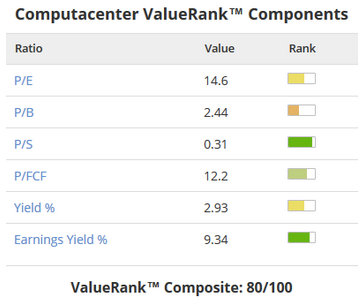
The nature of Computacenter’s business is to add value to the hardware and software assets it owns. This means a high price-to-book ratio is acceptable.
A trailing P/E of 14.6 looks reasonable and is below the FTSE 350 average of 17.2. A price-to-free cash flow ratio of 12.2 makes the valuation seem even more appealing. Relatively few companies can deliver solid earnings growth and generate this much free cash flow.
Although Computacenter’s yield is an unremarkable 2.8%, it has been well covered by free cash flow since at least 2009. This should make for a safe dividend and provides headroom for sustainable dividend growth. This is an important aspect of an income stock.
The final point worth mentioning is Computacenter’s earnings yield of 9.3%. This reflects the group’s net cash and shows how a low operating margin doesn’t prohibit above-average returns.
Quality numbers
Computacenter appears to be good quality. Let’s start by returning to profitability, which I touched on above.
Computacenter’s operating margin has averaged 2.2% since 2009 and was 2.5% in 2014. At face value, this suggests a heavily-commoditised business that has to compete on price. To some extent that’s true, but it’s not the whole story.
Many successful investors believe that return on capital employed (ROCE) is a more meaningful measure of profitability than operating margin. This is because, when comparing stocks, it shows how efficient a company is at deploying capital.
Computacenter’s return on capital employed has average 15.8% since 2009. That’s very impressive, especially as the firm has maintained a net cash balance throughout. This suggests to me that the company’s management use capital expertly and do not invest in activities that are unlikely to produce a satisfactory return.
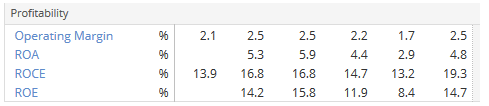
Computacenter’s high average ROCE contributes to its QualityRank of 97. Other key factors include a Piotroski F-Score of 8, which indicates good all-round balance sheet strength and profitability.
The firm doesn’t get a perfect score, however. The current ratio is barely adequate, at 1.3, while the majority of the firm’s assets are either illiquid (data centres) or intangible. If for any reason the firm’s business model ceased to work so well, its valuation would not be backed by assets.
I can accept this risk, given Computacenter’s long history of successful execution. Indeed, I’d argue that the firm’s consistent performance suggests it has a narrow moat of some kind in its chosen markets.
This could be some combination of scale, cost and reliability -- or perhaps simply a very effective sales force. I’m not sure, but I believe it exists.
Computing momentum
Computacenter shares have gained 25% so far this year, adjusting for the effects of the 15:17 share split in February. That’s more than double the 10% return posted by the firm’s index, the FTSE 250, over the same period.
The shares aren’t obviously expensive, however, and current momentum could quite easily continue. Computacenter currently has a MomentumRank of 90 and its 2015 forecast P/E of 15.3 drops to 13.3 when adjusted for net cash.
Broker forecasts have remained largely unchanged over the last three months, after a sharp fall earlier this year. The trigger for this was a fairly cautious outlook statement in the 2014 results, citing short-term challenges in all major markets.
I’m unsure of how to interpret this cautious view, given that broker forecasts still suggest net profit will rise by 15% this year.
Technical signals suggests that price momentum remains strong.
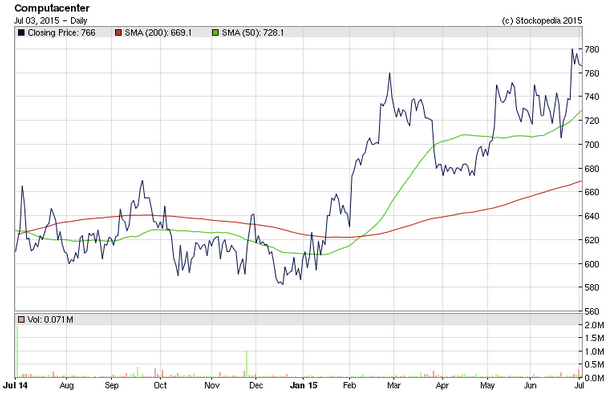
Computacenter’s shares are within 2.5% of their 52-week high, and have a 6-month relative strength reading of 20. Since making a golden cross in February, the 50-day moving average has remained well above the 200d MA.
What next?
Computacenter’s transition to a service-led business should help to drive future profit growth, but the firm could still suffer further teething problems.
Last year’s £100m capital return was part-funded by the sale of a non-core business. This year’s share split means that per share comparatives look weaker, but investors shouldn’t be deceived by this. Profits and dividend are both expected to rise.
In my view, the numbers speak for themselves. A long and consistent record of above-average returns underlines the firm’s appeal.
As a value-oriented investor I find it difficult to buy stocks trading at long-term highs. However, in the case of Computacenter this approach has previously cost me dearly. It could do so again.
As always, please DYOR before making any trading decisions. This article represents my views only and certainly isn’t advice.
Disclaimer
This is not financial advice. Our content is intended to be used and must be used for information and education purposes only. Please read our disclaimer and terms and conditions to understand our obligations.

No comments yet
No one has commented here yet! Why not be the first one?