Stock in Focus: Provident Financial shows how High Flyers can go bad

How often do shares of a FTSE 100 company fall by 68% in one day? Thankfully, not very often.
But when subprime lender Provident Financial issued a major profit warning on Tuesday, cancelled its dividend and warned investors of a FCA investigation, the shares crashed.
The good news is that investors with balanced, diversified portfolios shouldn’t have suffered too much. A 70% loss on a 5% position will only reduce the total value of your portfolio by 3.5%. That’s disappointing, but hardly the stuff of nightmares.
The bad news is that Provident shares have now fallen by 80% in 2017. It’s probably fair to ask if the group’s turnaround can be achieved without some lasting damage.
Whatever happens, I think it’s worth asking whether we could have seen this crash coming. And as there are no suitable new stocks for the SIF Portfolio this week, I thought I’d use this week’s article to try and answer this question.
What went wrong?
If you haven’t been following the Provident saga, here’s a quick recap of what’s gone wrong at this company.
Back in 2016, the company decided to swap its army of 4,500 self-employed doorstep debt collection agents for 2,500 employed “customer experience managers”. The switch was meant to take place in July this year, but it’s now clear that this project has been a costly fiasco.
Firstly, many of the firm’s self-employed agents walked off the job before the July deadline. This meant that loan payments weren’t being collected on time. In June, management said the impact of this would be £40m and warned that new lending was £37m below prior year figures, due to a drop in sales penetration. Guidance for pre-exceptional profit from home credit was cut from c.£110m to £60m.
Since rolling out the new system in July, it seems Provident has suffered serious teething problems. Collection of loan payments is currently running at 57%, compared to 90% for the same period last year. Sales of new loans are £9m per week lower than in 2016.
Full year guidance for the home credit business has now been cut from a pre-exceptional profit of £60m on 20 June to a pre-exceptional loss of £80m-£120m.
RIP ROP?
There’s also one final sting in the tail. It turns out that back in April 2016, Provident’s Vanquis Bank credit card division agreed with the FCA to suspend sales of its Repayment Option Plan (ROP) product.
I’m not sure this has been made clear to investors previously. In July’s interim results, the firm simply referred to “some further reduction in the penetration of the ROP product”. Well I should think so, given that it hadn’t been on sale for more than a year.
ROP is a so-called forbearance product. It allows borrowers to miss a certain number of credit card payments without their credit rating suffering. For this privilege, Vanquis credit card customers pay 1.29% of their balance each month. When compounded, that’s equivalent to an extra 16.6% interest each year, in addition to the card’s 39.9% APR rate.
Vanquis Bank is currently awaiting the outcome of the FCA investigation into ROP. But Provident said today that ROP currently generates gross revenue of £70m per year. It’s not hard to imagine that most of this is profit. Losing this income stream could put a dent in Vanquis Bank’s profitability.
Did the StockRanks provide a warning?
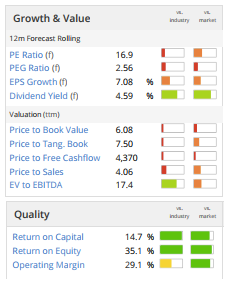
Back in May, Provident Financial had a StockRank Style of High Flyer. High quality and momentum scores appeared to compensate for a poor value score. Holding onto the stock probably seemed logical, even though the StockRank was fairly low, at 54:
10 May 2017
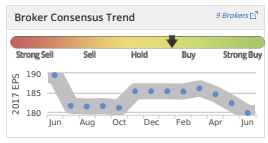
By early June, before the first profit warning, the picture was getting worse. Provident Financial’s StockRank Style had been downgraded from High Flyer to Neutral. The StockRank had fallen to 45. This was due to a 19-point slump in the MomentumRank, which had fallen from 70 to 51 as brokers cut their forecasts for the year:
3 June 2017
Three negative factors were now apparent. Negative earnings momentum, a falling StockRank, and a downgraded StockRank Style.
This trio should perhaps have been a warning to sell, or at least take some profits. But for shareholders with a long-term view, this would probably have seemed an over-reaction. I know I’ve sat through such early warnings and done nothing.
Here’s what happened next:
1 July 2017
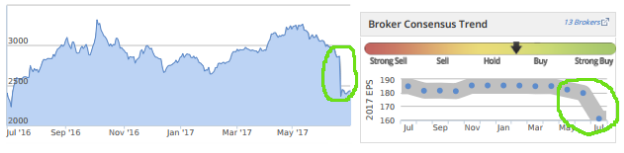
Provident’s StockRank fell to 37 after June’s profit warning. Brokers slashed their earnings forecasts for the year. The writing was clearly on the wall. But still investors clung on.
After all, surely these problems were fixable? I have to admit I thought they should be. And so did some fund managers. Neil Woodford topped up his funds’ holdings following June’s profit warning, taking his stake in the group to over 19%.
In defence of those who held on, I’m not sure the scale of the shortfall in collections was really clear at that time. The figures published on Tuesday suggest to me that this backlog could take years to clear. I also suspect that some degree of impairment may be required to avoid accusations of unreasonable behaviour. After all, how many of Provident’s customers will have set aside and saved all of their uncollected weekly payments?
What can we learn?
In my opinion, this is another win for quantitative analysis over gut-feel stock picking.
Stockopedia’s algorithms didn’t know all the details of the firm’s problems. But by analysing all the available data, the algorithms concluded that Provident stock might be likely to underperform.
Unfortunately, Provident Financial has now provided us with a textbook example of what can happen when a High Flyer goes bad.
Is it a contrarian buy?
By focusing on lending to customers with poor credit ratings, Provident has generated an average return on equity of 35.9% since 2011. Ethical questions aside, this is an outstanding record of profitability. So is the business really worth 80% less than it was eight months ago?
I’m not sure. It’s surprising that such a well regarded management team has managed to mess things up so badly. But the group said on Tuesday that trading in its other divisions -- Satsuma, Moneybarn and Vanquis Bank -- remains on track.
Tuesday’s warning seems to suggest that a group profit of at least £80m is likely this year, down from £219m previously. I estimate that this is equivalent to around 53p per share, giving a forecast P/E of about 11 with (almost certainly) no dividend.
I’m fairly sure brokers’ 2018 forecasts will have been slashed following Tuesday’s news. Beyond then it’s harder to call. You could certainly make a case for Provident shares being undervalued on a two or three-year view. You could equally suggest that this century-old business will never recover its reputation and market share. I’m undecided, so will stay away for now.
Disclaimer
This is not financial advice. Our content is intended to be used and must be used for information and education purposes only. Please read our disclaimer and terms and conditions to understand our obligations.

11 comments
Sold at just over 905p and happy with a decent profit. I think it will take quite a while for it will recover more if at all. A long hard struggle to rectify the damage already done to the company.
Fortunately got the timing on this about right for a change, its now topped the £9 mark at 10:19AM on the Stoco screen, up 21.3%
Another day another $, so to speak.Time 9:37am , Price 873p up 16.8% with a high today of 888p. Let's hope the reversal continues.
this has returned 98% in the last 3 days if you bought at the lowest dip at 450.10p.
seems to be a general trend at the moment with big drops at the moment recovering a fair amount a few days after.
Decided to take a punt on this this morning. Shares traded so far about 5.3M price 785p time 12:40pm up 18.8%.
Let's see how it pans out over the next few days. I do not usually go for bottom fishing, but thought this was worth a try.
This was heavily shorted again yesterday with a total of 17.5M shares traded which drove the share price to it's all time low for this year at about 426p and a valuation of around 1900p (figures from Vector Vest)
Yet again the FCA has got it's teeth into an investigation with the company causing further distress. However today with such a huge difference between the value and the share price being undervalued by such a high amount, the share price has reversed direction with 12M shares traded.
It will be interesting to see if the "bargain share price" continues to rise tomorrow as most of the price movement appears to have been between 4:00pm and close of business.
Maybe Crawshaw (LON:CRAW), Solid State (LON:SOLI), and System1 are better examples of high flyers going bad. I'm sure there are plenty of others that have crashed also.
I notice Costain (LON:COST) and Severfield (LON:SFR) are on your screen, are these not suitable in include in your portfolio?
Hi Herbie,
I think Costain (LON:COST) is a very good company, but the portfolio already includes Morgan Sindall (LON:MGNS), so I think Costain and Severfield (LON:SFR) would overlap too much in terms of diversification.
Regards,
Roland
OK, yes I understand Costain (LON:COST) and Morgan Sindall (LON:MGNS) are similar and both low margin contractors. £SEVR is a bit different and is tempting now it's fallen back, but not keen on the share options though.
Hi Roland,
I'd argue that a HighFlyer didn't go bad.
You noted that the Stockopedia style transitioned from a HighFlyer to Neutral on the 10th May when the price was close to recent highs of 3250.
The Neutral stock then started to slide, lurched in June and proceeded to collapse.
Re Brokers targets, J.P. Morgan Cazenove have slashed theirs from 3200 to 1200 and give it a rating of neutral from overweight, and Barclays have reduced their target from 3150 to 600, and have moved their recommendation from overweight to equal weight.
I don't know why we take any notice of what these guys say. It's a bit like reading your daily horoscope!