Sylvania Platinum and Games Workshop: share buybacks and all-time highs

Sometimes the simplest stock market signals can be the most powerful. A lot of importance is currently being attached to companies that are able to maintain dividends in this market. The same logic can be applied those that have continued with share buybacks.
One such company is small cap platinum group metals (“PGM”) producer Sylvania Platinum (LON:SLP) , which today trades at 43p. Its most recent repurchase announcement came on the 1st of July. Following today's update, I've taken a quick look at Games Workshop as well - as always, great to hear what others make of the results.
Sylvania Platinum (LON:SLP)
- Stock price: 43.68p
- Market cap: £121.87m
- 1y RS: +82.3%
(I hold)
I last looked at the company here in early March, a couple of weeks before the proverbial hit the fan. Its shares are down by more than 30% since an all-time high of 63p earlier this year (driven by surging basket prices). Even taking into account COVID-related earnings downgrades, the PGM producer is valued at just four times forecast earnings.
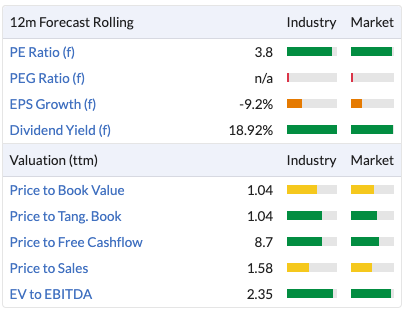
Brokers also appear to be forecasting a remarkable yield. In fact that yield looks so anomalously large I am tempted to put it to one side. The latest broker note I can get my hands on (Liberum, 25th of March 2020) does forecast a 10.89 cent dividend payment for FY20, but I’ll believe it when I see it.
What’s more certain is the ongoing share buyback programme. Back on 17 February the miner proposed a share buyback programme of up to 12 million shares. This was on top of millions of dollars spent on buying back shares in preceding financial periods and millions spent on life extension capex as well.
Here are all the buybacks during lockdown:
Shares | Issued share capital | Treasury shares | Total no shares with voting rights | |
200,000 | 289,724,772 | 7,310,483 | 282,414,289 | |
4,125,331 | 289,724,772 | 11,435,814 | 278,288,958 | |
549,669 | 289,724,772 | 11,985,483 | 277,739,289 | |
298,632 | 289,724,772 | 12,284,115 | 277,440,657 | |
5,215,000 | 286,845,657 | 14,620,000 | 272,225,657 | |
137,971 | 286,845,657 | 14,757,971 | 272,087,686 | |
62,500 | 286,845,657 | 14,820,471 | 272,025,186 |
Since its half year results back in February, SLP has bought back around 3.7% of its shares at a weighted average price of around 48p. Today you can buy its shares for less than the company has been paying despite a recovery in operations.
SLP has updated the market twice since its half year results. To recap:
April 28th - Q3 results for the quarter ended 31 March
- National lockdown; Sylvania Dump Operations (“SDO”) placed on care and maintenance. Suspension of deliveries and delayed revenue and cash flow.
- Ongoing power disruptions.
- Guidance of 74,000 to 76,000 for FY20 revised down to c68,000 ounces
- A large portion of cash is held in ZAR, which has weakened against USD and means the reported cash balance going forward might take a hit.
May 18th - COVID update
- SLP reports an easing of COVID-19 restrictions on mining companies
- The SDO commenced with scaled-down operations on 1 May 2020. All six operations are running at reduced but stable throughput.
What have PGM prices done?
An important piece of the valuation puzzle at SLP is basket price. The company processes platinum, palladium and rhodium and what commodity prices do here materially affects potential shareholder returns.
It seems to me as though platinum, palladium, and rhodium prices have stabilised at similar levels, on the whole, to the start of 2020. In fact rhodium prices, which are a more important part of the mix for SLP than for others, have been relatively buoyant.
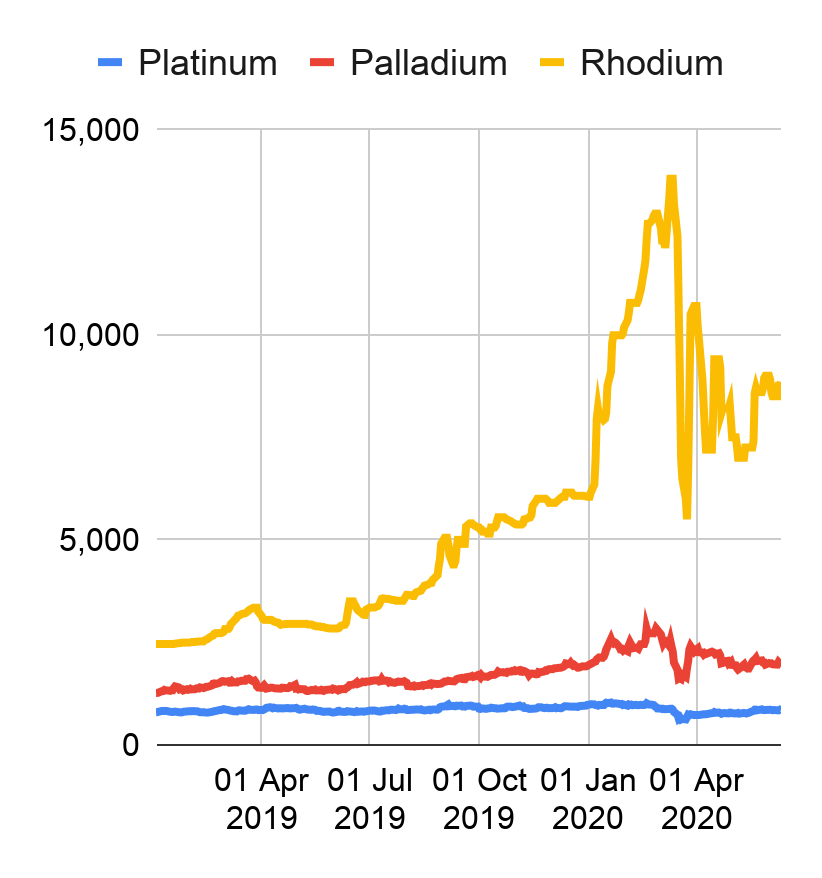
Ultimately, how valuable SLP is depends on how PGM prices do in future. From what I’ve seen, there are attractive supply/demand dynamics for platinum, palladium, and rhodium. Autocatalyst demand for palladium and rhodium in particular are encouraging.
Both the palladium and rhodium markets are in deficit, and these deficits are set to deepen in 2020. Your view on how prices here will perform over the medium term is very important to whether or not SLP is cheap. DYOR.
Valuation
A “discounted cash flow” analysis might sound complicated but it’s not. It can be a useful sanity check but the process is fraught with error, uncertainty, and subjectivity.
All you are doing with a DCF is estimating the value of an investment today, based on your projections of how much money it will generate in the future. Those cash flows or profits are discounted back to present day with a discount rate, to reflect the time value of money (“a bird in the hand is worth two in the bush”).
DCFs models get a lot of stick. You might accuse some people of starting off with a target price in mind, and then manipulating assumptions so that the model spits out that target price. Then there is the issue of discount rate. What’s a sensible one?
The Credit Suisse research department has looked at real equity returns since 1900 - 120 years of financial data - in its Investment Returns Yearbook 2020 and provides a useful range of real equity returns. Since 1900 through to 2019:
- The UK’s geometric mean real equity return was 5.5%,
- Europe’s geometric mean real equity return was 4.3%,
- The USA’s geometric mean real equity return was 6.5%, and
- The global geometric mean real equity return was 5.2%.
These are useful baselines. Then there is the renowned professor Aswath Damodaran suggests a “COVID adjusted” equity risk premium of 5.35%. If we add that to the recent UK risk-free rate of 1.1%, we come to a discount rate of 6.45%.
The fact is we can generate a wide range of present values in this way. The key takeaway is just the higher the discount rate, the more conservative your valuation.
Running some numbers
It’s probably best not to get bogged down in the detail. A back of the envelope calculation can still be quite enlightening. Suppose:
- SLP produces platinum, palladium, and rhodium for ten more years and then vanishes from existence. This is conservative because the miner is spending millions on life extension projects and has significant exploration assets it hopes to monetise.
- Using its FY19 basket price of $1,277. Conservative as the basket price was as high as c$2,300 as recently as February and medium term supply/demand dynamics appear to be encouraging for SLP’s metals.
- With a production output of 75,000 ounces produced per year - bang in the middle of SLP’s own guidance.
- Profit margins are maintained at FY19 levels.
Running those very basic assumptions gives the following table.
PGM (oz) | Revenue ($m) | Profit ($m) | Profit margin | Discount rate (10%) | Present value of profits ($m) | |
FY19 | 72,090 | 70.50 | 18.20 | 25.82% | ||
FY20 | 68,000 | 66.50 | 17.17 | 25.82% | 1.10 | 15.61 |
FY21 | 72,000 | 70.41 | 18.18 | 25.82% | 1.21 | 15.02 |
FY22 | 75,000 | 73.35 | 18.93 | 25.82% | 1.33 | 14.23 |
FY23 | 75,000 | 73.35 | 18.93 | 25.82% | 1.46 | 12.93 |
FY24 | 75,000 | 73.35 | 18.93 | 25.82% | 1.61 | 11.76 |
FY25 | 75,000 | 73.35 | 18.93 | 25.82% | 1.77 | 10.69 |
FY26 | 75,000 | 73.35 | 18.93 | 25.82% | 1.95 | 9.72 |
FY27 | 75,000 | 73.35 | 18.93 | 25.82% | 2.14 | 8.83 |
FY28 | 75,000 | 73.35 | 18.93 | 25.82% | 2.36 | 8.03 |
FY29 | 75,000 | 73.35 | 18.93 | 25.82% | 2.59 | 7.30 |
FY30 | 75,000 | 73.35 | 18.93 | 25.82% | 2.85 | 6.64 |
Total | 223.96 | 120.75 | ||||
Enterprise value ($m) | 127.59 |
This model shows that, at a 10% discount rate, which is significantly higher than some example baseline rates (almost double, in fact) SLP is valued as if it will return balance sheet cash to shareholders and then just drop off the face of the earth in ten years’ time.
It does not factor in the option value of SLP’s exploration assets or any upside potential in basket prices. According to Liberum, Volspruit alone is valued at $43m. I think this is a fair margin of safety. The key variable is what happens to basket prices though.
Applying a range of different discount rates yields varying results based on forecast profits:
Profit ($m) | DR = 12% | DR = 10% | DR = 8% | DR = 6.5% (AD) | |
Total ($m) | 110.25 | 120.75 | 132.89 | 143.26 | |
USD/GBP | 0.80 | 0.80 | 0.80 | 0.80 | |
Total (£m) | 88.20 | 96.60 | 106.31 | 114.61 |
Again, assumptions regarding frozen PGM prices and production, a ten year operating history before total shutdown, and no realised value from Volspruit, Grasvally, or Northern Limb assets are hopefully prudent.
Another way of looking at the value on offer with SLP is with relative valuation (any of the “price to” ratios).
The company is actively spending money on life extension projects. It has so far spent around $8m on Project Echo, with another c$2m to come. In fact, in FY19, the majority of capital spend went towards these extension projects with only a small proportion being spent on maintenance capex.
This suggests that in future the group’s free cash flow to shareholders could grow materially even if revenue and profits remain stable.
- The group guided to c$7m of capex in FY19.
- Taking FY19’s capex of $8.29m and assuming a split of two thirds growth and one third maintenance spend gets maintenance capex of (8.29 * 0.33 =) $2.74m.
- Subtract that from $17.4m of cash from operations and you get a normalised FY19 free cash flow figure of 17.4 - 2.74 = $14.66m
- Applying that to the share price would give a price to normalised free cash flow of 10.85x (or 8.55x excluding the $33.8m of cash on the balance sheet).
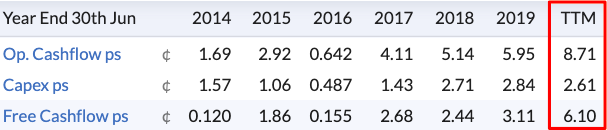
Again, I’m trying to make conservative assumptions here and it hardly shows SLP as expensive. The Financial summary is also pointing to a substantial uptick in free cash flow generation, which is encouraging:
My view:
The key variable at SLP continues to be basket price. Your thoughts here probably determine your view of its value as an investment, so DYOR on this important issue.
Management is clearly optimistic, given the ongoing share buybacks. Meanwhile, the group is an extremely low-cost producer with an AISC of less than $600. It is spending millions on life extension projects. Sylvania’s current mine plan is to process all dump material and current arisings at least twice. If basket prices permanently rebase higher, the economics are there to justify a third pass.
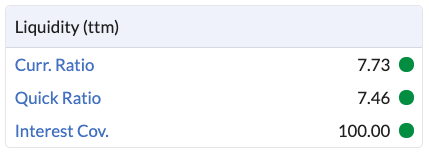
SLP is in excellent financial shape and with $33.8m of cash on the balance sheet (possibly more by now) and no debt. It also has stacks of liquidity, which helps to de-risk it as an investment:
As life extension projects are completed, there should be a drop in growth capex and more cash from operations can flow back to shareholders via buybacks and/or dividend payments. At 43p and less than four times forecast earnings, I think SLP is worth a close look.
Games Workshop (LON:GAW)
- Stock price: 7,775p
- Market cap: £2.32bn
- 1y RS: +60.5%
(I hold)
- Games Workshop (LON:GAW) ’s warehouses are now operational and its factory is working in a limited capacity,
- 306 of its 532 stores are now open in 20 countries,
- Stores continue to re-open across the world as local restrictions are lifted.
- The group is once again beating expectations: FY20 revenue no less than £270m and profit before tax no less than £85m.
This is a remarkable share price for a remarkable company:
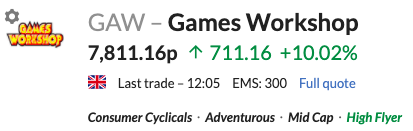
The company has beaten revenue and earnings forecasts again. Good operators have a canny knack for this. It’s not just about operational growth on their end - it’s about managing expectations on the other end as well.
Earnings beats drive share prices, so if you can do this consistently (and honestly, without gaming the system) then chances are the market will reward you with a premium rating. With GAW, the question is of valuation: are all the growth prospects priced in?
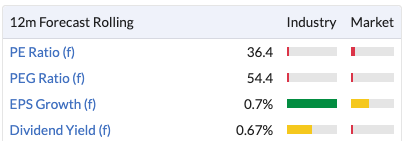
That said, anchoring and adjustment is a powerful psychological bias: when you start off with a particular number you tend to adjust your beliefs by revising that initial number, giving it a greater weight in your calculations.
For those that have followed GAW since its days as a 600p share that was serially warning on profits, today’s valuation might beggar belief. Here’s the 5Y share price chart:
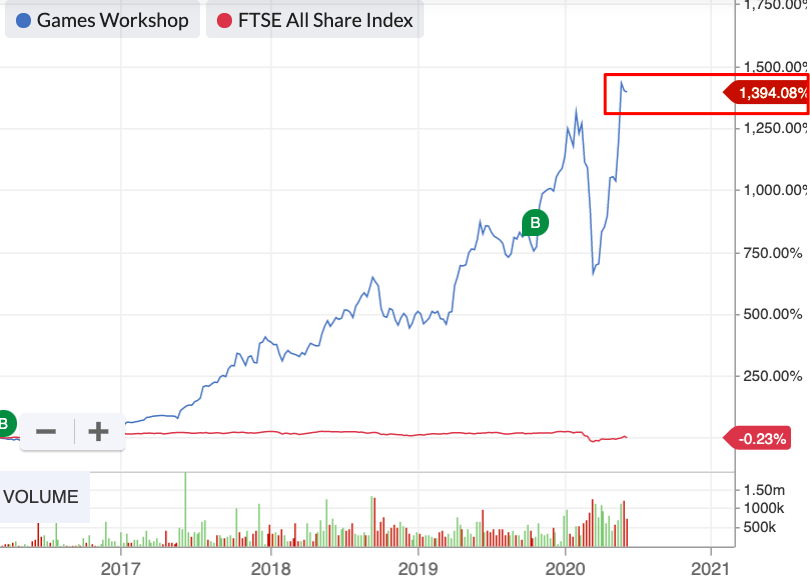
You can argue that it is too expensive, but I note that Jefferies recently initiated its Games Workshop coverage with a “buy” stance and a target of 8500p, although I haven’t seen the broker’s analysis for arriving at such a figure.
The fact is this remains a company of the highest calibre, with a long term, shareholder-friendly culture, valuable and distinctive untapped intellectual property, and great quality and profitability metrics.
It continues to grow sales and profits above expectations, it has upped the rate at which it releases new products and digital content, and it has relaxed its approach to licensing projects and royalty opportunities. The latter point is particularly encouraging for the future: GAW has a vast amount of world-building at its disposal and everybody’s searching for content.
It continues to grow sales and profits above expectations, it has upped the rate at which it releases new products and digital content, and it has relaxed its approach to licensing projects and royalty opportunities. The latter point is particularly encouraging for the future: GAW has a vast amount of world-building at its disposal and everybody’s searching for content.
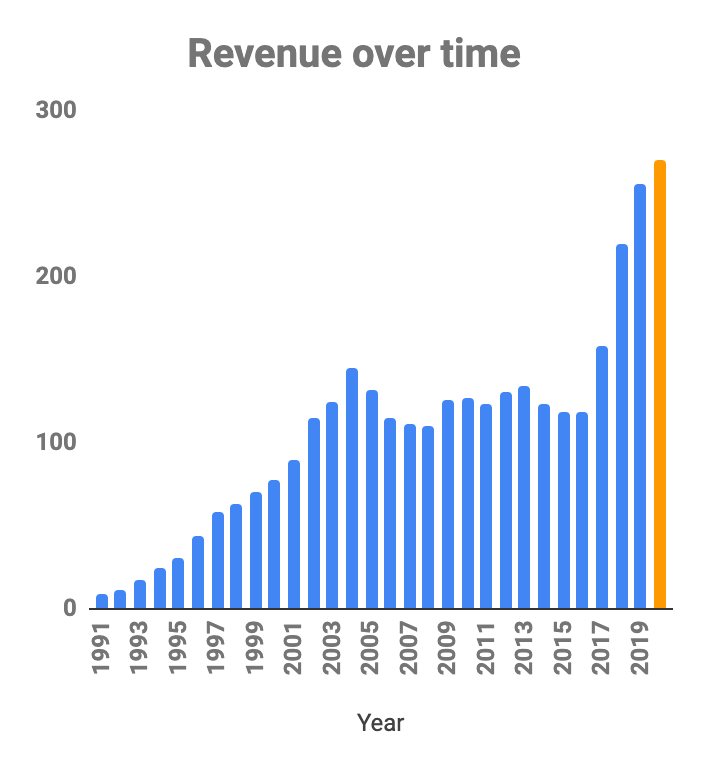
The group recently announced a project with Frontier Developments, who called GAW a “well-established and world-class creative UK company”. There is no reason it can’t expand into television as well, to provide the source material for a series similar to Netflix’s The Witcher (inspired by the popularity of CD Projekt’s blockbuster video games series).
All in all, these shares are not cheap but the future does look bright for GAW. Kevin Rountree coming in as CEO has proven quite the catalyst and there could be further opportunities to monetise its IP via licensing agreements in the years ahead.
Disclaimer
This is not financial advice. Our content is intended to be used and must be used for information and education purposes only. Please read our disclaimer and terms and conditions to understand our obligations.

24 comments
Sylvania will be featured on the MelloBash this Monday
https://www.stockopedia.com/content/mello-monday-featuring-stephen-english-jack-brumby-amp-graham-neary-766509/
"SLP is in excellent financial shape and with $33.8m of cash on the balance sheet (possibly more by now) and no debt. It also has stacks of liquidity, which helps to de-risk it as an investment"
At 43.75p I did think SLP was worth a close look, so I bought some today.
Apologies if inappropriate to post here but looks like massive demand for latest Games Workshop (LON:GAW) release - this from one of the independent retailers:-
https://www.goblingaming.co.uk/pages/preorder-update-please-read
581k sells vs 51k buys today with firming price. Market makers probably adding to their books.
I note that the price of Sylvania Platinum (LON:SLP) has just gone below the 200MA on increased selling volumes. The only recent news is that there has been a share buyback on 1st July. This is the first time (apart from during the crash in February / March) that the price has fallen below the 200 MA in the last two years. I've decided to sell and wait for a sign of recovery before buying back. Does anyone know why the share price has fallen so abruptly?
Shakin' the tree
https://www.ft.com/content/c5c...
Thanks Momoko. That was my first thought. There have been tree shakes on Sylvania Platinum (LON:SLP) before. This is the most effective one so far. And once prices fall below the 200 MA, they tend to fall lower. My hunch is that I will be able to buy back around 30 pence.
I hold Sylvania Platinum and certainly think that it represents one of the more compelling examples of value currently on offer. Deducting reported cash from the market cap suggests a PE of circa 2.9. Because the Sylvania Platinum (LON:SLP) forecast earnings for 2021 are slightly below 2020's it no longer qualifies for a PEG. However I think that forecasts for 2021 given current circumstances are fairly speculative and therefore shouldn't I believe be treated as more than a rough estimate.
The supply and demand dynamics for SLP certainly look good with the requirements of Rhodium and Palladium for electric and petrol vehicles. I think the case is less clear in respect of Platinum however I think that its wider use in respect of jewellery, dentistry, plastics, fertilizers and medical equipment should be given a boost as economies begin to reopen. Platinum is also at a relatively low price level historically and I think may have some upside in the near future.
On the debit side I am concerned about the rate of Covid 19 in South Africa which I think is the highest in Africa. Nevertheless the problem appears to be fairly minor compared to that in the UK and Western Europe.
I also hold SLP and live in South Africa. The country is coping remarkably well with Covid 19 and has a much stricter lockdown than the UK and many other countries. Deaths so far are incredibly low considering the living conditions of so many disadvantaged people. They are well into winter now and still seem to be on top of the situation.
Caper4
Thanks for giving a South African perspective, a little local knowledge is always helpful.
My impression is that Britain is slowly getting a handle on Covid 19 but ought to be better at learning from other countries including Germany and South Korea.
I view SLP as a cyclical value share. Over the last couple of months the market seems to have been a voting machine in respect of Sylvania Platinum (LON:SLP) and has voted it down or sideways. But I think as time progresses the market eventually weighs the merits of companies and that re-openings of global economies will spark the beginning of a new business cycle.
I suspect that the start to the business cycle could be prolonged and stuttering but certainly worth participating in. In the next few weeks I shall be looking at other economically sensitive companies to add to my portfolio.
Great in-depth follow-up to your March Sylvania Platinum (LON:SLP) analysis Jack. A lot of work there thank you. I'm really interested in this one and I appreciate the past is not the future, but nevertheless it does intrigue me...
So as far as I can see it all started at about 30p back in July 2006, peaked at all time highs of ≈ 115p a year later lasting roughly 1.5-years until the 'Great Recession' plummeting to 20p, bounced back to ≈ 55p about a year later keeping somewhat steady for 2-years, then dropping and mellowing to ≈ 10p for 6-years until it's ascent around 2018, glitching COVID-19 and now recovering.
Things presumably came to fruition the year after in 2007 and possibly at their best peak production with the demand and pricing to match — times were good on the market. They never really recovered after the GR eventually riding off into the sunset until later volume activity started to increase around mid 2016 with a 66m spike to rise again. Maybe someone knew something and woke the herd or was just coincidence.
Things certainly look rosy now though not without risks, but I'm curious on thoughts of what the dynamics were like for them back in their heyday, why the declining long pause and how that compares to now?
Hi can someone explain the purpose of treasury shares my take is that this is where shares are held after a buy back has been completed and they then drop off the total share count. What is the purpose of holding in treasury though is it so they can be reissued later if needed presumably at lower cost than cancelling the completely and then having to set up and pay for a placing/rights issue if company wants to issue more shares later ?
Happy to be corrected on any of the above.
Thanks
Hi Clarea,
I'm by no means an expert, but I read this...
'A company issues a share only once; after that, investors may sell it to another investor. When companies buy back their own shares, the shares remain listed as issued, even though they become classified as "treasury shares," because the company may resell them.'
Here are link descriptions/definitions to Issued Shares & Outstanding Shares if helpful.
Many thanks if I have it right then thy are never effectively cancelled just stored in a warehouse almost to be called upon later if needed.
Good article Jack.
"Then there is the issue of discount rate. What’s a sensible one?"
Often makes me laugh when mining projects give an NPV of a project yet don't mention the discount rate. Or they give a discount rate of 5% for a pre-revenue gold mine in Africa!
Hi Jack,
Something I previously always struggled with, was buying high quality companies with already high p/e's, such as Games Workshop (LON:GAW)
I find it hard to get my head around paying high p/e's, fearful I could be overpaying albeit for a great company.
I have found the following Credit Suisse research paper What does a price earnings multiple mean really helpful in this regard and would really recommend people give this a read.
A glance at the table on page 10, gives a feel how high(er) ROIC (above the cost of capital) can really turbocharge what a fair or justifiable level of p/e can be.
Understanding this has helped me purchase a number of high quality companies, including Games Workshop (LON:GAW) which have gone on to consistently increase their value, but which when purchasing always seemed to have uncomfortably high p/e's.
I would certainly be interested hearing of any other research on the matter, or indeed if the bods at Stockopedia could bring their wisdom to bear in regards to how one can equate "paying up" high p/e's for companies with earnings growth and high ROCE.
I would appreciate any thoughts on this.
Kind regards
Chris
Thanks for sharing the CS paper
Thanks Chris interesting insight. So are you comparing ROIIC to ROCE? And are you doing this for latest published full accounts? Using the calc for latest GAW data I have ROIIC well below ROCE. Do you agree or have I misunderstood the formula inputs?
High PE's, Mark Minervini has made a personal fortune out of them...
Correct. In his book Trade Like a Stock Market Wizard. Minervini regards a low PE usually as a sign of a declining company and a high PE usually as a sign of a growing company.
Quote: "The top 25 performing stocks (in the US) from 1995 to 2005 had an average PE ratio of 33x, ranging from a low of 8.6x to a high of 223x."
It's worth noting that Tesla currently has a PE of 134 and the share price has quadrupled in the last year from $250 to $1000.
Minervini also sees the 'superlow' PE as a red flag. The PE is low for a reason. It certainly does not represent a bargain, at least not for the growth investor.
Sylvania Platinum (LON:SLP) was on the Slater screen for months with an ultra low Slater peg, around 0.08 if memory serves me correct.
With no news that I could see, it lost its Slater peg overnight, and dropped off the screen, anyone know why?
Thanks Jack. Very helpful. I hold both Games Workshop (LON:GAW) and Sylvania Platinum (LON:SLP) and they among my better performers. At 40 pence I might top up Sylvania Platinum (LON:SLP), or else when the price of Palladium starts to go up again - say to $2200 (currently at around $1960, which is 40% below its 52 week high).
Whilst I agree with Frontier Development's assessment of Games Workshop (LON:GAW), I would caution against reading too much into another videogame tie-in with the GW intellectual property. There have been dozens and dozens of GW videogames over the years and all but a couple are solidly underwhelming and middling sellers.
If they can crack TV though, well... £££
I bought some of Sylvania Platinum £SLP when it was at 38p after it came up on one of the stock screens. I think it was the Zulu principle screen. It has held up pretty nicely since then.