UK house builders: Are Berkeley Group, Bellway and Persimmon a value buy or value trap?

International Business Times Video
Can anyone solve the UK's growing housing crisis? The new Mayor of London, Sadiq Khan, has a huge challenge on his hands now that he is settled at City Hall. He promised during his election to make 50% of all new homes in London "genuinely affordable".
This is how bad matters have become in London: according to estate agents Savills, first-time homebuyers in the capital now require a deposit equalling 131% of their annual salary.
Only 36% of 25-34 year olds owned their own homes in 2013/14, compared with a massive 66% in 1991 (Chart 1).Just look at the way that adults aged up to 34 have seen home ownership fall as a result of increasingly unaffordable housing – just 9% of 16-24 year olds owned their own homes in 2013/14, compared with 36% in 1991.
To this end, Mayor Khan will use the £400m ($580m, €519m) that remains of the London Mayor's affordable homes budget to support housing associations to build more London homes.
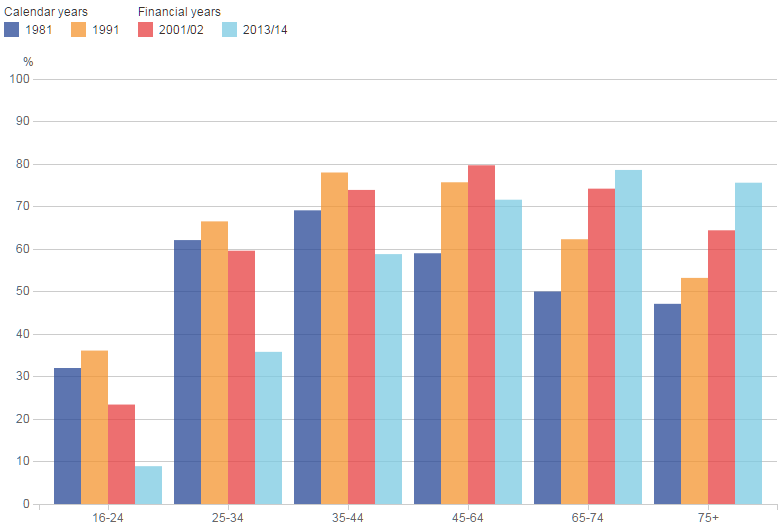 1. The 16-34 age group have seen a collapse in home ownership, ONS
This is not, however, exclusively a London problem. Indeed, back in 2004 the Barker Review concluded that the UK would need to build 250,000 new homes per year just to keep pace with the growing population.
But of course, this has not been achieved.
Matters are now so extreme that housing charity Shelter reported last year that a quarter of all adults under the age of 35 in the UK were still living in their childhood bedroom with their parents.
How big is the UK's housing shortage today?
Estimates vary, and the 2014 Lyons report estimated a shortfall of around 1 million homes.
Just look at the number of homes built per year since 2004, the year of the Barker Review. The National Housing Federation (NHF) assesses the need for new homes at 245,000 across the UK each year. But, in the last 11 years there has not even been one year where that many homes have been built.
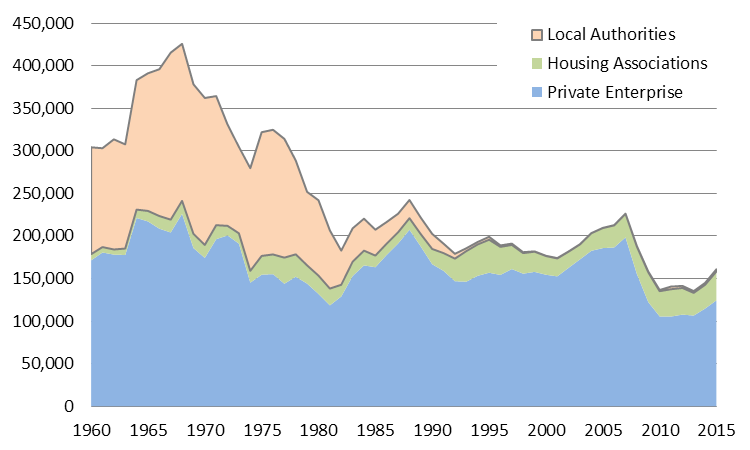 2. Steady decline in house building volumes since the 1960s
Department of Communities and Local Government
If we look at the yearly shortfall in newly-finished housing from 2004 to 2015, the total shortfall in housing today comes to a massive 880,000 houses and flats (Chart 3). Even this year, we are unlikely to see more than 170,000 new homes built in total, so still at least 75,000 short of the NHF's annual target.
Some believe that house builders are facing a big bust
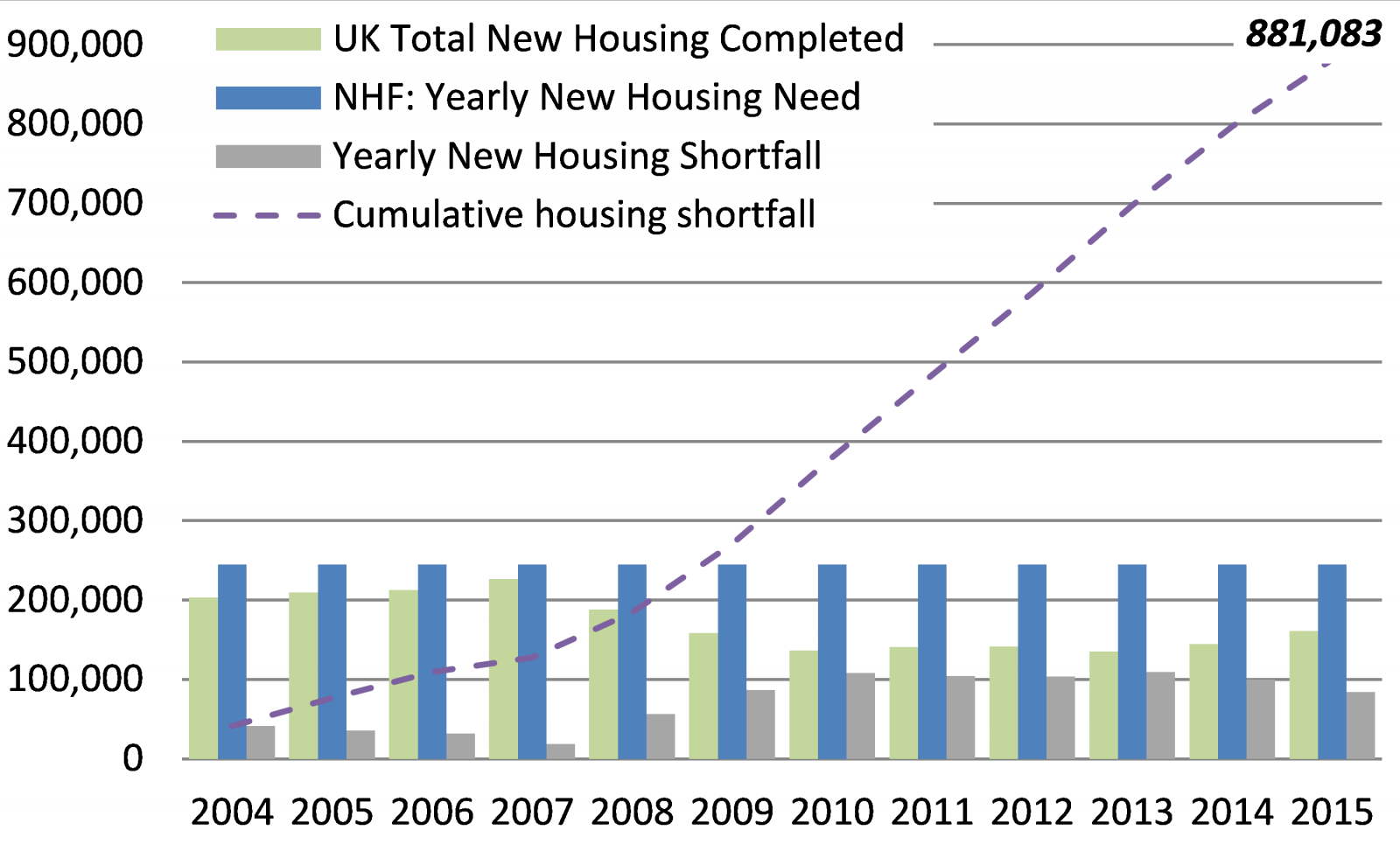
Department of Communities and Local Government
All of this might sound like music to the ears of the nation's house building companies like Berkeley Group, Bellway and Persimmon.
But there are naysayers who believe that these house builders face a big drop in their share prices, similar to the drops suffered during the last recession in 2009.
The Daily Telegraph is one such predictor of house builder doom, judging from an April article Shares in UK housebuilders are the biggest value trap the market has ever created.
It argues in essence that despite the seemingly attractive valuation levels that these house builders currently trade at, that they face a number of headwinds such as:
- a sharp post-Budget slowdown in buy-to-let housing demand from budding landlords now put off by higher taxes,
- the risk that the EU Referendum scares off foreign property investors, and
- the late point in the current UK house building cycle, just as a housing bubble forms and cost pressures increase.
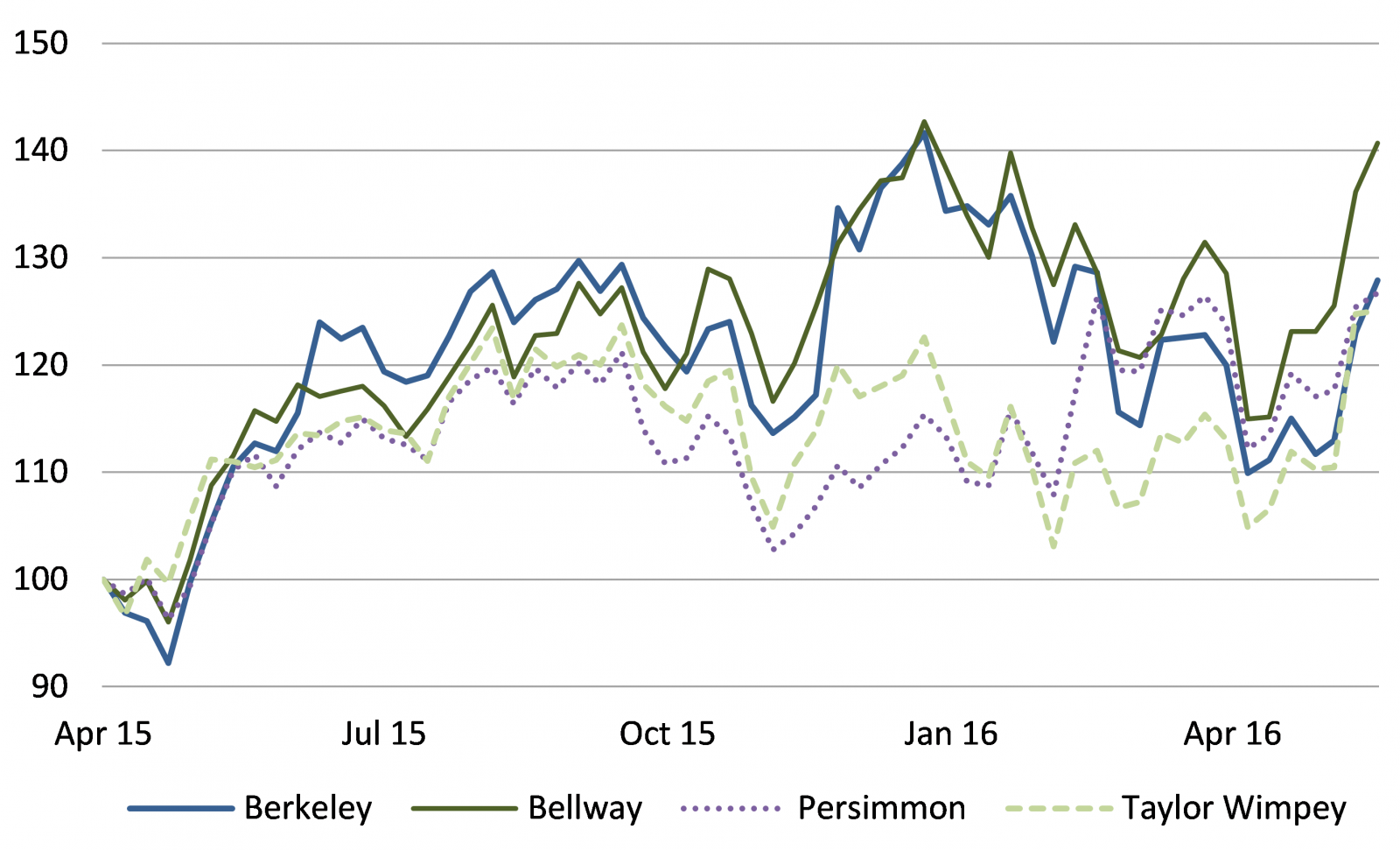 4. House builders see big share price recovery
Yahoo Finance
While all of these points are perfectly valid, I do not believe personally that these effects will be enough to push house building shares down further. After all, they have already suffered heavily from the end of last year up until April this year.
But the last month or so has seen a marked upturn in their fortunes, with many of their share prices back to or even exceeding end-2015 highs (Chart 4).
I believe that house builders will benefit from steady demand growth
I am not a house building doomsayer. Firstly, as we have already established, there is a clear long-term demand for housing in the UK that is very far from being satisfied.
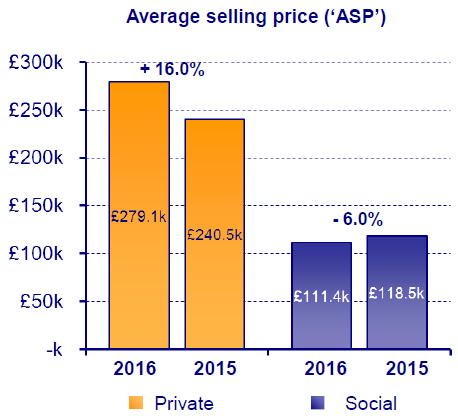 5. Bellway’s private selling price 16% year on year, Bellway
Secondly, house builders continue to enjoy rising selling prices for their new homes – Bellway have seen a 16% rise in the average selling price of their private homes for the six months ending 31st January 2016, which was 87% of their overall homes sold (Chart 5).
Mortgage lending is also holding up well, demonstrating that even after the rush by budding buy-to-let landlords to get a mortgage in March to beat the Budget deadline for the new higher stamp duty on buy-to-let properties, home buyers were still very active in April.
Indeed, the Council of Mortgage Lenders report that April's gross mortgage lending was as high as £18.5 billion, lower than March's bumper figure but still 16% above April 2015's level.
And investors are paid to wait, with juicy income yields
For investors starved of income by ultra-low or zero savings interest rates in bank accounts, house builders represent an attractive source of income from dividends paid out twice per year.
 6. House builders offer a generous 5.5% average income yield
Stockopedia
Holding UK house builder shares could well net you a 5.5% average income yield in the form of dividend payments over the coming year (Chart 6). And remember, dividends generally grow over time in line with profits, so this income payout can even improve in the future.
Summary: I think there are a number of good fundamental reasons to expect house builders to rise over the remainder of this year, so don't believe the doomsayers and tuck some shares away in your ISA.
Disclaimer
This is not financial advice. Our content is intended to be used and must be used for information and education purposes only. Please read our disclaimer and terms and conditions to understand our obligations.
27 comments
4 factors worry me with housebuilders at the moment
1. Historically high mortgage to income ratios of c5x outside of London, inside London it's about 10x according to HSBC research. This is the same as the 07 peak. So we look like we are at peak price.
2. The market is very much being supported by Help to Buy. One sales agent for Charles Church said to me you will hear the market grind to a halt if HTB is stopped.
3. As a result of peak prices, we have peak margins and peak ROCE for virtually the entire sector.
4. The entire sector, Bovis Homes aside, is trading at peak PRice to book, with Berkeley and persimmon trading at over 2x.
I have analysed this sector since 1997 and most metrics look to be at peak. So while there may not be a crash soon, the margin of safety doesn't appeal to me. The sector has typically traded between 0.9x TNAV to 2x in non stress periods. In stress periods the lower end of the range is 0.3x on average.
The one stand out value play to me is Bovis which is on c1.2x FY16 TNAV (tangible NAV Ie excluding goodwill). It has a c4.5 year land bank of consented land and its 19k consented plots represent just over 1 years volumes for Barratt (15k) and Taylor Wimpey (13.5k). It has a 23k land bank of strategic land and converted c10% of these into consented units last year. Its problems appear to be in the building side rather than the price at which the land was bought. This will be a focus for management. If the market remains ok but Bovis doesn't improve its margins it is not out of the question it gets bought (memories are painfully short I assure you in this sector). So I see a rerating potential here that I don't really see in the rest of the sector. On the downside I see it going to 0.9x book, c25% downside, but I think if the others derate it could be much more savage.
This sector will be fun and games until The Referendum is decided!
Good luck...
http://www.civitas.org.uk/content/files/Restoring-a-Nation-of-Home-Owners.pdf
Worth a read...
"Many experts believe that this unprecedented and deeply damaging ‘fourth house price boom’ has been caused mainly by our failure to build enough houses. They blame this on land hoarding by developers, greedy landowners, and conservative planning authorities which respond to pressure from local residents by refusing development permits."
"There are, however, strong reasons for arguing that restricted supply was not the key cause of this crisis of
housing affordability, and that even if we increased construction as many have urged, the impact on house
prices would be small."
"The main causes of our problem have been on the demand side. The failure to control the explosion of credit from the late 1990s onwards grossly inflated house prices, and the historically low cost of credit since 2008
has kept them inflated and prevented the price correction which is necessary to restore the link with earnings (as occurred in the three previous house price booms). The growth of buy-to-let has further fuelled demand, and this has been reinforced by an influx of foreign money into the luxury London market, the strong growth in immigrant numbers, and an increase in the number of parents’ drawing down their own housing equity to help their children buy"
On topic of the housebuilders. This thing is becoming a mighty hot political hot potato, a serious rage is building in the young professional class damaged by this non-sense.
Very much agree. Another day, another story about the way high house prices are blighting young people's lives. http://www.telegraph.co.uk/property/renting/generation-rent-young-married-pregnant-and-stuck-in-a-house-shar/
It's easy to imagine for those not badly affected by this, that things will carry on the way they are. But a look at the demographics of the UK show that things will change. The number of retirees slows down quite dramatically soon. While by 2025, the largest voting bloc will be those of voting age under the age of 40. They will not put up with being weighed down by student debt, low interest rates making it impossible to save or paying 10x joint salaries for a property somebody purchased 30 years earlier for less than 3x single salary.
It's no accident that George Osborne has staggered the implementation of Clause 24 until 2020. I'm sure his strategic plan is to get the keys to Downing Street in May 2020 and kick off the mother of all house price crashes the day after. I'm sure attempts will be made to try and stop the bubble from popping until that time, but I doubt they will succeed.
I don't know why TangoDoc is getting a hard time, so you might not agree, that doesn't make it a thumbs down does it? London has always been a special case and out of kilter with the property cycle that affects the rest of the country If young people can't afford to live in the city then it will have an adverse effect over time. As for land Cordea Saville's, who you would expect to be knowledgeable about land prices started a land fund around 2005 and it was liquidated at zero value and investors lost 100%. Now you could say that gearing was the cause or they bought at too high a price, it doesn't really matter it happened and gave a new meaning to "buy land they aren't making anymore". Everyone has an opinion some will be right and some wrong but not at the same time and certainly not forever. We have the biggest property bubble ever seen in this country and it will burst like all bubbles and that's my opinion. You don't need a lot a facts when figures like" 131% of a years salary is required for a deposit" and at an interest rate of 3% a tiny 1% rise means a 33% increase in repayment.
Sorry can't post links on my phone. Just google it.
Yes I have found it but that is about supplying the wrong sort of property, I would not want to live in a flat, certainly not an overpriced ugly one. If you supply the wrong product then people will not buy it.
If it is lack of supply someone needs to be able to explain nine elms disease. What we have is an enourmous speculative credit bubble. Fingers will be burned when it pops.
"nine elms disease" what is that?
Nearly every post above is addressing the supply side
How about addressing the demand?
Vote Brexit
An increase in population because of immigration is modest in comparison to the persistent survival of baby boomers, a trend towards smaller numbers living under each roof and less extended families, the birth rate, the extreme wealth of some who own more than one home and, in London and the South-east particularly, the phenomenon of homes being bought by foreign investors but not inhabited. Voting Brexit won't change things enough to offset the considerable drain of investment money from uK stocks, as prudent foreigners wait a few years to see how well we renegotiate all our trade deals. If fear of Brexit has already blighted the market, just wait and see what the real thing would do. Of course, we could always restore our nation's glory by a return to piracy, slavery and gun-boat diplomacy that served our ancestors so well. Avast behind!
Not sure that is correct, 2015 uk population grew by 500,000 net migration was over 300,000.
Are all these housebuilders also land speculators? If planning regulations ever got relaxed, you could get a scenario where land prices go down yet more houses get built -- when it's a good time to be an actual builder rather than a land bank.
I can't see land prices falling that much. There just is not enough land available, this is a small country with a high population. France has about the same population as the UK but its over twice the size. Yes there is land available but its in areas of low demand because of lack of jobs.
The shortage is of land with planning permission for residential buildings. Just abolishing the green belt(s) would do wonders. A lot of the existing urban housing stock is also low density, which could be rebuilt to higher density given the right tax/legal incentives. It's pretty difficult to do politically given vested interests, but that's not a physical space issue.
England is still most densely populated country in Europe. The south east is very densely populated. Yes you can build more houses but the natives will not like it. Much of that land is farm land so that could cause issues also. At the moment I think I would rather be a land owner than a builder.
I'm not sure about England as a pure entity, but, considering the UK as a whole, it is only the tenth most densely populated but that is not the relevant issue. What matters is whether there is enough money to go around to feed and shelter us all, and there is, but, I am ashamed to suggest, not the will to share it reasonably and the behaviour of people when crammed together in competition with each other. Perhaps we could ask how Monaco copes?
OK you can pick out countries like Malta and Monaco. But Monaco has a population of under 40,000, thats just a small town, its a bit different from 55m. Yes we can have 200m I'm sure but who wants to live like that. Its one reason why I moved away from Essex, its getting too built up, its becoming like London. But it will get worst if we stay in Europe, once countries such as Albania and Turkey join our population could soar and if we have to pay them benefits and provide housing we will start to feel the pinch.
While we insist that all life in the UK is London-centred, then it could well be unpleasant to live near there. I'd hate it though lived there in the 60's as a student when the London population was 11 million. Of course, we didn't all own a car each then. I have two daughters living in London after being raised in a hamlet in Leicestershire and they just love the melee.
No likelihood of Albania or Turkey ticking enough of the boxes to get admitted to the EU in our lifetimes. In my view, all the social ills we face in the uk are brought about by our own governments and can just as well be managed by them too.
Londons population has never been 11m, never been over 9m: http://www.londonspovertyprofile.org.uk/indicators/topics/londons-geography-population/londons-population-over-time/
I stand corrected. i don't know why that figure was stuck in my head.
House prices are driven by the supply of bank lending into the sector. Anybody who thinks differently has to explain why house prices fell by between 16 & 20% (depending whose index you believe) in 2008. The only fundamental change in 2008 was that the supply of lending into the market from the banks slowed down dramatically. It was only the introduction of various schemes to increase liquidity that stopped housing falling to fair value.
The Bank of England and the Government have both indicated they want to stop leveraged Buy to Let. The Government with 3% extra stamp duty on second or more home purchases, clause 24 and not moving CGT on property gains from 28%. The Bank of England Prudential Regulation Authority proposals tighten the screw on BTL lending. But the killer blow will be applied by the BCBS, where the Bank of England have been heavily involved in drawing up new risk weightings.
Buy to Let have been the vast majority of buyers at current prices. They are the only ones who still have access to interest only mortgages where their earnings from employment are not relevant.
How much are houses worth when buyers are constrained by the MMR rules (which themselves are pretty lax in historical terms)? They certainly aren't worth 10x or more local salaries which is where they've got to in many places.
House prices are heading down regardless of the result of the EU referendum. If the EU referendum result has any influence at all, it will be on the pace of the falls.
While I certainly have a lot of sympathy with this view, it does not tell the whole story.
The chart below shows the UK house price index (Halifax) against Bank of England data on mortgage approvals.
You have a point about bank lending however I don'y entirely agree, if demand in London was low prices would not be so high? Prices in London could well fall because foreign buyers are not buying anymore. Its nothing to do with bank lending. If no one wants to but a property then it will not sell, the price will fall until someone does buy it, if several buyers want the same property usually the price goes up. House prices crashed in 2008 because there was a recession, people were losing their jobs, people were not moving house and yes bank lending was also a factor.
Suppose there is a group of people in the market who thought that property would only go up. They may own 1 or more properties already. They'd be willing to release "equity" from their existing properties to put towards a deposit on another property. They'd be willing to continually increase their borrowing. When it came to negotiation on another property they would be willing to pay whatever uplift in value they considered that their own properties had achieved within the same period. In fact it wouldn't be in their interest to drive a hard bargain and move prices down as they wouldn't be able to release any more "equity" from their existing properties. If they need any encouragement I'm sure Estate Agents would happily invent another buyer for them to bid against.
Sounds a bit like a ponzi scheme. It's also, I suggest, the UK housing market since the financial crash. There are figures which show that the lions share of the increase in mortgage lending since then has been Buy to Let. The madness is best demonstrated by the activity before the introduction of the extra 3% SDLT where houses were being bid up by 7,8,9% or more to avoid the extra. But when you're only putting up a 25% deposit, 3% on the entire purchase price means finding an extra 12% in actual cash.
The Government and the Bank of England have both indicated that they intend to kill highly leveraged BTL. What happens next is a matter of opinion and what makes a market. My opinion is that house prices are heading down and a damn good thing that will be too.
I think are are right that house prices will fall, the question is when? The vote in 3 weeks time maybe the the trigger if we vote leave. If house prices fall it does not really bother me, I only have 1 house, I have to live somewhere, it will only bother me if I emigrate.
Is affordable under £600,000? Yes he could do that. House prices are about supply and demand. Yes I agree I think there will be a bounce after the EU vote. I did sell some last year but picked up Berkeley Group (LON:BKG) on recent fall.
Agreed - post-Referendum I think these are a good shout. I think they are currently being held back by concerns of Brexit and if we believe the odds that the Remain camp have it then housebuilders will perform well throughout the rest of the year in my opinion.