Zytronic: When a profit warning comes good

Introduction
Zytronic is a company that I first heard about on Paul Scott's blog roughly eighteen months ago. This isn't too surprising given that they're a niche manufacturer of touch screens who supply to industrial clients; hardly a household name. And yet many of us will have seen (or felt) their robust, vandal-proof products in a public space and been impressed by the sheer scale of the displays.
The problem with Zytronic is that they warned very significantly on profits back in May 2013 and the outlook appeared cloudy at the time. In the end it took the best part of a year for the company to demonstrate that this was a one-off blip and, for obvious reasons, the market in the shares remained subdued for perhaps another six months.
Now, though, the shares have reached the level that they were at before the profit warning (although still 20% down on the all-time high point) and the recent full-year results demonstrate real strength. My questions then are: is the Zytronic recovery sustainable; is there more growth left in the tank; and is it reasonable to buy at the current price as a long-term holding?
How do the numbers look?
There's no doubt that Zytronic, as an investment, is of above-average risk. It's small (£45M), listed on AIM (lax regulation), reliant on lumpy orders with limited visibility (customers order on demand) and engaged in an innovation arms race (touch screens are constantly evolving). These are all big red flags for companies with weak management or who supply high-volume, low-margin markets or those without some sort of moat.
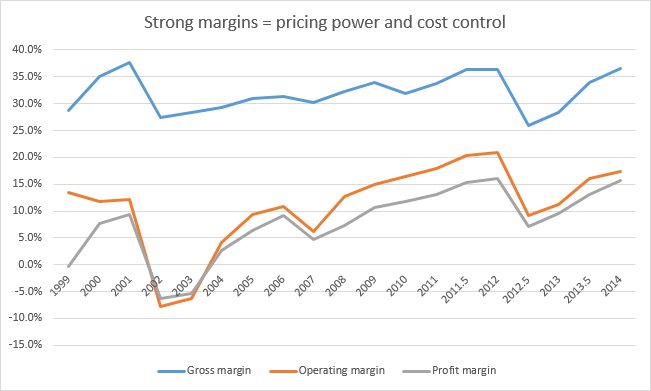
Fortunately Zytronic exhibits none of these problems and the consistently high gross margin demonstrates that they're in a sensible low-volume market. The net profit margins have proved more volatile but I think that there are two key points here: the business was badly impacted by the World Trade Center attack, and the 02/03 years were tough, but since then management have been hot on controlling costs and maintaining focus:
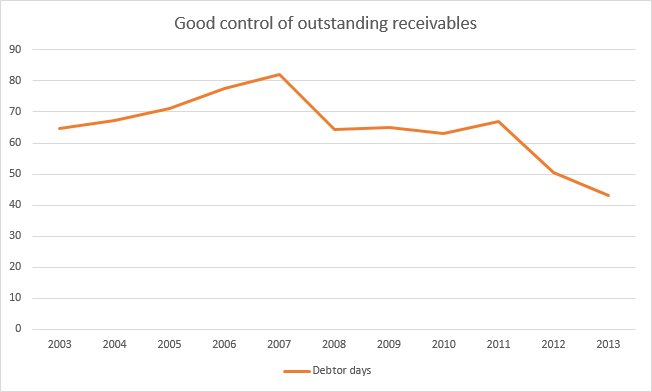
Another aspect of cost control, and clout in the market so that you don't get pushed around by the big-boys, is how effectively you manage outstanding debts. In a small firm like this you might expect to see invoices being paid within a couple of months, on average, and Zytronic are in this ball-park. However I really like the fact that the trend in debtor days has been downwards since 2007 and significantly so:
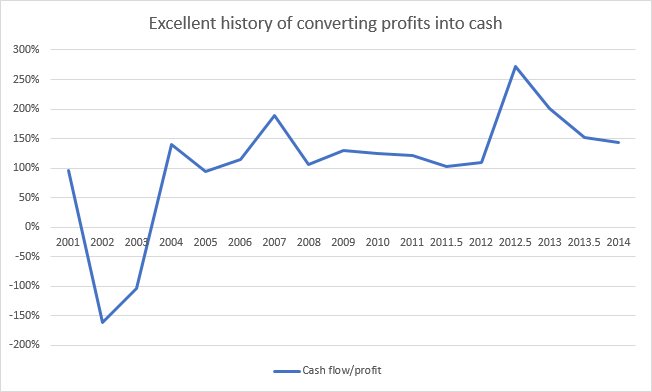
This is all great, and management appear in control, but it doesn't tell me whether the business is generating cash or if it's levered up to its eyeballs. To get an idea of this I like to compare the operating cash-flow to the operating-profit; if all is well then most of the profit should convert promptly. On this score Zytronic is more than impressive with a conversion-ratio above 100% for the past decade (the spike in 2012 is down to working-capital being released following the profit warning):
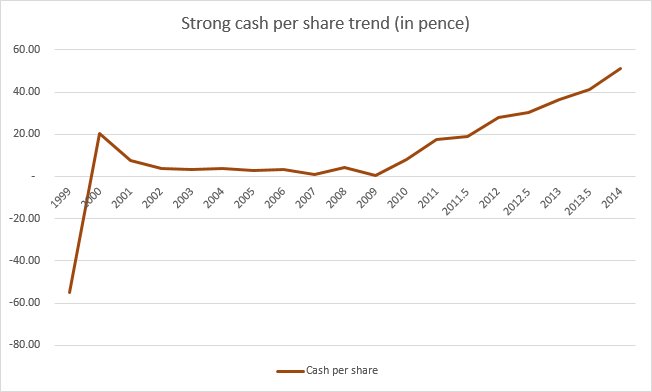
So lots of cash is being generated but we're not out of the woods yet. This cash could easily be sucked up by capital expenditure, debt servicing, legacy pension costs or over-generous dividends (to enumerate just a few options). Fortunately the company have three high-tech factories with good capacity (so capex is generally low but spikes occasionally), there's no debt, no defined-benefit pension scheme and dividends are typically over 2x covered. The payoff is an ever-increasing cash-pile of security:
There is a downside to all of this lovely cash though. It's up to about a sixth of the market cap and yet it's not doing anything; the interest being received on it is derisory and it's not required for working capital, R&D, capex or acquisitions. The inevitable consequence of this is that the ROCE ratio gets dragged down because so much equity isn't paying its way; even so the ROCE history (lower line) for Zytronic is really very positive:
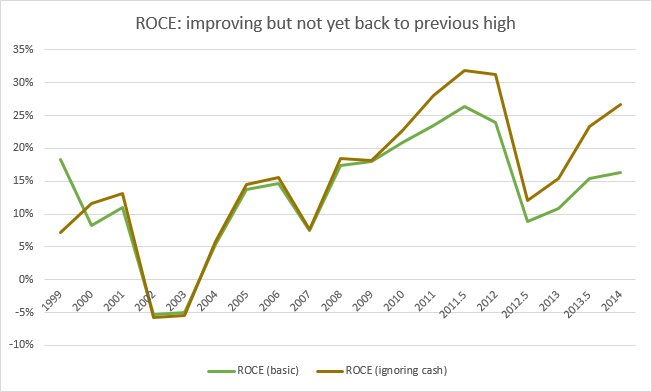
It's amazing really that the ROCE rose to 26% in 2011 but since then the return hasn't been so rosy what with the profit warning and cash-drag effect. If the cash is naively stripped out then the impact on ROCE can be seen in the upper line; before the order-gap last year the company was really flying. That said the recent trend is excellent and I can see how a return of 25% might be achieved next year.
Up until this point I can't think of anything I don't like about Zytronic apart from, perhaps, the nasty order-book gap last year. Since this juncture management haven't put a foot wrong and the share price has entirely recovered. So it's worth considering whether the company is now fairly-valued, if not perhaps over-valued, given the strength of the rehabilitation. Looking at the historic P/E ratio since 2006 (before this time profits were small and/or negative as the company grew) the average is around 18 but with extended intervals spent in the 10-15 range:
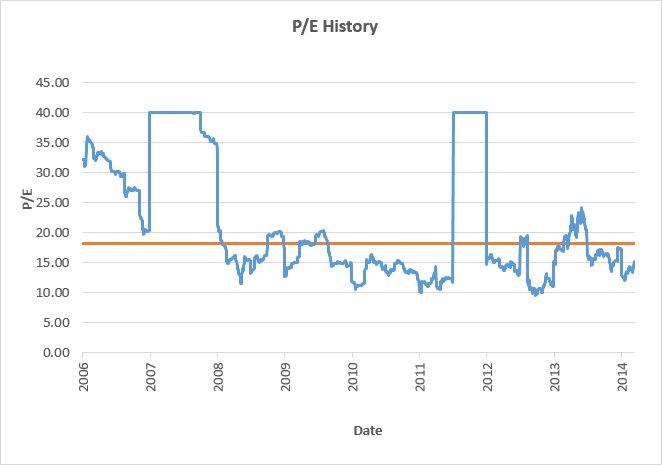
With a current P/E of 15 then the price is pretty much bang on trend and at about the right level. From a yield perspective the picture is more rewarding; for the last decade the payout has grown impressively and without pause. The consequence of this commitment to shareholders is a well-covered current yield of 3.5% - impressive for a small firm on AIM:
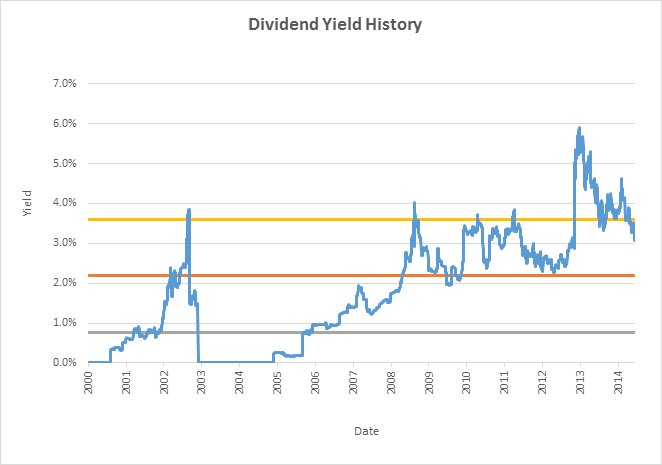
Given the size of the current cash pile management could easily increase the payout ratio or, if that feels improvident, a special dividend would also go down well. Either way the company is paying a healthy income without any strain on the balance sheet. As such I have no problem with the valuation of the company right now and can easily see the share price continuing steadily upwards if the business maintains momentum.
Conclusion
I must admit that I like Zytronic a lot and I particularly appreciate how transparent and direct their shareholder reports are. There's no spin or attempt made to adjust away bad news; when the poop hit the fan in 2013 there was no easy way to soften the blow and management didn't try. Instead they described the problems and, more importantly, laid out a plan to get the company back on course with a sensible recovery strategy.
In line with this plain speaking there's also no sign of the directors sticking their snouts in the corporate trough. The executive salaries are very reasonable for such a well-run company and the share options available are quite modest; just one reason why the share count has increased by less than 5% since 2001! This is indeed a self-financing, tightly-run ship.
Ironically this leads onto my most pressing concern with this firm; the management have negligible stakes in the business and when options vest they're as likely as not to sell their shares immediately. I admire this steely resolve not to feather their own nest but I wouldn't be averse to awarding the directors a few more options to align their interests with ours; rather a rare situation I'd say!
The other worry is the on-demand nature of orders, with limited visibility, and the reliance on three major customers for almost 50% of sales. I'm sure that these are fine clients but it would be pretty painful if one of them decided to move their business to a competitor. On the other hand the company is trading well and seems to occupy a high-end niche with a fair moat of technical expertise.
Overall I'm very impressed by both the management and Zytronic itself. There's nothing that I dislike about their stewardship of the company, the financial stability of the firm and the impressive comeback from last year's shock. I think that the brand has further to go in terms of expansion and in the meantime there's a healthy yield to enjoy. Not all AIM shares are rubbish I guess!
Disclosure: the author now holds shares in this company
Disclaimer
This is not financial advice. Our content is intended to be used and must be used for information and education purposes only. Please read our disclaimer and terms and conditions to understand our obligations.
23 comments
Hi Damian,
I've re-read your article, and it really is excellent, in particular the graphs you produce.
Personally I think ROCE is over-rated, because it encourages companies to take risks with their balance sheet, in order to produce a better ROCE figure - whereas as an investor I want them to be doing the opposite - accumulating assets (such as freeholds and cash) to protect my downside risk.
So your chart showing ROCE, and ROCE (excluding cash) was particularly interesting, and a very good way of displaying things.
Thanks again for an excellent article - I really like your in-depth analysis on particular companies.
Regards, Paul.
Thanks Paul - praise is always appreciated!
On the ROCE front I tend to agree that it is vulnerable to manipulation and so:
1) I think that it has to be considered in the round - if a company is running with a weak balance sheet then this will show up elsewhere. So ROCE is definitely not the only metric to use.
2) If a company has historically demonstrated a stable ROCE over many years, like Next (LON:NXT), then I see this as a positive factor and suggestive of a business with pricing power. If they've been taking risks then I expect the ROCE to be a bit more volatile!
Cheers, Damian
Great article. Out of interest, how do you make the P/E ratio and Div yield ratio history graphs? Are they from Stockopedia or do you get them from elsewhere?
Thanks tborrill. I'm afraid that I hand-craft the P/E and yield graphs (along with all of the others) in Excel!
Essentially I work out the rolling yield and P/E from the interim and final reports and chart this against the share price history as far back as I go. A bit of work but quite revealing I think.
Cheers, Damian
Thanks for replies about Russia. I think it is not so much Russia but CIS here is exact from RNS "Non-ATM kiosks, a buoyant application area in the former CIS territories in 2012 and 2013,countered the ATM unit increase with a 10,500 unit decline to 3,300 units. This was due to the geopolitical conflict effects in the region in 2014, which reduced overall infrastructure spend."
This is not clear but I understand its because of conflict in Ukraine? 10,500 decline does sound quite significant but in the overall scheme of things maybe not and its hardly going to fall much more.
My concern about sp is its gone up 50% in last 4 months, so feel I have missed the boat again.
OK I see where you're coming from herbie47. While I'd rather the CIS business hadn't declined so much in some ways I'm impressed that the company was able to handle such volatility. It seems to suggest that they have fingers in a lot of pies!
On the share price front I'm definitely coming round to the point of view that Ed has mentioned recently - which is that momentum is under-estimated as an indicator of out-performance by investors while too much weight is given to growth. While I'd love to bought in six months ago I still think that the numbers stack up and the price is already heading in the right direction!
Damian
Damian. The Zytronic regional sales split is in their YE presentation: http://www.zytronicplc.com/assets/Uploads/2014PreliminaryResultsPresentation.pdf which shows APAC (Asia/ Pacific region which includes Russia) as £4.1M of £18.9M turnover. The Russia news item relates to healthcare expenditure (probably private so not likely to be badly hit), but might be worth contacting the company to check? Ian
Hi Ian - I also looked at this presentation and came to the conclusion that Russia should be in the EMEA bucket rather than the APAC one (see http://en.wikipedia.org/wiki/Europe,_the_Middle_East_and_Africa). However it doesn't really matter which region Russia is in when it comes to knowing just how much profit depends on the rouble!
Herbie; I believe that 90% of their sales are export with a very wide spread of exporting countries; We need a lot more of these type of companies in the UK. The price doesn't look hot if you take into account the previous SP peak of 360p, nor that there is £7.8M of cash in the bank, (16% of the Market cap). The forward PE of 14.2 will drop if brokers further upgrade. Add to this a Quality score of 99 and an overall Stockrank of 99 and I can think of at least 99% worse companies to invest in!
I like ZYT but feel the sp is too high for me to invest at present. Also I have read elsewhere they have some exposure to Russia?
Hi herbie47,
It's true that the share price has been on a bit of a streak in the last few months but looking at the results/forecasts it feels to me that this is a catch-up rather than over-shoot phase. The company is no longer cheap, for sure, but I think that the recovery is proven and that there's more to come.
I'd like to see any links that you might have regarding Russian exposure though. There's no doubt that some of their exports end up in Russia (e.g. http://www.digitalsignagetoday.com/news/zytronic-touchscreens-powering-russian-e-health-kiosks/) but I haven't been able to determine how much revenue they derive from this market.
Damian
One of the things I really like about Zytronic (LON:ZYT) is that when they had a trading hiccup in 2013, management said the business was sound, they maintained the divi to emphasise that, said things would get back on track, and things did get back on track.
That builds a lot of trust between management and investors. Which is one of the reasons that I think this is a cracking little company. That, and the high operating margin, and the Bal Sheet stuffed with cash. Good outlook too.
Regards, Paul.
Just been reading through the full annual report that Zytronic put out at the end of last week. No big surprises in the notes which is good. Still I was impressed to see that their head-count is the lowest it's been in the last decade; that takes some doing. OTOH the total salary cost went up due, in part, to £400K in bonuses for the workforce. So the overall impact is pretty neutral; fewer workers for being paid more to work efficiently.
In terms of commentary it all looks good for the future and the company has some excellent products coming to market (such as curved screens). Also there seems to be improved focus on foreign distribution and an intriguing collaboration with Cryptera in the encrypted payment space. I could find much on-line about their research but hopefully there'll be a positive surprise in due course.
Oh and on the timing front it's more that I have lousy timing with respect to the market as a whole - on Monday I figured that we'd seen a decent pull-back and so opened up a handful of new positions. As soon as I'd done that, in the morning, the market tipped over the cliff and went into free-fall! Like I say I've got terrible timing (in the short-term at least; in the long-term it's pretty immaterial).
Damian,
If we could time when the market is at a low the task would simple. The stockmarket has been compared to a drunkard walking down the road - Impossible to predict which direction he will swerve in next!
Typically small cap shares do well in January so what you think may have been a poor entry point now may not be so in the end. With momentum shares, "Buy high, Sell higher! Good hunting, Ian
Damian,
If you are looking to improve your buying timing I suggest the look carefully into the directors comments in the trading reports and company presentations for clues about future trading. Look for optimistic, or better still "exceed expectations" information and judge this against historical value and quality numbers. Also look for anything that could be transformational and solves a problem - So buried in the Zytronic text was a new Feb 13 project pipeline tracking system designed to produce chase up or future sales. This is a simple transformational change that should reduce future profit warnings from lumpy sales. However the nature of their business means that sales will vary up and down and that's a fact of life.
The short term sales are ahead and the project pipeline is stronger, so with your positive financial trends, reasonable valuation and moat, I conclude that there is more in the tank! As ever DYOR - Ian
Hi Ian,
I absolutely agree and thanks for the advice. I know that I need to move beyond simply establishing a decent valuation and a solid trading record; the future is where growth lies and I need to consider the clues available. e.g. the new tracking system is a key one here along with the management comments.
That said in the past I've found myself overly influenced by rosy director forecasts, bullish bulletin board posts and general over-optimism about how the problems leading to a (theoretically) low valuation are going to be miraculously overcome. So I now force myself to be very cynical and to look purely at the numbers in the first instance; only if they look reasonable will I move onto the commentary and the bigger picture.
It's not a perfect system, and there's room for improvement, but it's a start!
Damian
Zytronic (LON:ZYT) is a cracking little company.
To a large extent though, you're wasting your time over-analysing figures.
It's all about now, and the current order book.
Regards, Paul.
Come on Paul don't discourage the lad, it is worthwhile to understand what a company does and how its figures stack up, otherwise how would you know its a "cracking little company?" While I agree the future returns (unknown) will be driven by current trading / order book and the starting valuation it does helps to know the nature / quality of the business .
I agree the past numbers are important to help judge likely future success.
In relation to the future, the order book is reported to be strong and the number of new projects is almost double. As important I see that very sensibly Zytronic introduced a new project pipeline tracking system in Feb 13 (coincidentally or not about 6 months into the YE 2013 profit warning). This is designed to monitor and develop new business enquires and mitigate lumpy sales and to avoid nasty surprises.
So a more of a planned approach is in place and to me their future looks a lot brighter.
Dec 2014: "Whilst we are only a couple of months into the new financial year the sales and order book are ahead of last year and our focus is on continuing to increase value for shareholders now and into the future. As at 30 September 2014 we have 69 active projects. Digital signage remains the strongest application area in terms of project volume. Strengthening is also observed in the financial, gaming and industrial sectors, where the number of active projects at the period end is almost double in each instance compared with the period start.
"During the year, a total of 342 enquiries have been validated and logged, bringing the total of validated enquiries to 718 since the initiation of the revised opportunities pipeline logging system that was introduced in February 2013. 120 of these enquiries have been converted into customer production and orders throughout the current financial year. Although being a project driven component supplier on an average 4 week order to delivery schedule, which creates short order book visibility, we have successfully countered this through the broad applications base for our components and the strength of the developing opportunities pipeline".
Ha ha! Thanks Paul - I'm glad to know that we're thinking the same way.
However I disagree over whether or not historical analysis is worthwhile for a couple of reasons:
1) If the management in place are broadly unchanged then I want to draw a picture of their reliability and whether the company is stable and taking advantage of a market where a decent return can be made. How do they react in good times as well as bad? Do their actions in one year reflect the comments of the previous year? Can they be trusted? Do profits normally turn into cash? Is the company propped up by frequent share issues?
2) I have terrible timing and absolutely no gut feel for the market as a whole or even companies individually. I don't know why but I just don't. So I need the discipline of forcing myself to really look at the story that the accounts portray and consider just how the numbers are being manipulated to create this story. I can't just go on recent figures or forecasts and future possibilities and be successful.
That said I know that I need to give more weight in my thoughts to current trading and how this might be extrapolated over the next 6-12 months. So any feedback is welcomed as I want to deliberately improve my analysis!
Cheers,
Damian
I agree with your Zytronic (LON:ZYT) analysis and add a few comments as a holder. From a quality aspect the recent return numbers are great (inc ROIC 22%), the F score whilst listed as 8 is only a whisker from F9 (click on blue Piotroski F-Score to see actual pass/fail numbers) and the SR is 99 (in Top 1% of the market). Add 3M positive momentum, positive chairman comments and the likelihood of further broker upgrades and it's got the makings of a AIM winner. As ever DYOR. Ian
Hi Ian,
Thanks very much for your considered thoughts. You're spot-on about the F-score; very, very close although a cynic might say that they could have hardly failed to make more profit than last year (one of the other Piotroski checks)! Also I probably should have mentioned the positive director comments and recent earnings upgrades; all of this bodes well.
Damian