How JD Sports proved the potential of stock market high flyers

Two years ago, the fashion retailer JD Sports showed all the signs of being a high quality business that was growing popular with investors. In a competitive market, it was carving out a niche for selling activewear at premium prices. The only catch was that its share price was starting to look as premium as its products.
Since then, JD’s high quality and relentless momentum have propelled its shares by an impressive 250%. But only with the benefit of hindsight could you say that JD was ever a bargain in recent years.
This investment profile belongs to a group of companies in the stock market known as High Flyers. They are companies capable of compounding strong returns over many years - but you have to pay up for the privilege of owning them.
A case of style and substance
A key feature of High Flyers is their financial and franchise quality. Often they have strong brands or services that customers love. JD’s business model has deliberately left the “stack ‘em high, sell ‘em cheap” model to competitors like Sports Direct. By focusing on well designed, appealing stores, it’s attracted the best ranges from higher-end brands.
That makes it impressively profitable. JD produced strong operating margins of over 10% last year. Its return on capital - the returns that it gets from investing in store roll-outs - are an eye-catching 37%. And that roll-out programme is now accelerating across Europe.
Profit surprises spur momentum
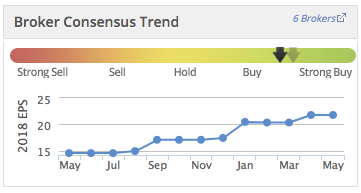
Fast, profitable growth acts like a magnet in the stock market and it causes prices to rise relentlessly. This is exactly what we’ve seen from JD. Over the past year, analysts have continued ratcheting up their 2018 earnings-per-share forecasts for the company - hiking them from 14.6p to 21.8p. That’s a considerable increase in growth expectations for a £4.3bn business. These upside surprises and regular forecast upgrades have underpinned the momentum in JD’s shares.
A premium share price
The inevitable catch for buying strong quality and momentum is that the prices of High Flyers risk bringing traditional value investor to their knees. Against Stockopedia’s ValueRank, JD has consistently looked pricey, yet the trade-off can be seen in the price performance.
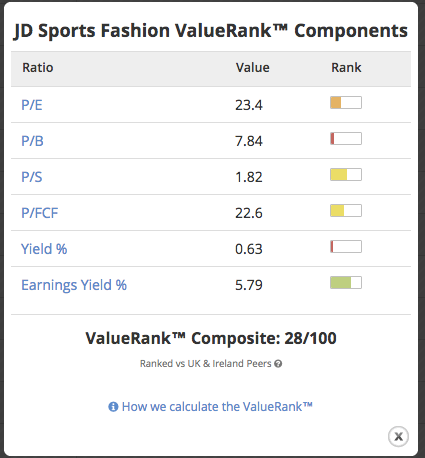
When it comes to valuation, what one investor sees as expensive, another may well view as a good deal. That’s exactly how Paul Scott saw it back when he reported on the company in February. If JD can keep growing at this pace, then it might be cheap at the current price. But like all High Flyers, the momentum factor is prone to reversals if growth slows and expectations are dashed.
A stock market High Flyer
JD isn’t the only company on the stock market with this type of profile. Against Stockopedia’s new Style and RiskRating classifications, it’s a Balanced, Large Cap, High Flyer. This is easy to screen for in the StockRanks portal (more details on how to do that are here), and the results include some well known names:
Name | Mkt Cap £m | StockRank Style | Value Rank | Risk Rating | Sector |
7,978 | High Flyer | 39 | Balanced | ||
5,737 | High Flyer | 24 | Balanced | ||
9,920 | High Flyer | 44 | Balanced | ||
3,578 | High Flyer | 28 | Balanced | ||
8,063 | High Flyer | 34 | Balanced | ||
22,658 | High Flyer | 36 | Balanced | ||
7,377 | High Flyer | 32 | Balanced | ||
4,330 | High Flyer | 28 | Balanced | ||
6,714 | High Flyer | 26 | Balanced | ||
3,527 | High Flyer | 42 | Balanced |
It’s worth saying that they’ve not all got relentless histories of unwavering price momentum. For example B&M, the discount retailer, ranked pretty poorly for its quality, value and momentum just a year ago. But improved quality lead to stronger momentum and it now has a much stronger profile. Most of the others, particularly Micro Focus, Mondi and Burberry have much longer histories as high quality, strong momentum stocks.
The appeal of this High Flyer approach is that it targets some of the best quality, fastest moving shares in the market - but they’re not immune from setbacks. When uncertainty sets in, the momentum in these shares can plummet. So they need to be watched carefully. But the flipside of that risk is that the combination of two factors in quality and momentum can zero-in on the type of company that’s capable of compounding investment returns over the long term.
Disclaimer
This is not financial advice. Our content is intended to be used and must be used for information and education purposes only. Please read our disclaimer and terms and conditions to understand our obligations.
20 comments
As Minervini states in his book, some of the best growth stocks that go on to be superperformers look expensive before their superperformance phase.
Let's face it, most value investors miss out on the best performing stocks.
Yes that true lately, I have switched from being a value investor to momentum. I used to hold JD Sports Fashion (LON:JD.) until recently, in the past they always looked too expensive, I should have bought just after Brexit vote but I was not buying shares then, so when they dipped down after a TV program I did buy some at around 310p, just feel too many headwinds, some costs I don't think have been factored in really such as business rate rises, high street retail is not a sector I feel comfortable about at the moment.
I like JD and was lucky enough to catch a 200% rise between 2011 and 2015, but as a value investor the price is now way outside of my comfort zone.
I would happily get back in again, but the company would have to issue a profit warning or two, or have some other problem in order to drive the price down.
A thirty or forty percent decline should do it, but I'm not holding my breath!
people have the mentality that once something is a high flyer most if its gains are gone, ie at the top level, and cant go any further which is incorrect.
The trick is to find them before they get high flyer status, anyone can flag a stock or company once its had a 200%rise!
Nonsense.
Explain please
Maybe you should read Minervini's books. Also a lot of high flyers keep on going up for years, there are some screen's on here. Also look at Phil's fantasy fund.
Read them thanks
I regularly buy high flyers and get excellent returns from them.
This does need to be linked to a Bull mkt when entering to provide a buffer for the 20% retracements, otherwise does require a deal of confidence.
The stocks that will transition towards official High Flyer status (according to our Styles categorisation) will usually start from one of the following buckets:
1. Momentum Traps - i.e. high momentum shares that are high priced with low quality ranks. If the momentum turns into a profitability turnaround then the improvement in the Quality Rank will transition the stock to High Flyer status. An example here may be a company like Sophos that's projected to turn profitable.
2. Super Stocks - high QVM companies that start 'cheap' but gradually get more and more prized by the market, eventually becoming so pricey they shift to High Flyer status. The temptation is to sell these stocks too early, but it's normally a mistake if the Q & M ranks stay high. We've seen this transition time and again. JD Sports is a classic example - several years ago it was a high QVM share, and many were skeptical of it... but as it's got more and more expensive, the shares have kept on trucking. Looking narrowly at PE ratios could have led to an early sale.
3. Falling Stars - i.e. high Q, low M, low V - the Falling Star bucket often holds High Flyers that are taking a pause. While this category underperforms the High Flyer Style on average, it is the best performing set of the losing Styles and can be a good place to look for out of favour high quality shares. There are some really great companies in this bucket right now - like Domino's Pizza... the question is whether they can reclaim former glories !
Thanks Ed, a sensible reply is much appreciated,
Of course not all Momentum traps are unprofitable, I hold one Burford Capital (LON:BUR) where the profits went up 74% last results but it's still a momentum trap, QR is only 37, I believe the figures are skewed because of an acquisition just before the results. I'm still holding.
There's a great thread on Burford Capital (LON:BUR) elsewhere including an explanation of why it's rated as a momentum trap but it's actually more of a fund? Do search for it!
Thanks, I am aware of it and think you will find several of my comments on there. I don't always agree with Stockopedia ratings.
Hi Ed,
If you could crunch some numbers it would be interesting to know ...
1) What %age of Momentum Traps migrate into High Flyer?
2) What %age of Falling Stars migrate into High Flyers?
(The migration to HighFlyer is not in itself a guarantee of a profitable investment either)
I think this would highlight the folly of trying spot outperforming High Flyers of the future whilst they are Momentum Traps or Falling Stars.
Personally when I filter for High Flyers I'm still very particular about the characteristics I'm looking for PLUS they will need to be breaking out or continuing an existing bullish trend.
Of the 124 stock that have cycled through my Fantasy Fund (and my personal trading accounts) over the last 4+ years I have had:
1 stock gain 300%+
4 stocks gain 200%+
5 stocks gain 100%+
11 stocks gain 50%+
12 stocks gain 30%+
9 stocks gain 20%+
33 stocks gain 0%+
21 stocks lost <10%
18 stocks lost < 20%
5 stocks lost < 30%
4 stocks lost 30%+
So my performance is not boosted by a stellar 10 bagger but rather a steady stream of hits combined with a determination to cut losses early. In fact the big losses, i.e. 20%+ were in the early days of the fantasy fund and I'm much more disciplined now.
Best of luck
Phil
Average Loser -13%
Average Winner +50%
Yes , but then it comes down to the depth of Quality , which means more than looking at the 'Q' rating.
Having had a long position in JD for a number of years it is worth checking a 5 year chart which shows consistent share growth over that period with good sales volumes on purchases over that time frame.
One of the best High Flyers that is worth considering iand again I am holding a long position is a US share MOMO with a sales growth of 524%
Worth checking comparrison of these twu shares over the last 6 months.