How to find high quality shares that might pass the Warren Buffett test

Opinions are divided on how Britain’s Brexit-inspired political rollercoaster will play out in the the stock market. But one thing’s for sure, the active fund management industry is already feeling the effects. Risk-wary investors have been pulling their cash from active funds at a rapid rate this summer... but not everyone is feeling the effects.
Over the past six months Keith Ashworth-Lord has seen the size of his Sanford Deland UK Buffettology Fund nearly double to £1.13 billion. In that time, the number of holdings in the fund has risen from 30 stocks to just 34. That’s a big clue about the careful stock selection and high conviction that lies behind Ashworth-Lord’s strategy.
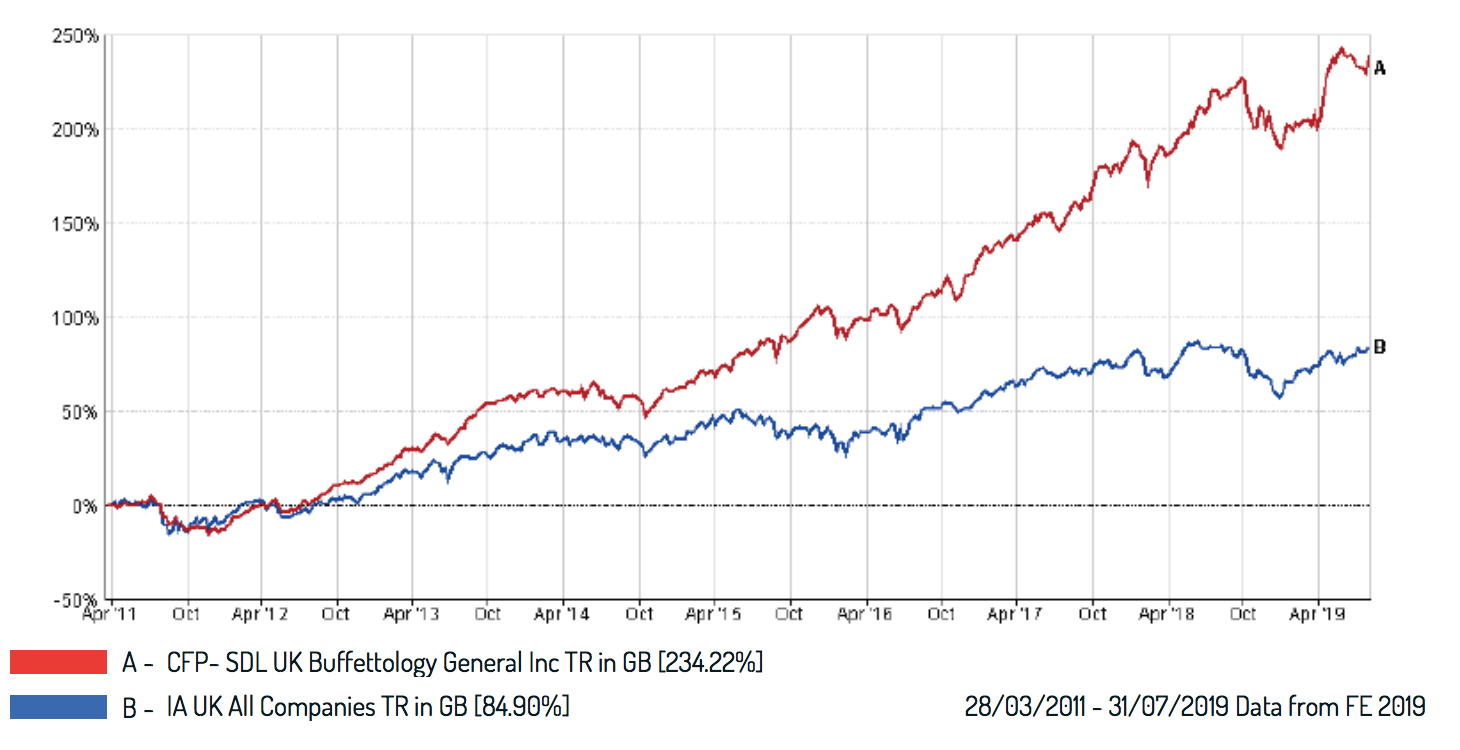
When I interviewed him three years ago, the fund had just crossed the £50 million mark - and then, just as now, he was insisting that 30-or-so stocks was adequate diversification.
As the name suggests, Ashworth-Lord’s Buffettology Fund takes its cues from the investing approach of the legendary investor, Warren Buffett. And while it’s easy to see why Buffett’s multi-billion dollar fortune is enviable, a big part of his appeal is his consistent common-sense approach to the stock market. His attitude to buying and holding stocks seems perfectly logical - so it’s understandable that others try to copy it.
Mimicking the success of a billionaire is perhaps easier said than done. But some of the most important lessons to take from Buffett’s journey as an investor come from how his thinking changed over time.
In his early career, Buffett was (literally) a student of Ben Graham’s deep value investing philosophies. Some of his early money was made in the kind of ‘cigar butt’ stocks that most investors wouldn’t touch. But as he said at the time: "A cigar butt found on the street that has only one puff left in it may not offer much of a smoke, but the bargain purchase will make that puff all profit."
It was only when he teamed up with business partner Charlie Munger that Buffett’s value focus started to soften. Munger was insistent that it was worth paying a fair price for quality. From there you can see why Buffett arrived at the view that his favourite holding period was “forever”.
A focus on long-term quality
Whether it was stocks like Coca-Cola and IBM, or private companies that their Berkshire Hathaway conglomerate bought outright, Buffett and Munger were focused on the long term. They were seeking firms with ‘economic moats’ that had durable competitive advantages and the capacity to compound returns over long periods.
Buffett, of course, had a few structural advantages over the average investor. For a start he had a vast pool of cash from the floats in his wholly-owned insurance companies that was available to invest. But that doesn’t mean that individual investors can’t learn and apply some of his investment rules.
There are various interpretations of his approach, but one strategy that has held up well in the current market conditions (when many other strategies have suffered) is one that uses what’s called ‘sustainable growth’.
This concept was first outlined in a book called The New Buffettology, written by David Clark and Mary Buffett (a divorced former daughter in law of Warren Buffett). To start with, it looks for all the classic features that Buffett likes in a ‘consumer monopoly’ type of business:
Earnings should be strong and growing
It should be conservatively financed
It should earn a high rate of return on shareholders’ equity
It should generate a consistently high return on total capital
It should no need to constantly reinvest in capital
The stock should be good value
In this strategy, a key part of assessing whether the stock is good value is to consider its expected sustainable growth. This is the growth rate the company can sustain without having to take on debt or issue new shares. This calculation brings together the 10 year rate of return on equity and the dividend payout ratio and gives you a percentage expected sustainable growth rate. Ideally, a Buffett-inspired investor would be looking for a rate of more than 15 percent.
We model this strategy at Stockopedia (you can find the screen here) and these are some of the stocks currently passing the screen rules.
Name | Mkt Cap £m | EPS Gwth Streak (years) | Return on Equity % 5y Avg | Return on Capital Employed% 5y Avg | Earnings Yield % Last Yr | Expected Return (Sustainable Gwth) |
4,795 | 9 | 1,618 | 2,078 | 4.18 | 1,132 | |
2,116 | 9 | 72.0 | 66.0 | 5.81 | 45.8 | |
206.6 | 8 | 30.3 | 27.3 | 6.09 | 43.6 | |
2,337 | 6 | 66.0 | 18.6 | 5.46 | 41.0 | |
3,269 | 9 | 45.7 | 42.8 | 7.87 | 36.9 | |
2,125 | 6 | 30.0 | 34.7 | 11.7 | 33.1 | |
800.4 | 7 | 86.7 | 67.0 | 4.79 | 30.7 | |
866.5 | 7 | 50.5 | 59.9 | 5.66 | 27.2 | |
399.4 | 6 | 21.1 | 27.8 | 11.6 | 25.8 | |
1,965 | 8 | 20.6 | 19.2 | 20.5 | 23.6 |
These shares generally have solid growth records, but that doesn’t always reflect in their price charts. This is a strategy that prioritises financial quality, but it doesn’t guarantee that they’ll be in favour with the market. So this is very much a starting point in isolating the type of quality share that someone like Keith Ashworth-Lord would then research in much more detail.
Generally, sustainable earnings growth, high profitability and efficiency can be clues to the types of companies that have well-protected competitive advantages. These are the moat-like qualities that Warren Buffett is known to be so fond of. So for an investor looking for the kinds of long-term compounded returns that have been so successful for Buffett, a focus on quality could be a good place to start.
Disclaimer
This is not financial advice. Our content is intended to be used and must be used for information and education purposes only. Please read our disclaimer and terms and conditions to understand our obligations.

15 comments
Quixant (LON:QXT) took a real pasting today, down 46%.
I think most efforts to follow Buffett have failed and even he is not doing very well these days.
Yes I agree that the (Warren) Buffettology-esque Sustainable Growth Screen has not been great. It is probably because return metrics cannot pick out a Moat. If we look at the current Top 10 screen selections arguably none have a Moat that enhance their future earning, so their price is mostly going down or sideways. Needs an additional market +ve Momentum element in lieu of a human Moat confirmation to sort out the wheat from the chaff!
'...metrics cannot pick out a Moat'
Absolutely right. The concept of a moat requires one to think outside the box. Moats are a nebulous concept that can refer to all manner of properties from a strong brand name like 'McDonalds' to a unique product like 'Microsoft Office'. There are subtler moats like a young, talented management team. If a company is likely to be either dominant or expanding in ten years time it probably has some kind of a moat.
If you look at the Buffettology screen performance it is very poor. Starting in Dec 2011 there was a good 18 months when the screen rose by 33%. Since mid-2013 to now it has only risen by 13% more or 2%pa which does not even keep up with inflation. 6 years of negative real returns would put anyone off following this screen. The FTSE100 went up by 24% in that time. I think most efforts to follow Buffett have failed and even he is not doing very well these days.
Hi Ben,
Thanks for the interesting article. You wrote:
"We model this strategy at Stockopedia (you can find the screen here)"
If one looks at the screen, which is called the 'Buffettology-esque Sustainable Growth Screen', its performance has not been outstanding compared to some other Stocopedia Screens. It is up by just 45% since inception in 2012, whereas the 'Screen of Screens' is up by 139% and the 'Price Momentum Screen' is up by 253% over the same period (all ignoring dividends and transaction costs).
However the Stockopedia screens are rebalanced every 3 months. As the Buffettology approach is to buy and hold, it would be interesting to know what the performance of the very first 'Buffettology-esque Sustainable Growth Screen' portfolio would have been had it been kept unchanged since inception.
It's worth pointing out that whilst Buffett has had massive compound US 40 year out-performance, his last 10 years have not been so good. This is largely because of his avoidance of FANG type stocks, which have helped the S & P perform particularly well. Buffett believes that the US market is currently overvalued and is sitting on $120B in cash - An S & P Index may his advise for the common man, but it's not for him.
Keith by contrast has out-performed Buffett and the UK market over the last 8 years, (albeit over a far shorter total investing period and with a much smaller portfolio). This is not to take anything from Keith though and accounts for his success in attracting significant new funds. Iconically he has a relatively new position in Berkshire Hathaway.
Great article Ben, thanks.
Keith Ashworth-Lord has an impressive record and his ideas are sound. But it's worth remembering that Warren Buffett and Charlie Munger made their fortunes mainly from trading the US markets. It might be worthwhile for British investors to overcome their domestic bias and look for US companies with moats. Over the last few years Microsoft, Visa, MasterCard and McDonalds have outperformed most active and passive funds - both in terms of return and low volatility - and look set to continue to do so. Whilst these companies are unlikely to multibag, I believe that they - and other US giants - should form a part of a well diversified portfolio, along with an S&P index tracker such as £VUSA.
What shres does Ashworth-Lord invest in?
The largest holdings in the fund are Ab Dynamics (LON:ABDP), Games Workshop (LON:GAW), Bioventix (LON:BVXP), RWS Holdings (LON:RWS), Craneware (LON:CRW), Hargreaves Lansdown (LON:HL.)
Charlie Mungar, Warren Buffett's right hand man was once asked why more people haven't copied Berkshire Hathaway's investment approach. Charlies reply was; "More investors don't copy because the model is too simple".
I have heard Keith speak several times and always been impressed with the fundamental simplicity and similarityof his investment approach which he boils down to ....I do believe that long-term, there is a 100% correlation between the operating performance of a company and its share price movement.
Not all of their picks will be winners, but a majority companies (with excellent profitability) carry on winning to produce market beating returns.
Totally take your point, but 'misleading' feels a bit strong perhaps? As opposed to talking about investment returns, the context of cash inflows/outflows was made pretty clear.
A factor for me that is a bit off-putting re the Buffetology fund is its 80% weighting to UK companies – a lower quality market to the US. Presumably rights attached to the Buffetology name mean Keith is limited to where he is able to invest?
Yes and the returns this year have been modest compared to say Smithson Smithson Investment Trust (LON:SSON) whose Investment trust which is international, is up 26% since launch nearly 11 months ago.
Does Buffett beat the market? I thought he advised people to buy a S&P tracker.
Sorry timarr, but how is the comment misleading? The size of the fund can increase by both fund performance (12% you quote) plus new money added by investors. If the size of the fund doubles from just over £500m to over £1b the growth can come from new investor money and performance of shareholdings.
I've been following Ashworth-Lord for a while now and he does have some good quality holdings. The likes of LSE, Croda, Diageo, Ab Dybamics, Games Workshop have been good long term holdings.
Sorry timarr, but how is the comment misleading? The size of the fund can increase by both fund performance (12% you quote) plus new money added by investors. If the size of the fund doubles from just over £500m to over £1b the growth can come from new investor money and performance of shareholdings.
Well, I'm far from an inexperienced investor, but I did a double-take, before going off to check what the actual return was. Given the range of knowledge of readers I think the article should have laid out the components of the fund growth, rather than just assuming it would be obvious to everyone.
For example, if the 100% growth came from 50% performance and 50% new money that's a very different position to 10% performance and 90% new money. The former says something interesting is happening in terms of investment skill, the latter that something interesting is happening in terms of investor psychology. Those aren't the same things at all.
But "slightly misleading" is hardly damning criticism, I'm sure Ben's had worse in his time :)
timarr
Over the past six months Keith Ashworth-Lord has seen the size of his Sandford Deland UK Buffettology Fund nearly double to £1.13 billion. In that time, the number of holdings in the fund has risen from 30 stocks to just 34.
I think that's a little misleading. Buffetology has a fine record, but it's up about 12% in the last 6 months. The size of the fund has increased as investors have piled in - which creates its own problems, as they can no longer invest in the small companies they originally targeted. We can see this in the recent stock selections.
No reason that the fund can't continue to outperform, but it's bound to have a period of underperformance at some point, at which time the hot money will depart. But the liquidity looks good, no obvious reason they should suffer the same problems we've seen with Woodford's funds.
timarr