International SIF Folio: Diversifying in North America and Europe

Systems such as the StockRanks and my own SIF screening criteria are designed to improve the odds that a basket of stocks will beat the market. They don’t offer any guarantee of favourable results on individual stocks. To (hopefully) gain this statistical advantage, we need a large enough sample of stocks.
My International SIF portfolio is in danger of falling short of this goal at the moment. After last month’s six-stock clear out, it contains just 15 stocks. This means that sector and geographic diversification isn’t as good as I’d like to see.
Happily, this month is a buying month, so I’ve been hunting through my screening results to find new, diversified picks.
Before I start reviewing this month’s new stocks, I think it’s worth taking a quick look at the current composition of the International SIF:

This pie chart seems to suggest a reasonable degree of diversification, although defensive sectors such as Consumer Defensives and Healthcare and Utilities are missing altogether.
However, the portfolio’s shrunken size means that my exposure to some markets is falling well short of my target allocations:

The portfolio is underweight in all regions, but notably so in North America and Asia/Australasia. To try and even things out, I’ll give preference to new stocks from these markets, in favour of those from Europe.
This is how the portfolio looked on the 18 February:

New stocks this month
Here are the companies I’m going to be considering this week:
Canadian natural gas processing equipment group Enerflex (TSE:EFX)
Singapore-based palm oil producer First Resources (SGX:EB5)
Norwegian fish group Austevoll Seafood ASA (OSL:AUSS)
US golf products group Acushnet Holdings (NYQ:GOLF)
Enerflex (TSE:EFX)
Enerflex designs, builds and installs equipment used “to process and move natural gas from the wellhead to the pipeline”.
It’s a £890m Toronto-listed company that’s traded on public markets since 1993. The shares are ranked highly by Stockopedia’s algorithms, which have awarded Enerflex a StockRank of 94. I’m also encouraged by the Balanced RiskRating, which indicates share price volatility in the lowest 25% of the market.
Although the folio already contains another energy stock, US refining group Hollyfrontier, I think Enerflex’s international focus on gas equipment makes it sufficiently different to justify its inclusion.
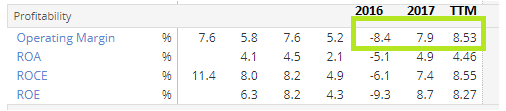
Although I don’t expect fireworks from this stock, it does look like an attractive overall package to me. Profit margins have recovered from the 2016 crash and may be heading towards double-digit territory:
Net debt has fallen steadily and represents just one quarter of fixed assets, or roughly 1.5 times net profit.
Trailing 12-month earnings of $1.07 per share are expected to rise to $1.31 per share in 2019. This puts the stock on a forecast valuation of 13, with an expected dividend yield of 2.5%.
I’ve added Enerflex to the International SIF. The group is expected to report Q4 earnings on 22 February, so we won’t have long to wait for an update on the outlook for 2019.
First Resources (SGX:EB5)
This Singapore-based firm is a palm oil producer which manages more than 200,000 hectares of plantations in Indonesia and two of its own refineries. It has a market cap of £1.6bn and generated a net profit of $138m in 2017 on sales of $647m (USD).
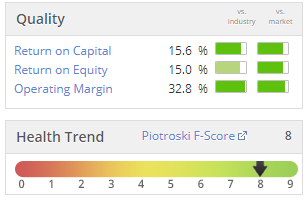
This appears to be a highly profitable business, with operating margins in excess of 30% and attractive returns on capital employed. It also scores highly with the Piotroski F-Score for financial health:
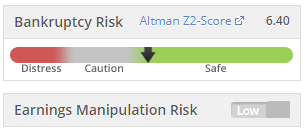
Stockopedia’s algorithms don’t seem to have spotted any worrying signs of financial risk or potential misconduct, either:
Looking ahead, earnings are expected to have been broadly flat in 2018 but to rise strongly during the current year:
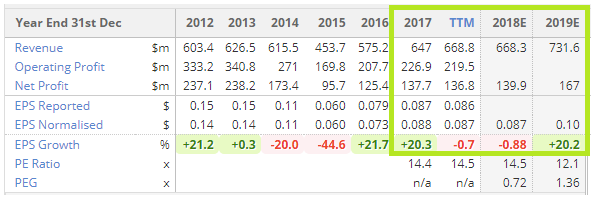
The forecast valuation of 12 times trailing earnings and a 2.4% yield don’t seem wildly unreasonable. Net debt also looks manageable, at about 2.2 times 2018 forecast net profit.
This business is classified as Consumer Defensive by the sector classification system, so will hopefully add some useful diversity to the portfolio.
I’ve added First Resources to the International SIF.
Austevoll Seafood ASA (OSL:AUSS)
The second defensive stock to join the International SIF this month is Norwegian fish producer Austevoll Seafood. This £2.1bn business is expected to generate revenue of nearly NOK23bn this year - about £2bn.
The group operates fishing vessels, fish farms and various processing plants. It claims to be one of the largest producers of salmon in the world. Austevoll also has large-scale operations in white fish, fishmeal and tinned fish.
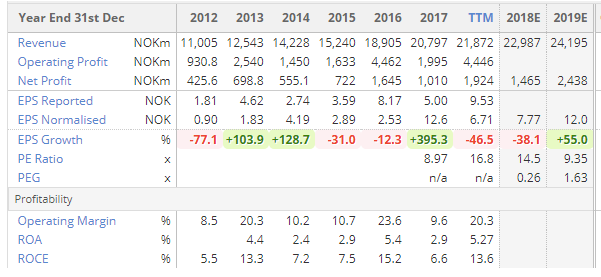
The company’s profitability has fluctuated wildly over the last six years. I haven’t looked into whether there have been any acquisitions during this time. But this volatility might indicate that this is more of a commodity stock than a true defensive.
Despite this concern, I don’t see much overlap between this business and any of the others in the portfolio. Global demand for fish is expected to rise by about 50% over the next 15 years. This seems likely to create serious environmental concerns, but I’d guess it will also generate commercial opportunities for businesses such as Austevoll Seafood.
I’ve added Austevoll to the International SIF this month.
Acushnet Holdings (NYQ:GOLF)
Golfers may be familiar with Acushnet’s two main brands, Titleist (balls and clubs) and Footjoy (golf wear).
The company says that it’s been making golf balls since 1932 and reports that its Titleist Pro V1 golf balls accounted for 73% of balls played and 71% of wins on the worldwide tours during the 2018 season.
The company claims similar number one positions for several other products. I know nothing about golf, but I guess these must be well-established brands with a loyal following (and good marketing support).
One downside of this business for investors is that it only floated on the stock market in 2016. Here in the UK, recently floated businesses have often delivered sub-par performances over the last few years.
I don’t know if things are different on the other side of the Atlantic, but given that I don’t have any specific rules against recent IPOs, I won’t exclude Acushnet Holdings on these grounds.
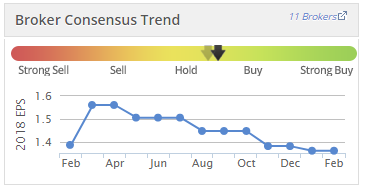
Perhaps a greater concern is that the broker consensus trend has been pretty weak over the last year:
However, consensus forecasts suggest that earnings are expected to bounce back in 2019. EPS growth of 18% is expected, according to these numbers: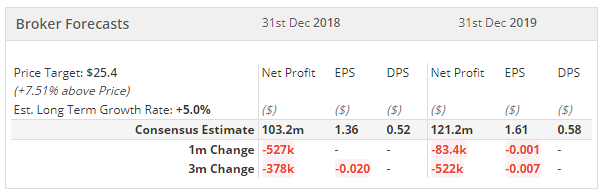
The stock’s quality and valuation metrics look okay, if not spectacular:
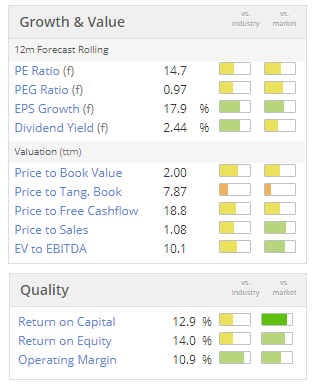
Although there’s room for improvement here, there’s nothing to suggest obvious problems.
As always with this virtual portfolio, my analysis of the stocks is fairly minimal. This is a numbers game. My hope is that by filtering stocks for characteristics I believe are attractive, I’ll be able to beat the market.
So far, this hasn’t worked well. The International SIF fallen by 10% since launch in November 2017, excluding dividends and trading costs. But it’s still quite early days, so I’m persevering a little longer before deciding whether to pursue this strategy.
As always, I’d welcome your views on the stocks I’ve discussed today and on international investing in general.
Next week, I’ll return to my main UK SIF portfolio, in which I invest some of my own cash. Recent progress has been blighted by accounting problems at Staffline, but I’ve otherwise been encouraged by newsflow and share performance so far in 2019.
Disclaimer
This is not financial advice. Our content is intended to be used and must be used for information and education purposes only. Please read our disclaimer and terms and conditions to understand our obligations.

5 comments
Hi Roland
I am quite new to investing in non-UK stocks and so far have only experimented with buying US and European stocks through Hargreaves Lansdown. Consequently I am investing in sterling which gets converted to the currency of the target equity.
An important aspect I have faced in this endeavor is FX charges as well as FX conversion rates.
Both of these aspects impact an investment at point of buying and point of selling. They also occur at receipt of dividends.
I appreciate that with your administration of the International SIF you put aside transaction charges as well as dividends which to some extent may even things out.
But one point you might want to consider is to record the sterling to local currency exchange rate at your point of buying. Then again at your point of selling when that occurs. Then factor these into your eventual reporting of the gain/loss of an investment.
I mention this as my experiences with exchange rate fluctuations can have a material impact on an outcome of portfolio performance. I am not suggesting taking these into account at each reporting point but only in relation to the buy and sell events.
Regards
Howard
Hi Howard,
You make a good point - FX charges and conversion rates can be significant, especially for smaller positions.
I am not in a position to comment on FX charges, but my method does (I think) already take into account exchange rates.
When I add or remove a stock in this virtual portfolio, the local share price is converted into GBP at the prevailing exchange rate.
The profits and losses I report are calculated based on the GBP buy and sell prices, so they should reflect currency fluctuations as well as underlying share price movements.
Regards,
Roland
Hi Roland
Thanks for the response, yes that makes sense. Yes your transactions will reflect the currency changes. And thus the full gain/loss of the investment.
What I experienced however was that my final gain/losses on my investments incorporated two components the share price moves as well as the currency moves. I accept often it is not worth making the distinction. But if a buy is made when sterling is weak against a currency, but at sale time sterling is strong against that currency. Then the share price gain/loss is quite distorted from the final achieved gain/loss of the individual investment.
Usually this might not be important but with Brexit looming, I think sterling rates could fluctuate quite wildly.
For example a US stock could be bought in the next few days, with a weak sterling to dollar exchange rate.
But then say it is sold in say nine months time. At point of sale this investment could possibly be quite a large gain. But the share price could in actuality be a loser from original purchase price. But if sterling had gained say 10 to 15% post-Brexit (as some suggest it could), then the gain for yout SIF is purely a currency gain, not a stock performance gain. The converse could occur also.
But as you are using the SIF to test your approach across non-UK markets, I'm not quite clear how your results can be fully assessed without also extracting out currency moves across the lifetime of the holding.
I apologise if this is going off at a tangent so please feel free to ignore it if it's not worthy of a response. It's highly possible I have not yet grasped the issue yet as I am still experimenting.
Regards
Howard
Hi Howard,
Thanks for your detailed reply. I think you're right to highlight the impact exchange rates can have on gains and losses from investments in foreign shares.
I've glossed over this in the past, because I view it as a semi-random factor that's outside investors' control. But it is potentially significant (and interesting), and I think should start to measure it.
From now on I'll record the gain/loss for each stock in its native currency and in GBP. I'll also try to restate my results so far. I think I have all the information needed, as Stockopedia's Folio feature captures the exchange rate used in each non-GBP transaction. I'll share these restated results in my next International SIF article, which will be mid-late March.
Regards,
Roland
Hi Roland
Thanks for your rapid response.
I like your solution I had not quite derived such a clarification of the best way to assess my own non-UK holdings. I'll adopt your method and watch with interest how the International SIF develops.
I'm an avid reader of your articles I continue to learn a lot from them. Many thanks for your efforts.
Regards
Howard