Semi Year SNAPS - more top stocks for 2015

Most stock market watchers could be forgiven for thinking that 2015 has been a bit of a damp squib. Some promising early gains for the FTSE 100 have been all but given up, Greece worries have weighed hard and the dour Scot failed again to regain his Wimbledon crown. But beyond the headlines stock markets have been treating sensible small cap investors to quite a bounty.
The FTSE Small Cap Index is up over 7% year to date while the FTSE Fledgling Index has rallied 17%. Closer to home my own 20 stock “New Year NAPS” list has stormed to a 29.5% return in just over 6 months. In the light of this recent good fortune, I felt it time to dust off my quill and pen a few words to reflect on what’s gone right, what’s gone wrong and what on earth should be done now… if anything at all.
From NAPS to SNAPS…
Newcomers to the site might want a quick refresher of how the NAPS were selected. We’re a DIY research site and we don’t do ‘tips’, so rather than hand pick some stocks for the year like you might find in newsletters or magazines, we thought we’d just throw the task at our core algorithm - the Stockopedia StockRanks. With a few simple filters to avoid tiny and hard to trade stocks we named the 2 highest ranking stocks across each of our 10 ‘economic sectors’… from Energy to Telecoms…. and threw them in a portfolio. You can check out all the original rules here.
Genuinely, I didn’t have vast hopes for this set of stocks as many were selected across sectors (e.g. Utilities) not exactly renowned for market beating returns. But they’ve absolutely trounced the market, beating the FTSE 100 by 22% in six months. Only Idox has fallen into negative territory while every other stock has returned 10% or more. The best, International Greetings, has more than doubled.
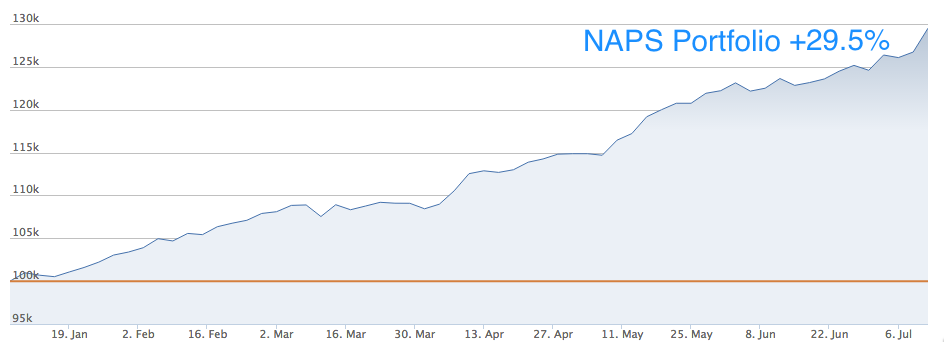
All this good fortune has started to make me nervous. After all, this was essentially a systematic portfolio and one of the most important parts of any good system is sound risk management and rebalancing. The portfolio positions have now drifted substantially leaving greater exposures to some stocks and smaller exposures to others. Should we just let our winners run, or should we be a bit more mechanically ruthless ?
Our tracking of the StockRanks has found that more frequently rebalanced portfolios have outperformed annually rebalanced StockRanks though at the expense of higher potential costs. So we thought why not pitch the laissez-faire New Year NAPS portfolio against a six-monthly rebalanced SNAPS alternative ? Perhaps we’ll gain a few more insights by year end in the process.
But first…
…some half year lessons learned
While it’s far too early to draw conclusions from the performance to date… it’s much more fun to give it a go… ;-)
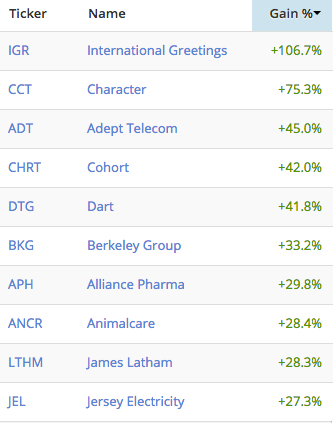
1. Diversification works: The top two performers year to date have been card distributor International Greetings ( up 106% ) and toy maker Character Group ( up 75% ). Both were ‘honourable mentions’ in the original list - qualifying amongst the top 20 NAPS (+29.6%), but not among the top 10 (+23.7%).
Now a lot of macho investors think that high conviction concentrated portfolios are the only way to build wealth in the stock market. But a 10 stock concentrated portfolio would have underperformed by missing out on these two huge performers.
Perhaps instead of thinking that owning more stocks leads to a smaller contribution from each winner - try thinking that owning more stocks gives you a higher chance of owning the really big winners. That’s what makes the difference.
2. Elephants don’t gallop (as much): The best performers were either micro-caps or small caps well under the radar of institutional investors. These are the kinds of stocks that only private investors can make the most of. The big caps, Berkeley Group, BT and Imperial Tobacco, all performed admirably up between 17% and 34% but can’t offer the kind of giant outperformance available in small caps. It’s worth remembering that investing in small caps can be a double edged sword (ask anyone who was investing in 2008) … so diversifying across different sized companies is plain common sense.
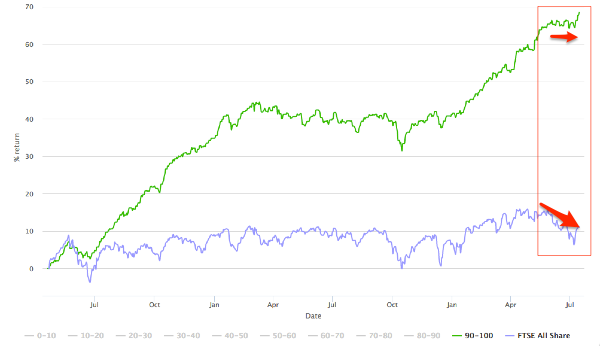
3. Watch your stocks not the indices: The most critical barometer of stock market health is sets of actual stocks not the market indices. The major indices are very poorly composed, often subject to the bully boy tactics of the big leveraged futures traders and not necessarily reflective of underlying market health. It’s notable that in spite of the macro nervousness the NAPS portfolio (and the top 10% of StockRanks stocks in general) barely fell more than 1 percent at any time year to date.
William O’Neil taught me that the time to escape equities is when they all individually start behaving negatively, not when the major indices are having a wobble. So keep yer head son !
4. Sector overweighting: The one thing I’m uncomfortable with in the original portfolio is the fact that we’ve put equal weightings into every sector. It could be argued that we should put less positions in sectors that have less weight across the market (like Telecoms and Utilities) and more into sectors with larger weights where there’s a higher probability of finding outperformers (e.g. Cyclicals & Industrials). But we started with a plan so we’ll continue.
On the merits of sloth
Before we do anything… let’s praise bone idleness. One of my best all time portfolio picks was Domino’s Pizza which I bought for an investment club back in about 2004. It duly proceeded to ten-bag within 10 years and I still parade this as an emblem of my own stock picking prowess to the others in the club.

What I don’t tell them is that I bought it in my own portfolio at the same time, with rather more measly results. The 25% I pocketed 6 months later felt good at the time, but was extortionately expensive with hindsight. The one thing I’ve learned since has been best phrased by the great Jesse Livermore in Reminiscences of a Stock Operator:
After spending many years in Wall Street and after making and losing millions of dollars I want to tell you this: It never was my thinking that made the big money for me. It always was my sitting. Got that? My sitting tight! …. Men who can both be right and sit tight are uncommon. I found it one of the hardest things to learn. But it is only after a stock operator has firmly grasped this that he can make big money.
The truth is that most of the stocks in the NAPS portfolio are still behaving well. Only Idox and Town Centre Securities have dropped below an 80 StockRank. Shouldn’t we just let these winners run? Why on earth do we need to rebalance the portfolio at all ?
Well the truth is we don’t and probably shouldn’t. Trading stocks is expensive and it adds a big drag on any portfolio. Small caps have wide bid-ask spreads costing several percent on the round trip buying and selling a stock. If you do that a few times per year the transaction costs will eat up your outperformance. So when in doubt it’s often best to do nothing at all.
But there are great merits in rebalancing too… if some stocks have got ahead of themselves, rebalancing can, like Robin Hood, steal from the rich and give to the poor and help to improve risk adjusted returns. We’ve often written that the optimal frequency of rebalancing is very dependent on one’s personal situation - taxability of the account, portfolio size, choice of strategy etc - so there’s certainly not one shoe that fits all. So what we’re doing here today is to be taken as an illustration only. DYOR and check out some of our archive articles on the subject.
The Semi Year SNAPS…
To make the SNAPS rebalancing easy we’re going to stick to our original criteria - bringing the portfolio back in line with an equal weighting across all the currently qualifying candidates. It’s brutal, but this kind of approach has been shown to work. Winners that still qualify (like International Greetings) will be sold down back to a 5% weighting while those that no longer qualify will be sold completely, being replaced by new candidates.
In screening for the new candidates using the StockRanks portal we found that half the stocks that originally qualified in January still do today. This is great as it minimises the churn (and potential transaction costs) in the SNAPS portfolio.
Thanks here to Ben Hobson who has written a brief summary of the stocks that are new in the SNAPS portfolio…. for a brief write up of the stocks that REMAIN please see the original NAPS article.
Consumer Defensives
Imperial Tobacco REMAINS. £31.63bn, StockRank 98.
Cranswick is OUT replaced by… Carr's Milling. Carr’s is a diversified group specialising in agricultural feeds and supplies and flour production. It also has an engineering division that manufactures equipment used in the nuclear and oil and gas, among other activities. Mkt Cap £151.6m, StockRank 96
Consumer Cyclical
Character Group is OUT replaced by … Epwin. Defying the trend for new IPOs to end in disappointment, shares in building supplies firm Epwin have risen by more than 30% since it floated on AIM in July 2014. This is a cyclical business that’s benefitting from improving economic conditions. It has some strong quality indicators in addition to the surging momentum. Mkt Cap £176.2m, StockRank 99.
Berkeley Group REMAINS. Mktcap £4.5bn, StockRank 98
Industrial
Dart Group is OUT replaced by… Empresaria Unlike some other recruitment firms, shares in Empresaria have been fairly muted over the past year. However, signs of improving efficiency and management ambition have invigorated the shares in 2015 and Damian Cannon gave it a big write up in May. Mkt Cap £30m, StockRank 99
Costain is OUT replaced by … Air Partner. Shares in Air Partner took off in April after the aviation services company bounced back from a poor first-half to report better than expected full year results. No debt and more than £18m of cash meant the dividend was hiked, leading to a forecast yield of 6.2%. Mkt Cap £43m, StockRank 99.
Financials
Catlin delisted (OUT) in the first half and was replaced by H&T Group. H&T, best known as a high street pawnbroker, is in the midst of a restructuring programme to reinvent itself. It has managed to survive in a tough period where other peers like Albemarle & Bond went bust. It is cash generative and has been paying down debt. £73m MktCap, StockRank 99.
Town Centre Securities is OUT replaced by… 3i. 3i is a stalwart of the British private equity and venture capital industry, and a member of the FTSE 100. The key factor here is momentum, with the price of 3i shares on a positive trend since early 2013 and brokers consistently increasing earnings forecasts over the past year. Mkt Cap £5.38bn, StockRank 98.
Basic Material
James Latham is OUT replaced by Sylvania Platinum. AIM listed mining shares have a terrible reputation for being highly speculative investments that often turn sour. Shares in Sylvania Platinum, a producer of platinum group metals are well down from their highs four years ago, but momentum has been building. The company recorded a loss last year but a rebound to profitability looks to be on the cards in 2015. Mkt Cap £34.8m, StockRank 95.
International Greetings REMAINS. £91m, StockRank 99.
Technology
Idox is OUT replaced by Computacenter. It describes itself as a computer infrastructure company and has a name that’s stuck in the ‘90s. Yet Computacenter is starting to reap the rewards from two years spent refocusing its business. It throws off cash and has some strong quality credentials. Mkt Cap £946.9m, StockRank 98.
Cohort is OUT replaced by 888. Online gaming company 888 is currently in a battle to buy rival firm Bwin.party. Its share price momentum has been strong in 2015 and it boasts some impressive quality characteristics, including a high return on capital and wide margins. It might be a sin stock, but it’s highly profitable. Mkt Cap £978m, StockRank 96.
Energy
Lamprell REMAINS. MktCap £514m, StockRank 96.
NWF REMAINS. Mkt Cap 72.3m, StockRank 97.
Telecoms
Adept Telecom REMAINS. MktCap £47m, StockRank 93.
BT REMAINS. MktCap £39n, StockRank 89.
Healthcare
Animalcare REMAINS. MktCap £45m, StockRank 96.
Alliance Pharma is OUT replaced by… Indivior. Shares in pharma company Indivior have risen by 68% in the seven months since it was spun out and floated by Reckitt Benckiser. Concerns exist about the future profitability of its drug portfolio butr on the current financials it continues to rank exceptionally well on a blended basis. Mkt Cap £1.79bn, StockRank 99.
Utility
Jersey Electricity REMAINS. MktCap £58m, StockRank 96.
Dee Valley REMAINS. MktCap £56m, StockRank 87.
Trumping those behavioural biases
I can’t tell you how much that new list of stocks makes me squirm. The idea of rebalancing out of such names as Cohort, Costain, Character Group and James Latham into some of the above stocks fills me with terror. My own bias says Indivior has done enough already ( I own it ) while Empresaria, Air Partner and Sylvania Platinum are sending the overall list deeper into microcap territory which is not an area of the market I personally enjoy investing in. So my bets are on the original NAPS portfolio winning the horse race at the end of the year… but of course… I most likely am seriously biased and over-attached to the names already held. Would be fascinated to hear your opinions.
Disclosure of interest - Of all the stocks mentioned Ed currently has stakes in 3i, Berkeley Group, Character Group, Computacenter, Costain, Dart and Indivior.
Disclaimer
This is not financial advice. Our content is intended to be used and must be used for information and education purposes only. Please read our disclaimer and terms and conditions to understand our obligations.
22 comments
Is this what you are looking for?
http://www.stockopedia.com/content/new-year-naps-top-10-stocks-for-2015-89568/
Ed,
Tad confused - I thought the NAPS was 10 stocks chosen and the 38% appears to be 4 of those and 6 "honourable mentions" and thus looks a bit sneaky. Where can I find a list of the 10 NAPS and/or the top 20 in full - perhaps I missed it as my navigation skills around the site are not too hot.
Maybe webinar will explain.
Ed, great article again! Managed to pick up on CCT before Xmas and still holding on for the ride, so I won't be dropping it just yet. I understand that you want rigid rules to run the mechanical process, but how much difference is there in choosing between stocks with ranks such as a 99, a 98 or a 96?
For those of us that don't want "the computer driving the car", it seems like a pragmatic approach might be to select from high ranking stocks but maybe allowing a tiny bit of bias in i.e. I don't like mining stocks. I plan to run a real life mechanical portfolio with a trailing stop loss at differing levels of ATR for each share, so that there will be some downside protection against car crashes.
Cheers, Mark
Ed - while the stock rank graphs are in development, is it possible to create a screen for Stock rank changes in the meantime?
Mike - it's already built - check here - http://www.stockopedia.com/stockranks/movers/
This most interesting. I've never put much faith in theories of future behaviour of stocks based on patterns from the past and realise that much of my stock picking relies on an emotional gut feeling. That means that I am interested in the psychollogy of managing a portfolio as much as the win/lose element. My gut feeling has worked for me in so many ways through life, why change now? i mention this in the context of whether any portfolio has to be arithmetically balanced. It seems to me that, without proof, those with intrinsically neat minds might be offended by imbalance and feel happier when they have evened things up. We are all capable of looking at a winning stock and irrationally assume it can't go higher and sell too soon. That is a sort of roulette approach. We know Mr Market is extremely neurotic but are we not also touched by non-scientific attitudes too? Each one of us likes to think we are unique but, by being on this site, we're behaving like a herd. Comfort zones!
One thing does interest me and that is the level of comfort I feel when I buy an expensive stock in comparison to the slight anxiety when it trends towards the penny share. It is clearly nonsense but I assume it drives others too. What I'd like to know is this; has anyone studied the relative movement of stocks at both ends of the cost spectrum? It might be a hard thing to set up as it is unlikely that the stocks selected for trial will be comparable in any other way.
Ed, good article. thanks for sharing these ideas.
Nice one Ed!
The European/US stocks I listed in the original thread would have produced a 25% return and that's despite Southwest Airlines Co (NYQ:LUV) dropping 19%
I also wince when my screening keeps throwing up Per Aarslef (and it has been for ages) despite already sitting on a 63% gain. I probably won't add as I'm already sitting on a nice position but it's repeated appearance in my screen reduces the temptation to top slice.
I also can't quite bring myself to buy high stock ranked growth stocks with low risk adjusted PEG when they have a non-cheap PE, for example Nutrisystem Inc (NSQ:NTRI)
Sadly my overall my European weighted portfolio hasn't quite kept pace with my Euro stock naps, still 12% since January with the Greek crisis rumbling has been ok and I think if it's resolved then things will take off again.
Best of luck
Phil
Phil, Do you share you stock screening rules anywhere on here
Great article Ed and congratulations on proving the power of the Stockrank system.
As an aside, I'm sure I'm not the first to ask this but what about developing stockrank charts for each stock, to show how individual stockranks have changed over time? Would be intriguing to see the ranks set against stock performance for individual stocks, or indeed against each other. As Paul Scott has commented previously, its interesting to see how companies with stockranks in the 60s or 70s can shoot up into the 90s on a good trading statement.
Hi Jimbob - we are doing this behind the scenes. We want to release it to the website as part of some major upgrades in 2016 and I'm sure it will be popular.
e.g. Here's Avesco which I know is one of Paul Scott's favoured stocks. We can see the rank has risen since a low in April 2014 quite consistently.
Now different people might use the ranks in different ways, but for me the 90+ area is most interesting. AVS popped up to a 90 rank in April when it was priced at about 12p just ahead of its recent rocketing move +70% on the June half yearly report. The early move to a 90 rank ahead of the results (and share price move) was due to improving broker forecasts - which pushed up the Momentum rank.
Now I must admit this is a cherry picked example, but it does illustrate the point you've made.
Thanks Ed, can't wait to see it up and running next year!
Cheers, James
Thanks Edward for explaining. Sorry I have another query, Berkeley seem to listed under Financials in SR but are under Consumer Cyclical on SNAPs?
Yes Berkeley Group is a good point - I should explain. When I first wrote the NAPS piece, Thomson Reuters were about to reallocate BKG to Consumer Cyclicals like the other housebuilders. I preempted the change on their word by allocating it into Cyclicals for the NAPS piece but they ended up not updating it. I've left it in Cyclicals for that legacy reason.
I see, I agree it makes more sense being in Consumer Cyclicals.
Good article thanks. Prompted me to act in the new year and happy with the results.
Out of interest why was Costain kicked off, it still has a SR of 99?
I'm not a fan of it and I hold Air Partner (LON:AIP).
I do hold Dee but thinking of selling them.
Can't get excited about Carr, growth looks slow and margins are thin.
@herbie I hold Costain myself. As explained the SNAPS uses a purely mechanical / brute force / survival of the fittest approach. Costain gets the boot because it's fallen to third in the Industrials list and there's only space for 2 industrials. Simple as that. It's the 5th stock ranked overall in the UK though... so other approaches would certainly include it.
@Tom Regarding behavioural biases... I did find myself wanting to override the process while writing. e.g. with Sylvania Platinum - the spread is actually about 4%. That's very expensive to trade, it's also a tiddler and I'd never heard of it so I found myself wanting to choose Centamin instead. But the whole point has been to avoid any emotional or personal selections... i.e. to go for a 100% mechanical approach. But it is very hard to carry through - we have demons that come out when confronted with stocks we've never heard of.
This article should be taken as illustrative only - it's not my own real world portfolio though (as mentioned) I do own 7 of the stocks mentioned across both articles. On a personal level this year I've hedged a lot of my equity exposure, i.e. netting off some of the downside risk in stock markets by employing short sales. There are lots of ways to do this - all have their own upsides and downsides. Spread betting and CFDs are probably the easiest ways to do it in the UK right now but one has to make the decision as to whether to short individual shares, ETFs or indices, or indeed whether to use options. I've been meaning to write about long/short strategies for some time but haven't got round to it.
My own portfolio is just under 2/3 long and 1/3 short across a range of UK, European and US stocks - and employs a fair amount of leverage. I'm trying to capture the spread between the higher StockRank stocks and the lower StockRank stocks while maintaining equity upside exposure. Overall I'm...
The performance has been very good year to date - my longs have performed well while the shorts have minimised the downside volatility when the market has fallen. I will get round to writing about the challenges of practically implementing this kind of strategy in a future post.
Thanks for the excellent article Ed, very interesting and I have looked at quite a few of those companies, Character, Adept, 888, NWF, Empresaria. I also own Indivior although I still like Alliance Pharma and Animalcare in that sector on a longer term view.
A great read indeed, thanks for your insights into the thought process behind the new portfolio! I like the description of your battle with biases in the final paragraph, it's just amazing how hard is to think straight when money and reputation are on the line.
The candid documentation of these considerations, however, is going to make it much easier to recognise to what degree you were subject to biases during the process. Quite a useful exercise I think and something I will try to do myself.
Tom
For next year I'd suggest playing with the sector allocations, there's comment on this in the original article. Tech is about 2-3% of the market, but 10% of the NAPS. Maybe allocate one stock to each sector at 5bp intervals - so all sectors with upto
5% of the market get one stock
5-10% get another
and so on (in a similar way to preferential voting systems)
That would reduce the number of stocks in Tech, Utilities and increase in Consumer D/C. I guess this would be slightly pro-cyclical, but two utilities is surely overkill.
Have you thought of putting NAPS into the Screens section? Would complement the Rankings Performance charts
Thanks for this very interesting article. Re sector weighing, I did an allocation on my shares and about 35% fall into Industrial sector, however there some very diverse companies in there, in my opinion some are in the wrong sector, you have airlines, architects, recruitment, shipping/broker, financial service companies, mining, engineering etc. So as Industrial is so wide I suggest maybe 4 or 5 from that sector and cut 1 from Ultilities which smaller and narrower. Also Health and Telecoms?