Serica Energy: a super stock with a 9% yield

This North Sea oil and gas producer currently trades on a forward price-to-earnings ratio of three and boasts a 9% dividend yield. There’s a healthy cash pile as well.
We’ve covered this stock here before, but much has changed over the last 18 months, including the acquisition of Tailwind Energy.
Stockopedia’s algorithms rate Serica Energy (LON:SQZ) as a Super Stock. I think it’s a good time to take a fresh look at this business.
Summary
Pros:
Cash-rich group with low-cost production assets in the UK North Sea
Specialist in operating and improving the performance of ageing fields
Tailwind acquisition has improved asset diversity and resulted in more event split between oil and gas production
Seemingly modest valuation on three times earnings, with 9%+ dividend yield
Experienced management, supportive main shareholder
Cons:
Many of Serica’s assets have limited lifespans
Minimal hedging means a high level of exposure to commodity prices
There’s no guarantee continued reserve replacement will be possible at attractive costs
Risk of Serica ‘diworsifying’ into international operations and losing money
Decommissioning liabilities may be greater than expected
Net cash position may partly reflect the need to provide for future liabilities
Profile
About the stock
Serica Energy is an independent oil and gas producer operating in the North Sea. It operates in the Energy sector and is part of the Oil & Gas industry group.
Serica was founded in 2004 and floated on London’s AIM market in 2005. Today it has a market cap of £850m and a recent share price of 220p.
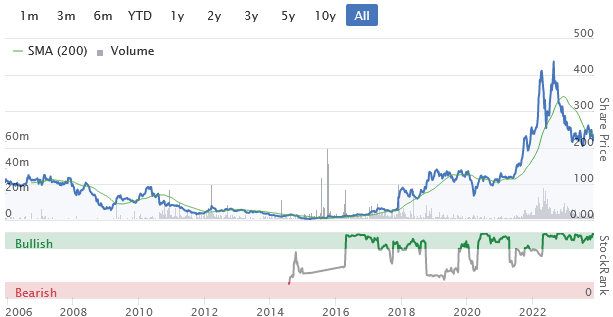
The StockRanks show high quality and value scores for Serica, with improving momentum. This suggests that the business might potentially be in a sweet spot of improving performance and attractive valuation.

About the opportunity
Earlier this year, Serica Energy completed the acquisition of privately owned North Sea firm Tailwind Energy . This resulted in a 75% increase in Serica’s reserves and a significant increase in oil production.
Serica’s production is now split 55%/45% between gas and oil respectively, whereas it was previously 90% gas. In the UK market at least, gas prices tend to be far more volatile than oil prices, so this shift should provide more stable and reliable cash flows.

Source: Serica Energy H1 2023 presentation
In addition, Serica now has two production hubs and 11 producing fields in the North Sea, so it is no longer dependent on a single set of assets (the Bruce, Keith and Rhum hub).

Source: Serica Energy H1 2023 presentation
The acquisition of the Tailwind assets has also added new near-term opportunities to add to the group’s production. A number of wells are scheduled for 2024.

Source: Serica Energy H1 2023 presentation
Serica appears to be performing well, financially and operationally. While not without risk, I think it’s possible that the market is undervaluing the potential returns that Serica will generate over the coming years, as suggested by the current 9% dividend yield.
Business & Model
What is the company’s history and what does it do?
Serica was founded in 2004 as an exploration company, operating in a number of regions globally. However, the discovery of the Columbus gas field in 2006 and its subsequent appraisal gave the firm a foothold in the North Sea that was expanded when Serica acquired a stake in the Erskine field from BP in 2014.
Since then, the company has shed its assets elsewhere and focused its efforts on becoming an established North Sea oil and gas producer. Serica now specialises in buying mid-to-late life assets and investing in them to improve their performance.
Unlike majors such as Shell (LON:SHEL) and BP (LON:BP.), Serica typically operates on fairly short cycles. Its efforts are typically focused on fields that are in production or have already been appraised. This means that investment in drilling and other infrastructure typically delivers production gains and positive cash flow within fairly short time frames – sometimes just months.
Given the uncertain and inconsistent nature of UK energy policies in recent years, this has proved to be something of an advantage for Serica. Unlike some other North Sea producers, management have felt able to continue investing, as they’ve been confident of achieving returns within the period covered by current tax and capital allowance regimes.
Market & Competition
What is the state and size of the company’s market?
Serica only operates in the North Sea at present, so I think it makes sense to view this as the company’s market, rather than comparing it to oil and gas producers with a larger geographic footprint.
The group says that its investments and acquisitions over the last decade have made it one of the ten largest oil and gas producers in the North Sea.
The group’s production during the first half of this year totalled 49,000 barrels of oil equivalent per day (boe/d)/ Full-year guidance is for a production rate of 40-45,000 boe/d.
Data provided by the North Sea Transition Authority (NSTA) suggests that total North Sea oil and gas production this year is expected to be 1.23 million boe/d. This suggests Serica currently has a market share of around 3.5% in its core market.
However, I think it’s likely that Serica’s market share could increase in future years. North Sea production is expected to continue declining, and Serica’s proven expertise and growing scale and financial strength may leave it well positioned to acquire further assets.
Who are the company’s key competitors?
The majority of production is still handled by larger firms, led by Harbour Energy (LON:HBR) and majors BP, TotalEnergies SE (LON:TTE) , and Shell.
Shell, for example, produces around 10% of UK oil and gas.
This chart produced by Serica at the time of the Tailwind acquisition provides a useful overview of the firm’s UK North Sea production peers:

Source: Serica Energy January 2023
However, Serica’s focus on mid-late life assets means that it’s also able to work as a complementary partner to the supermajors – the company’s Bruce, Keith and Rhum (BKR) fields were purchased from a consortium made up of BP, BHP (LON:BHP) and TotalEnergies, for example.
How does it derive its competitive advantage?
Serica’s products are not differentiated – oil and gas are almost entirely commoditised. The company’s production could be substituted by output from elsewhere in the North Sea or by foreign imports.
To the extent that Serica has a competitive advantage, I think it’s derived from its size – big enough, but not too big – and its credentials as a successful and responsible operator.
Financial strength is probably another modest advantage. Serica has a net cash balance sheet. The company may also be able to draw on financial and trading support from its largest shareholder, commodity trading house Mercuria.
Is the competitive advantage durable?
Sercia’s current operations, financial position, and strategy suggest to me that the firm’s competitive advantages are likely to be sustainable over the short-to-medium term. This company appears to be a good operator in a profitable market.
However, I think these advantages could easily dwindle in the future if the business is adversely affected by changes in external market conditions, tax and regulatory regimes, and – ultimately – falling demand for fossil fuels.
Financials & Ownership
What is the record of growth and profitability?
Serica’s revenue and profit have grown strongly since its acquisition of the BKR fields in 2017:

Profitability has also been very strong during this period, with exceptional – albeit volatile – quality metrics:

However, it’s worth remembering that this has been a very good period for almost all oil and gas producers, thanks to the high energy prices we’ve seen since the start of the war in Ukraine.
Is the balance sheet in good health?
Serica’s latest accounts showed free cash flow of £107m during the first half of the year and balance sheet showed a net cash position of £234m at the end of June 2023.
However, it may be worth noting that the accounts also show various other long-term liabilities totalling £214m that are not included in the net cash calculation. In fairness, many of these liabilities – such as decommissioning cost, for example – may not be payable for many years yet. Even so, they could represent a future claim on the company’s assets and cash flows.
On balance, though, I believe Serica’s financial position looks fairly strong and is unlikely to restrict the company’s near-term ability to invest in new projects or pay dividends.
Is there evidence of historic share dilution?
Serica issued 111m new shares earlier this year as part-payment for Tailwind Energy. This represented a c.40% increase in the group’s total share count.
Prior to this, the company had not issued a significant number of new shares for at least 10 years (share count is shown on the Accounts->Balance Sheet tab):

The full consideration agreed for Tailwind valued the acquired reserves at around £15/barrel at the time the deal was agreed. This doesn’t seem unreasonable to me, given the ongoing low operating costs (c.$20/boe) of the combined group’s assets.
What is the ownership of the company? Does management have stakes?
According to Stockopedia’s shareholder data, Serica’s management do not appear to have notifiable stakes in the company.
The company’s largest shareholder – commodity trader Mercuria – was the previous owner of Tailwind Energy and acquired its holding in Serica as part of the terms of the Tailwind acquisition.
Unusually, the company’s second-largest shareholders are private investors – David and Debbie Hardy. The couple are reported to have started buying the stock during the oil price downturn in 2014/15 when Serica stock traded under 10p for a time.

Digging into the last annual report indicates that chief executive Mitch Flegg owned a modest 184,445 shares at the end of 2022, worth around £400k currently.
Longtime chairman Tony Craven Walker had a more substantial holding of 7.4m shares, but has since retired and is no longer required to disclose his holding unless it rises over 3%.
New chairman David Latin did not own any Serica shares at the end of 2022, when he was a non-executive director.
Valuation
How does the relative valuation compare versus industry and sector?
Stockopedia data suggest Serica is attractively valued compared to its industry group and to the wider market:

However, it’s notable that while the stock looks exceptionally cheap on earnings and free cash flow measures, the shares are more averagely valued against their book value.
One possible interpretation for this might be that while Serica is more profitable than the industry average at present, this level of profitability might not persist.
The other possibility is that Serica is truly an above-average operator with a high-quality portfolio of cost-advantaged assets. In this case, we might expect the business to remain more profitable than average (relative to book value). That could justify a share price re-rating over time.
Trends & Catalysts
Are there any significant macro trends the business is benefiting from?
Both oil and gas prices remain elevated compared to the five years prior to the pandemic.
UK natural gas: UK gas prices are nearly three times higher than they were in November 2019:

Oil: the price of Brent crude oil is also well above the average level seen between 2015 and 2021:

Elevated commodity prices can have a powerful effect on producers’ profits, as their costs may be largely fixed.
Are there any catalysts that could drive a rerating in the medium term?
Serica’s valuation on three times earnings is extremely low and represents a significant discount to the average rating of seven times earnings among UK-listed oil and gas companies.
As mentioned above, such an extremely low rating sometimes indicates that the market does not expect the current level of profitability to be sustainable.
This might be explained by the fact that prior to the Tailwind acquisition, all of Serica’s assets were expected to cease production within 10-15 years. If the company is able to credibly extend the expected production lifespan of its portfolio, perhaps in part with the Tailwind assets, I think the business could justify a higher valuation.
Another possible catalyst for a re-rating might be for it to become widely accepted by the market that oil and gas supplies will remain tight for the foreseeable future.
Risks, Threats & Hurdles
Operational risk: Oil and gas production always carries the risk of serious disruption caused by internal or external factors. A company of Serica’s size might struggle to recover from a serious incident.
Political/regulatory risk: tax rates, investment allowances and resource extraction policies can change at short notice. The introduction of the UK Energy Profit Levy in 2022 is an example of this.
Commodity price exposure: Serica has largely wound down its hedging programme. As a result, the majority of the group’s production is directly exposed to market pricing. This means revenue and profits could swing sharply – up or down – in the event of sharp movements in oil and gas prices.
Limited lifespan of assets: prior to the Tailwind acquisition, all of Serica’s assets were expected to cease production in 10-15 years. My understanding is that most of the Tailwind assets are also relatively mature.
While the company plans to add some production by drilling new wells on existing assets, I believe regular acquisitions of new production assets are likely to be needed to maintain output on a medium-term view. There’s no guarantee that attractively priced, well-located assets will continue to be available.
Decommissioning: Serica appears to have capped its decommissioning liabilities fairly effectively, so far.
For example, with the BKR acquisition, the sellers will be liable for the majority of decommissioning costs. Serica’s liability is limited to 30% of actual costs, less any tax relief that the BKR sellers receive on such costs.
Decommissioning costs for the Tailwind portfolio are described as “markedly lower”than North Sea peers, for various reasons.
However, I would argue that on a medium-term view, there is a risk that decommissioning costs will be higher than expected. This is one reason why I believe that the company’s net cash position is not all surplus to requirements -- in the event that assets are being wound down, the company may need to be able to fund final liabilities from cash, not debt.
To be clear, I don’t see this as a big concern at this time. But I would argue that it’s a good reason why companies such as Serica may deserve to trade at a discount to larger and more diversified energy sector peers.
Recent Trading & News
Serica’s recent half-year results looked broadly reassuring and were largely as expected, in my view. Headline operating performance reflected lower oil and gas prices compared to the same period last year, plus some cost inflation:
Operating profit: £159m (H1 2022: £196m)
Average realised gas price of 96p/therm (H1 2022: 136p/therm)
Average realised oil price of $64/bbl (H1 2022: $108/bbl)
Average operating cost: $17.50/boe (H1 2022: $16.10/boe)
Production for the period rose to 49,350 boepd (H1 2022: 38,100 boepd), reflecting the contribution from Tailwind for part of the half year.
However full-year production guidance was tweaked lower to 40,000-45,000 boepd (previously 40,000-47,000boepd), reflecting a slightly longer-than-expected maintenance period on the BKR assets over the summer.
In a recent interview, CEO Mitch Flegg says this reduction reflected work on surface equipment that was undertaken to reduce the chance of more serious problems in the future. Flegg says the work was not related to the performance of the wells or reservoirs. In other words, the reduction in full-year production represents deferred production, not lost production.
Serica ended the half year with net cash of £234m and the company reiterated its commitment to the dividend, declaring an increased interim dividend of 9p per share (H1 2022: 8p).
Broker forecasts suggest a full-year payout of 20p for 2023 (2022: 22p), but at this stage, a cut seems unlikely to me. I would have thought a payout of 22-23p is more probable, unless oil and gas prices weaken markedly in H2.
Sentiment & Outlook
What do the brokers currently think and are they upgrading estimates?
Earnings estimates for commodity producers are often prone to regular revision, depending on commodity price movements. Expectations for Serica’s 2023 and 2024 earnings have varied quite widely over the last year.
Expectations for 2023 have been downgraded over recent months, but estimates for 2024 remain fairly strong and the broker consensus rating has improved over the last three months:

(Note that the substantial revision to 2024 earnings between March and July primarily reflects the Tailwind acquisition.)
Technical momentum measures provide a mixed view, with volumes up in recent days, but relative strength mostly negative, and the stock trending lower:

The stock’s MomentumRank has improved recently, though:

What would the person selling to us be thinking and who are they?
Serica currently appears to have a healthy financial position, modest valuation, and high dividend yield.
Given this, I would expect that a seller at the moment would probably have concerns about the sustainability of the group’s earnings. This might be due to fears that oil and gas prices will fall, or perhaps to company-specific concerns of some kind.
Conclusions
It’s unusual for a healthy, profitable company to be trading on a P/E of three unless the market has serious doubts about the sustainability of its earnings.
In Serica’s case, I think the main risk factors are the limited lifespan of many of its assets and the potential for unpredictable changes to the tax and regulatory regime for oil and gas production.
One further possibility is that oil and gas prices will not maintain their current strength, despite (apparently) widespread positive sentiment. I don’t know how likely this is, but history tells us that it is always possible.
On the other hand, Serica does appear to be operating well at present, from a position of financial strength. The presence of 25% shareholder Mercuria may also mean that Serica can secure financial backing for future investments on more attractive terms than might otherwise be possible.
Given the strength of the group’s recent financial performance, I think it’s fair to say that the shares are reasonably valued and have the potential to perform well from current levels.
On balance, I think that Serica shares look attractive at the moment, with the proviso that in this market, assumptions made about the future may need to be reviewed regularly.
Disclaimer
This is not financial advice. Our content is intended to be used and must be used for information and education purposes only. Please read our disclaimer and terms and conditions to understand our obligations.

28 comments
As Serica is again re-visiting the 180p region I thought I would update my Feb 5th analysis - that Serica had hit my (Nov '23) 180p target buy price, but had not yet generated a buy signal.
As of today, it has still not generated a buy signal. My TA target has moved down slightly to 179p, and is indicating that the price is unlikely to clear the 180p region for another month or so.
Some of the directors have been dipping their toe in this week since the drop. Good to see.
My broker passed me yesterday’s update notes from Jefferies (target price 280p) and Peel Hunt (target price 351p). As a retired analyst, head of research etc etc, I don’t put much value on stockbroker research having written many similar notes myself! But as a very longstanding holder of SQZ (over 10 years) and with a large holding, I opted to add to my holding yesterday.
Thanks Kuronagi, interesting to see your comment.
My main concern here is the cash flow appears to have disappeared, and net cash at year end dramatically lower than at the interims. The other thing I noted was Mitch Fleggs tone, where he had previously emphasised the strong cash flows of Serica but not mention in this update. I hold, and added this morning too as it appears oversold
Short term the price of UK Gas per therm has dropped to 70p and according to Trading Economics will trade between 77p and 90p from the end of this quarter to end of year. Oil on the other hand is running ahead of what they achieved for a first half.
Given the slight weighting to Gas means H2 revenues will probably be c 10% lower. So dividend forecast drop to 20p seems reasonable to me. Still over 10% on current disappointing sp.
Did I miss any reference to the latest Farm In with JOG/Shell? Implications of this should extend life of producing assets
Would expect Labour to remove much if not all of the Investment Incentive almost on Election. Difficult to justify greater subsidy for investing in O&G sector over renewables in current climate, one would think.
Don't know if anyone reads these old share tips, but back in November ('23) I commented on here that my technical analysis indicated a target (closing) price of 180p for Serica. It's now hit that target (overshot slightly), and my analysis is still indicating 180p. Although the price chart hasn't yet generated a buy signal, the buy price looks pretty close.
Thank you Roland for excellent analysis. I have been thinking about Serica Energy (LON:SQZ) since John Rosier bought it for his JIC portfolio, which was quite sometime ago so I suspect he is sitting on quite a nasty draw down. (I no longer subscribe, just too many subs going out).
I have another high yielding low PE stock (Sylvania Platinum (LON:SLP) ) in my portfolio and while the divis are lovely when they come in I would be happier if it went to a 10 or 12 PE!
Sometimes negativity on a stock, a sector, a geography is so entrenched that almost nothing bar a take over or the second coming will make it re-rate.
In my opinion oil and gas have a very long future. I have recently read How the World Really Works by Vaclav Smil and if you buy in to his thesis, oil and gas are with us for a very long time. (How we solve the carbon problem is another issue). For example there are approximately 1.2 billion cars in the world, of which 10 million are EV. That proportion is not going to change significantly for a long time. Much more compelling but less simple arguments apply to steel, concrete and food production. (It is like smoking. It might, if you are a European, seem as though tobacco is doomed, but there are 1 billion smokers in the world, who are probably not giving up any time soon. I do not hold and never would, big tobacco).
The reality is that the modern world needs and will always need, for the foreseeable future, oil and gas.
I am almost certain I will take a small position and see how in goes from there.
Regards
Michael
Hi Michael,
FWIW, I have been a significant holder in Serica Energy (LON:SQZ) for about three years (buying in originally around £1). I have sold & bought a lot of times during that period - I am very regretful that I did not sell out at its peak of around £4, but in all honesty it still remains my biggest holding (across all of my accounts) and it seems to still be extremely cheap.
I enjoy getting the large dividends whilst I wait for the price to come back (not sure it will hit £4 again), but am very happy - if I wasn't so heavily invested I would happily buy more.
When I say "heavily" its probably not that big compared to those that happily hold their biggest investments at 10-20%+ of their PF, but it seems a lot to me (probably about 8-9%).
The investment case seems to continue to be strong and even with the super-tax I still see them throwing off loads of cash - plus they have the Tailwind tax losses to help with this.
I cannot see O&G consumption being impacted for years to come and I see plenty of opportunities for good operators to keep growing - not always in the UK, but I do expect energy security to become a bigger issue in the next couple of years when the MP's finally wake up to the reality.
I note Roland's comment about 'ultimately falling demand for fossil fuel'...if thinking in terms of the next 15-30 years, we know that the trend for the last 30 years has been increasing demand for fossil fuel, despite all the talk and trillions spent around the world on the so called 'energy transition'.
Whatever other factors govern the SQZ price, I really doubt a lack of demand will be a factor.
, we know that the trend for the last 30 years has been increasing demand for fossil fuel, despite all the talk and trillions spent around the world on the so called 'energy transition'.
ultimately it may be horlocks but at least some are confident things may change within the next decade
https://www.iea.org/news/the-e...
The combination of growing momentum behind clean energy technologies and structural economic shifts around the world has major implications for fossil fuels, with peaks in global demand for coal, oil and natural gas all visible this decade – the first time this has happened in a WEO scenario based on today’s policy settings.
hmmmm caveat who are the IEA and are they talking their own shop up ? i suspect they may be.
I think that all the variables that are outside management control make SQZ a share to trade, not to (plan on) holding long term. It's been in a downtrend since Aug 22 and regression analysis implies this may continue, with a potential low around 180p, which is where I've set my buy target.
Hi Roland thanks for a brilliant article, it’s great to read such in depth research on a particular stock. Found the paragraphs on risks, valuation and profitability helpful. I have also wrote a piece on Serica energy as part of my own research . I’ve posted it to the discussion section for Serica if you or anyone else would like to read it.
Held until the awful reverse takover by Tailwind that benefitted the board and not smaller shareholders. Awful deal doubling down on the North Sea knowing government policy was not to encourage production in the UK. Moved to Canadian and even Brazilian oil stocks with their much longer decades of reserves, low extraction costs and good dividends and no 75% levy on any profits.
I have been of the same mind, why have the worries of an unstable tax regime . My oil interests are scattered around the world excluding the uk.
Ned Kelly can I point out that Mitch Flegg CEO of Serica Energy (LON:SQZ) pointed out on 19 Sept that the Tax Losses inherited from the Tailwind Merger would significantly mitigate the Tax paid by Serica. I think he said that that the actual rate would be 55% which is a material reduction. Taken from my notes on the 19th Sept and subject to checking and I stand to be corrected.
Agree with Ned below personally think you are underestimating the political risk as set out in quotes and articles below no new oil licenses and increased tax
https://www.theguardian.com/bu...
https://www.theguardian.com/po...
https://www.bbc.com/news/uk-sc...
Energy is about to get a lot more political involvement in a years time with the new Labour government
A good article but you make relatively little mention of the UK Excess Profits Levy (EPL), which is in place until 2028 under the present rules and Rachel Reeves threatens to make worse under a Labour government. This, I believe, is the real reason that @SQZ trades on such lowly multiples. Without it the price would be much higher.
Yes, I agree, the two tranches of windfall taxes have really taken the shine off the price.
The first 25% windfall tax came into effect from 26/5/2022, the additional 10% levy from 1/1/2023. Labour have stated in the past that if they come to power they will retrospectively apply the first windfall tax from 1/1/2022, i.e. covering an additional 5 months which saw very strong gas prices. I don't know if that remains their position, and personally I think they'd probably quietly drop a retrospective tax after getting elected, but it can't be helping sentiment.
Thank you Roland for a first class article on Serica Energy (LON:SQZ)
I hold at 9% of my Portfolio. John Rosier wrote in late Sept " the shares are valued at two times free cash flow and fall into my bonkers cheap category."
He reckons the full year Div will come in at 24p a yield of 10.6% based on a price of 226p.
I am content to hold but am mindful of the risks.
UK North Sea producers have become (nearly) uninvestable due to the 75% tax rate and the uncertainty of an incoming Labour government (not that the previous one was any more sympathetic to energy producers).
For this reason, I'll stick with Canadian and US producers.
My concern with Serica Energy (LON:SQZ) is management. They lack skin in the game and their interests are not necessarily aligned with shareholders. They blocked the takeover approach from Kistos Holdings (LON:KIST), which would have massively benefitted shareholders, seemingly because it would have resulted in management being displaced. Yet they pushed through the Tailwind deal on far inferior terms for shareholders, seemingly because it meant they kept their jobs.
Hi Roland, firstly an excellent in depth article thank you.
I believe Serica Energy (LON:SQZ) are very canny operators and will squeeze every last drop of oil or gas from each asset. That typically means the extracted energy is or will be greater than the lifetime volume assessment when they purchased the asset. They are value operators literally scraping the bottom of the barrel.
Regarding overseas expansion they've hinted this is far more likely to be somewhere like Norway than somewhere like Namibia, IE, management are looking for opportunity within their comfort zone and in jurisdictions more supportive than the UK.
Politically I'm not sure how things can get much worse and as management have stated, the Unions want to support a quarter of a million North Sea jobs and Starmer is apparently going to magic up national energy security.
My feeling is that Serica seeks to extend its own shelf like and has a handle on the market and macro risks. The question is how well they navigate that which they can't control.
Kind regards,
TEIN
[I hold]
This is about Serica Energy (LON:SQZ) but it is not even listed on the right hand side. Looks like the tag is missing, so it won't come up in any search on Stockopedia.
Hi Rusty2,
Thanks for flagging this up - it should be fixed now.
Roland
If you click the up symbol ^ to the right of HBR it will show a list of Securities mentioned: SQZ is is listed just under HBR.
It was not, that why I posted about it, it was added later. It also did not come up in a search on Serica Energy (LON:SQZ) . See also Roland's reply to my post.
But this dividend is ONLY sustainable for another 2 years ( not a long term dividend yield play ) and after that sales will fall unless new licenses are granted.
I own Serica Energy (LON:SQZ) myself, the dividend yield is too good to pass on. However, Keir Starmer has said that Labour will issue no new oil and gas licences in the North Sea, so while this will not affect existing assets the long-term prognosis is not good.