SIF Folio: Cash keeps me ahead of the market as I consider BAT

This week I want to leave the market meltdown to one side and focus on the latest developments in my rules-based Stock in Focus (SIF) portfolio. I’ll also consider another new buy - 8% yielding FTSE 100 stock British American Tobacco.
Before that, I want to look at how SIF has performed versus the market in recent weeks. I also want to consider how the portfolio’s cash balance is influencing my returns.
Beating the market (so far)
SIF has obviously suffered badly in this market crash. But I’m happy to report that based on its performance since inception in April 2016, SIF is still in positive territory. In contrast, the portfolio’s FTSE All Share benchmark has fallen deep into the red over the same period:
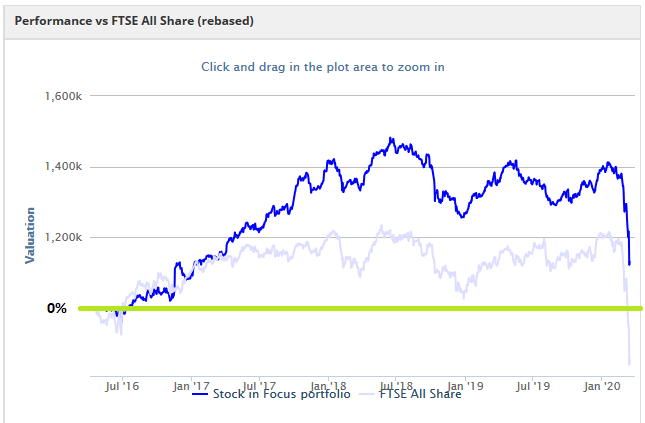
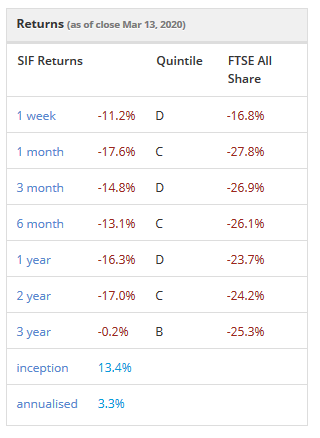
(These figures are complete until 13/3 and don’t include Monday’s sell off)
Even after Monday’s sell-off, SIF is still up by around 5% excluding dividends since April 2016.
I’d like to claim all the credit for this market-beating performance. But in truth I don’t think it’s down to the stocks I own, so much as the stocks I don’t own.
In a market crash, an investor who holds a lot of cash will probably outperform the market. That’s the position SIF has been in over the last few weeks. Even after two recent purchases (Morgan Sindall and Ten Entertainment), cash still accounts for around 35% of the portfolio:
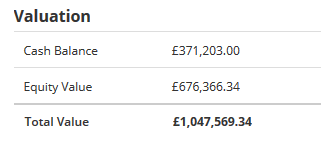
(16 March 2020)
Given the scale of the equity sell off, I’m pretty sure SIF’s outsized cash balance has done me a big favour.
Why does SIF have so much cash? In the months before the market crashed, the SIF stock screen was returning fewer and fewer stocks. This meant I couldn’t replace all of the stocks that were sold. The portfolio shrunk to 14 stocks, well below its target size of 20. I had hoped that this would happen when market conditions became uncertain, but I couldn’t be sure if it would work.
My screen has come back to life! Since the market crash started in late February, my screen has come back to life.
I didn’t expect this to happen so quickly. I thought that my momentum rules would prevent too many new stocks from qualifying. But as I write, my screen results contain 16 stocks, up from just five or six a few weeks ago:
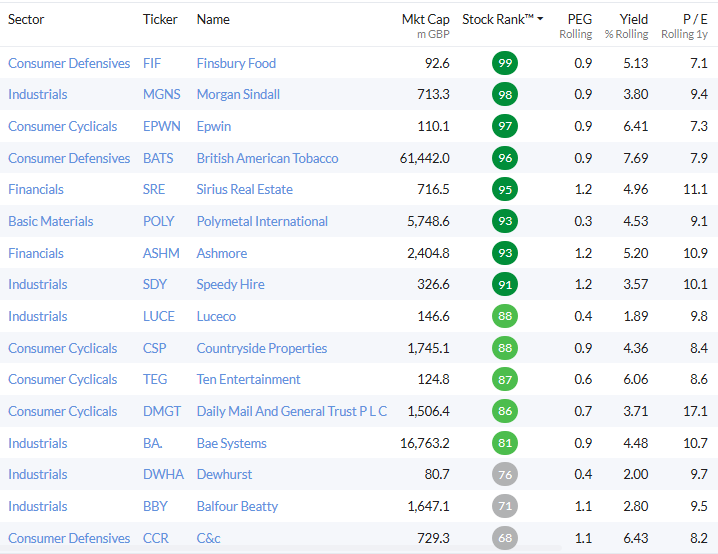
To be honest, I feel like a kid in a candy store. I’m tempted to buy more than one stock at once. But I’m going to stick to the rules and make just one purchase each week. After all, while I’m personally very comfortable buying (some) stocks at their current valuations, I know things could also get worse.
An important test
I see this new market phase as an important test of my system.
So far, we’ve seen SIF deliver good results in easy, rising markets from 2016 until 2018. The portfolio then held its ground when market conditions became more uncertain, reducing equity exposure and allowing cash to build through 2018/19.
The SIF rules are now highlighting a growing number of stocks which meet my criteria for buying. The portfolio’s equity exposure is increasing again. I hope this will result in market-beating gains when a recovery does come, but of course this remains an unknown.
One thing I am happy about is the opportunity to add more defensive stocks to SIF. In the four years since I launched this portfolio, good quality defensive stocks have mostly been too expensive and slow-growing to pass my screening tests. The portfolio has always been underweight defensives, as it is now:
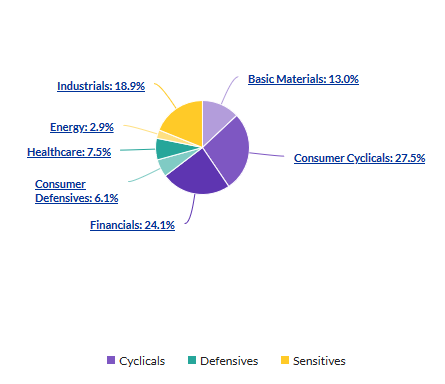
My screen results suggest I may be able to correct this balance at attractive valuations over the coming weeks. I’m going to start today with a look at FTSE 100 firm British American Tobacco.
British American Tobacco (LON: BATS)
Tobacco stocks have been unloved in recent years. But as far as I can see, the reality is that their business models are still working pretty well. Corporate and portfolio consolidation has enabled companies such as BAT to protect their famed margins and free cash flow.
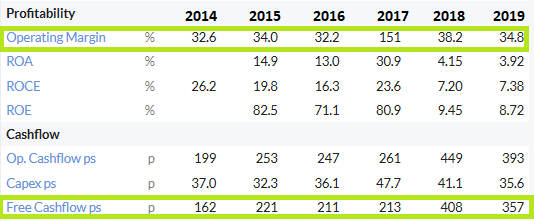
British American’s 2019 numbers suggest to me that there’s still plenty of life left in this business, even if outright growth prospects are limited:
Revenue: £25,877m
Operating profit: £9,016m
Cigarettes sold: 677bn
From a financial perspective, I think that attractive returns should still be available from this sector. Let’s take a closer look at this business.
A super stock?
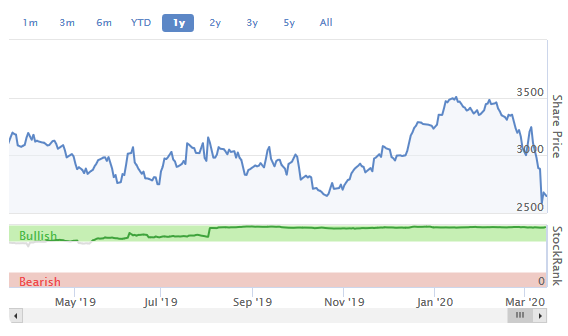
Stockopedia’s algorithms certainly like BAT. Over the last year, its StockRank has risen close to 100, as shown below the excellent new charts:
With a StockRank of 96, British American Tobacco is now one of the top-ranked stocks in the FTSE 100:
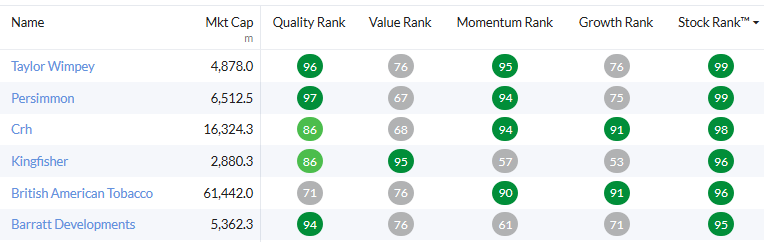
Why do the shares score so well?
High yields score well for value
BAT’s trailing dividend yield of 7.6% is an obvious attraction. But the stock scores well on a range of other yield and valuation measures, as the ValueRank breakdown shows us:
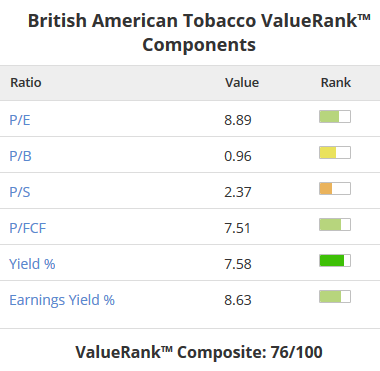
Is the stock’s 7.6% high dividend yield sustainable? We can test this by inverting the stock’s price/free cash flow ratio to get its free cash flow yield. I estimate this as 13.3%, on a historic basis. This suggests that BAT’s dividend payout was covered comfortably by surplus cash last year.
Another attraction is that BAT’s earnings yield (EBIT/EV) of 8.6% is above my screening threshold of 8%. This suggests to me that investors are paying a reasonable price for their share of the group’s profits.
The elephant in the room is debt. Net debt was £41,726m at the end of 2019. That’s equivalent to leverage of 3.5x EBITDA. I’d normally rule out a stock with this much debt, but in BAT’s case I think the risks are manageable.
The borrowings are a legacy of the group’s 2017 combination with Reynolds American and are gradually falling. BAT’s debt is investment grade and issued at low interest rates. Less than £5bn is due for repayment in 2020.
Given the group’s 35% operating margin and consistent profitability, I think problems are unlikely.
Structural quality
High profit margins are one obvious measure of BAT’s quality. But what lies behind them? One aspect is the group’s portfolio of valuable brands, such as Lucky Strike, Dunhill, Camel and Rothmans. These provide pricing power.
A second attraction is that the firm’s core product - cigarettes - doesn’t require much investment. Stockopedia’s stats suggest that capex has averaged about 13% of operating cash flow in recent years, resulting in excellent free cash flow conversion:

The QualityRank breakdown gives us a broader view of BAT’s quality factors:
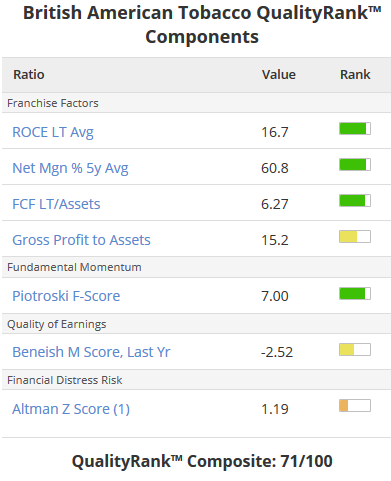
The only point I want to highlight here is BAT’s return on capital employed. The long-term average of 16.7% seems pretty attractive. But it hides a mixed picture:
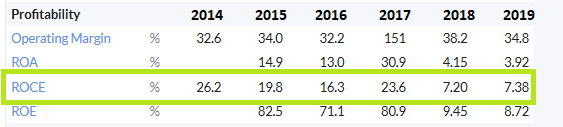
What’s happened since 2017? Broadly speaking, my view is that the average ROCE of 16.7% used in the QualityRank is more representative of BAT’s performance than the 2018/19 figures above. My analysis suggests that these have been disproportionately depressed by the effect of consolidating Reynolds American into BAT’s balance sheet, following the 2017 acquisition.
On balance, I’m quite comfortable with BAT’s quality score.
Reassuring momentum
Momentum seems an unlikely attribute for a £61bn tobacco company. But BAT appears to possess plenty of it:
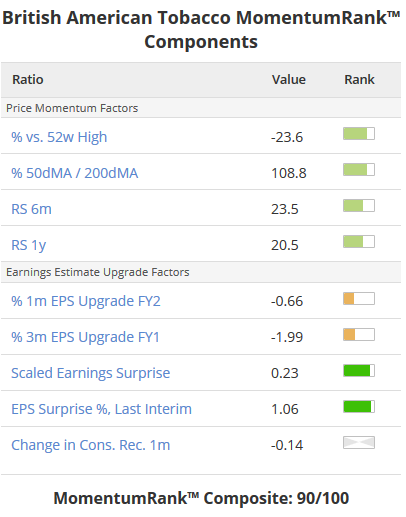
There are two main takeaways here, in my opinion.
The first is that despite the recent market slump, BAT’s positive relative strength shows that it has outperformed the wider market over both six months and one year. That’s generally seen as a positive indicator that outperformance could continue.
The second point is that earnings forecasts have been pretty stable in recent months. At the risk of seeming insensitive, I would guess that tobacco sales are among the areas least likely to be affected by the coronavirus outbreak. I expect earnings to remain fairly stable.
On this basis, the stock’s rolling forecast valuation looks fairly attractive:
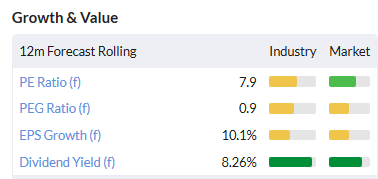
It’s not often you can buy a stock with a P/E of 8 and an 8% dividend yield that should be covered by free cash flow. I think it’s fair to say that the shares could offer some value.
My decision
I appreciate that the combination of FTSE 100 membership and dubious ethics will rule out British American Tobacco for some subscribers. But at this stage in time, I welcome the combination of sustainable earnings and dividend income I expect BAT to provide.
Thus I will be buying the shares for the SIF folio and my own real-money replica portfolio this week, after this piece has been published.
Disclosure: Roland owns shares of Morgan Sindall Group and Ten Entertainment
Disclaimer
This is not financial advice. Our content is intended to be used and must be used for information and education purposes only. Please read our disclaimer and terms and conditions to understand our obligations.

22 comments
Regarding ethics of tobacco:
1 I believe in freedom of choice. The risks of smoking are clear and much effort is made to explain these. People still choose to smoke.
2 Deciding what is unhealthy is not black and white. It's a gradual scale. I like beer and wine. This is also not healthy. Should we discourage people from investing in alcohol ?
3 People consume way too much sugar, causing obesity, diabetes and so on. It's probably worse than rat poison, since people wouldn't eat rat poison, but for some reason, are prepared to turn a blind eye to sugar. Is it ethical to invest in producers of sugar and companies who load their beverages with it ?
4 The worst sector of all for ethics would probably be coal fired power stations. China, JAPAN, India and other nations are building loads of them. These pump more CO2 into the atmosphere, whether the rest of the population likes it or not. Despite there being perfectly good alternatives for generating electricity. Coal power stations screw up the whole planet for us AND future generations. Countries like Japan really should not be building loads of coal fired power stations. Smoking just poisons the people who choose to smoke, which comes back to freedom of choice.
Efforts to discourage smoking are orders of magnitude above those to discourage other unhealthy behaviour.
Then if we do not approve of tobacco, what next ?
Do we start with prohibition ? This leads to organised crime with all the existing illegal drugs. When the US tried it with alcohol, it led to organised crime. So if we ban tobacco production, it will be likely to result in similar problems.
So I conclude that having organised tobacco production and measures to discourage smoking is the best compromise.
That's where we are at. Since the government shouldn't be producing cigarettes, it follows that we need a legitimate private sector tobacco industry.
Since I had to put up with smoking at work and in pubs in my early life, is there any reason why I should not profit from the mugs* that continue to smoke ?
Note: I very strongly support bans on smoking in public and ramping up measures to discourage smoking. But whilst people smoke, we need organized legal production of cigarettes.
[*Like many other readers, I continue to consume alcohol, so cannot claim any intellectual superiority over smokers]
In some third world countries I don't think some are aware of the dangers from smoking and some governments ban vaping for tax reasons and say it's unhealthy. If you ban tobacco why can't people vape instead which is probably a lot healthier. Also smoking does affect other people, I used to work in a bar and smoking certainly affected my breathing, the smoking ban was a good thing for me, also my clothes did not stink of cigarette smoke the next day. Nearly got into a row on holiday about smoking with another guest and in some countries there are no restrictions, why do so many people smoke in restaurants, smoking seems more popular now than about 15 years ago, so many younger people seem to do it, I'm talking more about other European countries here, such as France.
I agree with some of your other points, drinking in moderation is generally ok. Who invests in coal power stations in Japan? but I suppose if they fit very efficient filters it could be alright. Sugar I agree, one big health issue, too much sugar in things like bread, cereals and all sorts of other things, the Govt. should do more to reduce and not replace it with artificial sweeteners, it is the same with salt, far too much in most foods.
Of course investing in shares is different from actually using the products.
Does anyone here invest in companies they don't like?
Many thanks for all the feedback on this piece, I really appreciate all feedback and always read the comments.
I just wanted to follow up on the (many) comments highlighting the ethical objections to investing in tobacco stocks.
I do understand these objections and to some extent share them. But SIF is a rules-based portfolio where stocks are selected based primarily on financial ratios. I try not to distort this with too many subjective or arbitrary judgements.
To be honest, if I put my ESG hat on and ruled out all sectors where I can see ethical objections, there wouldn't be many left!
I don't mean to belittle the ethical issues here - tobacco is worse than most, in my view. But I hope you can see where I'm coming from with this.
Regards,
Roland
I do not agree in profiteering from tobacco companies.
Sorry my previous post was on the wrong post but I can't delete it now.
The concern about tobacco is the switch to vaping which must be losing them revenue, some countries ban vaping at the moment but that may change.
Surely this analysis relies upon the underlying data being correct? Some of these yields, profit forecasts etc must be lagging behind the reality of the current situation? The Compass announcement has given us some clues as to the possible discount to current valuations and forecasts
Also - we are in the middle of a respiratory pandemic. If respirators become rationed to those most likely to recover ( reasonable assumption) then smokers may well find themselves at the back of a very long queue.
intuitive6191,
I agree that 2020/21 earnings forecasts for most companies are likely to be wrong - and in some cases meaningless - given what's happening. I tried to focus more on British American Tobacco (LON:BATS) historic performance in this piece, to gain an idea of the firm's performance in normal conditions.
However, although it sounds crass, I'd guess that most people's smoking habits aren't likely to be too heavily affected by COVID-19. So although I would generally expect earnings forecasts to fall, I suspect the consensus forecasts for BAT may still be broadly plausible.
Regards,
Roland
Hi Roland, Just wondered if you have any thoughts why Ten Entertainment holding up way better than Hollywood Bowl in current carnage ?
Thanks Andy
Hi Andy,
I haven't looked at Hollywood Bowl (LON:BOWL) in detail, but I have a similarly good impression of it.
Liquidity is always an issue with small caps in situations like this, so the varying share price movements might just reflect trading patterns and liquidity.
Indeed, I've just checked Hollywood Bowl's share price as I'm writing this and the shares are up by 30% this morning, after a confident trading statement last night. This should reduce the differential between Ten Entertainment (LON:TEG) and BOWL share price movements.
It's a crazy time at the moment. In my opinion, shareholders just have to sit tight on stocks where they have conviction and wait for normality to return, something I believe will happen sooner or later.
Obviously this is only my opinion, not advice. Everyone's situation is different and I may be wrong.
Thanks,
Roland
Thanks for the reply Roland in hind sight I think someone new couple of days ahead of the possible closure rns being issued and was piling out. Level 2 was 20 shares on the bid 50,000 on the offer on that day so market makers were desperate to get stock off the books. So looks like a case of insider trading sadly
The only stock I will not buy is Tobacco stock ( buying stocks in a company and making money, that's killing millions of people) I can not do it.
Everyone to his own.
BAE Systems are partly responsible for war crimes in Yemen. Has to be worse than BATS
I'm seeing a pattern over the last 2 days with some shares, large fall in the morning and then a bounce back, this morning it was BP (LON:BP.) down 10% but then back to around -2%, same with Softcat (LON:SCT) and Avon Rubber (LON:AVON). yesterday, I think there are opportunities if you can time it right but it is high risk.
Anyone know why Judges Scientific (LON:JDG) is down so much in the last 2 days?
Beware of the FDA!
When the Surgeon General of the USA and other health bodies make pronouncements it creates purchase and when they change, sale opportunities.
Thank-you for the encouragement. I sold out completely in January 2020 after two years of multiple buying and selling, trying to have a full position just before ex-dividend date. It worked well.
In January 2019 it was slightly cheaper than now (low price 2336) because of some threatened regulation and the last market sell-off. Nevertheless with an ex-dividend 26 March worth purchase this week or next.
dubious ethics ?
Great detailed research ,but I have never owned any tobacco stocks on principle. I detest the insidious marketing to Third World countries to 'hook' the masses .
I would not buy into tobacco. The overall health costs of smoking extend far beyond the costs to health services, are generally detrimental to workplace efficiency through time lost through sickness and lost production and must certainly depress the performances of other industries and businesses. The accumulated costs of the tobacco industry are more than the economy can afford.
I agree tobacco is one sector I won't buy, there are some others also. But does smoking actually cost the health service money? There is also the revenue from tax on tobacco.
Smoking may even save the health services money by reducing longevity. But so does murder and I wouldn't buy shares in the mafia either.
Doesn't the tax gained from smokers help to pay for NHS costs?
That's why I said "I agree tobacco is one sector I won't buy"
Gambling is another, too many lives ruined. Yes there ethical issues with many shares but some are bigger than others, killing people early is not something I want to invest in. One reason why I did not buy some funds because they had too many tobacco companies.
With you Herbie had a couple of good friends of mine lives ruined by gambling lost house, wife and children put into rented, hundreds of thousands lost. Even after reformed one of the gambling companies put 5k in an account to tempt back into old habits.