SIF Folio: Dividends add 29% & D4T4, CARR and MACF are under review

It’s the end of another month, so it’s time to review stocks which have been in my SIF fantasy fund for nine months or longer.
Three companies are in the spotlight this week:
- Big data software group D4T4 Solutions (LON:D4T4)
- Agricultural and engineering group Carr’s (LON:CARR)
- Packaging group Macfarlane (LON:MACF)
Here’s how these stocks have performed during their time in the portfolio:

I’ll come back to them in a moment, but first I want to take a slight diversion to a topic that’s close to my heart: dividend income.
Dividends add 29 percent
Stockopedia’s Fantasy Fund system doesn’t currently recognise dividend income. However, I do track the income generated by my picks.
I can tell you that the (virtual) income received since I launched the portfolio in April 2016 has had a big impact on my total return to date.
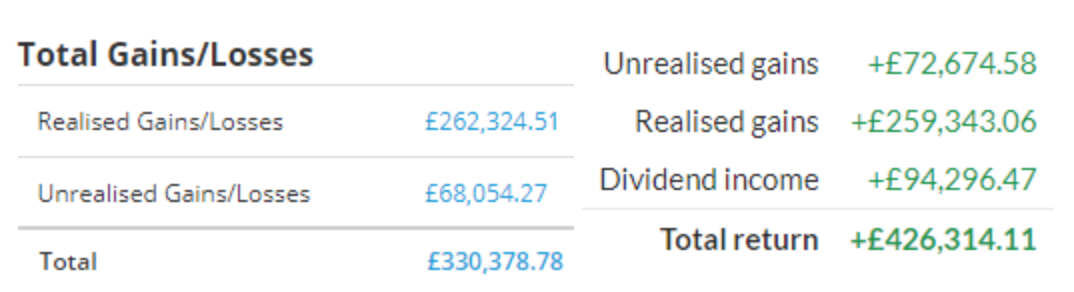
Below on the left is a screenshot from the SIF fantasy fund page. This shows total return to date on the nominal £1m starting value, excluding dividends.
On the right is a screen capture from the excellent new Stockopedia Folio system, which automatically breaks out dividend income to show the contribution it makes to total returns:
(The initial value of the portfolio was £1m)
At the time of writing, the portfolio is worth £1,426,314.11 with dividends, and £1,330,378.78 without dividends.
Dividends have added 9.6 percent to my total return over 3.5 years. That won’t be too surprising -- it’s just under 3 percent each year.
What’s more surprising is to realise that this dividend income has increased my total return to date by 29 percent.
I think these numbers are a useful reminder of the power of dividends, which can of course be reinvested or withdrawn to suit your requirements. That’s not true of capital gains, which must always be traded to be realised.
Diversion over. Let’s get back to this month’s threesome under review.
D4T4 Solutions (LON:D4T4)
(Original coverage 04/12/2018)
Shares in this ‘big data’ software company got off to a flying start when they joined the SIF folio last December. Progress has cooled since April, however. Note that the stock’s gradual decline is also starting to be mirrored in its StockRank:
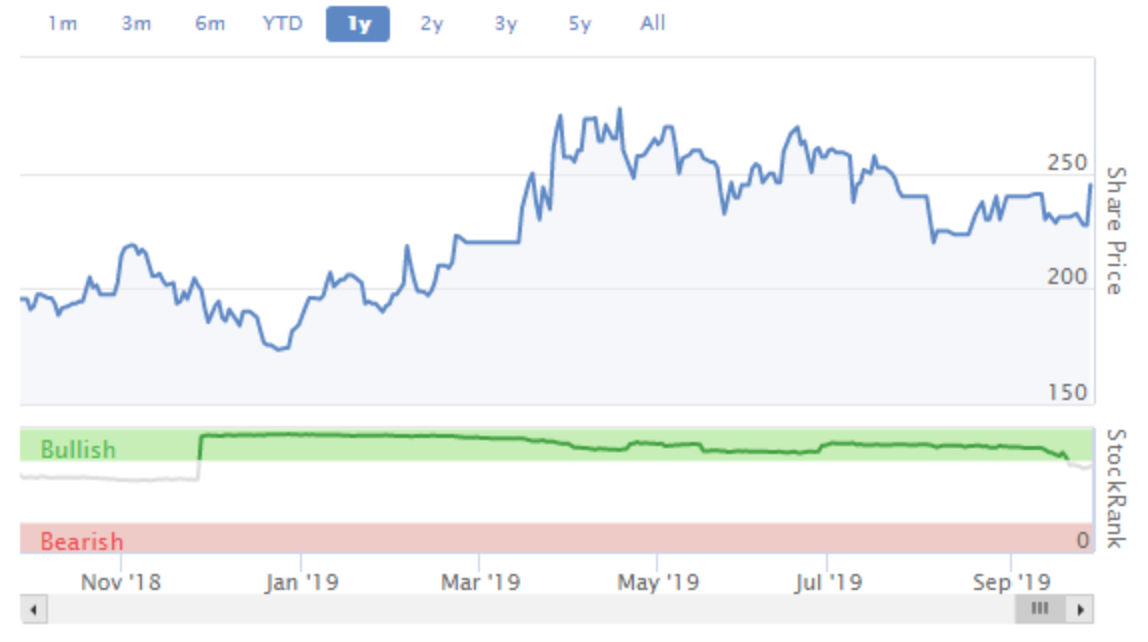
What lies behind this price action? A year-end trading update in April and subsequent final results in June struck a cautiously optimistic note, and confirmed that performance was expected to be in line with expectations.
I suspect some shareholders were disappointed that management didn’t upgrade guidance for the year ahead.
2018 saw the group deliver an impressive 57 percent increase in adjusted earnings. In contrast, forecasts for the current year suggest earnings growth of just 2.1 percent. Forecasts for FY21 indicate eps growth of 3.5 percent.
Is D4T4’s growth engine running out of steam? One person who should know is co-founder John Lythall, who ran the company from 1985 until 2016 and remains a non-executive director. Mr Lythall sold 1.2m shares in early July, reducing his holding from 5.5 percent to just 2.6 percent.
Two fellow directors, COO Mark Boxall and Chief Data Officer Matthew Tod, also logged big sales. Mr Tod has since resigned and will leave at the end of September.
I also note that D4T4 is about to get a new CFO. The firm has been without a permanent CFO since 4 July, even though the previous incumbent gave notice in April.
My view: I’m not suggesting that anything is amiss. But the picture no longer looks as enticing to me as it did when I bought the stock. We have:
A big founder share sale
Boardroom turnover
Earnings expected to flatline over the next 18 months
The shares trade on 17 times forecast earnings and yield just 1.4 percent
In fairness, I should say that the balance sheet remains debt-free. Last year’s 25 percent return on capital employed was also impressive. However, I don’t see a compelling case for buying the shares at current levels, unless you have an in-depth understanding of the business and see hidden value.
D4T4 Solutions now fails five of my 15 screening tests, mainly due to its higher valuation and slowing earnings growth. I also note that the StockRank has fallen from 94 at the time of my purchase to just 71 today.
I’m quite happy to take profits at this point and allow events to unfold without me.
Verdict: Sell
Total return: +25pc
Carr’s Group (LON:CARR)
(Original coverage 11/12/2018)
In April, Paul Scott described Carr’s as “a rather dull agriculture and engineering group”. His view was that most investors could probably find more exciting opportunities.
I must admit that over the last nine months, Paul’s scepticism has proved justified. Carr’s share price has gone nowhere much except down and the SIF folio’s holding is currently running a 13 percent loss.
Where the stock does score very highly in my view is as an income investment. Adjusted for splits, Carr’s dividend has not been cut since at least 1993, the farthest back I can find records. During that time, the dividend has grown from a split-adjusted 0.39p to 4.5p. My sums suggest that gives a compound annual growth rate of about 10 percent per year, over 25 years. Not bad.
I think that what I’ve learned is that this is not a stock that’s likely to be suitable for shorter holding periods.
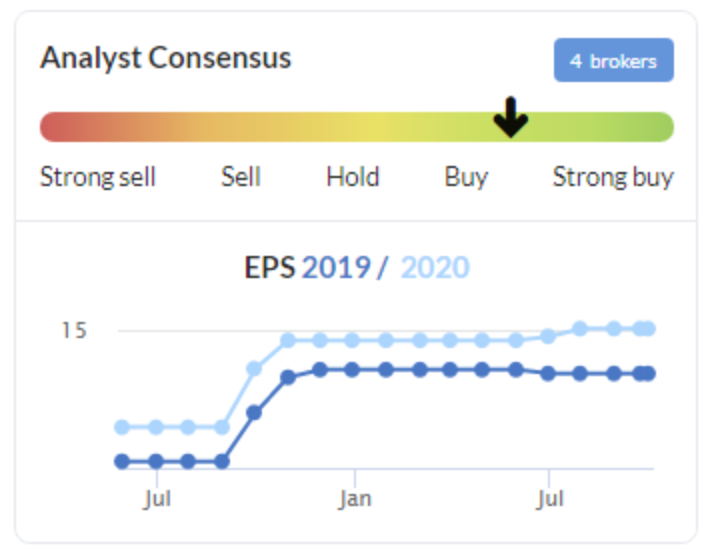
Trading: Since I bought the stock last December, Carr’s trading has been in line with expectations of modest growth this year. Brokers covering the firm have remained remarkably consistent/resolutely uninspired over this time, depending on your view!
My view: With Carr’s stock now trading on nine times forecast earnings and offering a dividend yield of 3.5 percent, the shares look reasonable value to me for a patient income investor.
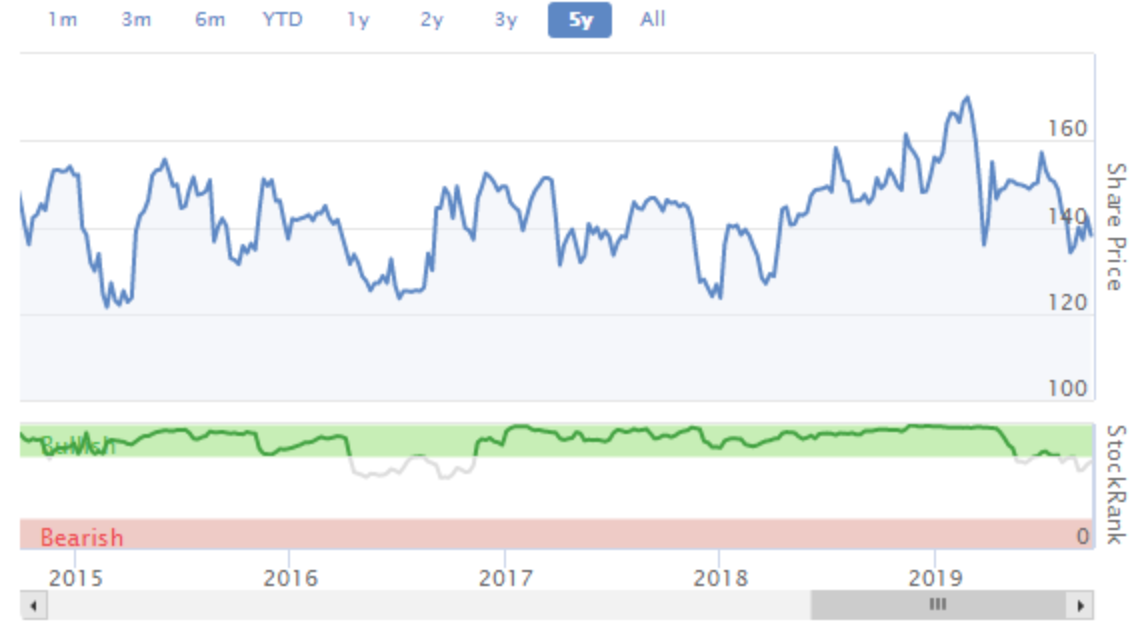
However, this stock has been range-bound over the last five years, and I can see no obvious catalyst for a re-rating. It’s certainly a dull picture and I see that the StockRanks are starting to lose faith:
Carr’s lacklustre profit growth and share price performance means that it fails a number of my screening tests. I have no choice but to sell the stock from the SIF folio.
Verdict: Sell
Total return: -13pc
Macfarlane (LON:MACF)
(Original coverage 18/12/2018)
Let’s finish with a winner. My timing was lucky when I added small-cap packaging group Macfarlane to the SIF fund in December. After the autumn sell-off, the stock bounced back quickly in early 2019:
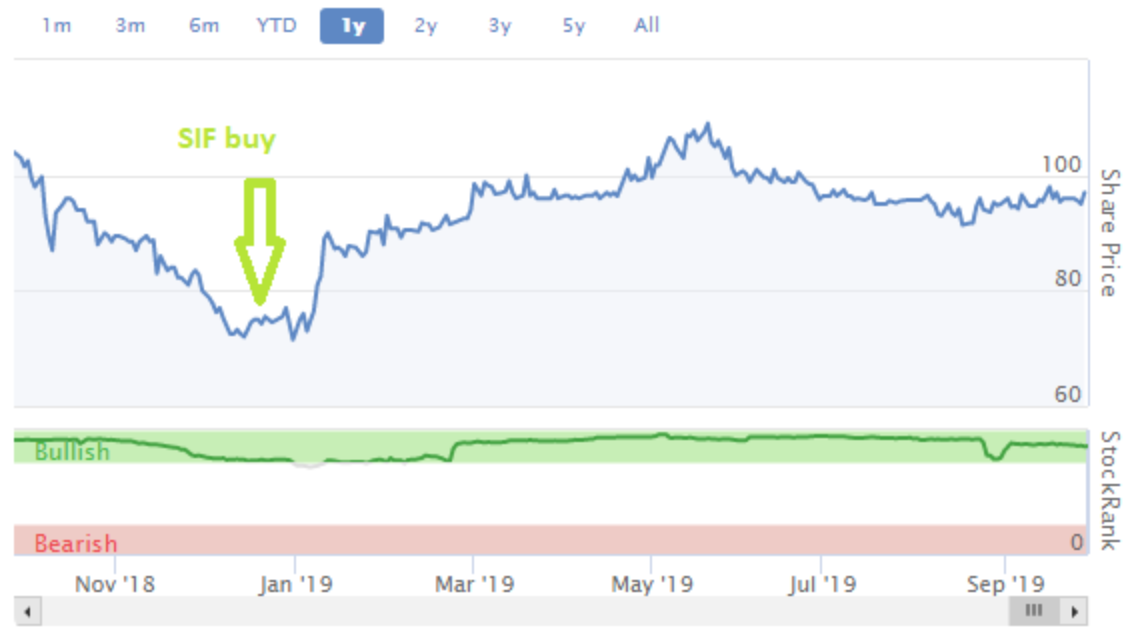
As it happens, February’s final results showed that sales rose by 11 percent to £217m in 2018, while underlying pre-tax profit climbed 20 percent to £11.2m. These numbers were said to be in line with expectations, but they represented an impressive ninth consecutive year of profit growth.
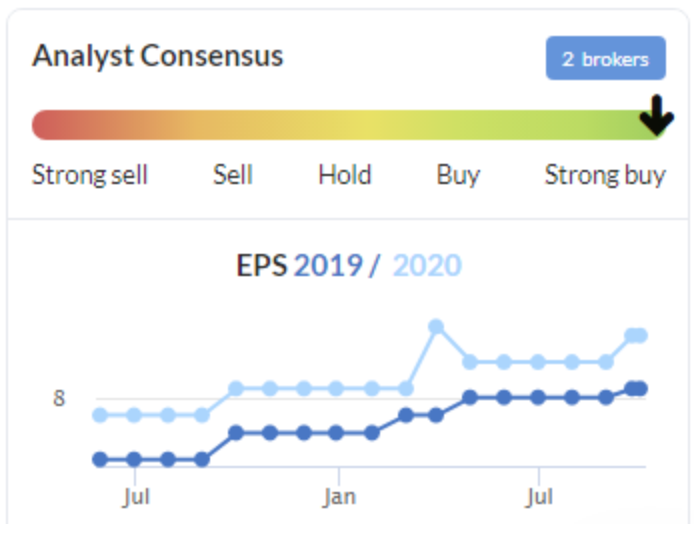
Chairman Stuart Paterson confirmed guidance for “further progress in 2019” despite difficulties in the retail sector. Analysts covering the stock were sufficiently impressed to tweak their forecasts higher.
Macfarlane’s recent half-year numbers also triggered a small tweak to this year’s forecasts and a bigger increase for next year:
My view: Although I believe that packaging carries some cyclical risks, I see it as a sector that is likely to benefit from modest structural growth over the coming years.
Macfarlane’s valuation remains reasonable, in my view. The shares trade on 11.4 times rolling forecast earnings, with a 2.7 percent dividend yield. My only slight reservation relates to the group’s gearing, as reflected by the new IFRS 16 regulations.
Is leverage higher than we thought? The new accounting rules require companies to show a right of use asset and a matching lease liability on their balance sheets. This has been reflected in a big increase in Macfarlane’s reported net debt:
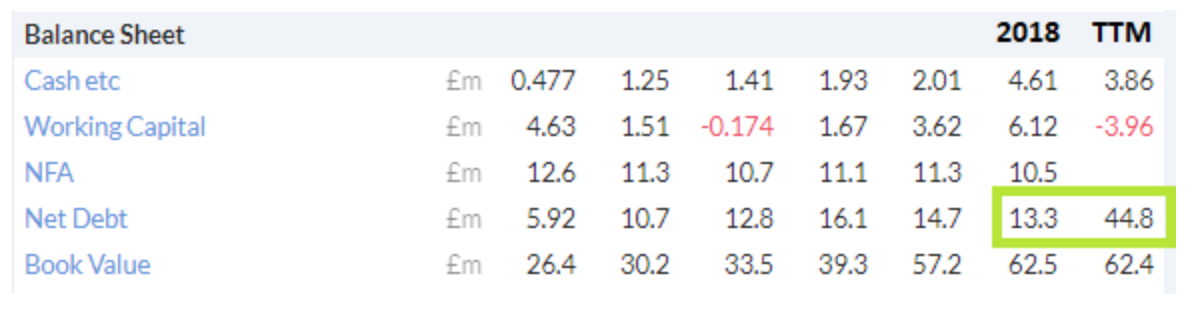
This increase reflects £29m of finance lease liabilities which the company has added to its balance sheet. These are said to represent buildings and plant, such as printing presses.
Adding the corresponding right of use assets to the balance sheet has increased the value of Macfarlane’s Property, Plant & Equipment (PP&E) from £8.7m to £39.5m. Management say that right of use assets are valued to reflect the total lease liability, less accrued lease payments. I think we can view this as a loose approximation of the value of these assets.
This ‘missing’ PP&E was previously accounted for with operating leases, which show up as an operating cost only, with no balance sheet presence. I think this change is interesting -- it seems to suggest that this business is more capital-intensive than we thought. It also suggests a higher degree of leverage (relative to profits) than was previously apparent.
All else being equal, I expect the group’s return on capital employed to fall as a result of this accounting change.
I should caveat these comments by saying that I’m not an accountant or an expert on lease accounting. My comments reflect my view only -- and if I’ve made any glaring errors, please feel free to point them out.
Getting back to Macfarlane, this stock no longer passes all of my screening tests, in part because of the impact of IFRS 16 on various quantitative metrics.
Given the firm’s consistent performance and confident outlook, it may be too soon to sell. But I’m going to stick to my rules and will be selling the stock from SIF this week.
Verdict: Sell
Total return: +30.7pc
As always, I’ll sell these shares from SIF and from my personal holdings after this article has been published.
I’ll be back next week, hopefully with news of a new stock for the SIF folio.
Disclosure: At the time of writing, Roland owned shares in Macfarlane, D4T4 Solutions and Carr’s.
Disclaimer
This is not financial advice. Our content is intended to be used and must be used for information and education purposes only. Please read our disclaimer and terms and conditions to understand our obligations.

6 comments
the link "https://app.stockopedia.com/fa..."
doesn't work, it 404's back to the home page
Hi Old ManFit,
Stockopedia Fantasy Funds aren't yet available on the new version of the website.
To access the SIF fund (and all others) you'll need to switch back to the old version of the site.
The correct link for the Stock in Focus fund is:
https://www.stockopedia.com/fantasy-funds/stock-in-focus-portfolio-6449/
Regards,
Roland
Interesting observations on Macfarlane (LON:MACF) Roland.
You're probably aware that I had a bit of a spleen-vent on the subject of IFRS16 here and funnily enough it was MacFarlane that brought the ('debt') implications to my attention in the first place.
But there is more, you say :
The numbers suggest that certainly but I don't believe it is true. I cannot really see this accounting construct as capital, it's capitalised future expenses and seems bonkers - I was in two minds about the debt element but this looks a lot more clear cut to me.
Supposing a company pays £100k of rent per year. If they have a 10 year lease remaining they would appear to have £1m of "capital" tied up, but if they only had 2 years remaining on the lease it would only be £200k (in fact perhaps nothing if it then became classified as a short term lease). Presuming the business continues to operate into the third year , they will still be paying rent. (Whilst we are getting used to rents coming for retail real estate, I don't think that is true for commercial real estate in general).
And while we are on the subject, should we not also capitalise the business rates they will have to pay over the duration of the lease?
Anyway rant aside, it was actually the decision to take MacFarlane out of the SIF that intrigued me.
Looking at your screen I can see four failsRS 1y > 0 - Probably nothing to do with IFRS16 (although very tenuously the IFRS numbers could have knocked sentiment)
Earnings Yield % >= 8 - The enterprise value has increased by 20% as a result of IFRS, I think this would have been borderline on the old numbers.
Piotroski F-Score >= 6 - MACF scores 5 and without looking at the other elements that might be affected, I know it loses one point because debt has apparently gone up year on year. In reality debt reduced,but MACF did not restate the prior year numbers for IFRS16 (there was no obligation to do so)
Net Debt < Net Profit This would have been a narrow fail anyway (although I cannot see that MACF ever passed this test, so how did it get in?) As reported the numbers give profit of £9m vs "debt" of £45m
I do absolutely understand the point that this is rules based approach, but I can see a couple of challenges here.
During the transition period; you are actively discriminating in favour of companies that have yet to produce any IFRS16 numbers, but there is no reason to believe that discrimination provides any positive factor. (probably no negatives either, but could result in missed opportunities)
Once the transition is out of the way I can still see challenges that might imply that the screen needs to change - given that almost every company will be impacted to some degree.
(Once both the PY & FY numbers are under IFRS16, I think Piotroski will return to normal).
So to be selecting the same "types" of investments in the future, you might have to relax those criteria slightly. However, even if you do so you will be implicitly discriminating against companies that have long leases for property and/or equipment.
In the current environment that would certainly be a good thing for "retailers", but I cannot imagine you are picking up too many of those currently anyway. For other sectors and possibly retail in the future I cannot really see that would be a rational discrimination.
I don't know the answers there, but I do think that IFRS16 is going to prove to be quite a profound change by anyone screening directly or indirectly on 'debt' and potentially 'capital'.
Hi Gromley,
Thanks for your detailed comments, you make some interesting points. I also enjoyed your IFRS 16 piece and thought it covered the key issues well.
IFRS 16: Debt and capital creation?
I agree that the implications of IFRS 16 are potentially significant for screen-based systems and could cause some disruption. I'll come back to this in a moment.
Debt: As regards debt 'created' by IFRS 16, I think it's fair to assume that a contractual obligation to make payments for years into the future is equivalent to conventional debt. It's not the same as business rates, which would cease if the business ceased. Lease liabilities remain regardless of the state of the business, just like debt.
Obviously this is a bit simplistic. How do leases compare with debt in terms of recourse and seniority? Are any of the leases guaranteed? We don't know the answers without much in-depth research, but for equity holders I think it makes sense to take a conservative view and assume that all quasi-debt obligations rank ahead of equity.
Capital: What about capital employed? I agree that the 'right of use assets' and corresponding liabilities mandated by IFRS 16 are not a perfect representation of capital employed.
For property, considering outstanding lease terms as capital employed is perhaps not ideal. A company whose property is on a 20-year lease will appear to be more capital intensive than one whose property has a 10-year lease. This probably wouldn't be true for a property that was bought with conventional debt, such as a mortgage.
However, I think the IFRS 16 rules work much better for depreciating assets such as plant and equipment. The capital value of these assets does naturally depreciate with time. This is already reflected on the balance sheets of companies that use conventional debt. IFRS 16 now mirrors this.
I'm no expert, but it seems to me that IFRS 16 is a step in the right direction. After all, these assets do represent both capital employed (by the lessor) and debt-like obligations (for the company). The business couldn't function without this level of capital, so I'd argue that we should include these elements in our view of capital employed.
Macfarlane (LON:MACF) and the SIF screen
Getting back to Macfarlane, I agree that some of the screen fails can be linked to IFRS 16 and some cannot.
Even a single fail is enough to require me to sell a stock, so regardless of how we treat the impact of IFRS 16, I think the decision to sell can be justified, based on my rules.
Do I need to change the rules? You're right that there could be some wider implications of the IFRS 16 rule change, especially relating to statutory net debt. I may need to modify my screening rules to reflect this.
I'm still working out the best approach to take here, but I'll aim to comment on this in more detail in my articles over the next few weeks. Thanks for bringing this to the foreground for me!
Regards,
Roland
What does SIF an abbreviation for? It is not obvious from the article!
It's just the name given to his portfolio 'Stock in Focus' - see bio top right