SIF Folio: It's time to make a proper decision about T Clarke

The inglorious departures from the SIF folio of Bilby and Staffline over the last two weeks have drastically reduced the fund’s exposure to UK-focused cyclical businesses.
Still left in the fund are car dealership group Lookers and brick maker Michelmersh Brick Holdings. Arguably, packaging group Macfarlane shares some exposure to the UK cycle as well.
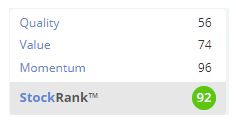
Against this backdrop, I’m forced to again consider whether to add building services contractor T Clarke (LON:CTO) to the folio. This highly-regarded small cap is still the top-ranked eligible stock in my Stock in Focus screen results. It’s also highly-rated by Stockopedia’s algorithms:
I first considered T Clarke a few weeks ago but opted to add emerging market asset manager Ashmore instead to improve my diversification. My exposure to UK cyclical stocks is now much lower, so I feel that I should now make a more committed decision about T Clarke.
Sector backdrop is mixed
Let’s start with a look at the wider Construction & Engineering sector to which T Clarke belongs.
According to the Stockopedia stats, companies in this sector trade on a median price/earnings ratio of 9.1 with a median dividend yield of 3.8%. Earnings per share are forecast to rise by an average of 6.9% this year.
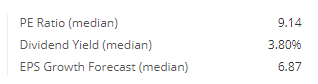
These numbers seem to paint a fairly neutral picture to me. You’d expect low valuations for companies of this kind, but it’s encouraging to see that sector earnings are still expected to rise this year.
At a company level it’s probably fair to say the outlook is more mixed. Notable losers over the last six months include Bilby and Kier Group, which fell 40% on Monday after a big profit warning.
However, even Kier singled out its ‘Buildings’ division as being the only area where it was still seeing revenue growth, albeit at a slower rate. I’d imagine this is where the firm’s activities coincide with those of T Clarke, so that seems cautiously optimistic.
Deloitte’s latest London Crane Survey suggests a similar picture. Activity in the London office market is said to be robust, but with a shrinking long-term pipeline. This is important as the City is a key market for T Clarke, which has outfitted many of the City’s major office buildings.
I should also point out that Kier Group was listed in T Clarke’s Mello presentation as one of the firm’s “top clients based on current revenue spend”. Hopefully there’s not too much credit risk there.
Momentum has been strong
The market has remained positive on T Clarke over the last year. Indeed, the firm is the top-performing stock in the Construction & Engineering sector over the last six months:
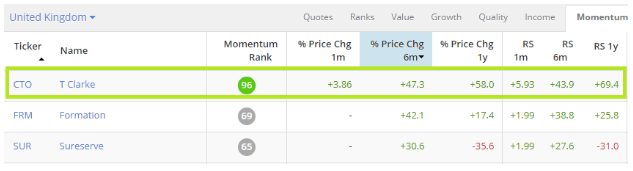
The CTO share price has risen by about 45% over the last half year. Although this has made the shares more expensive, this increase has partly been offset by a 24% rise in broker consensus forecasts for the current year:
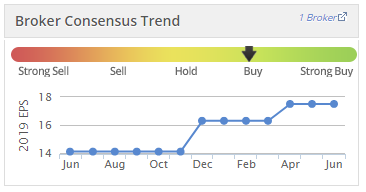
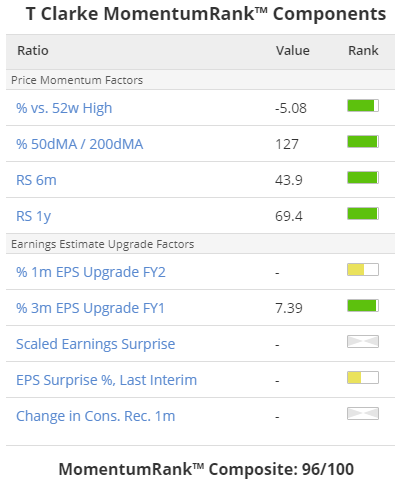
This momentum is evident in the group’s MomentumRank score of 96, which is hard to fault:
T Clarke’s latest guidance certainly suggests a pretty robust outlook. At the end of April, management reported a forward order book of £403m, compared to £368m at the same time last year. Margins are said to be on track to deliver “a sustainable 3% operating margin in 2019”, compared to 2.6% last year.
Importantly, the firm says that it sees “no lack of opportunities across all of the market sectors in which we operate”.
Sector-best quality?
Given this guidance, either management are guilty of blind optimism, or the outlook really is quite strong. In my view, the latter is more likely.
Chief executive Mark Lawrence started with T Clarke more than 30 years ago as an apprentice. Having attended the T Clarke presentation at Mello in May, I was impressed by Mr Lawrence’s commitment to staying specialised and operating within a disciplined financial framework. Indeed, in following this company over the last few years, I’ve formed a strong view that it’s one of the top-quality companies in this sector.
All of the firm’s activities are focused around designing, installing and maintaining electrical, mechanical and IT services. By staying specialised and employing a skilled workforce (80% of work is done by directly-employed staff) it’s built a reputation for reliable delivery. In 2018, 88% of turnover was with repeat customers.
However, according to Stockopedia’s algorithms, T Clarke’s QualityRank is pretty ordinary, at just 56/100. Am I missing something?
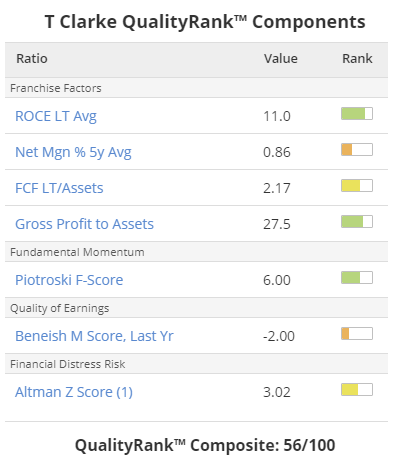
I’d identify two main areas of relative weakness here. The first is the Piotroski F-Score of 6/9. The F-score -- or fundamental health score -- is heavily weighted in the QualityRank calculation. However, as with any numerical test, it can be influenced by marginal results.
For example, according to the Stocko data, T Clarke’s gross margin fell from 12.3% to 12% last year. I’m not convinced this is very meaningful, but it was enough for the stock to fail one of the F-Score tests.
The second area of apparent weakness is the firm’s five-year average net profit margin of 0.86%. This isn’t great and is a useful reminder that this is an inherently low-margin business. The only point I’d make is that margins have been consistently improving for several years:
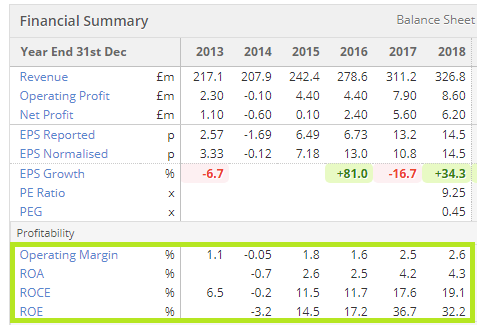
As mentioned already, the company expects its operating margin to hit 3% in 2019.
Cyclical risk: All this talk of margins brings me to the elephant in the room. Despite a cash-rich balance sheet, rigorous bidding process and operational excellence, T Clarke is still a cyclical construction business. So where are we in the current cycle?
The short answer is that I don’t know. But I think it’s fair to assume that we’re in the second half, perhaps even the final quarter.
One way to measure this might be to look at the current state of T Clarke’s profit margins and compare them to the years either side of 2008. Handily, this information is available in the 2010 annual report, together with a comparison to peer group rivals:
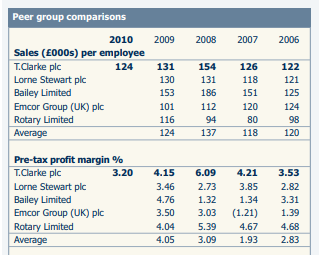
Source: T Clarke 2010 annual report
As you can see, there was a rapid peak and decline in margins, centred around 2008. I’m not sure if this past performance is a useful indicator for the current market, but it does suggest that margins over 4% are unlikely to be sustainable.
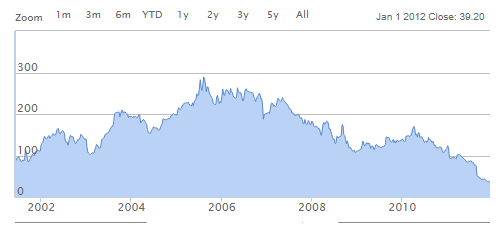
It’s also interesting to map these margins against T Clarke’s historic share price movements. The shares peaked in 2006, two years before margins peaked...
Is this the right time to buy?
I note that T Clarke’s biggest institutional shareholder, Miton, has been selling down steadily over the last year.
According to the 2017 annual report, Miton had a 17.7% stake in March 2018. By July 2018, that had dropped to 9.99%. And in March 2019, it fell to 4.95%.
Miton appears to have started building its stake in T Clarke in 2013, since when the shares have (roughly) doubled. Large shareholdings in small caps must be sold while the market is still rising, as selling in a falling market is impossible without destroying the share price. So by selling now, Miton’s fund managers seem to be indicating that they think the top is much closer than the bottom.
Taking a shorter view, the stock doesn’t seem too expensive. The shares trade on about nine times trailing earnings and 7.6 times 2019 forecast earnings. A dividend of 4.4p per share is pencilled in for this year, giving a 3.3% yield.
My decision: I haven’t gone against my screen for a while, but I’m going to this time. I can’t shake off the feeling that the potential downside here is much greater than the likely upside.
Although I’m not a technical trader, T Clarke’s share price chart doesn’t reassure me either:
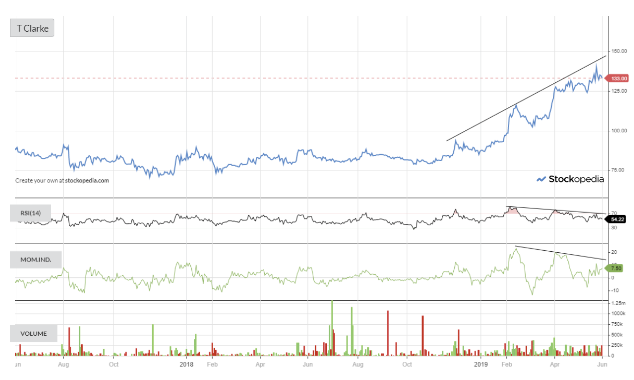
The divergence between the rapidly-rising share price and the falling relative strength index (RSI) and momentum indicators traditionally indicates that the share price trend could be weakening.
I may be missing out on a great opportunity here. But having been bitten by profit warnings at Bilby, Keller and Staffline, I’m minded to be a little more conservative about investing in low-margin contracting stocks at this stage in the cycle. I won’t be adding T Clarke to the SIF folio at this time.
As always, this is my opinion only and not advice. Please DYOR and let me know what you think in the comments below. Am I wrong to deviate from my system?
Disclosure: Roland owns shares of Michelmersh Brick Holdings, Ashmore, Lookers and Macfarlane.
Disclaimer
This is not financial advice. Our content is intended to be used and must be used for information and education purposes only. Please read our disclaimer and terms and conditions to understand our obligations.

8 comments
I agree with you Roland on both the fundamentals and tech analysis; i did consider it last year after Mello but decided against it, although there was quite a lot of excitement about it among the investors. From the TA point of view since the recovery from 2007 the price either falls well back or consolidates after a big steady rise, also the price did not exceed 90 from 2014 for 5 yrs then broke out & gained 55% to the recent high. On past performance & because of the Market and the business CTO are in I would steer clear.Also it has just had some very big lows which nearly breached the 200Ma, if it did that Momentum would drive it down more.. I would buy , if the business stays the same , when the price gets near to 85.
On May 16th Simon Thompson, in IC, rated T Clarke (LON:CTO) a strong buy at 128 with a target price of 150. I hold. Hopefully the recent dip in price to 123 is just a reflection of the macroeconomic situation and the cyclical nature of the business. Despite the somewhat narrow profit margin this is probably a reasonably priced share and I have no immediate plans to sell. A fall to 85 looks unlikely - but one never knows in this business (predictions are at best uncertain, as I'm sure Neil Woodford would agree).
Hi Roland
As I read this (12:59). T Clarke (LON:CTO) fallen -10.59%.
Not sure if its trades between institutions or start of down turn. I'll watch carefully.
Sadly I hold.
EDIT(13:03): Oh two big sells amounting to 180 thousand units.
Regards
Howard
Hi
"EDIT(13:03): Oh two big sells amounting to 180 thousand units."
Am I right in assuming this info is not available in Stocko?
Thanks
Hi prem14
I got it from the LSE Interactive Chart/Today view ---- make sure to tick the show volume box and I usually select the candlestick view.
https://www.londonstockexchange.com/exchange/prices-and-markets/stocks/summary/company-summary-chart.html?fourWayKey=GB0002015021GBGBXSET3
Regards
Howard
Hi Howard/prem14,
One comment I would make - I'm not sure that the T Clarke (LON:CTO) sells Howard mentions were two large single trades. The list of trades which went through today on the LSE doesn't seem to include any that large:
https://www.londonstockexchange.com/exchange/prices-and-markets/stocks/exchange-insight/trade-data.html?fourWayKey=GB0002015021GBGBXSET3
I'm no expert on this and may have missed something, but it looks more like a group of smaller trades to me.
Regards,
Roland
I agree with you Roland and think there is better buys available and would therefore remain neutral on this one.
On one hand the momentum in the share price looks great and could continue for another while who knows and I like to buy into companies with a positive trend... On the other hand the margins are small so do they really have any sustainable competitive advantage?
As you say it is always hard to determine where in the cycle we currently are and as a holder of Redrow (LON:RDW) I have to ask some of the same questions
Hi InvestorJohn,
I agree that the same questions apply to Redrow (LON:RDW) -- but with an added political dimension due to the effect of Help to Buy and the tendency of UK governments to interfere with the housing market.
Regards,
Roland