SIF Folio: Why I’m tempted to mine royalties with Anglo Pacific (+ Bilby update)

It’s been almost a month since I last added a new UK stock to the SIF folio. The company in question was small-cap building services firm Bilby. This holding hasn’t got off to the best start as it’s already fallen by 17%.
This makes Bilby the second biggest faller in SIF. Regular readers will know that I don’t use stop losses or sell stocks ahead of schedule. So Bilby will keep its place in the folio for at least nine months. However, I think it’s worth taking a quick look to see what, if anything, has gone wrong.
Bilby - founder share sale?
I’m not too concerned by the sudden drop in Bilby’s share price. The firm’s full-year results in July were good and there’s been no newsflow to justify a fall since then.
One possible explanation is that there’s a big seller in the market. This idea seems to be supported by market data on 3 September, which suggested that more than a quarter of the group’s stock has just changed hands:
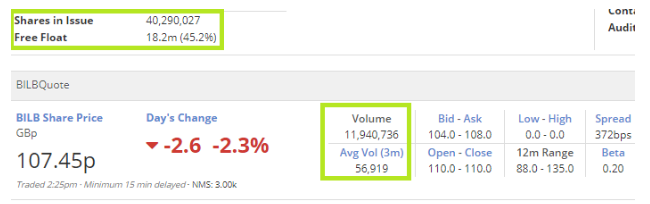
The only shareholder who controls this many shares is founder and Deputy Chairman Phil Copolo. Mr Copolo’s last-reported stake was 35.9% (14.5m shares).
Update 04/09/2018: An RNS has been released this morning confirming that Phil Copolo has sold his entire stake in the business and plans to retire, after 40 years in the hot seat. Given that he’s 65, this doesn’t seem overly worrying. The shares have been placed with institutional shareholders at 100p, hence the recent price weakness. You can read the full announcement here.
Moving on, I think it’s worth noting that the technical picture still looks reasonably supportive, with the 50-day moving average now ahead of the 100-day figure:
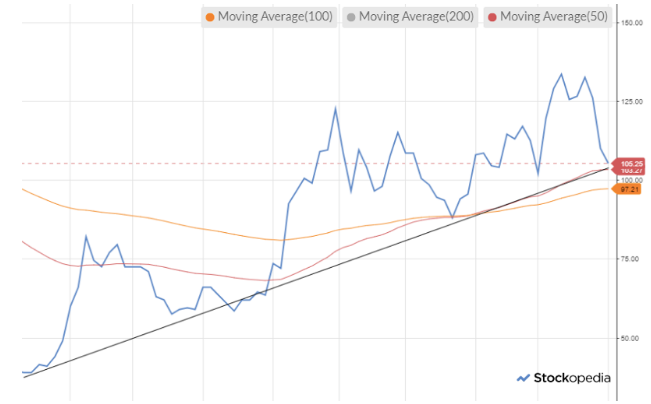
The black line is mine and suggests the share price could find support at this level.
Can Anglo Pacific deliver another 42% gain?
Although it’s an area where I have an interest, SIF’s exposure to the natural resources sector has been limited so far.
The highlight to date is last year’s investment in FTSE 100 iron ore giant Rio Tinto, which generated a total return of 42%. However, my screen is now highlighting another potential opportunity in this sector, mining royalties group Anglo Pacific.
Stockopedia’s algorithms currently view this £272m firm as a Super Stock with a StockRank of 88.
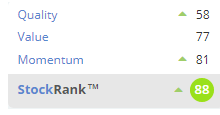
Anglo Pacific is essentially a financial business. It makes money by buying non-operated stakes in commercial mining projects and then receiving royalties from future production.
The firm’s main asset is a stake in the Kestrel coal mine in Australia. Former owner Rio Tinto recently sold its 80% stake in this mine, as part of its exit from the thermal coal sector. The new operator, Adaro, has apparently announced plans to double production at Kestrel over the next few years. This could give Anglo’s revenues a significant boost.
Anglo’s half-year results suggest this business is already firing on all cylinders. Revenue rose by 12% to £19.1m during the first half of the year, while adjusted earnings rose by 19% to £15.4m.
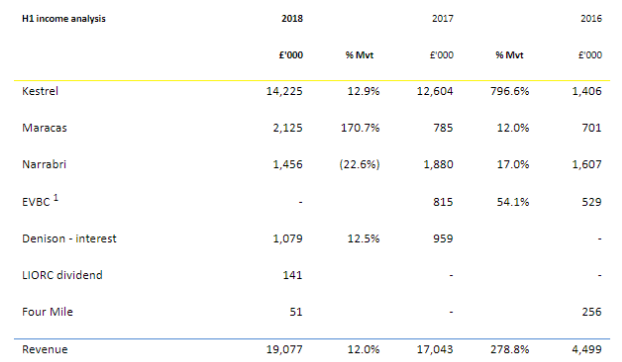
The revenue split shows how Anglo Pacific remains dependent on Kestrel
Times are good for Anglo Pacific at the moment. But I think it’s worth emphasising the two main risks for investors.
Lack of control: The company’s royalty agreements sometimes only cover one section of a mine. This is true at Kestrel. During H1, 96% of mining at Kestrel was within the group’s royalty lands. However, this hasn’t always been the case. In 2016, only 67% of Kestrel sales came from Anglo Pacific land, and in 2015, the figure was just 49%.
This variation isn’t under the firm’s control. It means that even when market conditions are stable, royalty income can be volatile.
Commodity prices: Royalties are usually based on a percentage of gross revenue, so they are dependent on commodity prices. Here’s a recent example of a royalty deal. So if commodity prices fall, revenue falls too.
Management should be able to protect shareholders from these risks by building a cash buffer during boom years and using this to pay dividends during lean periods. Chief executive Julian Treger attempted this during the recent downturn. He almost succeeded, but ultimately the depth of the downturn and the lack of Kestrel royalties in 2015/16 forced him to cut the dividend and issue new equity:
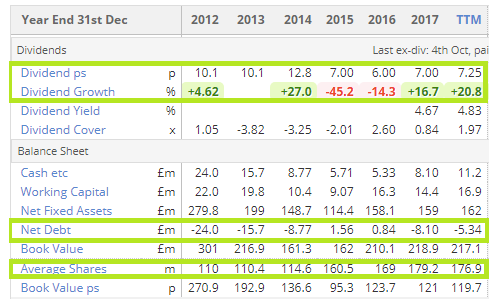
The firm’s book value per share remains well below historic levels, but it is quite attractive relative to the last-seen share price of about 150p. So let’s take a closer look at the stock’s key quality, value and momentum metrics.
Value works for me
A ValueRank of 77 suggests few serious problems in this department.
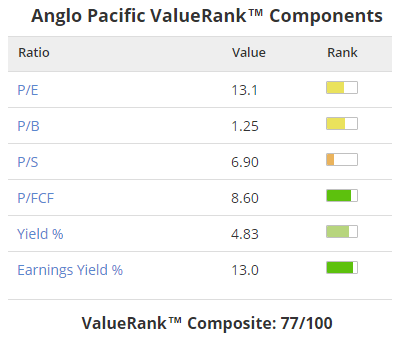
My core valuation metric of earnings yield (EBIT/EV) is attractively high, at 13%. This is backed by a price/free cash flow of just 8.6. Inverting this ratio gives an impressive trailing free cash flow yield of 11.6%, which should help Anglo Pacific to rebuild its cash reserves.
Asset values can vary depending on commodity prices. But if my view that we’re in the early stages of a mining growth market is correct, the price/book ratio of 1.25x doesn’t seem excessive either.
Cyclical quality?
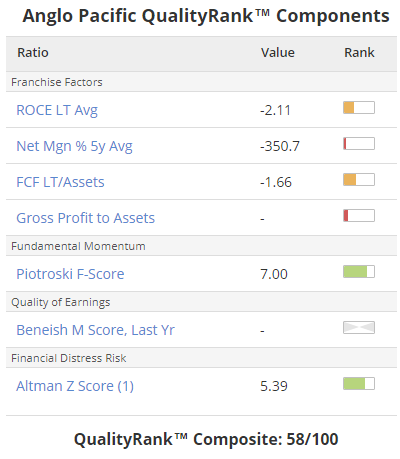
The Stocko figures suggest rather average quality metrics for Anglo Pacific:
In my view, there are two halves to this story.
The first is that cyclical businesses often struggle to deliver above-average returns over a cycle. In this case, the five-year period included in the long-term average Franchise Factors all include the 2014-16 mining downturn. This was a tough period even for the best of companies.
In this case, Anglo Pacific’s figures were skewed by a thumping full-year loss of £47.6m in 2014. This was mostly driven by £31.5m of impairment charges triggered by reduced asset values and a production suspension at one mine.
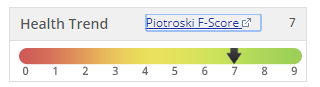
The second part of the quality story is represented by the Piotroski F-Score. Broadly speaking, this fundamental health score represents performance over the last 12 months.
Here we see a much more attractive picture. The mining downturn has already dropped out of the figures and the stock passes 7/9 of the F-Score tests. Profits, strong cash generation and an improved balance sheet all contribute to this strong score.
Given the cyclical nature of this business, I’m happy to focus on the recent past and the projected future. So to justify a purchase, what I need now is a strong momentum score.
Improving momentum
The stock has a MomentumRank of 81, which suggests a strong outlook:
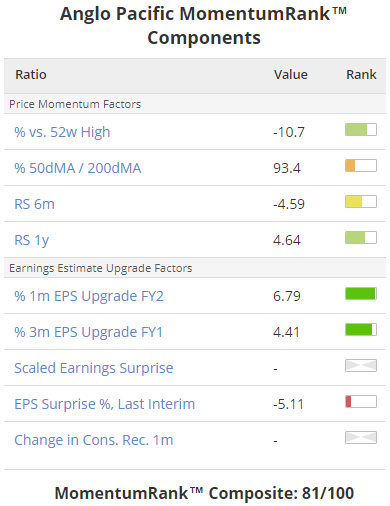
This all looks fine to me. Anglo Pacific’s share price is only 10% from its 52-week high. Most importantly, earnings estimates have recently been increased for 2018 and 2019.
Although the last set of earnings was said to be slightly below expectations, the broker consensus trend displays the kind of strong upwards path I like to see:
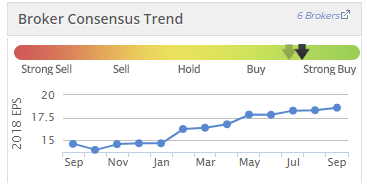
These upgrades have left the stock trading on a rolling forecast P/E of 8.6, with an expected yield of about 5%.
My decision
At this stage in the mining cycle and with this valuation, I think Anglo Pacific should be able to generate positive returns for shareholders. At the very least, I think the downside risks should be reasonably contained.
I’ll be adding this stock to the SIF folio and to my own holdings this week.
Disclosure: Roland owns shares of Rio Tinto and Bilby.
Disclaimer
This is not financial advice. Our content is intended to be used and must be used for information and education purposes only. Please read our disclaimer and terms and conditions to understand our obligations.

14 comments
Thank you for this reply and sharing your expertise.
I have decided to hold off buying until the price goes below 140p (when/if?) which is approximately a 50% retracement on the recent spike as I would feel more comfortable with an entry point at those levels.
Regards
BB
Hi Roland
Thanks for bringing this company to my attention. I really like it and it would certainly help to diversify my portfolio. I am not an expert on these things but I cannot get over paying a premium to book value for the shares. Should I be using different valuation metrics? You mention that you consider P/B attractive at these levels.
I should be grateful of any further comment that you can make.
BB
Hi BB,
Thanks for your comment. As a value investor at heart, I also like buying asset-backed stocks at a discount to book value. But the reality is that this is often only possible during severe downturns, such as that seen a couple of years ago in the mining sector.
Although Anglo Pacific (LON:APF) now trades at a premium to book value, I don't see the stock as overvalued given recent results. If these are sustainable then I feel comfortable with the current valuation.
It's worth noting that stocks trading at a discount to book value are often doing so for valid reason. The assets on which the book value depends may be worth less than expected in the open market for example. This is potentially the situation with retail property stocks at the moment (e.g. £INTU).
These situations can sometimes take much longer than expected to resolve. Several of the big FTSE 100 banks have traded at a discount to their book value for years now, due to the low returns they've generated during this time.
Having said all of that, buying good assets at a discount is still possible sometimes. And it can still be very profitable when you get it right!
Regards,
Roland
Disclosure: I own shares of Anglo Pacific
Hi Roland ...
Thanks for your comments on Anglo Pacific .
l have always liked the idea of collecting " ticket punchers " .
Frankly , aside from my green credentials being in tatters , l cannot see how the world could ever reduce
coal consumption any any significant way .
Hence coal is now o.k with me , especially since l did not have the courage to buy Whitehaven at the very bottom !
My chart of APF shews a distinct trading break-out in place .
Beat wishes , Ramon .
Hi Roland. Can I ask how you got the view in the first picture at the top of this page showing Bilby's trading volume etc.? I don't seem to be able to find this view in Stocko. Thanks.
Sorry, please ignore me - I couldn't see it for looking but now I found it.
I have bought and sold Anglo Pacific for some years now and never had to sell at a loss with a good div too
I will hold for some time I guess
Anglo Pacific is listed also on the Canadian Exchange and as I prefer the Canadian Dollar to the £ I bought it on the Canadian 2 years ago.
Hi roland,
I was interested to read your article on bilby .
My concerm would be the historic profit levels are rather lack of profit that worries me.
Last years figures good , but can that be maintained With this type of business .
Having said that seems a possible buying opportunity at present price
Hi Roland,
Many thanks for another interesting and thought provoking article.
I am intrigued by your comments - "But if my view that we’re in the early stages of a mining growth market is correct.." and would be interested in your thoughts behind that.
I hold a number of mining and energy stocks in my own SIPP and have been wondering if I have let things get a little out of balance so another perspective on the mining sector, even a brief one, would be very welcome.
Richard
Hi Richard,
Thanks for your comment. I'm not a mining analyst, but I do have some interest in this sector. Broadly speaking, my view on the market at the moment is that having recovered from the downturn and strengthened their balance sheets, mining operators are now starting to think about consolidation and perhaps investing in new projects.
Anglo American (LON:AAL) and BHP Billiton (LON:BLT) have both approved multi-billion dollar projects recently (here and here) and Rio Tinto (LON:RIO) also announced an increase in capex in its recent results. Prices for most commodities remain supportive and there seems to be a consensus that the supply-demand balance for copper in particular may tighten over the next few years.
In this environment, my view is that there will be winners and losers. I don't think all mining stocks are cheap at the moment, but I do think that some offer good value on a medium-term view.
A diversified mining royalty company offers an alternative way to gain exposure to this market. To this end, I think it should be possible for Anglo Pacific (LON:APF) to deliver attractive returns over the next few years.
Of course, I may be completely wrong! All of this is my opinion only, so please DYOR.
Regards,
Roland
Disclosure: I own shares of Rio Tinto and Anglo Pacific.
A diversified mining royalty company offers an alternative way to gain exposure to this market. To this end, I think it should be possible for Anglo Pacific (LON:APF) to deliver attractive returns over the next few years.
Roland,
I'm a little confused by this after you mentioned in your article that 75% of royalty revenue comes from only a part of a thermal coal deposit that was SOLD by Rio Tinto. So it's difficult to see how you could claim Anglo Pacific (LON:APF) is diversified (single mine + single commodity) or that there is upside from investments that the likes of Rio Tinto (LON:RIO) are making for the future, when in fact they are divesting thermal coal interests?
All the best, Si
Hi Si,
Thanks for your comment. You're right in that Anglo Pacific (LON:APF) is probably still too dependent on coal. But the firm is taking steps to improve diversification. Revenue from Vanadium trebled during H1 and the company has spent $51m so far this year on diversifying its portfolio (e.g. new copper and iron ore royalties).
In the near term, global demand for thermal coal remains still strong for electricity generation. So I expect Kestrel to continue to generate plenty of cash.
I mentioned recent new spending by companies such as Rio Tinto (LON:RIO), BHP Billiton (LON:BLT) and Anglo American (LON:AAL) to support my suggestion that the mining sector is cautiously returning to growth. In such an environment, I believe Anglo Pacific should be able to make some attractive new investments. But I didn't intend to suggest that there was a direct link between Rio's spending and Anglo's profits.
Hope this helps,
Roland
I was very interested to read this latest SIF article as I have holdings in both companies :-)
I have watched the Anglo Pacific (LON:APF) share price move in both directions since I acquired my shares in March, and I am happy to continue holding. I think that their increasing diversification across different resources should hopefully offer better protection to resource price cycles.
Yesterday I topped up with a third (albeit still small compared to most on Stockopedia I am sure) tranche of Bilby (LON:BILB) shares having seen the huge sale that went through, as I assumed that this was (hopefully) the end to the selling activity that has resulted in a ridiculous decline in the share price from the recent high of 137. I agree that the departure of Mr Copolo should not be a concern, after such a long spell with the company why shouldn't he retire at 65? Today's announcement includes reassuring repositioning of personnel to fill his shoes. The content of the recent results looked extremely positive.