SIF Folio: Why marginal gains could help Tesco beat the market

One of the techniques that’s credited for the success of the British Olympic cycling team under Sir Dave Brailsford is an approach known as the aggregation of marginal gains. The argument is that by making small gains in many areas, the end result is significantly better.
Brailsford says that while going for gold seemed “too daunting” when he became performance director in 2003, the team was able to search for small improvements everywhere “and found countless opportunities”.
Team GB went on to win eight gold medals in cycling at Beijing in 2008 and another eight in London 2012. Having previously won just one since 1908, the change in the cycling team’s fortunes was marked.
Marginal gains in investing?
Not everyone agrees that marginal gains were responsible for the cycling team’s transformation, but for investors the maths is quite compelling.
1% gain each day for one year = 3,780% gain (corrected 16/1 - thanks to the many readers who pointed out this error)
1% decline each day for one year = 97.5% loss
Here at Stockopedia, we’re not looking to win any races. But we do want to find ways of producing investment results that have a consistent edge over the market average. One way I try to do this is by investing some of my cash in a rules-based portfolio.
Regardless of the market mood, my screening rules find stocks with consistent qualities. My trading activity is also governed by rules. This prevents me doing things like panic selling or supersizing my favourite positions.
My hope is that by doing all of this, I’ll be able to avoid the cost of cognitive bias and stay ahead of the market as the years pass. So far, it’s worked out okay. The value of my SIF Folio has increased by 30% since its launch in April 2016. Over the same period, the FTSE All-Share has gained just 8.4%. (Both figures exclude dividends.)
What’s this got to do with Tesco?
I’m sure you don’t need me to remind you of Tesco’s long-running marketing slogan, Every Little Helps. This is aimed at convincing customers of the retailer’s everyday low prices. But I can’t help feeling that since boss ‘Drastic’ Dave Lewis took charge in 2014, this motto has also been applied to the group’s operations.
Mr Lewis has closed unprofitable stores and flogged non-core businesses. He’s also improved the firm’s accounting standards, financial controls and product ranges while presiding over a move into wholesale. Margins are starting to recover and cash generation has improved significantly. As a result, net debt has fallen from £9.9bn to just £3.9bn in 4.5 years.
This week I want to ask whether I should add Tesco to the SIF fund. Sharp-eyed readers will note that Tesco doesn’t currently qualify for my main SIF stock screen. Indeed, only eight shares qualify for this screen at the time of writing. Most are already in the portfolio. The remainder are unsuitable, for various reasons.
However, because it’s been at least four weeks since I last added a stock to the portfolio, my rules allow me to relax certain screening criteria. By altering the maximum PEG ratio and minimum earnings yield, I’m able to buy shares trading on slightly higher valuations.
You can see my relaxed SIF stock screen here.
Almost the only company which doesn’t duplicate any of the stocks already in the portfolio is Tesco. Although this stock shares currently has a rather low StockRank of 35, this isn’t necessarily a problem if it satisfies my other rules.
The story so far
I last covered the UK’s largest supermarket in July 2018. At that time the shares were trading at around 260p. I took a positive view on the turnaround story, but was unsure about the price.
Using some basic technical analysis, I said that “I wouldn’t be surprised to see a period of consolidation in the near future”. My view was that the shares were fully priced but would be worth considering around 225p.
As it happens, Tesco stock is now trading just below my target price, at 218p (at the time of writing). Although the shares have bounced from the sub-200p lows seen at the start of the year, the technical picture has reversed since my last piece and now shows improving momentum and relative strength readings:
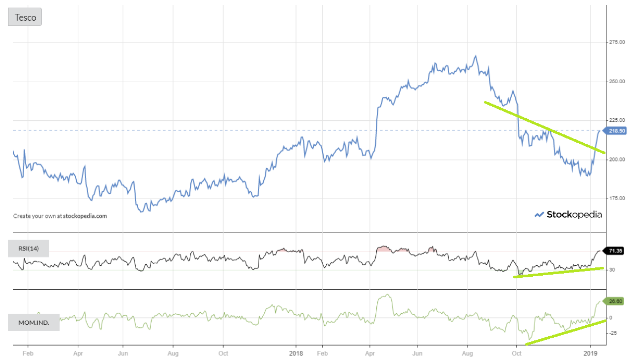
Sadly, my forecasting isn’t always this accurate. But I’m certainly comfortable with this picture if the stock’s other metrics stack up favourably. Let’s take a look.
Value is improving
Tesco’s ValueRank remains fairly average, at 52. But the picture has improved since last July:
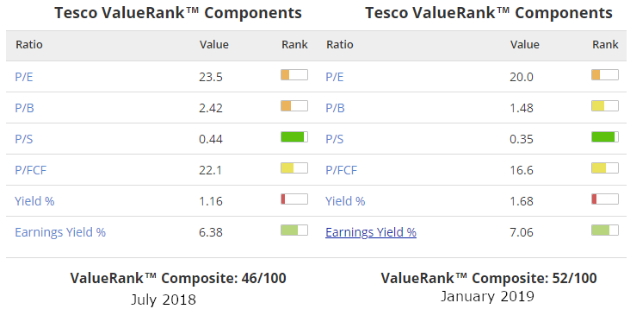
The stock looks cheaper today on all measures. Earnings yield (EBIT/EV) is now close to my preferred minimum of 8%. Free cash flow remains higher than earnings per share.
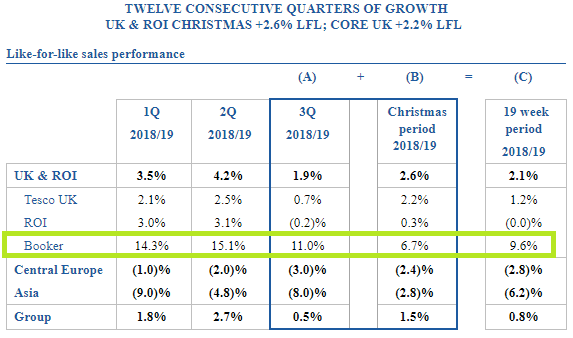
Last week’s third-quarter/Christmas trading update showed UK sales up by 2.1% over the 19-week period. Mr Lewis confirmed that results for the current year are expected to be in line with market forecasts. I’ll look more closely at these in a moment, but if this guidance is correct, then I’d expect the stock’s ValueRank to improve significantly after Tesco’s full-year results are published in April.
2015 is still hurting the quality score
It can be difficult to judge a turnaround stock by its quality metrics. Margins, return on capital and cash generation all tend to suffer when a company goes through a bad patch.
This is evident from a look at Tesco’s QualityRank, where the franchise factors for the last five years are very poor:
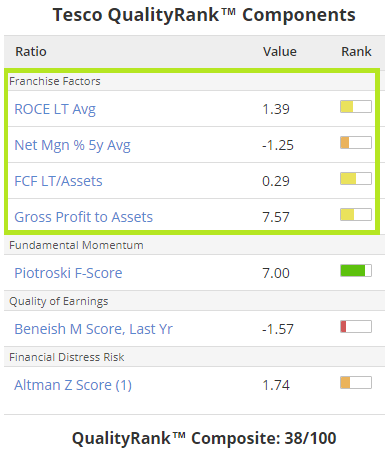
However, I don’t see this as a big concern. The problem stems from 2015, when the group reported a thumping £5.7bn loss. This is weighing down the five-year average margin and ROCE:
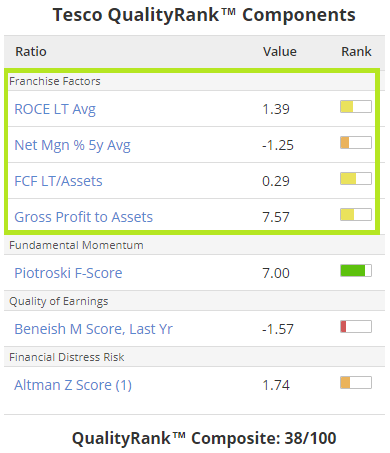
In reality, the group’s free cash flow, margins and return on capital employed (ROCE) are all improving. Trading margin rose by 0.3% to 2.9% during the first half of last year. Management guidance is for a figure of 3.5% - 4% in 2019/20.
I’m quite comfortable with the quality situation.
Earnings growth should support momentum
I’ve already touched on why I think Tesco’s price momentum may be improving. But what about earnings momentum? The firm’s latest trading figures suggest that the acquisition of wholesaler Booker group is playing a key role in sales growth:
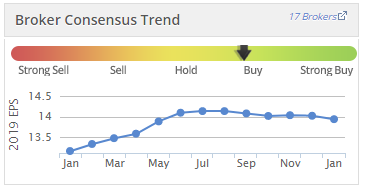
Analysts’ earnings forecasts have edged marginally lower in recent months, but the consensus is broadly positive and essentially unchanged since May 2018:
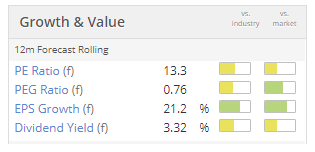
These forecasts value the stock on a rolling forecast P/E of 13, with a dividend yield of 3.3%. That seems reasonable, given that eps growth is expected to remain at 20%+ over the next year:
My decision
I rate the boardroom partnership of chairman John Allan and CEO Dave Lewis very highly, based on their performance so far. With no sign of either man departing, I’m quite comfortable with the fundamentals and outlook for Tesco.
Although returns may not be spectacular, I see this as a fairly low-risk and defensive buy at the moment. As a UK-focused business, it could also enjoy a Brexit bounce if the current impasse is resolved.
I’m going to add Tesco to the SIF Fantasy Fund this week and to my own holdings, after this article has been published.
Disclaimer
This is not financial advice. Our content is intended to be used and must be used for information and education purposes only. Please read our disclaimer and terms and conditions to understand our obligations.

10 comments
An interesting read, as usual; I think the Booker acquisition makes them stand out from the other supermarkets and offers much better growth potential than, for example, Sainsbury's acquisition of Argos.
The relaxed SIF rule set throws up one or two other interesting shares, such as Mission Marketing (LON:TMMG)
At the risk of spoiling these comments and bringing it back to the subject of Tesco, I know that the team at Supermarket Income REIT - a management team I rate, are positive on Tesco.
They often point out that Tesco is the world leader in online grocery delivery, and they took a positive (if brief) view of the last results, available on their website, where they viewed the reaction to the results as a buying opportunity.
No position myself in Tesco, but sometime I am watching and considering.
John,
You know its half the fun!!!
And Tesco has done its 1% today. I hold.
Isn't that an increase of 3678% ?
I agree,
Great post, but I'd be disappointed with this result if I'd done 1% everyday ..... "1% gain each day for one year = 37.8% gain".
Have you got your decimal point in the wrong place Roland?
Edit, BTW agree with your thoughts on Tesco. I bought for my SIPP last week.
I respectfully suggest that you revisit your percentage calculations near the beginning of the article.
I think you mean 37 times better, not 37%
Thanks to all the readers who pointed out the error in my calculations. A 1% improvement each day for a year is indeed a 378% improvement.
Apologies for the error. I blame Brexit...
Roland
Roland,
1.01 to the power 365 = 37.8
An improvement of 37.8 times is a lot more than a 378% improvement.
Aghhh. You are of course correct, John. An improvement of 37.8 times is a 3,780% increase.
Perhaps I keep reading it wrong because it seems too good to be true.
Thanks all for pointing this out. I will amend the article.
Roland