SIF November review: +44% from Morgan Sindall, Sirius and Air Partner

Market conditions seem to be changing. The number of stocks qualifying for my Stock in Focus screen has fallen steadily recently and is now down to just 14. Several of these are already in the portfolio, or would be ruled out due to duplication issues.
If this continues, then the SIF portfolio may move steadily into cash until more attractive opportunities emerge. I’m not overly concerned about this, as I don’t believe you need to be fully invested all the time. Indeed, I think that’s one of the advantages private investors have over most fund managers, who have little choice but to deploy cash when it’s made available to them.
In any case, I’m not looking to add any new stocks to the portfolio this week. It’s the end of another month, which means it’s time to take a look at stocks which have been in the SIF portfolio for nine months or more.
Do they still qualify for my screen, or is it time to jettison these shares and free up some virtual cash for new opportunities?
The situation is quite interesting. But before I get started, I’d like to flag up my article from last week. I’ve launched a new international version of the SIF portfolio, which uses a modified version of my screen to select stocks from all the countries covered by Stockopedia.
I’ll be including monthly updates to the International SIF from now on, so I’d be interested to hear more about your experiences investing overseas. We had some interesting comments last week regarding the impact of dealing costs and foreign exchange.
A 44% total return
Here’s a summary of the three stocks up for review this month, and their performance to date:
Construction and regeneration group Morgan Sindall
Germany-focused business park operator Sirius Real Estate
Last month’s holdover stock, aviation services group Air Partner
A quick look at the Fantasy Fund page suggests these stocks have delivered a cracking performance for the portfolio, especially Morgan Sindall:

Including dividends, the average total return from these three holdings has been 44%.
Notwithstanding this, all of these stocks will have to be sold this week unless they continue to qualify for the Stock in Focus screen.
Morgan Sindall
Construction and services group Morgan Sindall has proved to be one of the portfolio’s most successful investments so far. This FTSE 250 firm has upgraded profit guidance more than once since it joined the portfolio, and has published some strong results.
Unlike certain rivals, this firm has taken care to protect margins and maintain a strong balance sheet. Net cash at the mid-year point was £96m, and full-year guidance was recently upgraded from “not less than £75m” to “in excess of £100m”.
One reason for this prudence might be that founder and CEO John Morgan owns 10% of the stock. With his own money on the line, Mr Morgan doesn’t want a Carillion-style blowout...
Broker consensus forecasts have followed the shares higher, albeit not quite so quickly. Whereas 2017 earnings forecast have risen by 26% to 115.3p since the stock joined the portfolio, the shares have risen by 54% over the same period.
As a result, the stock’s 2017 forecast P/E has risen from 9.4 in February to 12.1 today. Although this may not seem excessive, it’s worth remembering that the group’s operating margin remains stubbornly low, at under 2%.
This translates into a profit of around £50m on turnover of about £2.8bn. It’s easy to see how relatively small problems could take chunks out of the group’s profit margin.
Still a Super Stock
Stockopedia’s computers remain very keen on Morgan Sindall, which has a StockRank of 99 and a StockRank Style of Super Stock.
In a discretionary portfolio, I’d probably continue to hold this stock. But the outlook for earnings growth in 2018 is more modest than for 2017. This, combined with the stock’s rising valuation, has lifted Morgan’s rolling PEG ratio to rise to 1.34.
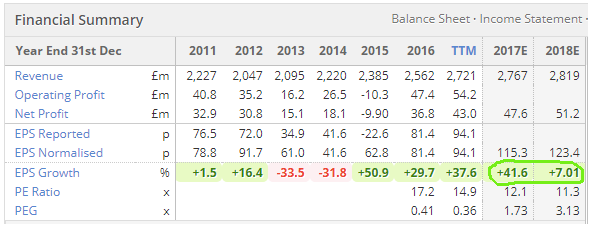
As a result, this stock no longer passes all of my screening tests. It will be sold from the portfolio this week, locking in a handsome total return of 59%.
Total return: 59pc
Verdict: Sell
Sirius Real Estate
German business park operator Sirius Real Estate was one of the stocks I purchased earlier this year, when I was using the Jim Slater-inspired relaxed version of my screen.
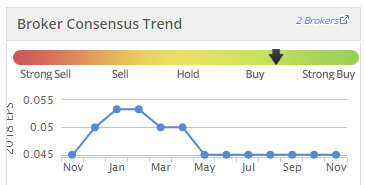
It’s proved a successful trade, despite the rather discouraging broker consensus trend that’s developed:
In June’s full-year results, Sirius reported an 8.5% increase in like-for-like portfolio valuation, supported by LFL growth of 5.1% in annualised rental income. The group’s revenue rose by 23% to €68.8m, while adjusted earnings per share rose 34% to 4.25 euro cents.
Earlier this week, the group published an encouraging set of half-year results. Like-for-like rental income rose by 2% during the half year, while revenue rose 8.3% to €35.3m.
However, it seems that short-term performance may be dampened by the current portfolio recycling project. The company has sold a number of mature assets with an average occupancy of 90%. These have been replaced with some underperforming assets boasting an average occupancy of just 58%. The plan is for the firm to implement its usual improvement strategy in the hope of re-renting at higher levels and with greater occupancy.
These shares now trade at a premium of about 15% to their adjusted net asset value of 55p. The yield remains attractive at 4.1%, and I can see no reason to think that Sirius won’t be able to add value to its new properties as it has done previously.
Long-term holders might want to sit tight. However, earnings are expected to fall in 2018, as the loss of income from mature sites hits the portfolio. As a result, Sirius no longer meets my requirement for forecast earnings growth. So I’ll be selling this stock from the portfolio this week.
Total return: 29pc
Verdict: Sell
Air Partner
Aviation services group Air Partner has been in the portfolio since December 2016. It’s stayed longer than the minimum nine months, thanks to strong earnings growth and a previously modest valuation.
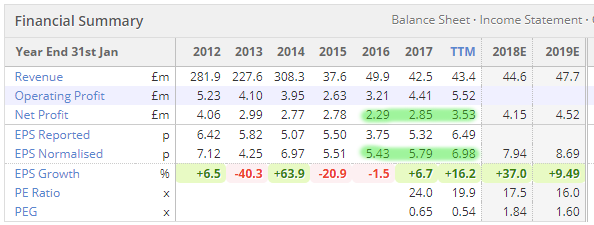
However, as with Morgan Sindall, valuation is starting to edge ahead of the expected rate of earnings growth.
The stock now trades on a rolling forecast P/E of 16, with a forecast PEG ratio of 1.39. At the time of purchase, the rolling P/E was 11 and the PEG ratio 0.76.
Although the outlook still seems positive for Air Partner, it’s not cheap or fast-growing enough to meet my screening rules, so will now be sold.
Total return: 44pc
Verdict: Sell
I’ll be back next week, hopefully with a new stock for the portfolio. As always, I’d welcome your comments on any of the stocks covered in today’s piece.
In the interests of full disclosure, I should point out that at the time of publication, I own all three of this week’s stocks. I will be selling these later this week, after this article has been published.
Disclosure: Roland owns shares of Morgan Sindall Group, Sirius Real Estate and Air Partner.
Disclaimer
This is not financial advice. Our content is intended to be used and must be used for information and education purposes only. Please read our disclaimer and terms and conditions to understand our obligations.

4 comments
Well done Roland on them gains ,enjoy your thought process when analyzing stocks.Is there any rules which prevent you from purchasing a stock which you have recently sold ie MGR ,they seem to pass all your criteria.
Hi Coniston,
I don't have any rules against repurchasing stocks, and have done so once or twice. Miton (LON:MGR) is a stock that's appeared in the screen from time to time, although it doesn't seem to qualify at the moment.
Regards, Roland
Re: Morgan Sindall (LON:MGNS) ... have you considered the Risk Adjusted PEG? (See https://www.stockopedia.com/content/the-peg-ratio-dismantled-or-how-to-buy-your-growth-stocks-on-the-cheap-62191/)
This allows me to hold Superstock/HighFlyers whist still appreciating in price even if they appear to be no longer exhibiting very cheap growth. It also means I select less volatile stocks.
The Risk Adjusted PEG of Morgan Sindall (LON:MGNS) is 0.37
Note: You can't see PEGR on a StockReport but you can add it to portfolio tables and you can screen for it.
Hi Phil,
Thanks for this interesting suggestion. I have to admit I've not come across the risk adjusted PEG before.
For anyone who isn't familiar, the link in Phil's comment is worth a read, but in short the risk adjusted PEG uses ß (beta), a measure of a share's volatility, to favour less volatile stocks.
Personally, I don't mind a volatile share price if I'm comfortable with the progress of the underlying business. But I understand that it spooks some investors. And there's also some evidence to suggest that low volatility stocks can deliver comparable returns with less downside risk than more volatile stocks.
Another potential downside of volatility is that if you're buying and selling on a schedule, as happens with the SIF portfolio, you can be forced to buy and sell at less attractive prices than might otherwise be available.
So reducing volatility in the portfolio could be attractive.
Should I change the rules? I haven't had a chance to read the Javier Estrada paper linked to in Ed's article on the PEG ratios. But my instinctive concern with this approach would be that long periods of low volatility, such as we've seen in recent years, can provide a false sense of security. For low margin, cyclical stocks such as Morgan Sindall (LON:MGNS), the financial weather can change rapidly.
For example, if Morgan Sindall experienced a shortfall of expected revenue of 1% (£28m on £2.8bn), its 2% operating margin means that operating profit could fall by up to 50%. This is an extreme example, but as we've seen with Serco (LON:SRP), Capita (LON:CPI), G4S (LON:GFS), Carillion (LON:CLLN), Interserve (LON:IRV) et al, such meltdowns do happen.
I'm going to investigate how PEGR would affect my stock choices in a little more depth. I'm also going to look at PEGY, which by including dividend yield as well as eps growth, would broaden the range of stocks available in my screen.
Thanks again for flagging this up. Definitely worth some further research.
Regards,
Roland