Will my international SIF Portfolio beat UK stocks?

One of the big benefits of a rules-based strategy is the amount of time it saves, once established. I’ve certainly found that with the SIF portfolio.
A second benefit is that you can expand your investment universe without an exponential increase in the level of effort that’s required. Strategy Editor Ben Hobson’s article last week on the benefits of international investing prompted me to consider whether my SIF portfolio rules would work equally well with international stocks.
To find out more, I’ve decided to set up an international version of the SIF portfolio.
Doing this required a series of decisions to ensure that I ended up with a manageable and (hopefully) reputable set of companies to invest in. So in this article I’ll explain the process I went through to create the portfolio.
Note: This is strictly a virtual portfolio. No real cash is involved and I won’t be buying any of these stocks, unless I state otherwise. As always, none of what I say should be taken as investment advice.
Getting started
To get started, I made a duplicate of my UK Stock in Focus screen so that I could alter some of the rules.
The first decision was which countries I should include. As I have full access to the ‘all regions’ version of Stockopedia, I decided to include all available countries. This mean Europe, USA, Canada, Australasia, India and selected Asian countries.UK stocks will also be allowed.
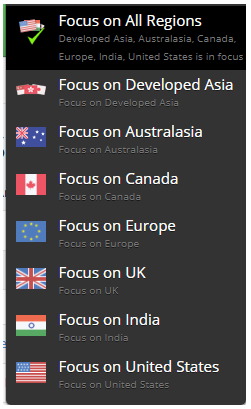
Setting up my international screen to include all countries gave me 138 stocks to choose from. That seemed like too many, so I decided to tighten up my screening rules. My aim here was to try and compensate for the greater risk of investing in overseas markets with which I have no familiarity.
How I changed the screening rules
I didn’t want to change the basic philosophy of the SIF screen, which is designed to look for affordable growth stocks. I want established, profitable and dividend-paying companies, with evidence of positive momentum. I don’t want outliers of any kind, such as special situations, deep value plays or turnarounds.
Thinking about the practicalities of investing overseas, I decided that I wanted to restrict myself to stocks large enough to have good liquidity and, hopefully, decent corporate governance. So I made the following changes to my screening rules:
UK SIF Portfolio | International SIF portfolio | Reasons for change |
Market cap >£50m | Market cap > £250m | I wanted to rule out the smallest companies to try and avoid liquidity and governance issues. I also hope to ensure a higher level of analyst coverage by raising the minimum market cap. |
Piotroski F-Score of at least six. | Piotroski F-Score of at least seven. | I believe the F-Score is an effective way of highlighting companies with good fundamentals and growing profits. Increasing the minimum score to 7/9 will hopefully tighten the focus on quality companies, without being too restrictive. |
Net debt less than 5x net profit | Net debt less than 4x net profit | Again, reducing the ratio of debt to profits will hopefully help the portfolio to avoid major losses. |
At least one set of broker forecasts | At least three sets of broker forecasts. | I’ve noticed that some quite large companies, principally Chinese firms listed in Hong Kong, are only covered by one broker. In the nicest possible way, I’d like more reassurance of their bona fides than this provides. So I’ve opted to require coverage by at least three analysts, in the hope that this will weed out any dubious firms... |
For the full set of rules for the UK SIF Portfolio, click here.
For the full set of rules for the International SIF Portfolio, click here.
Stock selection and diversification
The results of my international SIF screen will be ranked by StockRank, as is the case with the UK SIF screen. So to select stocks, I’ll work my way down the list, starting with the highest-ranked stocks.
To give you a taste of the kind of diversity these rules provide, here are the 16 top-ranked stocks from my starting set of screen results:
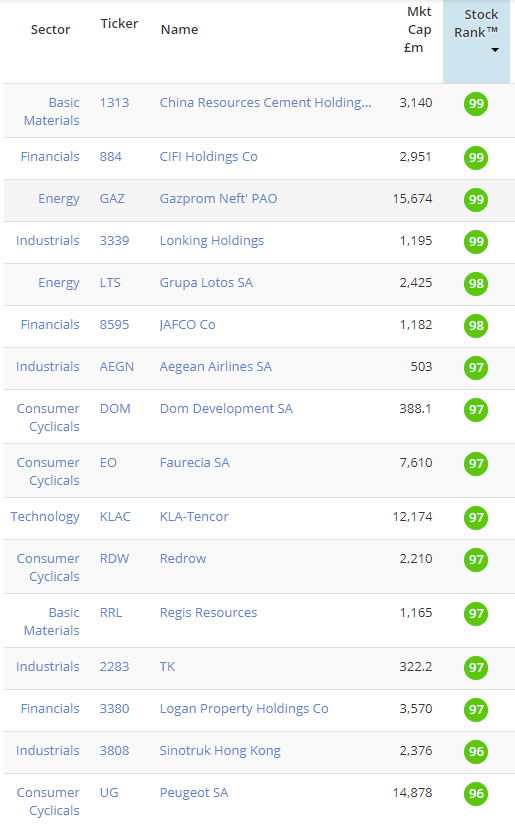
Diversification: I plan to take a slightly more relaxed approach to diversification than with my UK-only portfolio.
Investing over such a wide range of countries adds additional challenges. For example, is the performance of a housebuilder in Japan correlated with a UK housebuilder? I suspect the answer is usually no. But what about a car parts manufacturer? The answer could be yes.
I’ll use the sector and company info provided by Stockopedia to try and avoid obvious duplication. I’ll also try to include a decent geographic mix, plus a blend of defensive and cyclical stocks.
Buying & selling schedule
I want to maintain the rolling buy/sell schedule of the UK SIF, so that I can compare the performance of the two portfolios. But I don’t want to have to work on the international portfolio every week. So what I’ve decided to do is to try and add three shares each month, targeting a portfolio size of 24 stocks.
My minimum holding period of nine months will remain the same.
First buys
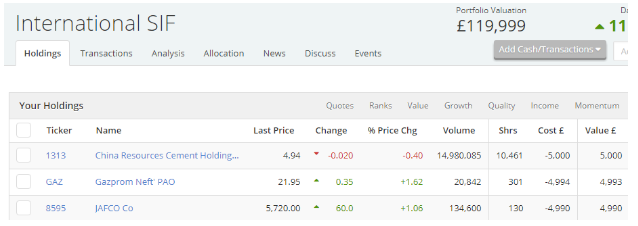
I’ve been through my screen results and selected three shares to get the ball rolling. They’re an interesting mix, but in some ways little different to the types of business you might find in the FTSE 350:
China Resources Cement Holdings: This Hong Kong-listed firm is a £3.1bn holding company of the cement and concrete operations of China Resources Group. The company says it is a top supplier of ready-mixed concrete in Southern China. With a StockRank of 99, the fundamentals look good and the valuation seems modest.
Gazprom Neft’ PAO: One of the top Russian oil and gas groups, with a market cap of £15.7bn. It has a listing on the LSE, so would be relatively straightforward to buy. The big Russian oil companies benefit from low costs, (allegedly) relaxed regulation and vast reserves. If the recent oil price recovery holds, now could be an opportune time to get involved.
JAFCO CO: A Japanese private equity business with a market cap of £1.2bn So perhaps a UK comparison might be 3i Group, which like Jafco is ranked as a ‘Super Stock’ by Stockopedia. Jafco’s valuation at 1.1 times book value seems reasonable to me and is lower than the equivalent figure for 3i of 1.4x.
Tracking the fund
I’m going to start the International SIF with a virtual cash balance of £120,000. Each position will be equally sized at £5,000. I’ll ignore trading costs as they’re too hard to estimate, but obviously these could be significant in a real portfolio.
I’m not able to set this up as a second fantasy fund, as Stockopedia only allows one of these public portfolios per user. So I will run this as a private Folio in my account.
I’ll share the progress of the international SIF here periodically if it’s of interest to readers -- so please let me know if you have any views on international investing.
Disclaimer
This is not financial advice. Our content is intended to be used and must be used for information and education purposes only. Please read our disclaimer and terms and conditions to understand our obligations.

5 comments
Roland
An excellent addition to your UK SIF and articles. Please do publish regular updates.
I set up a portfolio of 30 stocks drawn from US, Europe & UK last year 29/11/16 to draw myself into the details of screening across markets and considering impacts of FX costs.
The reason for 30 stocks was to pick three of the highest ranking stocks for each of the 10 sectors. Like you I used a fixed amount per stocks (£10k), but unlike you I allowed the FX differentials to erode into this £10k to gain an appreciation of how much it might cost me to invest in such a portfolio.
FX costs alarmed me. Out of the original £300k investment pot I only achieved virtual investments to the tune of £260k. Thus giving me a 13.3% headwind at the outset. Now, this might rebalance in the future when holdings are disposed of and might be compensated for if one were to receive dividends in a real portfolio (also not accounting for different tax regimes). I have not tested this out yet.
Today the virtual portfolio is £326.3k. Against the invested £260k, in nearly a year, the portfolio has risen 25.5%. But, only 8.8% against the original £300k. On 29/11/17 I will do a virtual liquidation of the portfolio to see if the original FX headwinds are compensated for.
Another point of interest which has surprised me is that there seemed to be a market bias as to which holdings were the least effective. Ten holdings were losers but 8 of the 10 were US stocks, four ranginging from -52% loss to -32% loss. Of the winners five were above 55% all UK/European. Games Workshop (LON:GAW) the stand out gainer with 297.2% gain.
Having not yet done an end of year detailed analysis I do draw from this some ideas about investing internationally.
Clearly it offers diversification. FX can be a headwind at the outset but might offer compensations during the lifetime of a holding and on disposal of an asset. I would certainly not simply execute a buy and hold strategy but rather employ a selling strategy to exit losing positions. It seems that the portfolio was facing a US market challenge not simply a screening challenge. So, having a fixed holding period of say 9 months, I would suggest might impair performance across markets. If I had employed a sell strategy and simply reverted sales to cash the returns would certainly have been greater.
I will certainly move more towards international investing (I'm very encouraged by PhilH's fantasy portfolio results)
https://www.stockopedia.com/fantasy-funds/philhs-fund-4060/
I look forward with great interest to your future postings with your new international SIF.
Regards
Howard
Hi Howard,
Thanks for your detailed comment. When analysing UK company accounts, I tend to view FX effects as something that can be significant in the short term (e.g. mining stocks over the last 18 months) but will balance out in the medium term.
I'd take the same view with foreign shares, although it could take several years to prove this theory right (or wrong!).
One point I probably should make is that the additional transactional costs (from a typical UK broker) for international dealing could soon eat into the returns of regular traders, especially if the amounts being invested are relatively small.
I'd certainly want to work out the costs of international investing and understand the FX buy/sell rates in more detail before starting to invest overseas. In reality, I suspect that I would use ungeared spread betting where possible, for tax-free simplicity.
Regards,
Roland
Roland
Thanks for your response.
I wonder, I am not schooled in spread betting at all, could you elaborate in your point ....... 'In reality, I suspect that I would use ungeared spread betting where possible, for tax-free simplicity.'
I am asking, not necessarily in this thread, as it might be a lengthy topic, but later on as you develop your portfolio and do future write ups. I think others might be interested to learn from your experience on this point.
Regards
Howard
"FX costs alarmed me. Out of the original £300k investment pot I only achieved virtual investments to the tune of £260k. Thus giving me a 13.3% headwind at the outset."
How can fx charges be so high? I moan about my 1.5% fee.
You must have been unlucky with the US ones, although I don't think Stockopedia works so well in that market.
Hi Herbie
I too have the 1.5% fee (HL).
I realise I ought to have been more explicit with my expression 'FX costs'. These were two costs.
I worked out the value of the holding in the new currency then I reduced it by 1.5% to incorporate FX costs. So my costs were currency differences and FX costs. (as I noted, the currency erosions might reverse if I re-translate holdings back into sterling, but one cannot be certain, thus it was a useful point for me to appreciate before embarking on a real-world portfolio).
Ref the US ones. Yes, these were a surprise. The screening was the same for all 30 stocks, so there might be some hint (but the sample is too small and short to draw any meaningful rules) that screening selection criteria do not necessarily work as well in across markets. Indeed that was part of the reason I tried the experiment. I can't identify any interesting characteristics yet as I have not analysed the results. But, from my own subjective experience, certainly investing in the US market feels very different to when I am investing in UK or European markets. Just a feeling though.
Regards
Howard