SIF Portfolio: January review - McBride, Redrow, BAE Systems & RM

The last few weeks have seen a flood of company news hit the markets, as earnings season cranks into life. Several of the stocks in the SIF portfolio have been affected, some positively and some less so.
This week we’ll see how that news has affected the outlook for two of these shares, consumer goods group McBride and education services firm RM.
As it’s the last week of the month, I’ll be reviewing all of the stocks which have been in the portfolio for nine months or longer:
Housebuilder Redrow
Consumer goods maker McBride
Education software and services firm RM
FTSE 100 defence group BAE Systems
Here’s how these four firms have shaped up during their time in the portfolio:
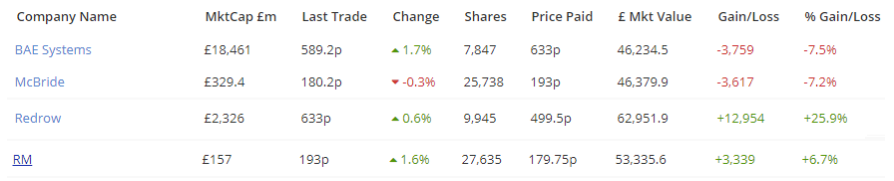
It’s a pretty mixed picture. So let’s drill down and take a closer look. Which of these stocks will remain in the portfolio for February?
Redrow
Housebuilder Redrow is up 26% plus dividends after 10 months. The shares have slipped back a little since December’s review, but this stock remains a strong contributor.
It’s not clear to me how likely further gains are, but profit forecasts for the year are bullish, suggesting earnings growth of 11% for 2017/18 and 9% for 2018/19.
I’ve long since given up trying to predict a market top in this sector, but one thing I have noticed is that several of the big house builders are speeding up production. For example, Taylor Wimpey recently noted that “we have increased the pace of production so as to meet market demand”. Strong demand is a legitimate explanation, but another possible reading of this is that these firms are starting to sense that the market may be peaking.
If that was the case, they’d want to convert work in progress into cash as quickly as possible. This view might fit with last year’s insider sales by Berkeley Group’s Tony Pidgley and Rob Perrins (total £44m) and founder-chairman Steve Morgan at Redrow (£153m).
Stockopedia’s algorithms continue to like Redrow stock, awarding it a StockRank of 96 and a StockRank style of Super Stock. Redrow also has a RiskRating of Adventurous. This combination has performed strongly in recent years, as Ben Hobson explained in this article.
Given this, housing bulls will be pleased to hear that Redrow continues to qualify for the SIF screen, passing all 14 of my rules.

This mid-cap owner manager firm will stay in the portfolio for at least one more month.
Total return to date: +28.9pc
Verdict: Hold
McBride
McBride looks likely to end January down by around 20%, thanks to a profit warning and a fairly uncertain outlook. I commented on this earlier this month, so I won’t repeat myself here, except to say that I’m no longer sure this business offers the defensive advantages I originally hoped for.
I now think that producing private label goods for supermarkets is a ruthless business that potentially negates the defensive advantages of selling consumer goods. Perhaps this is obvious with hindsight!
The portfolio is going to have to record a loss on McBride. The stock no longer qualifies for my screen on two key counts, earnings yield and the ratio of net debt to profit:
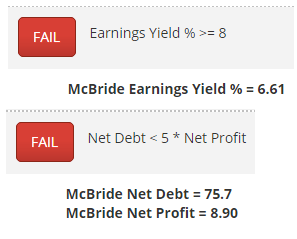
Note regarding debt: McBride’s statutory net profit last year was £8.9m, but the adjusted version was £23.9m. In this case the main adjusting item is £13m of refinancing charges, which were offset by an £11.3m cash inflow from the settlement of forward derivatives.
The new debt arrangements are expected to save £2m per year, so this looks a like good deal to me. As such I might be tempted to accept an adjusted profit figure of £20.2m (£8.9m+£11.3m). This would bring the net debt/profit profit ratio down to 3.7x, well below my limit of five times.
Notwithstanding this, McBride has to go. And given the uncertain outlook, I’m not too sorry about this.
Total return: -5.1pc
Verdict: Sell
RM
Towards the end of last year, I was starting to wonder what I might have missed with education group RM. The shares were drifting, despite a cheap-looking valuation and positive broker sentiment.
My answer came on 7 December, when the company issued a trading update advising investors that results for the year ended 30 November should be ahead of expectations.
The gains appear to be the result of organic revenue growth and better-than-expected synergies from Connect Group’s education business, which was acquired in June 2017.
The shares have gained 16% since December’s update, and the SIF portfolio’s holding is now showing a modest gain. More interestingly, RM still passes all 14 of my screening tests, so will remain in the portfolio for another month. As the full-year results are due in February, this means we’ll get a chance to see how the 2017 figures affect RM’s StockRank and financial metrics.
Total return to date: +7.7pc
Verdict: Hold
BAE Systems
I suspect I’m in something of a minority here, but I quite like investing in big cap stocks and have had some good results from them over the years. Elephants may not gallop, but when they start moving they can still cover some ground.
Defence group BAE has been a double bagger for me in the past, while generating an enviable stream of dividends. I wasn’t expecting a repeat performance when I added the shares to the SIF portfolio in April last year, but I was hoping for a slightly better showing than we’ve seen.
This is a share which seems to keep on hitting a wall of worry. There’s often uncertainty over the timing of future contracts to build ships and fighter jets, plus niggling doubts about the pension deficit. Heavy dependence on US/UK and Middle Eastern defence spending is another risk.
This mixed sentiment has been reflected in the stock’s broker forecast trend, which has been pretty unexciting over the last year:
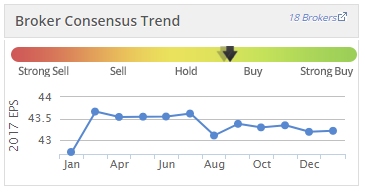
After peaking last summer, the shares have drifted steadily lower. Personally, I think this stock remains an attractive income pick. If I held the shares in a discretionary portfolio, I’d probably sit tight for now.
However, as things stand, BAE no longer qualifies for my screen, scoring a fail on no fewer than four counts:
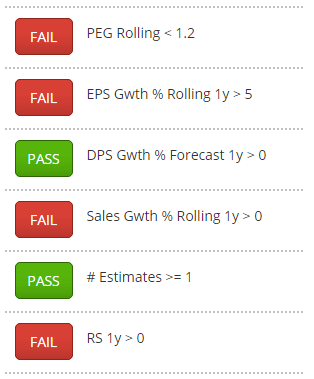
This leaves me with no choice but to eject this big cap stock from the portfolio this month.
Total return: -6.2pc
Verdict: Sell
2 sells, 2 holds
It’s not often that two stocks are held over in the portfolio after their initial holding period is up. I’m quite comfortable continuing to hold both RM and Redrow, which I own personally as well as in the SIF.
On the other hand, BAE Systems and McBride will both be sold this week in accordance with the portfolio rules.
P.S. This week’s article should have included details of three new stocks for my international SIF, which I launched in November. I’ve added these stocks but have run out of space for this week, so I’ll include details of these in next week’s piece.
Disclosure: Roland owns shares of BAE Systems, McBride, RM, Connect Group and Redrow.
Disclaimer
This is not financial advice. Our content is intended to be used and must be used for information and education purposes only. Please read our disclaimer and terms and conditions to understand our obligations.

2 comments
Hi Roland ,
Good article as usual just wanted to know your thinking behind net debt less 5 x profit , I use 3 x (based on NT rules) but maybe I should be more relaxed be interested to know your thoughts .
Thanks
Tony
Hi Tony,
Thanks for your comment. My choice of five times is slightly arbitrary, as I need a one-size-fits-all solution. I can see the argument for using a lower limit such as yours, especially if we were (are?) in a climate where debt costs could rise.
On the other hand, I believe some defensive and highly profitable businesses can function safely with higher levels of leverage. Not all debt is equally risky, in my view, depending on its context and cost.
One point I would make is that Stockopedia's Naked Trader screen uses a limit of 3x operating profit (EBIT). My 5x rule is measured against net profit, from which interest and tax costs have been deducted.
So my limit is potentially quite close to that used in the Naked Trader screen, depending on the size of a company's interest and tax costs.
Regards,
Roland