SIF Portfolio: My GKN mistake, plus US retailer Kohl’s & other foreign stocks

The Melrose-GKN battle drew to a close a few hours before the markets closed for Easter. So this week I’m reviewing the outcome of this hostile bid and the result its delivered for the SIF portfolio.
I’m also going to take a look at the foreign stocks I added to the international version of the SIF last month.
Melrose wins GKN contest
Shortly before markets closed on Thursday, turnaround specialist Melrose Industries issued a statement confirming that more than 52% of GKN shareholders had accepted its takeover offer.
As GKN is a portfolio stock, this is relevant to us. The takeover offer means that GKN shareholders will receive the following for each GKN share they own:
81p per share
1.69 new Melrose shares
Final GKN dividend of 6.2p
At the last-seen Melrose share price of 229p, I calculate that the Melrose offer is worth 474p per GKN share. This would result in a total return of about 5% on the portfolio’s purchase price of 444p.
However, as around 80% of the payout will be in Melrose shares, this value is likely to change before the deal completes. This is probably why GKN shares are only trading at about 450p at the time of writing.
As the SIF Fantasy Fund isn’t able to handle the complexity of this kind of corporate transaction, I will simply close the GKN position at the market price this week. I expect to break even, roughly.
This indifferent result leads me to my final point. Adding GKN to the portfolio was a mistake. This isn’t because it hasn’t made a profit. It’s because a company that’s in a bidding period is clearly a special situation. This puts it outside the scope of the SIF portfolio.
There’s no harm done this time, but this is a useful reminder that investing outside the rules has rarely added any value to the portfolio.
A US super stock for the International SIF
As promised last week, here’s a review of the three foreign stocks I added to the international version of my Stock in Focus portfolio in March.
You can read more about this virtual portfolio in my introductory article from November. In short, the idea is to select stocks using my rules without really knowing anything about the underlying companies. I want to see if a strict rules-based process like this can really generate profits for small investors.
Here’s an overview of the three stocks I added last month.
Kohl’s Corporation (NYQ:KSS)
One of the surprises last month was to see three major US bricks-and-mortar fashion retailers qualify for my international screen:
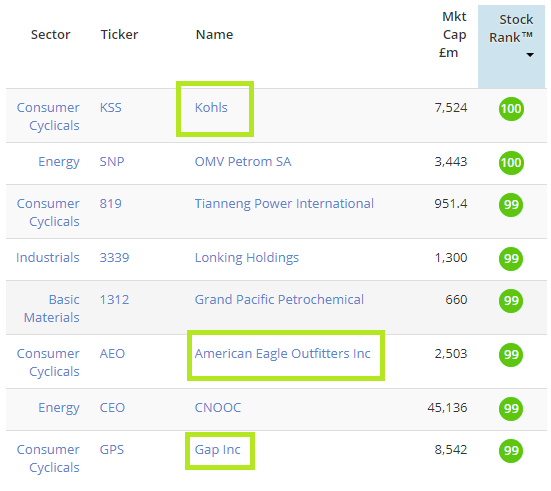
Is this a contrarian opportunity, or are these stocks potential value traps? My pick was top-ranked department store Kohl’s, which currently has a StockRank of 100 and Super Stock status.
I’ve never been to a Kohl’s store. But I have noticed some interesting press coverage recently suggesting that the group might be avoiding the decline that’s afflicting US rivals such as Sears and UK chains like Debenhams.
A partnership with Amazon is delivering promising results, while the firm’s policy of locating most stores on strip malls rather than in shopping centres may also be helping. Funnily enough, Kohl’s is also planning to sublet store space to Aldi supermarkets.
The numbers certainly look good. The shares have a trailing P/E of 14.6 and a rolling forecast P/E of 11.8, with a generous forward yield (for a US stock) of 3.9%.
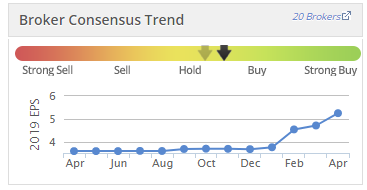
The group has also recently beaten earnings forecasts, triggering a round of analyst upgrades:
One possible risk is that net debt of $3.2bn equates to around 3.7 times forecast net profit. Borrowings have fallen by 20% over the last two years, but this level of leverage is still at the top end of my screening range.
A second potential problem is long-term lease liabilities. I haven’t done any research into the group’s store leases, but long leases can be problematic for retailers as they make it hard to close stores. This is one of the main risks facing Debenhams.
My view: The stock’s trailing price/free cash flow ratio of 10.3 suggest to me that cash generation is very good. And Kohl’s earnings yield of 14% indicates that the equity valuation remains attractive, even when debt is factored in.
On the basis of a brief inspection, Kohl’s looks like an attractive business. I’ll be interested to see if the recent strong performance can be maintained.
Leopalace21 (TYO:8848)
This oddly-named firm is a Japanese property business. It appears to build and lease apartment complexes. These aren’t just in Japan. Recent projects have included serviced apartment complexes in Cambodia and Vietnam, targeting foreign business travellers.
This is the kind of business I’d prefer to buy at a discount to net asset value. But the price/tangible book value of 1.5 doesn’t seem too excessive, as the firm has a net cash balance and has delivered improved returns in recent years:
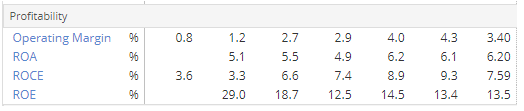
The dividend yield is relatively modest, at 2.5%, but earnings are expected to rise by 12% over the coming year (31 March year end). The forecast P/E of 13 doesn’t seem excessive to me, if we accept the premise that Asian economies are generally in good health.
Foster Electric Co (TYO:6794)
This audio electronics firm is the third Japanese company to join the International SIF. I’ll probably avoid any further picks from Japan in favour of increasing the portfolio’s exposure to continental Europe, south-east Asia and the Americas.
This company was founded in 1973 produces audio equipment such as speakers for automotive and hi-fi applications and headphones. Much is sold for OEM use, but some is also sold under the Fostex brand.
Fostex headphones and speakers on sale at prices between £100 and £1,000, so this firm seems to cater for the mid-high end of the market.
Operating profit has risen by at a compound average rate of 8.7% per year since 2012, while sales have risen by an average of 6.1% per year. The company appears to have taken a big hit to profits last year, but forecasts suggest this should be a one-off:
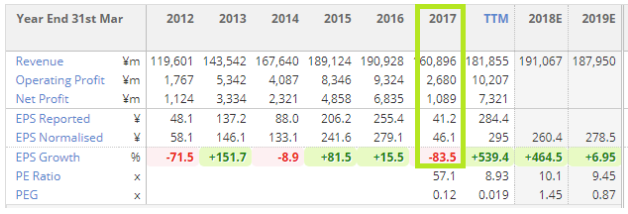
Looking ahead, Foster Electric seems affordably priced on 10 times forecast earnings. Net debt is minimal at ¥1,757m. Although the forecast yield of 2.0% is low, it’s covered 5.2 times by earnings so should be fairly bulletproof.
I’m interested to see that all three of the portfolio’s Japanese stocks appear to be conservatively financed, with low debt levels and high levels of dividend cover. Perhaps this is a characteristic of the Japanese market?
Portfolio progress
Here’s a snapshot of how the portfolio looks at the start of April:
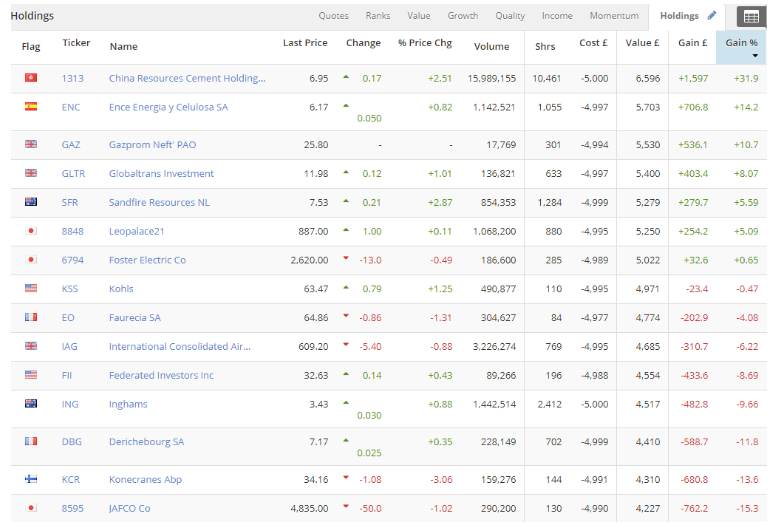
The portfolio is broadly flat so far, with a net profit of less than 1% after four months. It’s too soon to draw any conclusions, but I hope this taster of highly-ranked stocks outside the UK is of ongoing interest to readers.
Disclosure: Roland owns shares of GKN.
Disclaimer
This is not financial advice. Our content is intended to be used and must be used for information and education purposes only. Please read our disclaimer and terms and conditions to understand our obligations.

No comments yet
No one has commented here yet! Why not be the first one?