Sylvania Platinum - cash rich, growing and cheap

In prevailing market conditions, where participants are fixated on downside risk, looking for quality, growing companies with safe balance sheets and margins of safety is more important than ever. Sylvania Platinum (LON:SLP) might be one of those companies - if you believe the current prices of palladium and rhodium can be maintained.
Sylvania is a low-cost South African producer and developer of platinum, palladium and rhodium. Surging platinum group metals (PGM) prices have propelled the group’s shares ever higher in recent weeks. Barring a one day drop last Friday, it has also held up relatively well in the recent risk-off market conditions.
That is probably due to an attractive combination of rocketing profitability, stacks of cash on the balance sheet, and a shareholder-friendly use of prodigious amounts of free cash flow. The group’s shares currently trade on just 2.8 times forecast earnings and brokers have been busy more than doubling their EPS estimates for FY20 and FY21.
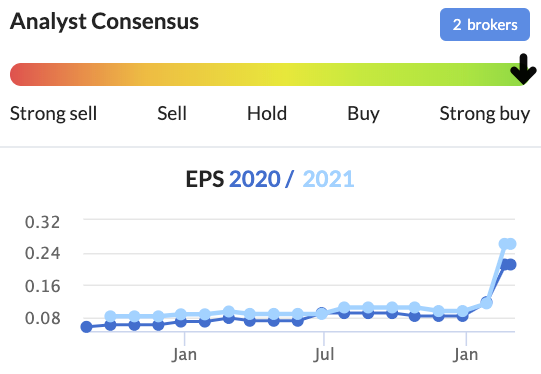
Sylvania has a market cap of £135m, but it also has $33m of cash, virtually no debt, and there is every indication the company will have added to this cash pile by the year end. The group also holds untapped mining assets with option value.
So what’s going on? Am I late to the party here or will the market at some point wake up and aggressively rerate this cash-rich South African miner’s shares?
Not without risk…
While the PGM metals Sylvania produces are in demand from auto industries for their pollution-reducing properties, it is worth remembering the Sylvania, as a low-cost operator, is operationally geared. That means profits that seemingly materialise out of nowhere can likely evaporate just as fast.
It is impossible to look at stocks without considering the Coronavirus at the moment, and I believe Sylvania could have some exposure to the economic disruption that has occurred so far. It is hard to quantify anything at this stage, but a lot of demand for PGMs comes from China’s automobile market. Assuming that spot prices for these metals can be maintained is central to the thesis that Sylvania shares are cheap.
The group itself flags other risks. In its FY19 results, it notes:
There are clouds on the horizon in automotive markets – China trade wars, Brexit, and such mean that we will remain with our conservative views of metals prices and revenue generation potential. What goes up (palladium and rhodium prices) can also come down as fast!
The group has also flagged and is managing persistent operational issues - namely water shortages, power outages, the possibility of strike action, and disgruntled communities.
Nevertheless, Sylvania’s relative valuation metrics are, frankly, remarkable. Despite strong relative momentum, the shares trade on c3 times forecast earnings and 2.5 times forecast EBITDA. If it can keep up cash generation, by the end of the financial year it could have as much as a third of its current market cap in cash on the balance sheet.
A valuable foothold in the world’s premier PGM complex
Sylvania has two distinct lines of business: the re-treatment of PGM-rich chrome tailings material from mines and the development of shallow mining operations and processing methods for low-cost PGM extraction.
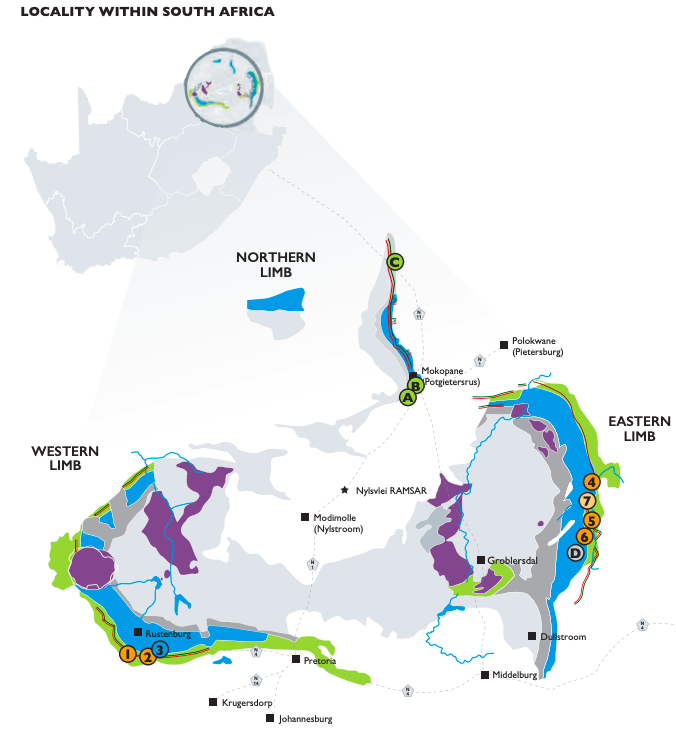
All of the Group's assets are situated in various locations across South Africa's Bushveld Igneous Complex (BIC), which is the world's richest source of PGMs. The entire intrusion stretches over roughly 66,000km² and has three distinct outcrops known as the eastern, western and northern limbs.
Sylvania has operations and projects on each of these limbs (more below).
Some 80% of the world’s economically viable platinum-bearing deposits are located in the BIC. The balance is largely in Zimbabwe (the Great Dyke deposit), Russia, and North America. Southern Africa is the only primary source of platinum, with platinum in Russia and North America mined as a by-product of other metals (mainly nickel and palladium, respectively).
It is estimated that about 38.1 kilotons of platinum metal in mineral reserves and resources reside in the Bushveld. Sylvania Platinum currently targets annual production currently of 74,000 - 76,000 ounces per year.
Operations
The group’s assets are split into two groups: Sylvania Dump Operations (SDO) and Northern Limb Projects.
The SDO are seven active PGM recovery plants that treat chrome tailings from surrounding chrome mines across the western and eastern limbs of the Bushveld Igneous Complex. On the western limb of the BIC there is:
- Millsell - This site started operating in 2008 and has a PGM split of 59% platinum, 24% palladium, 16.5% rhodium, and 0.5% gold.
- Mooinooi ROM - PGM split of 64.3% platinum, 25.1% palladium, 10.2% rhodium, and 0.3% gold. It began operations in 2012.
On the eastern limb, there is:
- Lannex - Lannex ramped up to full production in 2011 and has a PGM split of 58% platinum, 25.5% palladium, and 16.5% rhodium.
- Doornbosch - PGM split is 60% platinum, 29% palladium, and 10.5% rhodium. Operating since 2011.
- Tweefontein - 64% Platinum, 22% palladium, 13.4% rhodium, and 0.15% gold. Began operations in 2012.
Meanwhile, the Volspruit project covers two adjacent ore bodies that will be mined for PGMs and other base metals, such as copper and nickel, via two open-cast pits. Sylvania is also the holder of prospecting rights to some additional Northern Limb Projects in the BIC which are thought to hold platinum, palladium, nickel, and copper deposits.
Each of these could become a new mine. However, developing these assets appears to be a bit of a slog, with company representatives continuing to prompt the South African authorities into action.
From the FY19 annual report:
Volspruit Platinum Exploration - The Department of Mineral Resources has still not communicated any progress in the appeal lodged by interested and affected parties in June 2017 against the decision to grant a mining right application to the Company. The Company’s environmental consultants continue to make enquiries.
Northern Limb Projects - There has been no further development of the Northern Limb Projects during the last financial year, apart from that which is necessary to maintain compliance with the mining right and to defend title.
These assets give Sylvania useful options though - whether that be to sell them or embark on joint ventures. And any difficulties Sylvania has in developing them are presumably shared by other would-be operators looking to take share.
Financially healthy, cash generative, growing and cheap
The scarcity of PGMs is good news for SLP as an investment - particularly as palladium and rhodium are in increasing demand from the auto industry. Prices for those metals are rocketing, but again, management’s warning comes to mind: “what goes up can come down”. Given the group’s operational gearing, profits might evaporate as quickly as they materialise.
For now, trends are encouraging. Any hit to prices from Coronavirus-related disruption has yet to declare itself, and the company has a strong balance sheet with few liabilities and virtually no debt. Profitability has been compounded by margin expansion - Sylvania’s profit margin nearly trebled from FY16 (9.45%) to FY19 (25.81%).
We can see, however, that the group has reported a net loss in four of the past 12 years.
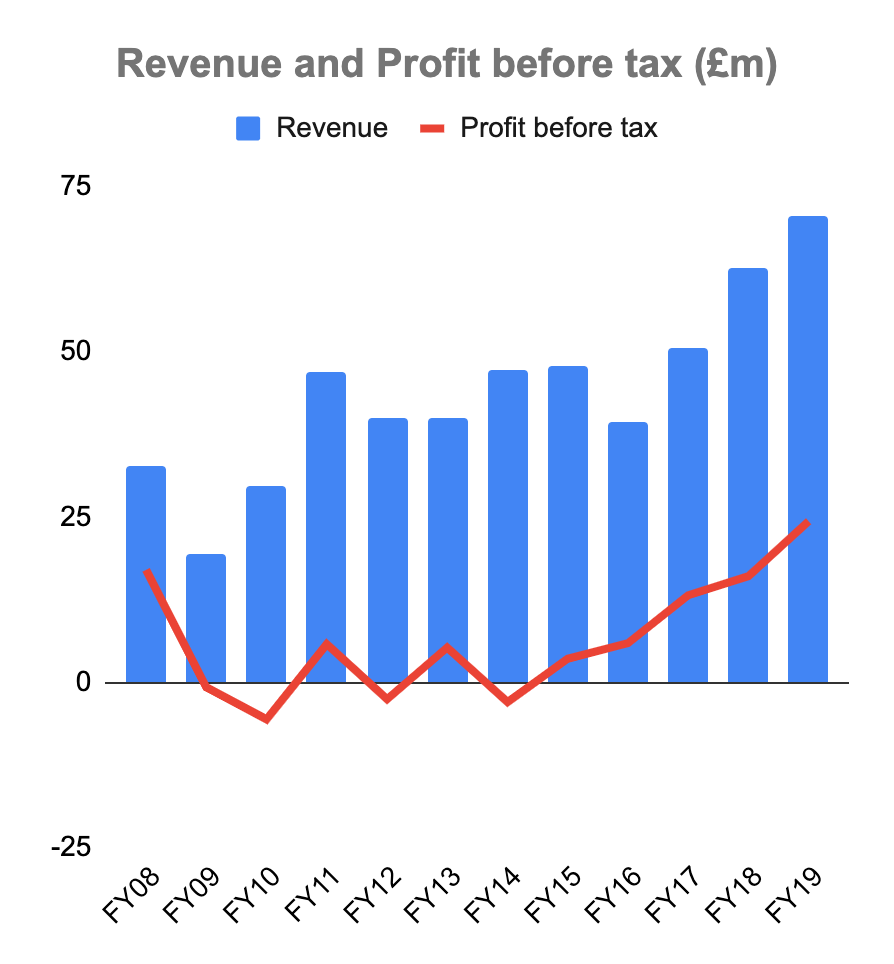
Cyclicality must be expected with mining stocks. Two of the key attractions of Sylvania as a small cap miner are its balance sheet strength and its positioning as a very low cost operator. No pension fund in sight and a negligible amount of debt ($616k) that is absolutely swamped by a rapidly growing $33.8m cash pile. The group’s value is supported by $53.5m of exploration and evaluation assets and another $37.8m property, plant and equipment.
As of HY20, the group’s average basket price was $1,830 per ounce versus a cash cost of just $554. This insulates Sylvania from at least a degree of price falls. The group also has exceptionally strong liquidity ratios, with a current ratio of nearly eight times.
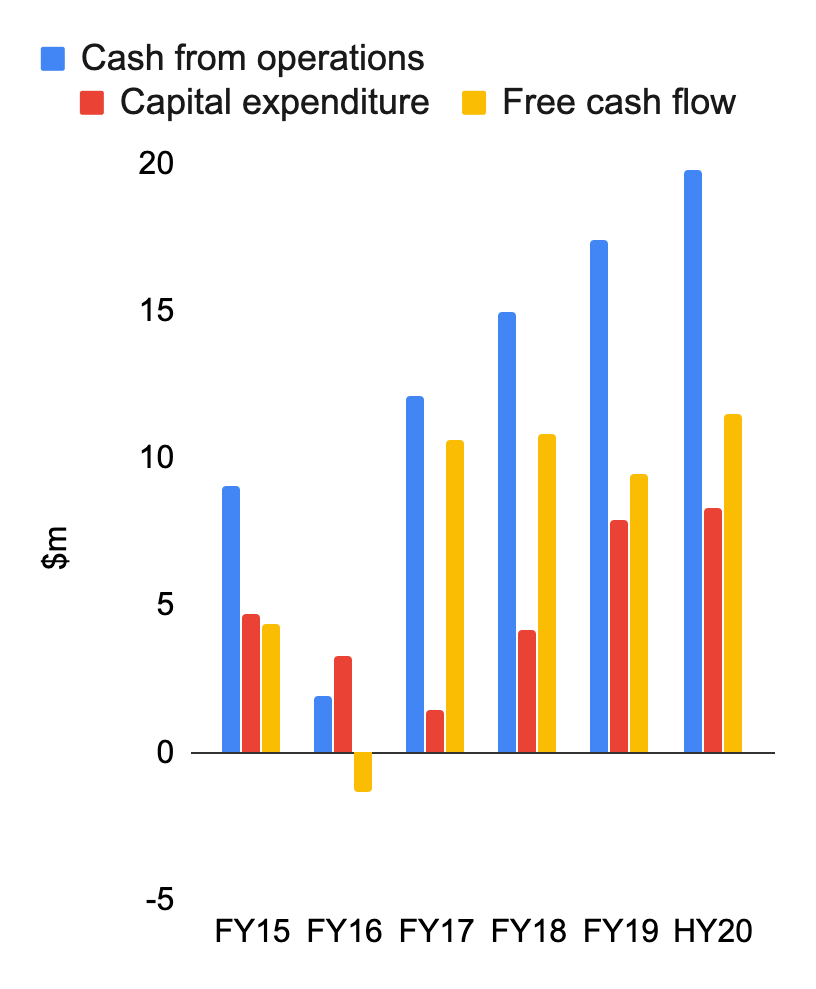
Sylvania is increasingly cash generative and is using free cash flow to buy back shares, pay dividends, and invest in growth projects.
In the group’s HY19 presentation, it forecasts a more than doubling of EBITDA to around $70m for the full year, which would put the company’s shares on just 2.48 times forecast EBITDA.
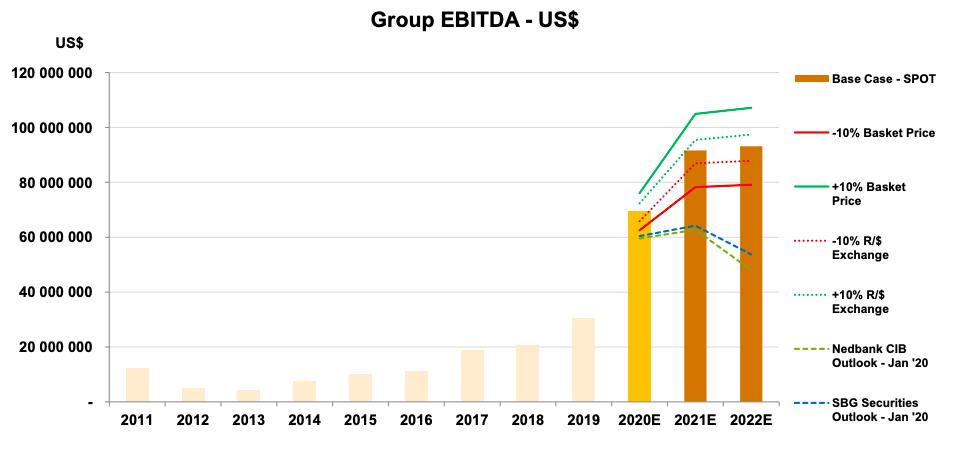
HY20 results show a step-change in profitability
Some key financial highlights from SLP’s recent HY 2020 interim results:
Operational
- A new half year record of 40,003 ounces, up some 17.5% from last half year’s 34,045 ounces.
- The Gross basket price for PGMs was $1,830/ounce compared to $1,201/ounce for the period ended 31 December 2018. Judging from price charts post-period end, I believe this basket price has continued to rise.
- Cash costs per ounce for the Group were ZAR8,140/ounce, or $554, compared to ZAR8,194/ounce in the previous corresponding period.
- The challenges mentioned in the 2019 annual report remain. SLP is building more boreholes in order to meet its water demands.
- Power cuts due to maintenance and power interruptions led to additional operational disruption - for example Project Echo completion data has been pushed back by one year to FY22.
Financial
- Revenue +84% to $59m
- Gross profit +239% to $34m
- Operating profit +266% to $33m
- Profit after tax +244% to $24m
- Diluted earnings per share +241% to 8.22 cents
Cash
- Net cash +54% to $33.8m. It should be noted that the Group holds a large portion of cash in ZAR and a strengthening ZAR:USD exchange rate will have a favourable impact on the Group cash balance, but a weakening of the ZAR against the USD will have the opposite impact.
- Net cash from operating activities +66% to $20m (including an outflow of $10.9 million for working capital changes due to timing, and $6.8 million paid in provisional income tax).
- The Company spent $3.0 million on capital expenditure comprising $1.7 million of growth capex and $1.3 million on maintenance capex.
- Free cash flow +105% to $17m.
- $2.9 million was paid to Shareholders as a dividend and $2.2 million was spent on share buybacks.
All in all, these are sterling growth figures for a company on such a cheap valuation.
PGM prices in 2020
The increase of Platinum, Palladium and Rhodium had the largest impact on the basket price. The average prices for the half year were:
- The average Platinum price increased 12% from $817 to $915/oz,
- Palladium increased 78% from $1,040 to $1,847/oz, and
- Rhodium increased 138% from $2,394 to $5,702/oz from 31 December 2018 to 31 December 2019.
Prices have continued to rise since, which bodes well for full year results. Today’s spot prices are:
- $871 for platinum,
- $2,420 for palladium, and
- $12,050 for Rhodium
PGM prospects
Sylvania is confident of producing between 74,000 to 76,000 ounces this financial year, which would be another record. Operational disruption continues to be a risk, however.
Perhaps the most important driver of share price performance will be the group’s basket price of PGM metals. The rand price of a typical South African PGM basket surged higher during 2019 to a new all-time high:
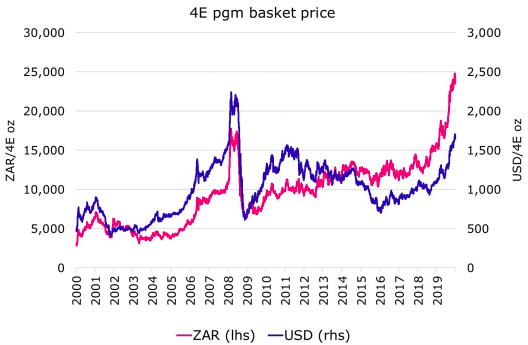
Source: Johnson Matthey February 2020 PGM Market Report
Sylvania’s management give some useful guidance on PGM market dynamics:
While platinum is forecast to make a modest recovery on the back of a rise in investor activity, autocatalyst consumption recovery and legislative changes in China and India, power supply issues and industrial activity have a major impact on a potential outcome and thus, once again, we are at the mercy of elements outside of our control. Palladium, however, is again expected to rise as a result of an increase in automotive consumption although rhodium prices may expect a moderate rise as market fundamentals stabilise following a release from pipeline inventories.
Johnson Matthey (which, as a provider of catalysts and catalyst systems to reduce emissions from vehicles and industry, is a big buyer of PGMs) released a PGM market report in February. Some brief notes below.
Platinum
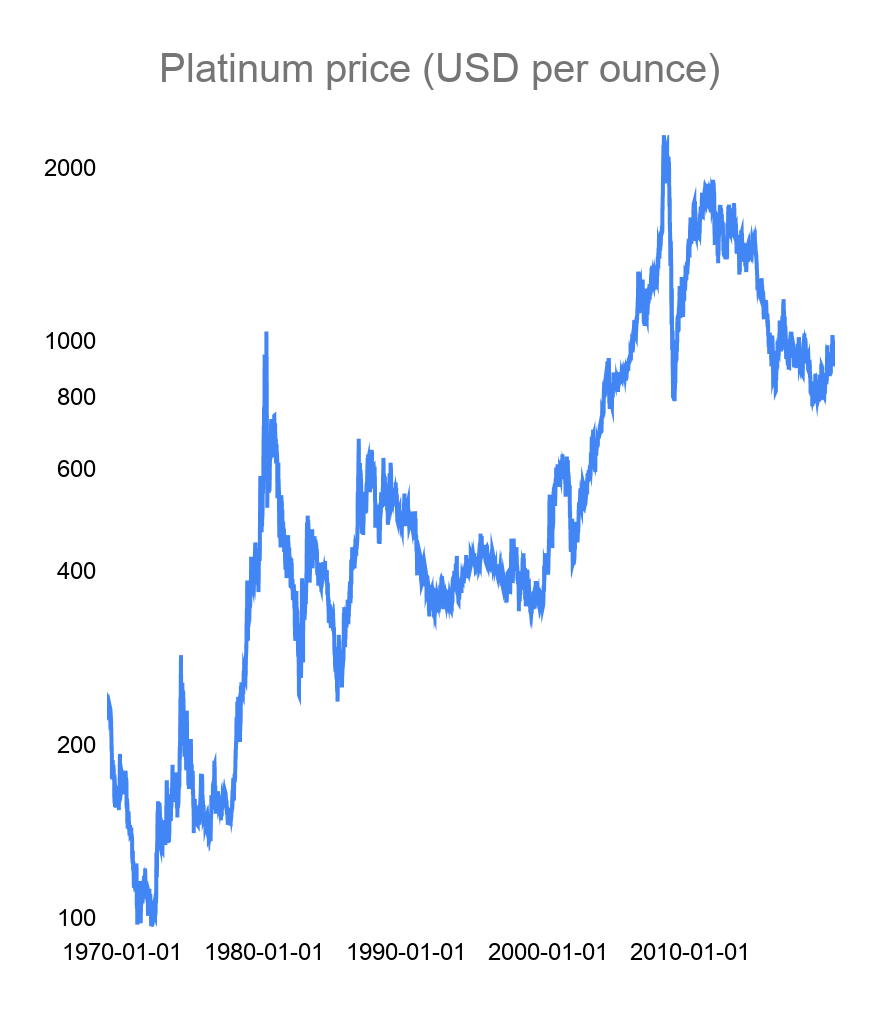
Demand for platinum increased in 2019. This general improvement in platinum market sentiment over the past year has also been reflected in the futures market.
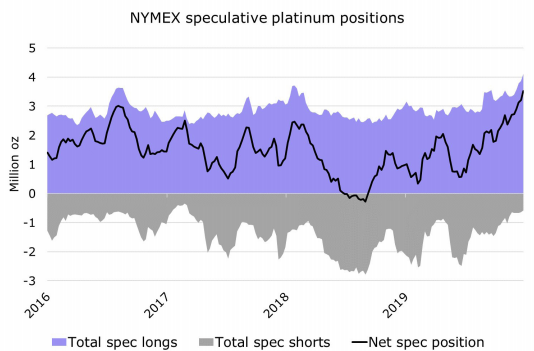
The Matthey report notes that the platinum market could well move back into surplus in 2020 and “demand is more likely to fall than to rise”. It’s worth noting that the price of platinum has slid along with the rest of the world over the past week or so, presumably on Coronavirus fears.
Palladium
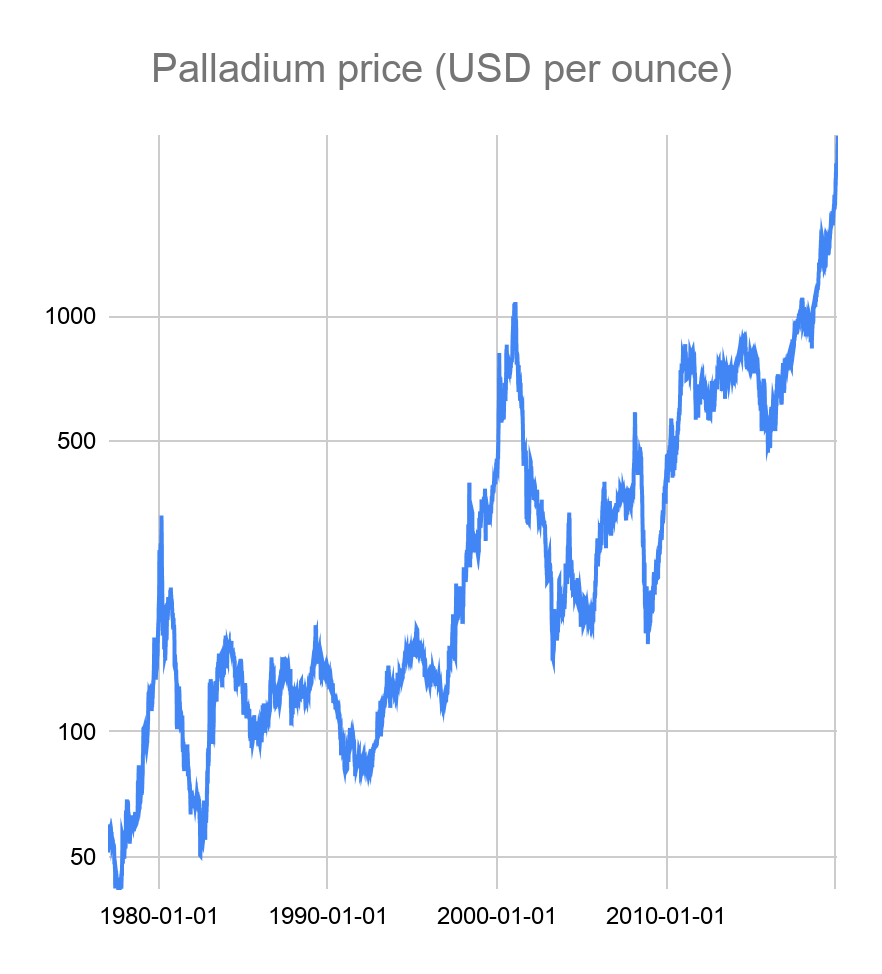
All-time highs were seen in the palladium price as the market moved over a million ounces into deficit in 2019.
Tightening emissions legislation and stricter vehicle testing regimes are driving up the PGM content of threeway catalysts in most major vehicle markets, with a 14% rise in global average palladium loadings on gasoline cars and double-digit growth in both Europe and China.
Palladium extended last year’s rally in the second part of February. It has risen more than 40%. The white metal continues to benefit from worries of a further supply shortage in 2020, as rapidly rising demand from automakers pushed the global palladium market last year to its biggest deficit in five years.
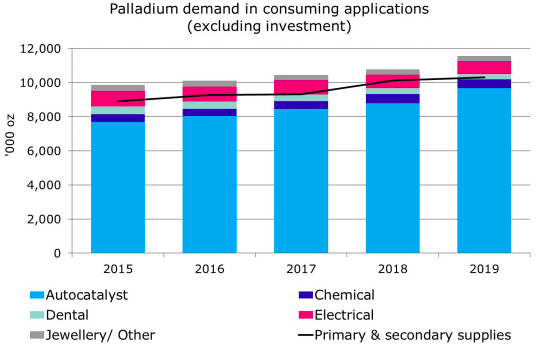
The palladium deficit is likely to deepen in 2020, as an increasing number of Chinese and European vehicles rush to meet environmental legislation. While the market remains in significant deficit, prices are likely to remain strong.
Rhodium
Rhodium prices jumped past $11,000 an ounce in February, with surging demand from the auto industry alongside with tighter supplies pushed prices up 90% since the beginning of 2020. Since then it has pushed on to $12,050.
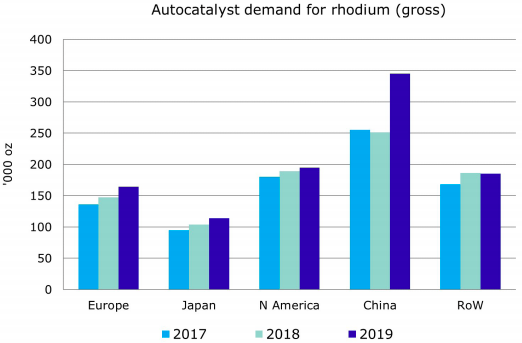
Rhodium moved into a modest deficit in 2019 and Matthey expects a deeper deficit in 2020, “as [the] automotive demand is likely to post further gains”. It seems likely that the market stocks of rhodium will need to be drawn down again in order to meet consumer demand.
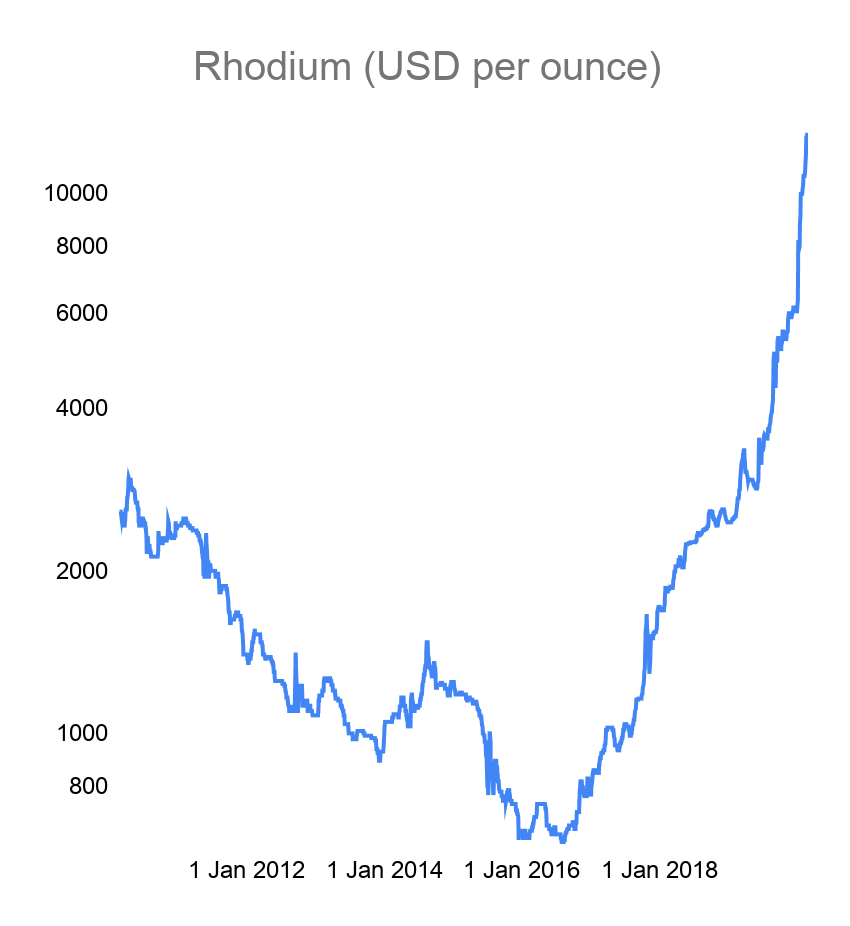
What is undeniable is that a significant amount of demand for these metals comes from China’s automotive industry...
Risks
Coronavirus - what has become obvious from reading matthey’s PGM report is that Sylvania is not immune from the evolving Coronavirus situation. A material amount of demand for its PGMs comes from China’s car market. Car sales in China tumbled in February and car production has presumably also been disrupted. Whether there will be any long term impacts on China’s car manufacturing remains to be seen. Either way, Sylvania’s exposure to this market should be considered.
Given Sylvania’s balance sheet strength and global trends towards environmental sustainability, I am cautiously optimistic given longer term trends (although if there’s anything we’ve been reminded of over the past week, it’s that things can change quickly).
Water availability is rapidly becoming a strategic issue for the SDO. There are capital implications, which will be factored into future capital expenditure for FY2020 and onwards.
The costs of tailings deposition facilities are furthermore increasing significantly due to legislative changes, but the Company is taking note of new technologies with a view to further water-saving opportunities.
Power utility infrastructure and supply issues are another concern along with power costs up 13%, driven by infrastructure constraints. A new power infrastructure is being developed at Tweefontein, which once completed, will enable the Company to begin construction of the last budgeted Project Echo MF2 module.
I would also draw attention to management’s FY19 commentary:
“Mostly due to matters outside of our control, Q2 and Q3 were challenging and resulted in lower production volumes and efficiencies. In particular, the water shortages at our Western operations, and power infrastructure and supply disruptions at our Eastern operations, as well as community disruptions associated with social unhappiness, culminated in unexpected and unplanned disruptions and downtime, impacting negatively on production.”
The company adds:
“Management continues to focus on improving communication and to engage with mandated and recognised forums from neighbouring communities in order to identify potential commercial opportunities and to manage expectations regarding employment and procurement spend. The relationship with these forums is critical, especially when assistance is needed to manage community members that threaten to interrupt operations, as various neighbouring mines have experienced.”
These are encouraging actions. Additionally, from the Matthey report:
“A research study in 2016 by eunomix showed that Rustenburg... accommodations and housing are lacking and have seen little to no effort from the mining companies to improve them. However, recently (2013–2016), the platinum companies have contributed more than ZAR 370 million into the city; funding local infrastructure, water supply and treatment centres, sporting programmes, tourism, public road expansions, sewage treatment plants, cultural activities.”
Conclusion
At the time of writing, Sylvania’s share price is rebounding strongly after last Friday’s fall
To summarise my stance:
Pros
- As long as palladium and rhodium spot prices can be maintained, Sylvania Platinum shares are cheap;
- Given long term market trends regarding more environmentally friendly automobiles, I believe there is a fair chance of this happening;
- On current forecasts, the group is cheap at c3 times forecast earnings;
- Shares trade on a modest premium to net tangible asset value but, assuming another successful year of operations, cash on balance sheet should increase materially;
- It is a low cost operator and is operationally geared to rising (and falling) prices;
- It has a strong balance sheet, lots of cash, and assets with option value. It can hopefully ride out periods of disruption;
- Sylvania is generating copious amounts of free cash flow and is deploying this in shareholder-friendly ways (dividends, buybacks and growth opportunities);
- When earnings growth and share price reratings happen in tandem, gains are material for shareholders.
Cons
- As a PGM miner whose commodity prices are in part driven by demand from China’s auto manufacturing industry, Sylvania is exposed, to some degree, to the economic disruption caused by the Coronavirus;
- The group has flagged persistent operational issues to shareholders - namely water shortages, power outages, the possibility of strike action, and disgruntled communities;
- Sylvania’s extraordinary increase in revenue and profitability is driven by low costs, operational gearing, and surging rhodium and palladium prices. What goes up can come down.
A note on recent events
While a lot of uncertainty remains around the nature and impact of the Coronavirus, what is more certain is the economic disruption it has caused as a result of quarantine measures. Given that China is the world economy’s engine, we must accept that there has presumably been material supply chain disruption. There has been a clear rotation out of risk-on assets as a result.
The situation is still uncertain but I am hopeful that the world economy can recover from recent events and that said disruption is one-off in nature (rather than having a permanent impact on trend rate of growth). Of course, opinions are cheap and subject to revision. I have no informational edge, no additional insight to give, and I will adjust my views accordingly as new facts come to light.
In the meantime, I am fundamentally optimistic regarding long term global development and what can be achieved and overcome through humanity’s innate sense of industry. It’s a part of the reason I invest in stocks.
Time horizons are important here. To the investor with a 1-5 year investment horizon, the impacts of Coronavirus are much more serious if they are forced to crystallise losses. Those with longer horizons are better positioned to ride out these types of shocks. While we cannot yet quantify the impact of the Coronavirus, I think on balance it is more likely that the global economy will recover from this than that it will be permanently damaged.
However, it is prudent to acknowledge a range of probabilities. COVID-19 and its impact on the world may well be long-lasting and substantial.
At the moment, I am operating under the assumption of a sizable but temporary economic impact this year, followed by a recovery. Of course, I don’t know any better than the next person.
Facing this unknowable future, I think the answer to insulating yourself from exogenous shocks remains relatively common-sense and constant:
- Buy great companies at good prices, with good structural growth opportunities in large markets,
- Look for strong balance sheets, profitability, and cash generation,
- If you are hunting for value, make sure of a rock solid margin of safety and be wary of debt,
- If possible, find moats and high long term returns on capital that can be defended over multiple years
You can’t predict the future, but you can build a strong, robust portfolio with good growth prospects. Sylvania is a promising candidate in this regard, given its balance sheet strength and low operating costs. Although exposure to China’s auto market is a concern in the short term and may cause volatility, I think longer term trends can win out and support spot prices. As ever, alternative views are welcome.
Disclaimer
This is not financial advice. Our content is intended to be used and must be used for information and education purposes only. Please read our disclaimer and terms and conditions to understand our obligations.

26 comments
Great article Jack. Thanks.
A significant additional long term risk is the replacement of ICEs with EVs or hydrogen powered vehicles. This could reduce the demand for PGMs by 80% over 10 years. Does anyone know whether there are any other use cases for PMGs on the horizon?
Excellent piece, thank you. Reinforces why hI am a subscriber. I will not buy as I hold other high risk stocks and have no room for more in this environment
Excellent article, Jack. Thank you.
Do you have any thoughts on Jubilee Metals £jlp which appears to have basically the same business model?
Ricardo
For me the big question is how quickly China will recover, as you can see in Howard's chart above, this could have a significant effect on car sales and therefore demand for PGMs. I believe EV sales in China were even harder hit. I'm holding on at the moment.
Jack thank you for the great analysis.
Looking at the stock report I am particularly struck by the fact that even if the Sylvania Platinum (LON:SLP) share price was to treble the forward PE Ratio would still be comfortably in single digits. Warren Buffett and others emphasize the Margin of Safety and I think there is a very strong margin in this case. I purchased this share last month and I will be keeping an eye on commodity prices and the business cycle as this share is clearly cyclical in nature as pointed out by the weather forecast.
Not surprisingly, auto sales in China plummeted last month.
What is more surprising is that sales in China have been falling for 20 of the last 21 months:
This is of significance given the scale of auto sales in China:
When I read the Strong Buy recommendation in the Investors Chronicle, I decided to do some research. My conclusions are somewhat different, and I would not buy this stock. There were three issues for me:
- Sustainability of current high commodity prices for palladium and rhodium. Sylvania is a low volume producer. The big suppliers appear to be Norilsk Nickel, Anglo Platinum, Sibanye-Stillwater and Impala. If they were to ramp up production of PGM metals, this would mean higher supply volumes and potentially lower prices. In other words, the current windfall profits might evaporate.
- Mine lives. According to the company's London Investor Presentation, the company's resources have a profitable operational life of at least 10 years. So one can expect that over the next 10 years one or more of their operating complexes will have to be shut down. A case in point is their Steelpoort SDO which was decommissioned in 2017. In a worst case scenario, by 2030 all of these operations will have ceased for a variety of reasons.
- Capacity constraints. Also in their presentation they say that their current annual production capacity is 78k oz max. The Production Profile graph shows that production has effectively plateaued from 2017 onwards.
Taking all the above into account, I did the following maths. Assuming a current share price of 50p, the company is valued at say £150m. In return for this, you get:
(1) the current equity. At 31 December 2019 this was US$148m or £115m, assuming US$1.28 to £1; and
(2) the value of future earnings. This is the big unknown. For example, if you assume that the company will continue to produce 78k oz for 10 years at a gross basket price of US$1,300 per oz, then this equates to around US$17m net income p.a. (see 30 June 2019 financials). So over 10 years, this is US$170m or £133m.
According to my calculations, an investment today of £150m yielding £248m in 10 years has an internal rate of return of only 5.2%.
Obviously if you assume that the higher basket price for PGM metals is sustainable (which I don't), then the rate of return will increase. If earnings were to increase to US$40m p.a., then this gives total equity of £428m at the end of the 10 year period. This is a rate of return of 11%.
Now considering all the risks that have been highlighted - labour unrest, power outages, lack of rainfall, drop in PGM market prices, GBP/USD/ZAR exchange rate movements etc - I personally would want to see a much higher return on my investment than the 11% in the most optimistic scenario.
One of the reasons companies have high P/E ratios is the belief that management will be able to grow revenues and profits by developing new products, finding new markets or increasing production through new manufacturing plants. I can't see that any of this applies to Sylvania.
Great report, but Just to be out of sync with consensus onion ;) ...
I held Sylvania Platinum (LON:SLP) but sold out today and yesterday. Why?
Low valuation high margin is often not a good wear for deep cyclicals....SLP may not have a straight economic cycle but it has acute cycles driven by end market fluctuations, but...
...its a growth market and not simple commodity you might say. Recent history and pricing says yes to that of course...but there are ongoing globally disruptive events (coronavirus which was preceded by a meaningful economic slowdown too). There are many examples of acute demand-supply imbalances in niche commodities. The dynamic always looks unassailably good. Anyway, I was happy to have the momentum behind the underlying commodities and cheap valuation as things looked good but the unfolding global dynamic provides challenge.
On top of that there are issues around supply. Admittedly they got stockpile so not heart attack risk but a change to dynamics of chrome producers they piggyback on for plant feed could lead to negative expectations being built in and a visible end of life of mine sort of valuation dynamic.
What about the cash hoard that SLP has?...very good point....but you can be guaranteed management will not deploy that meaningfully until its clear whether TSIHTF or not....that's best case 2 months (assuming phenomenal China snapback and RoW containing quite successfully and with low stress)...and then mgt will take a few more months just to be sure all okay.
Whilst I'm quite positive relative to consensus quite broad based Africa risk, I'm specifically negative SA -> worried tipped to negative around coronavirus. SA has ongoing political, economic and social fragility. It doesn't need more problems. On top of that it has a more aged and less healthy (in terms of chronic illnesses) population than many others bits of Africa. It is more prone to a coronavirus epldemic.
On a balance of risk perspective I'd rather own other things for upside from here rather than cheap commod company supplying a very richly priced niche. Supply-demand gets very edgy in these situations potentially and the customer behaviour (car manufacturers) can quite easily switch from anxious knee jerk hoarding to a bit of wait and see on the price (with some stores of commodity coming onto market too now that the price is falling rather than rising)
Overall, my feel is that from a portfolio perspective SLP correlated too acutely to the downside risks that could effect many other parts of market. Obvs the cash buffer limits it compared to many others....and I'll be interested again on significant downside volatility perhaps....but my feeling we are having as much of a correction of growth expectations (particularly in US where they were high) as virus panic (virus just let it out the bag) so the opp may be to pick up high growth at a cheap price
I always appreciate hearing counter arguments - in fact, it’s vitally important…
Whether or not you believe spot prices can be supported is a key part of the thesis here, I guess. Is this merely a cycle or is it exposure to a structural growth opportunity? And then, depending on which side you come down on, what are the implications for prices? The Matthey report suggests to me that at least for the next year, the overall supply/demand mix will be broadly maintained, in which case, FY20 growth might still be undervalued.
With its untapped mining assets, growing cash pile, and a current basket price that might not yet be fully reflected in the share price, the Sylvania Platinum (LON:SLP) opportunity might also be framed as a value-momentum rerating opportunity in the shorter term?
Of course, the Matthey report came out just before the Coronavirus sharpened the global community’s focus on downside risks and China essentially shut down for a week or two…
Thanks for the considered response. Curious to know what stocks are on your watchlist (if you feel like sharing ;))
China shut down was for about 4 weeks, it already had the New Year shut down which is for 2 weeks.
Fair... I had this BBC pic in mind when writing, quite interesting:
Interesting images, Jack. Chinese New Year started on 25th January, 2020. Of course weather can play it's part, Bangkok has had bad pollution recently but that is nothing to do with activity, it is more to do with the weather.
Hi Jack - it got long so I put here:
https://www.stockopedia.com/content/i-not-so-quickly-said-to-jacksome-general-current-views-569152/
On all metrics it does look very cheap. Even if the PGM basket falls swiftly to $1,200 per ounce, Sylvania will have been coining it in during the period of the bubble.
The key downside is the political risk. This is a factor with South Africa - just because something should not be legally actionable does not mean this will hold if the ruling party (or greedy elements therein) fancies a larger slice.
Disclosure: I hold
Re Howard’s comments about legal issues:
1. The legal case is against Samancor, by a Trade Union seeking financial compensation for what was ‘taken from the workers’
2. The case deals with events covering the period 2005-2007. I would think that 13-15 year delay might make it harder to substantiate any claim
3.There is no legal action against SLP
4.The case appears to be about behaviours of new owners and related parties about treatment of various assets and profits. Some of this pertains to SLP contract with Samancor, but much does not
5. It could be argued that assertion of demands for compensation against Samancor coincides with the improvement of profitability of SLP over the last three years.
6. Given that SLP has made losses in a number of years since the deal was done its hard to argue that it was given an unfairly cheap asset (particularly, and importantly, at the time the contract’s were set)
7. That said, the case for the defence by Samancor has not been made nor heard
This is South Africa, so who knows what will happen, but it appears that 14 years after the event, there are no allegations against SLP, and no legal case is being made
On that basis I’m happy to hold
What brokers are you using to purchase this stock?
Hargreaves Lansdown. It is quoted on AIM.
Great article Jack. This is my largest position and it is good to see you reaching a similar conclusion. Personally I believe that this is a very large pricing anomaly and in a years time should produce an excellent gain so long as the PGM prices do not crash.
To me whilst this is a well run operation (all in costs / oz have barely changed over the last couple of years and have been consistently low for the industry) the price anomaly has come about from the scale of the PGM price increases over the last year not being reflected in the share price. As you say H1 2020 average basket price rose to $1,830 / oz, and this is continuing to rise. However this rise has taken the basket price to $2,712 / oz (an almost 50% increase from H1 average).
I feel that the share price has yet to reflect even the basket price rise to $1,830, let alone the additional further rise to $2,712 / oz. It is as though institutions believe the price must be a spike that will drop rapidly down, however even if PGM prices dropped by 50% and stayed there long term (despite the various environmentally friendly car legislation suggesting demand will outstrip supply and additional supply is hard to come by for Palladium and Rhodium) Sylvania Platinum (LON:SLP) would still produce good profit rates.
Coronavirus has significantly reduced car production short term (though the Palladium & Rhodium prices have been marching higher regardless) however historically people put off large purchases in a recession or any disruption like this only to then purchase them in droves afterwards. It is more of a delayed than cancelled purchase.
Adding to that the significant percentage of net cash on the balance sheet and this feels like a pretty huge margin of safety, with an expectation of large appreciation, to me.
Looks like a no brainer £SLP. A great time to invest in this dip before it really takes off. Good Luck All
Thanks Jack.
A snippet from Simon Thompson's article on Sylvania Platinum (LON:SLP) yesterday:
"Liberum Capital's net profit forecast for 12 months to 30 June 2020 is US$59m (£45m), or US$40m more than the house broker was forecasting last September; its net cash estimate of US$59m (16p a share) is US$9m more than I predicted in my February article, and is almost treble the US$21m cash pile in June 2019; and dividend per share estimates of 15.3¢ (11.8p) for the 2019/20 financial year, rising to 20.8¢ (16p) the year after, equate to 56 per cent of the current share price"
That's some dividend
Excellent article by Jack with great detail on the stock which has been good to me. I was stopped out yesterday (nice profit) and bought back in yesterday with a higher investment. However the risk pointed out by Howard Marks comment has made me hesitate to increase my holding.
Does anyone know the extent of the potential cost to Sylvania if the claim against Samancor is upheld?
Excellent article Jack. Many thanks. Richard
this is an excellent, thought provoking synopsis on in my opinion a well managed coy. As JB points out it is certainly not without its risks, but I think the overriding factor in this story is the motor car and its future and transitioning from petrol to electric. It is my understanding that Rhodium forms a large part of the E vehicle and I do not foresee any dramatic change in the trend. Yes there will be pullbacks and corrections. Nothing maintains near vertical price rises. This is my reason for holding Sylvania Platinum (LON:SLP) and averaging up on dips as we had last week.
Great in depth article, Jack
With regard risks, there were reports at the end of last year that Sylvania Platinum (LON:SLP) had historically signed 'overly generous' &/or illegal mine tailings deals with Samancor. The mining union AMCU were said to be seeking $500m in compensation.
Sylvania Platinum (LON:SLP) made reference to these developments when releasing their 1Q results last October & denied any wrong doing. However I'd imagine this will continue to weigh on the share price until the matter has been resolved.
https://www.power987.co.za/news/whistleblower-on-how-chrome-workers-were-robbed-of-billions/
Thanks Howard, I will incorporate this into future reviews. Sylvania's notes about disgruntled communities did strike me as concerning but I put this down to a lack of community investment that has since been addressed.
very interesting Howard, as this story becomes more public which I have no doubt will happen as Sylvania Platinum (LON:SLP) newsflow becomes more public through greater editorial coverage then it might be a case of sell the story.