The Screen of Screens bounces back to triple figure returns

This time two years ago, one of the most popular ‘quality’ investment strategies tracked by Stockopedia was sitting on a three year return of just over 100%. After a strong run, the Screen of Screens drifted with the market in late 2015 and early 2016, but it’s recovered well since last summer. In that time it’s bounced back to the top of the 5-year ‘quality’ leaderboard, with a return of 113% - and it is doing even better in Europe.
To make it onto the Screen of Screens, a company has to be passing the rules of at least four of Stockopedia’s 60 long-only investing models. Those guru-inspired strategies are categorised as being either bargain, value, growth, quality, momentum or income. To make it onto the SoS, the precise style isn’t important - just the number of strategies passed. So, for example, one of the leaders in the list at the moment is the housebuilder Persimmon, which passes the rules of 12 strategies in the value, growth, quality and income categories.
A signpost to solid companies
The idea behind the SoS is that companies making it onto several different strategies should be a pointer to those with good fundamentals across a range of investing criteria.
Like all the investment strategies, the Screen of Screens portfolio is refreshed every quarter. That ensures it’s always holding stocks that are closely aligned with the strategy rules. Trading fees aren’t counted against the performance returns, but neither are the gains of dividend income.
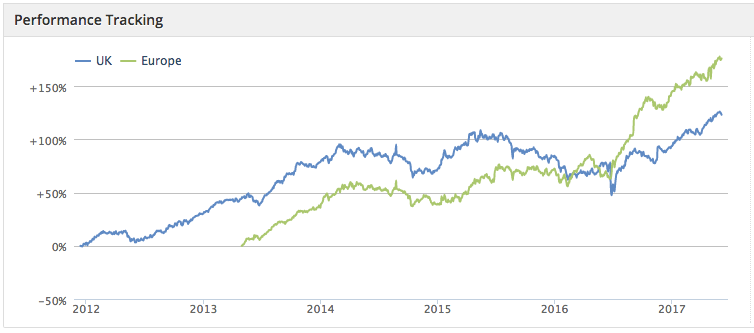
Over the past year - when markets have been pushing higher - the SoS strategy has returned 24.0% in the UK, and a really eye-catching 65.3% across Europe.
So what does a typical SoS stock look like? One observation since the launch of the StockRanks (Stockopedia’s calculation of each share’s quality, value and momentum) is that these companies do tend to score well against those investment ‘factors’.
Back in April 2015, Ed wrote that the average StockRank in the screen was 87 out of a possible 100. Right now, the median across the 54 UK qualifiers is slightly higher at 91. In Europe, the average StockRank for the 200 companies passing the screen rules is 92.
But while the average rankings are impressive, they do mask quite a wide spectrum of stock styles. We can explore this with pie charts (currently in development) that show the StockRank Styles and RiskRatings of the companies currently making the UK SoS list.
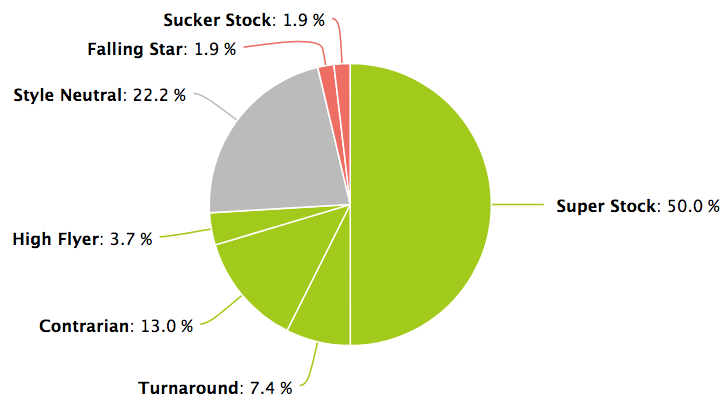
The StockRank Styles focus on the interplay between a stock’s quality, value and momentum. As expected for a ‘quality’ screen, the majority clearly rank well. Half are categorised as Super Stocks (with strong quality, value and momentum across the board). Among them are some of the housebuilders (Persimmon, Redrow, Bellway), construction and engineering groups (Morgan Sindall, Costain) and airlines (Wizz Air, International Consolidated Airlines, easyJet and Dart).
Another quarter account for the two-factor styles of High Flyers (quality & momentum - Moneysupermarket), Contrarians (quality & value - Kingfisher, Royal Mail) and Turnarounds (value & momentum - Investec, Legal & General).
Currently, 22% of the stocks passing the SoS screen are Style Neutral, meaning they don’t have strong factor exposure. That leaves just one that flags as a Falling Star and one that’s a Sucker Stock.
Rooting out false positives
Falling Stars are those that typically show signs of reasonable quality, but are expensive and have poor momentum. In this case, it’s a small biotech firm called Oxford Pharmascience. Sucker Stocks tend to have very low exposure to all three factors - and the company in question is Sterling Energy.
In both cases, these companies pass the SoS rules because they each appear in four ‘bargain’ investment strategies. But in terms of being quality businesses, many would view them as false positives for the SoS. In reality, they are highly speculative micro-caps operating in ‘blue sky’ sectors. On some measures, certain strategies view them as potentially attractive value, but the StockRanks certainly don’t.
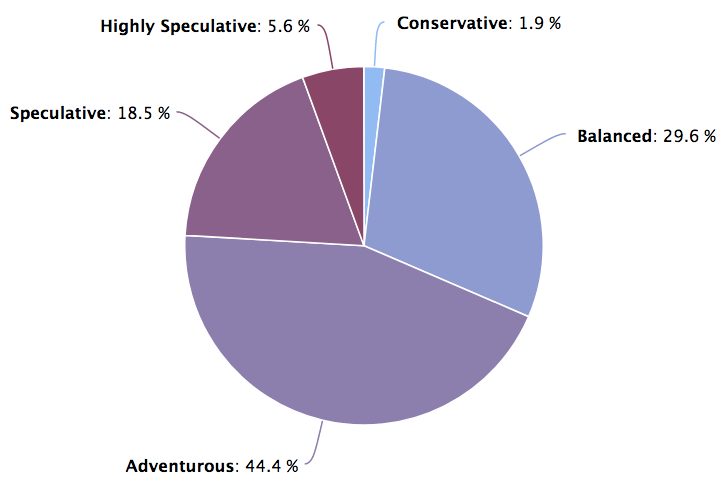
In terms of RiskRatings, which are Stockopedia’s measure of historic volatility, there are also some interesting observations. Right now, the mid-spectrum Balanced, Adventurous and Speculative categories make up 90% of the stocks passing the SoS rules. The two extremes of Conservative (SSE) and Highly Speculative (Ferrexpo, Anglo Asian Mining and Oxford Pharmascience) are very much in the minority. You can read more about the RiskRatings here.
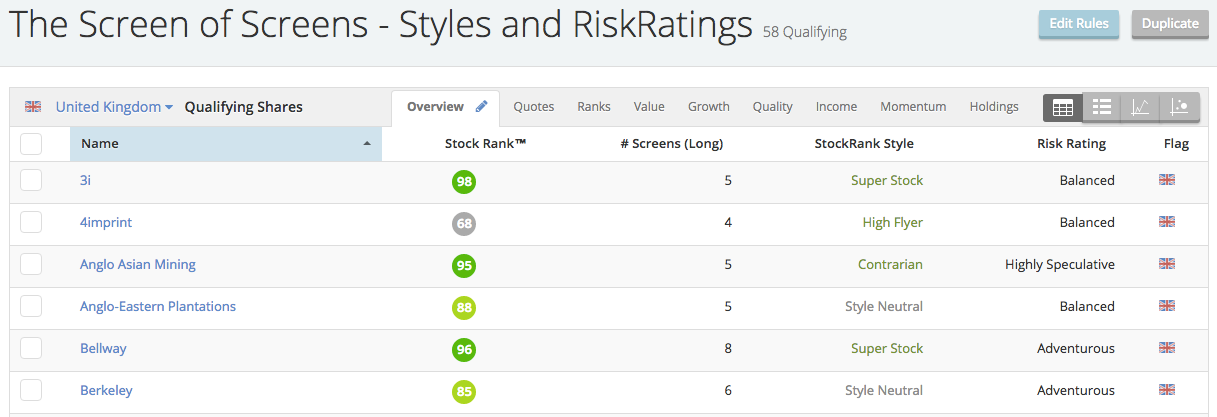
While these pie charts aren’t yet available, a useful alternative is to Duplicate any of the guru screens and add StockRank Style and RiskRating to the tables (see below). You can get started with this screen.
Overall, the Screen of Screens has been on an impressive run since last summer, which is a welcome change of fortune from the previous 12 months. In the past it’s proved itself to be a strategy that really does tend to outperform during bullish phases, but will drift in quieter conditions. We can’t extrapolate much from the StockRank Styles and RiskRatings currently in the screen - they may well change over time. But the heavy bias towards positive investment styles and a leaning towards Adventurous volatility does map quite neatly to the kind of performance we’ve seen from it in the past. The SoS is guilty of picking up questionable stocks at times, but it’s generally proved to be quite adept at finding stocks with a higher probability of success.
Disclaimer
This is not financial advice. Our content is intended to be used and must be used for information and education purposes only. Please read our disclaimer and terms and conditions to understand our obligations.

6 comments
One of the Key metrics on that value screen is the P/S (look it up on stocko help you if you don't know what it is)
Basically the lower the cheaper. From reading mountains of books and gurus anything below 1.0 is cheap.
Obviously loads of other metrics then to compare. Looking at (Free Cash Flow) FCF, then FCF 1 year ago then FCF 2 years ago , ideally you should see increase in cash each year to allow them to grow and not large negative numbers .
I check the market cap over 50 million and the spread bps (not more than 300bps - that's 3% you lose when you buy , like a commission)..It doesn't work in all cases but its a great easy way to identify cheap companies who are growing cash flow (I don't do non UK companies, like Russia, Israel etc,,)
I always filter by P/S the lowest first then work from there. so like 0.078 and not like 24.2 or anything too high..
I then check the graph and that its steady as a rock over time.... Do this example on the SOS screen and look at Morgan Sindall.... MGNS Cheap at 0.22 P/S ..FCF 2 years ago = -2.40, FCF 1 year ago = 3.10 FCF = 172.9... So growing a lot... Market CAP is 558 million so that's fine too.
Using a technique by Mark minavera in one of his books... I then check the 52 week low versus the 52 week high.. Mark states that %52 week low must be over a 100 and %52 week high must be roughly between -10% and 0...MGNS again in this area.......
I spend hrs and hrs looking at this stuff and I have made a mint..alas its in my pension . Up 30% since xmas
From the SOS place the chosen companies in order of Value (Stockopedia Rank) and buy the ones over 95. The returns are even better.
Lovely thank you Johnny.
Any chance of making the stock characterisations searchable ?
4th line down, in the first paragraph of the article. Just click on the blue text link and you'll be directed to the SOS.
Thanks Ben, very interesting,is it possible to direct me to the uk portfolio of SOS.