No Samsung phones, Nike uniforms for N.Koreans? Sanctions cloud Olympic perks (updated)
02/02/2018 11:15
* Tough sanctions, laws cause headaches for S.Korean
officials
    * Permission needed for flights between North and South
    * Perks such as high-end phones, equipment might breach
sanctions
    * For multimedia coverage: https://www.reuters.com/north-korea/

 (Add no comment from ice hockey federation; paragraphs 21,22)
    By Hyunjoo Jin and Christine Kim
    SEOUL, Feb 2 (Reuters) - All of the almost 3,000 athletes
competing at the upcoming Pyeongchang Winter Olympics are set to
get perks including the latest $1,100 Samsung  005930.KS
smartphones, top of the range new equipment to take home and
sleek Nike  NKE.N  uniforms.
    All except perhaps the 22 athletes from North Korea.
    Tough international sanctions including travel restrictions
and a ban on the sale of luxury goods and sports gear have
complicated South Korean Olympic organisers' efforts to provide
their northern neighbors with the same benefits available to
other Olympians.
    For months, South Korean President Moon Jae-in has sought
North Korea's participation in the hopes it will ease tensions
between the still officially warring nations and prevent the
kind of violent incidents which have plagued previous major
events hosted by the South.
    Officials have rolled out the red carpet and are keen to
make sure the visits go off without a hitch.
    North Korean female ice hockey players and their South
Korean teammates, who will compete as one nation in the Games
for the first time, have been living and training together this
week, even sharing a birthday cake.
    Other members of the North Korean delegation, such as the
cheer squad, will be housed in luxury hotels.
    Overshadowing those efforts, however, are a host of U.S. and
U.N. Security Council sanctions on Pyongyang over its efforts to
develop a nuclear-tipped missile capable of hitting the United
States.
    At almost every turn, South Korea has had to go great
lengths to make sure its hospitalities don't run afoul of
sanctions or other laws, according to several South Korean
officials.
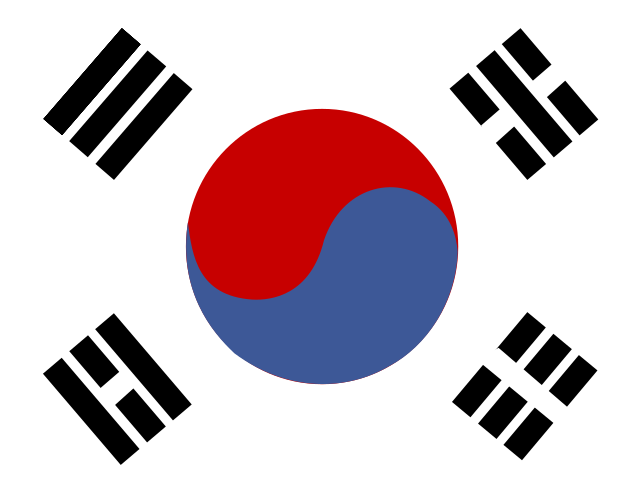
    Just raising the North Korean flag alongside other national
banners in the Olympic Villages required an exemption from South
Korean laws banning praise of the North Korea regime, a
Pyeongchang organizing committee official told Reuters.
    The officials all declined to be identified due to the
sensitive nature of the matter.

    NO GALAXY NOTE 8, NO NIKE?
    Samsung Electronics, an official sponsor of the Winter
Games, is offering 4,000 Galaxy Note 8 smartphones specially
designed for the Olympics to "all" of the participating
athletes.
    The International Olympic Committee will distribute them, a
Samsung Electronics spokesman told Reuters.
    But South Korea is not sure if North Korean athletes will be
eligible for the treats because of U.N. Security Council
sanctions, an Olympics organiser told Reuters.
    The official declined to elaborate, but experts say
providing the $1,100 Samsung phone could violate U.N. sanctions
that ban the sale of luxury items and electronics with a
potential "dual" commercial and military use.
    Meanwhile, the joint women's hockey team will wear uniforms
made by a Finnish company instead of official sponsor Nike,
because of concerns about U.S. sanctions, another South Korean
government official told Reuters.
    Unilateral U.S. sanctions go far beyond the U.N. sanctions,
effectively banning U.S. companies and individuals from trading
with North Korea.
    "We are trying to figure out ways to live up to the
sanctions," the official said.
    Nike did not immediately respond to request for comments.
    North Korean athletes will also have to return Finnish
hockey sticks, skates and other equipment the International Ice
Hockey Federation has "rented" for them when they leave South
Korea, the official said.
    The federation was not immediately available for comments.

    FLIGHT RISK
    South Korea's unification ministry said it had sought and
received temporary permission from the United States to fly an
airliner to North Korea this week.
    The flight took South Korean athletes for training in a ski
resort in the North on Wednesday, and brought North Korean
athletes to the South on Thursday.
    Any aircraft or ship visiting North Korea is banned for 180
days from entering the United States. The exemption granted this
week only applies to the latest flight, meaning U.S. approval is
needed any time North Korean officials visit during the Olympics
by airplane or ferry.
    A spokesman for the U.S. State Department said Washington
was in "close contact with the Republic of Korea on our unified
response to North Korea."
    A U.S. Treasury official said the department evaluates
applications "for certain prohibited transactions and
activities, which can include those related to the upcoming
Olympics", without giving more detail.
    For this week's flight, an Airbus  AIR.PA  aircraft was used
rather than one made by U.S. Boeing  BA.N  due to stricter U.S.
sanctions, South Korean broadcaster Channel A reported. Asiana
Airlines  020560.KS , who operated the plane, declined to
comment.
    To comply with South Korean military rules, the airliner
had to fly some distance out to sea to avoid flying over the
heavily fortified Demilitarised Zone, the unification ministry
said.

    FIVE-STAR HOTEL
    The North Korean Olympians are staying at the athletes'
village in Gangneung with athletes from other countries. The
Olympics organising committee was unable to say whether they are
being given any special treatment, such as beefed up protection.
    North Korea's 230-member cheering squad is expected to stay
at Inje Speedium, according to a unification ministry official,
a four-star hotel surrounded by forest. Rooms there cost 242,000
won ($226) to 715,000 won per night.
    Its taekwondo performance team will stay at the five-star
Grand Walkerhill in Seoul, which overlooks the Han River and
previously hosted American stars such as Michael Jackson and
Paris Hilton.
    The spending is not unprecedented. When North Koreans
visited the South for the Asian Games in 2002, the Seoul
government spent 1.3 billion won hosting them.
    But now, even paying for routine things such as medical
treatment or providing souvenirs can run into problems, said Yoo
Ho-yeol, a professor at Korea University in Seoul.
    "Benefits provided to North Korean delegation, which were in
the past were not subject to sanctions, can now become a
controversy, since sanctions have become much more comprehensive
in recent years," he said.

 (Additional reporting by Josh Smith and Haejin Choi in SEOUL
and David Brunnstrom, Siddharth Cavale and Karolos Grohmann;
Editing by Soyoung Kim and Lincoln Feast)
 ((hyunjoo.jin@thomsonreuters.com; 82-2-3704-5685; Reuters
Messaging: hyunjoo.jin.thomsonreuters.com@reuters.net))

Keywords: OLYMPICS 2018/NORTHKOREA LOGISTICS
Recent news on SK Networks Co
See all newsTo Buy Shares In Upstage Co., Ltd.
Brief: Sk Networks Q3 Operating Profit 28.6 Billion Won, Up 75% From Year Earlier
Brief: Nikkei Says Softbank, SK, LG, And Hanwha To Join Asia-Focused AI Fund
Brief: Sk Networks Q2 Consolidated Operating Profit 29 Billion Won, Up 15% From Year Earlier
Explainer: South Korea's SK Group considers asset sales, mergers as part of major overhaul