2018 Strategies Review - A tough year for the gurus

After a solid 2017, most of the 60 guru-inspired investment strategies tracked by Stockopedia hit turbulence in 2018. Much of the trouble started in the second half of the year - and the worst of it unfolded in the final three months. After a decade of powering market returns, growth and momentum strategies pulled back sharply. Whether it’s the start of a new trend is unclear. Either way, stock market investors finished 2018 feeling pretty bruised.
About the Guru Strategies
2018 was the seventh full year of us tracking the Guru Strategies in the UK, with slightly less performance history for Europe and the United States. Over time, these models have been a handy gauge of what’s working in the market and how different styles react to different conditions.
Not only do they show what’s working, but they also show when trends start to change. Through the lens of of the gurus, we get to see how different styles of investing - spanning Quality, Growth, Value, Bargain, Income and Momentum - interchange with each other.
Over the past seven years, which covers a good chunk of the boom in equities since the financial crisis, it’s clear just how successful the growth and momentum trades have been (see the orange and red lines in the chart below). That performance actually accelerated in the after the EU referendum in June 2016. In fact, it’s fair to say that both styles were still strong right up until last summer.
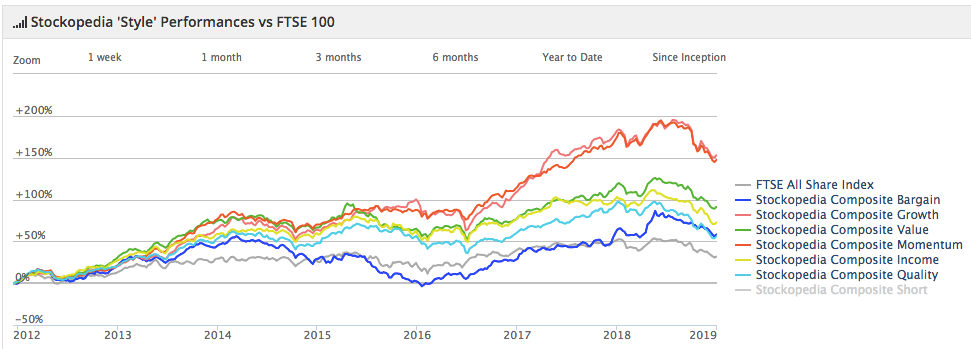
But as the year wore on, the bull faded fast. In the US, the prospect of rising rates and trade disputes were just two of the reasons why the S&P 500 finished the year down 6 percent. In the UK, the same concerns mixed with a host of domestic economic and political uncertainties sent the market sliding. The FTSE All Share closed the year down 13.0 percent, while the more speculative AIM All Share finished with a fall of just over 18 percent.
Index / Strategy Composite | H1 2018 | Full Year 2018 |
+0.6pc | -12.5pc | |
-0.8pc | -13.0pc | |
+0.5pc | -15.6pc | |
-1.5pc | -16.6pc | |
+5.1pc | -18.9pc | |
+3.1pc | -18.2pc | |
+1.7pc | -6.2pc | |
-3.9pc | -13.0pc | |
Guru Strategy Composite | +2.4pc | -11.7pc |
+2.2pc | -9.3pc | |
+5.9pc | -9.3pc | |
+10.5pc | -2.4pc | |
+1.6pc | -11.2pc | |
-4.3pc | -19.7pc | |
+0.4pc | -13.9pc |
In terms of the mechanics of Stockopedia’s Guru Strategies, each one has its own set of rules, and we constantly screen the market for companies that meet them. At the end of each quarter, those passing the rules are held in a portfolio for each strategy, which we track. It’s fair to say that the models aren’t always realistically investable, and sometimes there may not be many companies that meet their rules. In addition, we don’t account for the drag of trading costs or the bonus of dividend payments in the performance data.
A few highlights (and lowlights)
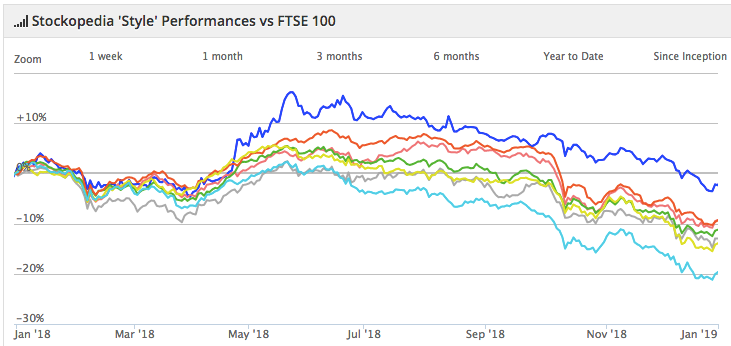
October saw the biggest falls for the previously strong growth and momentum strategies. Those models that posted positive gains - including the Jim Slater Zulu Principle screen (+8 percent) - either did it with strong results from a concentrated number of holdings or just managed to cling on to good returns from earlier in the year. Previous big 2018 winners for the Zulu strategy included stocks like dotDigital, Impax Asset Management and Iomart.
Moving into 2019, the number of stocks in the Zulu folio is stuck at six, which is the same as last quarter. Until the number of companies qualifying for that strategy rises, it’s going to be hard to get excited about growth. The Zulu screen is a neat balance between earnings growth, reasonable value and momentum. In the past it has been a good barometer of sentiment: when markets are under pressure the screen just dries up. Whereas in 2016, when markets were stable and just easing upwards, there were lots and lots of stocks passing the strategy rules and the folio did very well.
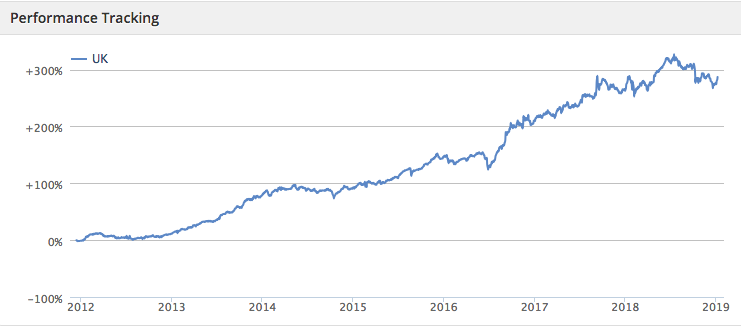
Meanwhile, in the momentum screens, the two that managed a positive return in FY 2018 were the Price Momentum and Jim O’Shaughnessy Tiny Titans strategies. That really masks what were two very solid performances though the bulk of 2018 and several years past. Tiny Titans, for instance, is a very simple two factor value and momentum screen focused on small-caps. But it just keeps on delivering consistent returns. To be fair, the stocks themselves can be illiquid, volatile and very unpredictable, but as a simple test of the power of small-cap value and momentum, it has been very robust over the past few years (see the chart below).
With stock prices tumbling and momentum dislocating, a lot of market commentary inevitably turned to whether value, as an investment style, would see a resurgence. It’s a bit early to say whether lower prices will lead to higher numbers of better quality of companies making it into value strategies. But there have been some promising signs. The leading value strategy in 2018 was the Ben Graham Enterprising Investor (+7 percent), and the number of companies passing that strategy does seem to have improved going into 2019.
Overall, the least worst style performance in 2018 was in the deep value bargain strategies. Here, the Trading Below Cash screen managed a 14 percent gain for the year. But it was propelled by a couple of big wins early in 2018, one of which was Webis Holding. So the true picture was that bargain strategies came under as much pressure as everything else in 2018.
Questions over quality
Over the past couple of years, the quality investing strategies - defined by gurus like Warren Buffett and Joel Greenblatt - have been fairly underwhelming. The Buffett strategies, for example, have underperformed and Greenblatt’s Magic Formula has been pretty flat too. Our take on Joseph Piotroski’s High F-Score model has perhaps been one of the most consistent.
Why the slow pace? It’s hard to say exactly but one argument is that the higher quality, large-caps the Buffett strategies look for have got pricey in recent years, which has held back returns. They had a terrible fourth quarter in 2018 but it’s worth remembering that the portfolios were refreshed just as the market started to slide. So those possibly expensive higher quality names quickly got cheaper. Refreshing into the new year, the new folios look fuller and perhaps better quality than we’ve seen in recent years. Certainly many of the holdings have rebounded with the market over the past week or so. So was it just that quality large caps were a bit toppy? We’ll have to see as the year unfolds.
Looking ahead to 2019
So what can we make of all this? Negative returns across the board for the gurus through 2018 were largely down to hostile market conditions in the last three months of the year. Before that, there had been some very strong performances. It’s a reminder, if anything, that it’s the longer term performance charts that really count. But from here, attention turns to how these strategies will react and recover.
While there’s never any certainty in the stock market, there’s perhaps just an extra twist of unpredictability about 2019. How that affects stocks is impossible to know. Hindsight bias says it’s pointless trying to map the past to the future in any kind of concrete way. But what we saw in the latter part of 2018 was a shift away from the go-go-growth and momentum trend that has been driving the market in recent years. Whether it’s a pause or a more solid change in direction… we’ll have to wait and see.
Disclaimer
This is not financial advice. Our content is intended to be used and must be used for information and education purposes only. Please read our disclaimer and terms and conditions to understand our obligations.

33 comments
Hello Everyone ...
To be frank l commend Luthrin's point about the utility of failing to account for actual dividends , bonus share issues and the rest in order to make a true comparison of all the gurus ' results .
Having read most , if not all , of the guru ' s books , my conclusion is that one should develop one ' s own screen
for the purpose of actual trading / investing .
In my own case , l just use a momentum - based method by the use of moving - average crossings . Though l have to admit l am a bit of a valueist .
To date , i am circa 80 % in actual cash , not bonds at all . Awaiting the crash [ which may never come ] !
Best wishes , Ramon .
You are right Ramon, moving average crossings are important, not only their crossings but also their direction. They also serve as the real trendlines rather than the ones you draw that may well have a lot of imagination attached. One of the very best to explore this concept and also the one who uses their order on the chart namely in top down order -- 50SMA, 150SMA, and 200SMA is Mark Minervini. This is an integral feature of his very successful investment strategy. He would not hit the buy button without having all the ducks in a row.
Experts! Can't be trusted ;)
Anybody who researches the post 1929 bear market will find that there were huge bull market rallies within it Wonder which guru strategies if any might be best suited if as I believe we are going back to the post 1929 bear market world
BTW @Stockochat hasn't worked for over 6 months
You couldn't win this Q4 whatever you did, but it doesn't matter, you'd still be well up on the decade, and still will if the FTSE or SPX falls further. This is why I trade (or rotate short-term, same thing), but short-term work involves technicals over fundamentals, and people don't like that, as surely earnings and news per company are what matters, not lines on a chart. But the reality is that intra-quarter, lines on a chart, and macro sentiment are all that matters, otherwise stocks would be flat between each earnings report.
Hi Adatherton,
Re: your statement "You couldn't win this Q4 whatever you did" What about if you had just shorted the FTSE or AIM?
You say "technicals over fundamentals and people don`t like that" .
Perhaps it`s time that these people learned to take a more balanced approach. As far as the gurus in Stockopedia are concerned the closest we get to a balanced view is William O`Neil`s site. The clue here is that it is called "-esque". To put it in other words it`s simply not the real deal. We know that O`Neil just like Mark Minervini is a techno-fundamentalist.. Their strategies involve precise timing of entries and exits from the market associated with the trend as well as the price/volume relationship of stocks. No quarterly reviews for these boys as the market does not work that way, they closely monitor their stop losses. This sort of approach is beyond the scope of our site and sadly as you say people don`t like it.
I have read O`neil`s books and my main guru is Mark Minervini, I have read his book `Trade like a Stockmarket Wizard` about three times and keep referring back to it. The book is a bit of a misnomer in that it`s focused on investment rather than trading.
This is why my portfolio has been about 85% in cash since late September and is likely to stay that way for the foreseeable future.
If one wants to follow a Quantitative investing style wouldn't the Guru screens be useful?
"In addition, we don't account for the drag of trading costs or the bonus of dividend payments in the performance data."
The lack of total returns data for portfolio holdings is Stockopedia's greatest weakness in my view and makes any analysis of guru strategies not only incomplete but potentially highly misleading. It seems nonsensical that income strategies are being compared to those of momentum and growth ones when the actual income from the companies held is missing from the performance calculation.
Take the Dividend Dogs screen for example. The current UK qualifiers have dividend yields ranging from 6.7% to 13.3%, so if 2018's qualifiers had yields in a similar range, what would the overall performance of that strategy have looked like if the income stream had been added to the capital return? In this strategy the dividends aren't merely a 'bonus' on the side as Ben's phrasing implies - they're core to the whole investing rationale.
I was thinking the very same thing. The fantasy portfolios are pretty poor for that very reason
Absolutely fascinating, and makes me feel even happier about my own portfolio performance last year - see https://roliscon.blog/2019/01/03/review-of-the-year-ive-seen-worse/ . Rather shows that screening based on a simple formula to pick a few stocks which you can stick to for months is not the answer alone. Needs to be combined with some trading activity on a day to day basis, and cash management to reduce exposure to the market when it is falling.
@Roger Lawson.
Hi Roger what do you mean by trading on a day to day basis? Wouldn't this introduce biases? Do you mean to use 200MA on the overall market or non-technical strategies to assess market momentum?
I mean you sometimes need to respond to news on a daily basis. Certainly I monitor my portfolio for news and individual share trends on a daily basis. I tend not to look at overall market trends because they get reflected in individual share movements anyway.
What influences your share price? The descending order would be economy,market,sector,industry and only then company. The market and the sector alone are likely to have a total influence of 80%.
Ignoring the elephant in the room and just looking at the individual share and the news relating has had a destructive influence of many a portfolio over the last few months.
Another factor is that very often a new bull run will produce a distinct change in sector strength, new sectors will emerge to the fore. Historically the new market leaders will make the largest percentage. advances early in a new bull market, research confirms this.
Hi Ziebots,
I Agree in principle, but Warren Buffett says why wast energy on what you can’t control. He therefore ignores the market and concentrated on Finding great companies at a good price.
The best time to actually buy stock is in a bull market. Sure, you cannot control the market but you can control the finger that presses the key to buy.
Hi Zeibots,
Hi Zeibots, your statement "The best time to actually buy stock is in a bull market" this may be true for traders, but not sure for long term buy-and-hold investors. Usually the best time to buy is when the markets are depressed.
Buying stocks in a bull market is true for everyone, there is no maybe about that. The crunch time is when the market retraces. This is when the big players take the profits that they have made and sadly many buy-and-hold investors simply hang on and watch their gains drain away and hope that someday the trend will change in their favor again.
You can learn a lot about yourself mmarkkj777 and your character as an investor by reading Lee Freeman-Shor`s book `The art of Execution`. This book is written by a fund manager who has done a lot of research on this subject and it makes a very good point -- the person who knows his character,and is knowing of his environment, is the one who wins over the long term,provided he is asked to make defined decisions.
Hi Zeibots,
I wasn't disagreeing with you. I quoted Warren Buffett. Mark Minervini has a totally different view to holding long term. Horses for courses.
Why do you say the buy and hold investors sadly watch their gains disappear. I haven't seen Warren crying about this, through any of the bear markets (he is giving most of his retained wealth away, is it $80 billion now?). There are no bigger players.
The market always recovers long term and goes on to higher highs.
I don't always, btw. I went to cash in Nov (have held during previous corrections/downturns).
I was just presenting an alternative view, that many long term holders buy when the market is depressed. Be brave when others are scared. Be fearful when others are greedy, as the old saying goes.
Thanks for the reading tip (I'll do that). None of us are too old to keep learning.
Yes Minervini is different but not the way you think. He is more proactive and closes all his losing positions before they decline by 10%. This leaves open positions in the winners only, no sentimental attachment. He hangs on to the winners.
Try this by going back in your portfolio records and imagine that you had sold all losers when they declined to this level. You will be astounded by the difference in the performance of your whole portfolio. Granted that some of the losers will recover later but overall this is not a risk worth taking.
Reading just pages 276-279 in his book will convince you.
Hi Zeibots,
I already do this. In other threads I have suggested to cut losses quickly and use a 8-10% close stop (and been critisised for it). I have read Minervini and he is a great trader and I have been using these techniques for a while now (with success). But I also have a passive buy and hold portfolio in my Pension.
Please don't try to try to second guess how I must think. My comment was that long term buy and hold investors (as opposed to a trader) buy when the market is depressed and prices are lower. I still think this is correct.
There is no right or wrong answer. Who can say if Warren Buffett or Mark Minervini are right. The answer is probably that they are both right and their respective methods work for each of them. In the end, that's all that matters.
You are on the right track in cutting losses at 8-10%, don`t just suggest it but do it. The critics of this strategy simply don`t understand the basics of running a portfolio and cannot do the maths.
However this strategy should be used hand in hand with the precise timing of opening your positions in the first place. This is to do with established trend and volume factors that give you the necessary information to ascertain if your chosen share is undergoing accumulation or distribution by the big players. This makes your stop loss levels much more meaningful and works best with equities that are liquid and have higher capitalization levels.
zeibots
Personally the stocks I bought in the bear market during late 2008 and early 2009, proved to much better performers than those I bought in 2007 during the bull market!
Of course you do qualify the view with
Bull markets have plenty of short falls that could easily be taken as the signal for a major retrace, but in fact were not.I you have the ability to determine, in advance, even with a modest degree of accuracy where the real market tops and bottoms are (rather than the false signals) then hats off to you. If that's the case, would you be prepared to share?
`Where the real market tops and bottoms are` -- there is no precise answer to this and the worst guide to this is provided by the financial press. The confirmed trend will tell you where you are in the market as well as the progress of individual stocks. looking at any stock`s life cycle you will find that they progress in different stages that are almost always linked to earnings. Stan Weinstein in his book that was first published in 1988 presented this concept. Nothing has changed since. This is also a core concept in Minervini`s strategy. Both of these as well as William O`Neil are techno-fundamentalists. Many years ago the banker Baron Rothchild was asked why he was such a successful investor. His reply was that he always bought too late and sold too early. Like the others he was interested only in the positive trend, this is Stage Two that is the advancing and accumulation stage. Minervini reviews all the stages in detail and makes it clear when they start and end.
Finally, my portfolio is over 85% in cash at this time and is unlikely to undergo much change any time soon.
Not sure this truly reflects gurus strategies, for example I know that Robbie Burns made huge profits by shorting the ftse 100 in the year as a hedging strategy. I don't know about the rest but I suspect he as an example made good profits in 2018
Strange as they are not listed on his site! If you look back at his spread bet shorts you can see that he shorted the ftse in 2010
Hi Phil,
I don't think Robbie puts everything on his Web site. I know he is fairly open, but he probably keeps some cards close to his chest.
He is also a Stocko user and looks at his namesake Guru screen, which must be pretty strange!
Hi Phil.
To be fair to Robbie Burns/the Naked Trader, the trades tables that accompany his blog are predominantly individual shares (both long and short) rather than broader trades he places on indices. If you follow his bi-weekly newsletter (or for that matter attend his regular seminars) he’s pretty open about what he’s up to both on specific shares and his views on the market in general.
He suggested taking profits and moving into cash in the late summer of 2018 and was advocating short index spread bets on the FTSE 100 when it was at or around 7600. In his Jan newsletter he claimed short index profits of £100k over the last quarter or so. I’m not sure his commentary would necessarily stand a full audit, but given his long track record I’m happy to accept his claims at face value. (He also admits to taking a smaller punt on a putative Santa rally that failed to arrive (so far).
While his writing style seems pretty light hearted and some may dislike his excursions into the TV schedules or the prospects for Fulham FC, he does seem to have a shrewd sense for the markets backed up by consistently good results (evidenced by a reported 14% gain in his 2018 ISA). He’s one of the few market commentators (beyond our own SCVR) that I rate and follow regularly.
http://nakedtrader.co.uk
Gus.
Hi Threeputt,
The Guru strategies, I'm sure, only represent a nod to the selection and trading styles of the actual Gurus. They should really be considered as separate entities (and I'm sure that was the intention).
Its still interesting to fish here for shares that match various screening criteria, even if you feel the market is not suitable for acquiring them at the time.
I attended Robbie's seminar late last year (Dec) and he was in fact shorting the FTSE at that time with a spread bet. He was going to close it and reverse the position for the Santa rally, if it occurred. He probably did it early Jan instead. I don't know his overall results for the year, but my guess is he probably did OK :-)
Good point, if you buy alpha stocks and short the index, theoretically you will gain in all years, although obviously you will lose overall, as alpha is not as much as overall growth.
Ben,
Another excellent review that demonstrates how difficult it is to make money in a failing market. There were few even so called low risk strategies that avoided a loss. What I take for 2018 is that it pays to revert to a greater and greater proportion of cash (in my case up to 50%) from companies within the portfolio whose momentum has weakened most, once it becomes clear that there is general stockmarket market weakness. Then sit on the sidelines and to avoid boredom take the odd stake in improving quality companies and hope for the best.
Edited...