2024 – A year in value

When I looked at the performance of the Value Rank at the end of last year, there was some good news. Unlike in 2022, the cheapest decile of stocks had beaten the FTSE All-Share in 2023. However, in 2024, the top-ranked Value shares have just kept pace with the broader indices:

The reality is that it has been another year of struggling small caps, particularly those listed on AIM:

Because the Value Rank deciles are equal-weighed, they tend to underperform market-cap-weighted indices during periods when the largest companies outperform. In 2024, the tax changes in the recent budget have had the biggest impact on AIM stocks. The attractions of companies that are cheap on earnings, cash flow or assets simply haven't been able to overcome the outflows from this particular part of the market.
2024 has been a much better year for investors who bought the cheapest decile of large cap stocks. These outperformed the market by almost 30% YTD:

This will be little salve for those of us who feel we can get a better edge in smaller companies. However, it shows that value investing still works well under the right conditions.
Even in the smallest of companies, the Value Rank has still been useful. In stocks with a market Cap of £1m-£100m, the average stock with a Value Rank below around 40 has significantly underperformed the market:

Over the last three years, the average stock with a Value Rank below 10 has performed abysmally. So even if investors don't view themselves primarily as Value investors, if they invest in smaller companies, they would be wise to avoid the most expensive stocks.
In addition to the overall performance of the 90+ Value Rank stocks, Alex has been able to break out the performance into the highest-ranked stocks of the individual components that go into the Value Rank. Here, the timeline is a little different as the study was done in October, so the data runs the year to 1st October:

It is notable that stocks that are very cheap on Free Cash Flow performed best. My hypothesis here is that companies that generated a lot of cash were able to use that to buy back their own shares and offset some of the outflows from the market. Likewise, companies that were cheap on Earnings Yield, which takes into account the net debt or cash that a company has on its balance sheet, outperformed. Perhaps this is because many of these companies had cash on the balance sheet that they were able to deploy during the year.
How did my 2024 predictions pan out?
I also made six predictions. Let's see how I got on with these:
2024 Prediction #1 - The focus will shift from inflation to current economic conditions.
Last year, I said:
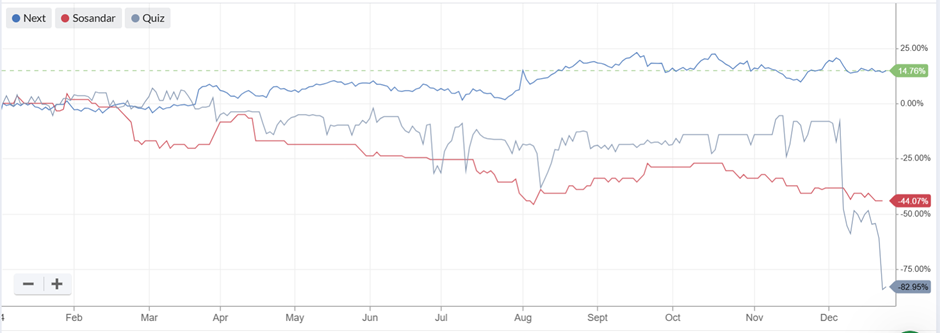
Consumer confidence is likely to be weak for some time yet. Investors will want to own the best operators. For example, in omnichannel retail, this means owning Next (LON:NXT) , rather than the also-rans, such as £:QUIZ or Sosandar (LON:SOS) . Investors may want to avoid sectors with UK consumer exposure altogether.
Although I didn't predict how a new government would impact investor and consumer sentiment, I was right to be cautious about consumer-facing stocks. As for the comparison between retailers, Next gained 15% YTD, Sosander lost 44%, and Quiz lost 83%. Not only that, but an hour after the market closed on Friday 23rd December, Quiz announced it was delisting.
I think I can chalk this particular prediction up as a win!
2024 Prediction #2 - Fund flows matter
Here I said:
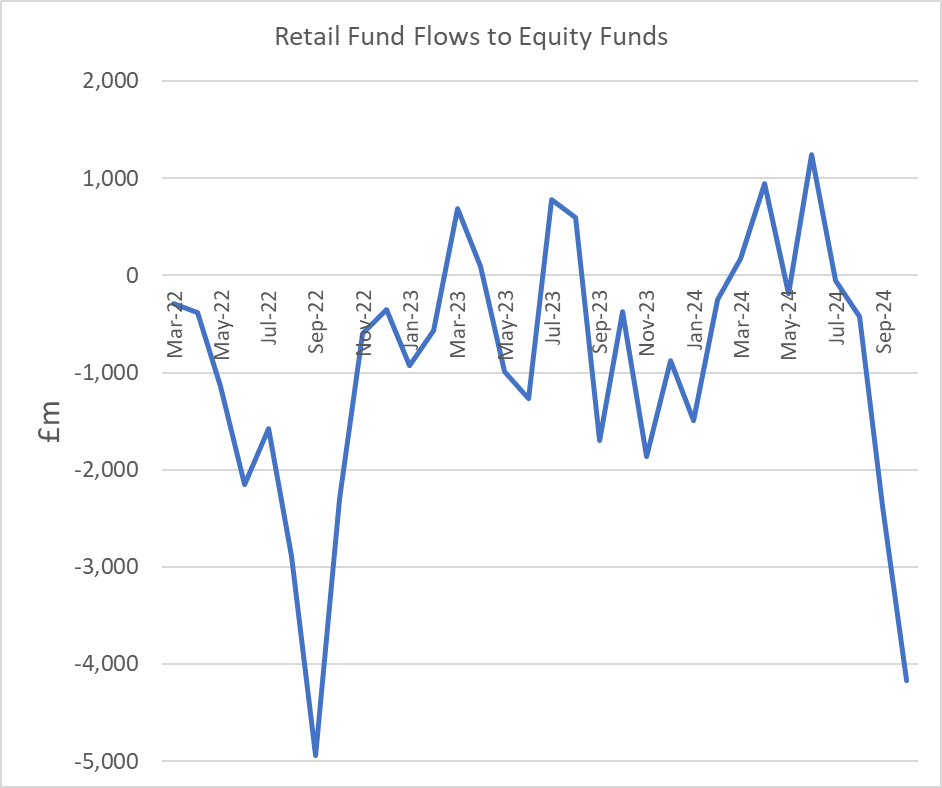
While we are not seeing retail fund outflows of the magnitude that we saw in mid-2022, we are not seeing any real trend of positive flows into equity funds either. In the medium term, these figures are favourable for the expected returns to equities since flows tend to be cyclical. However, in the short term, this remains a headwind. Since some funds may see sufficient outflows to make them forced sellers of illiquid stocks, investors should be on the lookout for bargains this year.
Here's what those flows looked like based on the latest data from The Investment Association:
And here is the same data cumulatively:
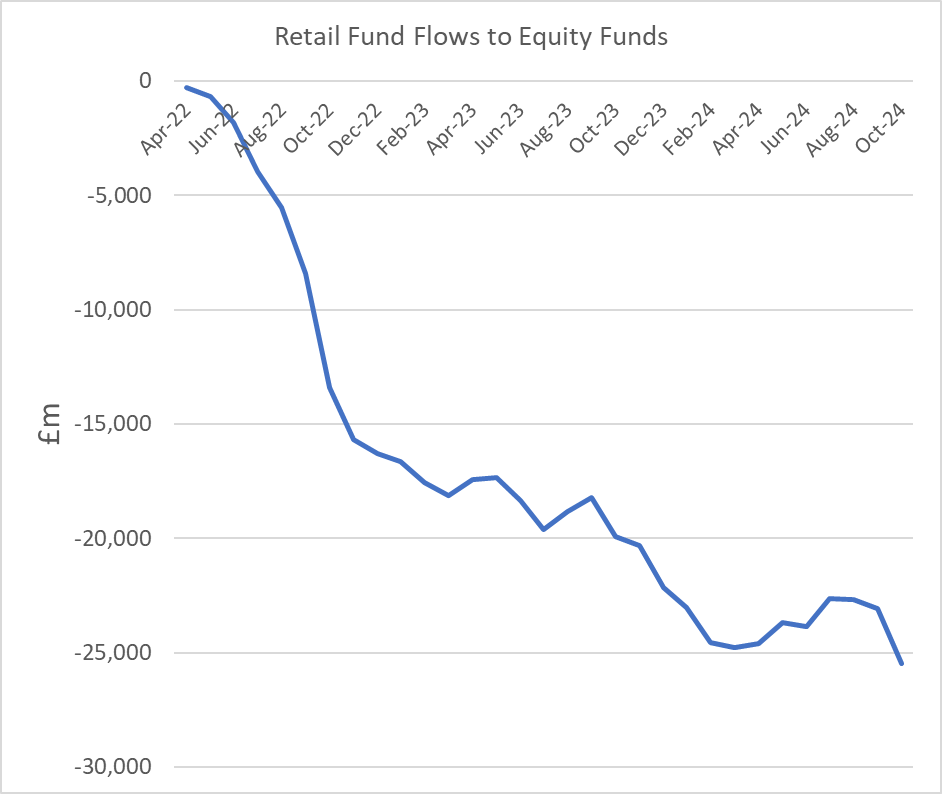
This matches what we know about the small cap markets. There was initial optimism in the Summer, but budget worries have meant that retail flows have made a new low (since early 2022) in October. This may be a slightly depressing view, but I don't think we can doubt that bargains have been available this year for those willing to battle against the equity outflows.
2024 Prediction #3 - Trading may not be a sin
I suggested that value investors should consider reacting to outsized moves caused by illiquid markets rather than only being buy-and-hold investors. While it is hard to generate an empirical study of this effect, my own practice of being willing to sell on strength appears to have added around 5-10% to my overall returns for the year. Notable successes include buying Severfield (LON:SFR) at just above 50p when it looked very cheap on earnings and selling just above 80p to add to competitor Billington Holdings (LON:BILN), which was on around half the rating. Following a profits warning, Severfield is now back down to 50p. Or buying Nexteq (LON:NXQ) below 100p and selling at around 150p when it spiked up because it was tipped in the Investors' Chronicle. It is now 64p. I could have just been lucky with these particular examples, and not every time I have reacted to short-term moves has worked out as well. However, when faced with market outflows and a tendency for shareholders to crowd into a limited number of stocks (tip-driven or otherwise), it has paid to be nimble.
2024 Prediction #4 - The rotation to small caps will continue
I got this one wrong. I assumed the valuation differential would cause the trend of larger caps to outperform smaller ones to reverse. I didn't foresee the challenges the Autumn budget would present for investors, especially those that affected AIM stocks, such as Inheritance Tax changes. While the worst fears of investors in this area may not have come to pass, sentiment doesn't appear to have recovered.
2024 Prediction #5 - Quality may make a comeback
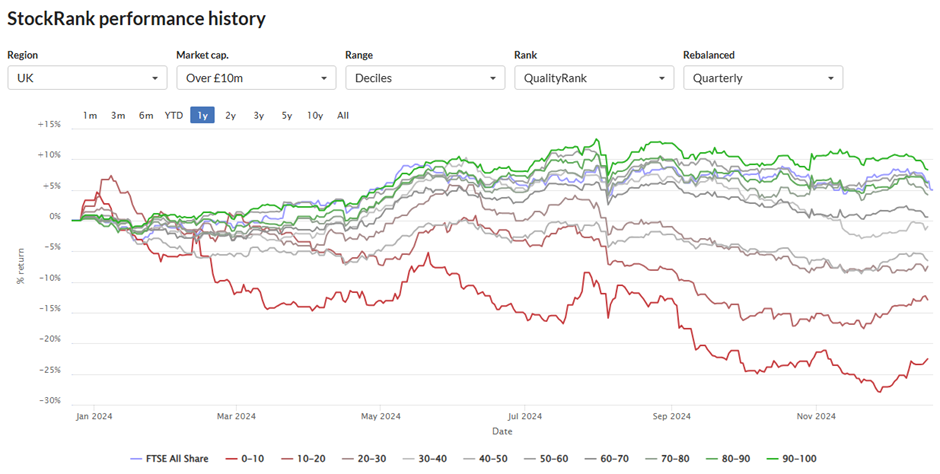
The highest quality stocks, as measured by the Stockopedia StockRank, beat both the FTSE All share and trounced the lowest quality stocks, so I think this is another win:
2024 Prediction #6 - Takeovers are likely to continue.
While the ONS provides takeover figures, it includes unlisted companies, so this isn't particularly helpful. Anecdotally, this has been a strong year for takeover offers and rumours of corporate action. The number of listed companies continues to decline rapidly, according to Statista:
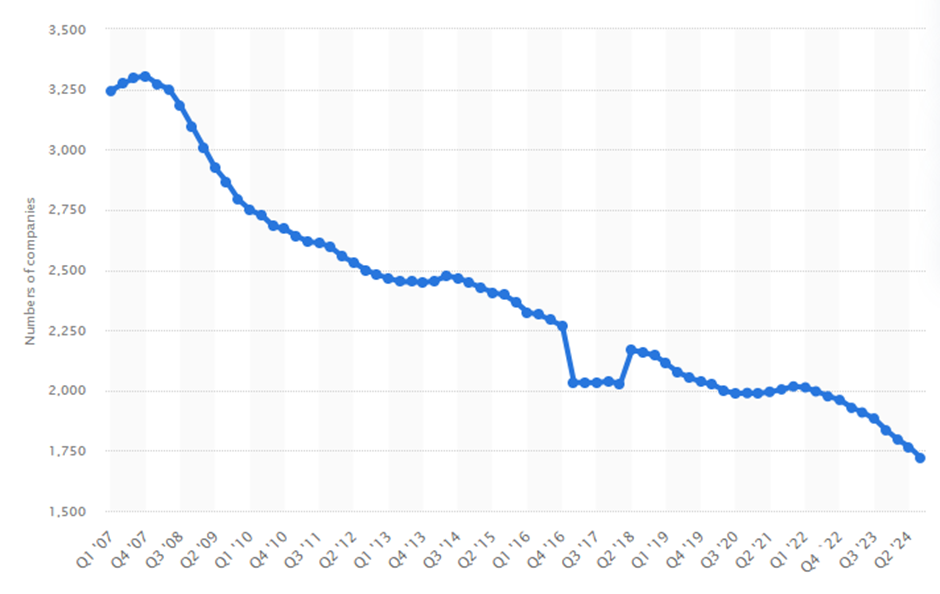
This will include delistings for other reasons, but it does suggest that listed takeovers have been strong in the past year.
So what about 2025?
2025 Predictions
1. Takeovers will continue to be regular occurrences
I feel less certain of what 2025 will have in store than I did going into 2024. However, my biggest conviction is that we will continue to see takeovers. If UK investors continue to sit in cash, worried about the short-term outlook, then larger UK companies, international businesses, or funds will see the UK market as irresistible. 2024 saw a significant number of takeovers. If UK companies remain on a material discount to international stocks and, in some cases, unlisted companies, then we can expect this trend not just to continue but to accelerate.
2. Cash will be king
I think we have already seen that, in a market where there have been outflows from equity funds, companies that have significant cash resources and are willing to use them to buy back shares have done better than those that haven't. I expect this trend to continue. On the other hand, this isn't a good time to be coming to the market for fresh capital. I expect any company that needs capital, at least in the short term, to pay a high price for it. In normal times, I am dividend agnostic. I like companies that don't have a good use for their excess cash to return it to shareholders, but if they do have a good use for it, I want them to reinvest that capital. However, in the current markets, there is almost nothing to stop the share prices of good, cheap companies from continuing to go lower. Hence, it makes sense to focus on companies that are generating cash and using that to buy back shares or pay out large dividends that can be reinvested.
3. Volatility will increase
Changes in government can cause significant shifts in policy, and these can have unintended consequences. For example, I don't think the current UK government intended to cause retail job losses when they increased Employers' NI. Yet, this seems to be one of the major outcomes. In the US, the markets have been optimistic about a Trump presidency, expecting tax cuts and a business-friendly environment. However, when these occur in markets that are at historically high valuations and aren't backed up by improved financials, such speculation can be the harbinger of financial excess that ends up in crisis. For example, Tesla's share price has doubled since Elon Musk aligned himself with Trump, yet EPS is declining, and Tesla's sales in Europe were down 40% in November. Predicting a financial crisis in any given year is a fool's errand. However, I think we can expect a period of greater uncertainty in the US, which will be reflected in greater stock market volatility. It is tempting to think that these events will leave the cheaply-rated UK markets unscathed. However, it would be naïve to think the UK will be unaffected by any significant US sell-off.
4. The smallest companies will finally catch up
Making this sort of repeated prediction after being wrong last year may lead to the accusation of being a stopped clock – I will be right one day! However, looking at valuations, the valuation gap between the smallest companies and the rest of the market has widened. In particular, many companies below £50m market cap look exceptionally cheap by historical standards:
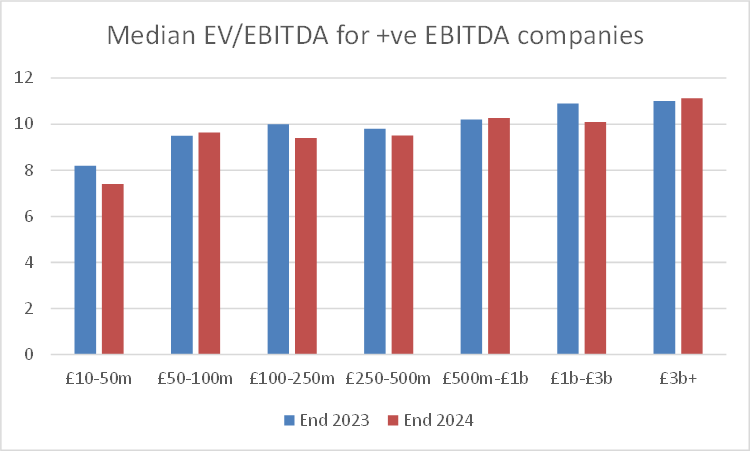
These smaller companies have historically had higher sales and earnings growth, which has been reflected in higher historical stock returns. I see nothing in the current markets that means that this won't also be the case in the future. This means that the current micro-cap malaise is more about fund flows and investor confidence than the companies themselves. These factors tend to be cyclical rather than secular trends. Hence, they will reverse at some point. My hope is that 2025 will be that year.
Whatever 2025 has in store, Stockopedia remains your invaluable companion in navigating the markets, providing tools and commentary to help you make informed investing decisions.
Happy New Year!
[Disclosure: Mark owns shares in Billington Holdings (LON:BILN) ]
Disclaimer
This is not financial advice. Our content is intended to be used and must be used for information and education purposes only. Please read our disclaimer and terms and conditions to understand our obligations.
7 comments
"For example, I don't think the current UK government intended to cause retail job losses when they increased Employers' NI."
I can't see how they could be unaware of that consequence. It was as clear as daylight that that job losses would occur.
They aren't economists. They are ideologues. Backed themselves into a corner by ruling out an income tax rise and are committed to redistribution of wealth, forgetting that they have specifically hamstrung those who create the wealth they would like to see redistributed!!
I think we have reached the point where the problems are now unsolverable DD due to the nigh on 3 trillion of debt. At some point the £400 billion borrowed during covid will be rolling off I'm guessing sub 0.50% gilt rates and need refinancing at rates currently north of 4.5%.
Only way I can see out is some form of global debt reset where they maybe all net off the same amount of debt held by central banks and against each other.
US and Europe, Japan all in same mess to different degrees to us.
Ahh they can just print some more
An A level economics student could have foreseen higher inflation and job losses after the budget!
Thanks Mark, very reassuring to see that free cashflow is a good indicator of value. I also appreciate that your predictions dont include anything like a specific % return on an index - usually a waste of time and inaccurate!
Thanks JSchoffer. TBH, I’m not sure I am particularly confident in making any predictions! But I find it a useful exercise, especially if I follow up and review what I got right and wrong.