3 Selling Rules

3 Selling Rules
As a long-term investor, the problem with selling is that it never seems the right time to actually sell an investment. If the share price is rising it feels like there will probably be further upside and if it goes down the valuation looks more attractive. Like many investors, I spend most of my time figuring out what to buy and hold, and never really consider why and when to sell.
I wanted to get to a point where selling was no longer an emotional response, but one based on written rules I could follow, which forces me out of positions to sell holdings for specific reasons. With a little bit more experience and time, I have been able to think about why and when to sell a position and write rules I can follow.
If I’m unsure if I should sell a position, I read and act upon my written rules to force me to make the decision. I would like to share these 3 rules with you and share 3 examples where the rules worked well for me personally.
The 3 Selling Rules;
- Sell when - a winning position exceeds 10-15% of my portfolio, consider selling 30% of the position.
- Sell when - share price exceeds assessment of company growth expectation and valuation (high end of valuation), consider selling 100% of the position
- Sell when - Change in fundamental expectations and valuation of the business decline, (deterioration in the market or operating conditions), sell 100% of the position
3 examples where the process has worked well;
Example 1 Caledonia Mining (LON:CMCL) Caledonia Mining, Jun-2020, Selling when the position was above 10% of my portfolio. I have held $CMCL as a hedge against inflation and recession since 2015. During April of 2020, this becomes greater than 10% of my portfolio. I sold approximately 30% of the holding selling at prices between1300-1800p. I am happy to sell to reduce my position and risk in a single share at a price I consider slightly above fair value. (see graph below).
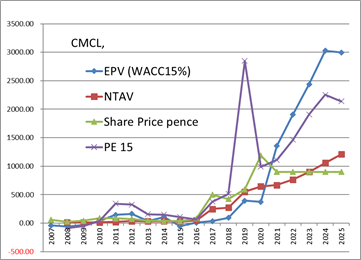
$CMCL Valuation as of 2007- 2025.
Post-Sale the share price has spiked at 1850p and decline 50% to 900p.
Example 2 Revolution Bars (LON:RBG) Revolution Bar, Aug 2017 selling position as share priced reached valuation and above with acquisition offers.
I bought the shares when the share price collapsed in May 2017 after a profit warning. With the share price close to NAV (approximately 100p) it looked like good value if the company could recover operational performance to previous levels. Soon after in July 2017, the company received an acquisition offer of 200p which saw the price rise to 180p. As it was close to fair value if performance recovered, I sold 50% of my holding. The offer was raised 203p and shareholders expected a bidding war would raise the offer further. I sold out 100% of my holding at 208p.
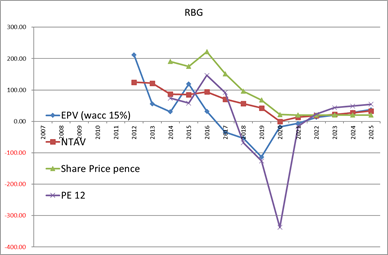
Valuation from 2014-2025.
Share price and valuations have continued to decline since 2017 as shown by the above graph.
Example 3 Loopup (LON:LOOP) , Nov-2020 selling as a business fundamental expectations decline.
I bought shares just before the Nov 2020 trading update at 155p. The trading update the next day suggested a collapse in revenues and the share halved at the market opened that day, (painful for a one-day investment). I sold 100% of the position immediately at a 50% loss. The graph below demonstrates my thoughts of valuation pre and post-trading up-date.
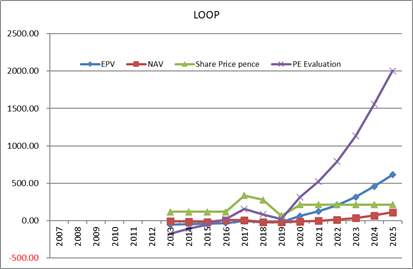
Valuation pre-Nov trading update. Jun-2020.
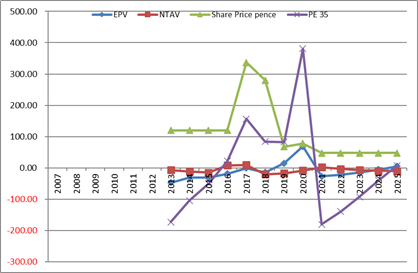
Valuation post-Nov trading update. Jun-2020.
Post selling Loopup (LON:LOOP) continues to report worsting trading with the share price trending further downwards.
Of course, many of my selling decisions have been far worst than the above examples and normally involve the share price multi-bagging after selling. In many ways I apply these rules to stop me from selling out investments too early.
I hope this makes you think about why and when to sell and adds to your own thinking.
BSV
Disclaimer
This is not financial advice. Our content is intended to be used and must be used for information and education purposes only. Please read our disclaimer and terms and conditions to understand our obligations.
13 comments
I can thoroughly recommend "The Art of Execution" on the subject of when to sell. It is a quick read but I re-read it several times a year. It has been one of the most useful books on investing I have come across. In my experience, time, research and ultimately loss(es) are great teachers. I have since followed a strict and more focused investing perspective and do not regret it. Just my opinion obviously but (after reading many books) this one is the one that helped more than any other.
I agree - essential reading
I took your recommendation and bought a digital copy yesterday, sat down with it and was through in about an hour. As you say, a quick read.
However, I didn't pick up as much as I had hoped to help the quality growth investor. The author encourages the trimming of winning positions and I'm just not sure it has been a good idea for any investor to trim big tech, or countless quality names like Halma or Spirax. They only tend to drawdown by 10% and the only time trimming pays off is by blind chance, when a waterfall crash lets the investor buy back in at a much lower price.
For the value investor it's another matter - plenty of good sense in the book. But frankly, as a business owner for most of my working life, including LSE-listed, it beats me why anyone would seek to own shares in struggling businesses with disrupted operating models and markets. Don't the studies all prove that the most successful investors buy the best companies and then hold for decades?
On what to do when a share falls, the advice is compelling - top up or sell out but above all, act! However I felt again that the book required more nuance - if a share falls on sentiment/no news or in a market-wide correction it is a different matter to falling on a profit warning. For that reason I felt the author's persistent use of examples that straddled the GFC extremely unhelpful.
None of the above is to denigrate the recommendation. I am certain that the implementation of one or other of the book's principles will pay dividends at some point.
I do find selling tricky. I have sold shares only to see them leap up as soon as I sell, Ergomed (LON:ERGO) is the latest one. Even when I sell because the Stockranks fall they still seem to go up, see Cerillion (LON:CER) back in March 2021.
I have sold some which are looking too high such as Luceco (LON:LUCE), Reach (LON:RCH), £FTRE and Kainos (LON:KNOS). I'm investing in ones that look better value or have pulled back from their recent peaks. Some of the ones I have sold I may rebuy if they fall back, this has worked well for some shares I have held.
Taking profits is not a bad thing, wish I had sold more of Sylvania Platinum (LON:SLP), running winners does not always work, see Burford Capital (LON:BUR) and Sylvania Platinum (LON:SLP), Best Of The Best (LON:BOTB) also but I never held that one, not a sector I invest in.
Hi BV,
Hugely important and challenging topic - sorry for joining late. As you say we spend far more time on the buying when deciding to sell is equally, or probably, more important.
I'm a conviction investor so not selling is a major failing of mine - which I'm trying to work on. I've introduced a few disciplines and techniques that have helped manage what is ultimately a personal psychological issue:
I will now look to sell:
aa) When the investment thesis has broken down;
bb) When I've got bored with a share - when you cannot be bothered to read the RNSs you're very likely to get caught-out;
cc) A more interesting investment prospect needs and deserves the capital more; and
dd) Telling myself to just sell a loosing position - I can always buy back-in (I rarely do).
This is not working perfectly but certainly has improved my performance. I too was caught out by LOOP - but didn't pull the trigger when i should have. So very much a work-in-progress and keen to pick up some tips from others wrestling with their psychology in the same way.
Regards Maddox
Hi Maddox,
I never had the sell a position to purchase another position, As I like to keep a level of capital for the next opportunity.
Loopup (LON:LOOP) was a good case in point. The graphical representation pre/post-update ( see example 3 in the main text) was enough to pull the trigger immediately.
BSV
An interesting post with, I think, a not unreasonable set of rules. Picking up on each of them:
(1) Whilst I would not invest over 10% of my portfolio in a new share, I am quite happy to allow a holding to grow to a disproportionate size when it is a 'victim of its own success'. In my opinion, delivering excess returns over the long-run relies on finding just a few multi-bagger success stories and sticking with them.
(2) Selling some or all of a holding when it is over-valued (as per my own valuation basis) is a discipline that I try to follow, although I do often find it hard to pull the trigger, as there is always the hope of squeezing out a little bit more.
(3) I buy into a share with a 'story' in mind, and selling when that story goes wrong is, I believe, the most important sell discipline. Fortunately, it is the one that I find easiest to do. However, i do consider if the story can be reframed and, if it can, do not necessarily sell immediately, but may convert the investment to a trade. For example, if my growth story share fails to deliver and falls by 50%, I may then consider it too cheap and look to delay my exit until it has recovered by a further 10%.
I never sell shares just because they are falling on no news. Generally, I would view that as a buying opportunity.
I never use stop losses, either. First, I generally have large holdings in small cap shares, so my exits need to be managed carefully; second, as intimated above, if the story is intact then the stop loss simply deprives me of a buying opportunity.
Yes, rule two is difficult to pull the trigger.
What I find that helps is divided the portfolio into positions I want to hold through the stock market cycle, let call them growth compounders with plenty of runways, and other positions which are cyclical in nature. I pull the trigger for the cyclical and sell 100% without worry. The growth compounders are valued more highly and over the longer term have further to go, So I cut the position to 5%, 3%, 1%, 0% depending on how overvalued it looks.
I still hold £TSTL which fits into this thinking, which I mostly brought below 30p back in 2012, it is still 1% of the portfolio as an overpriced compounder, and the only reason is so I can claim 100bagger selection sometime in the future assuming it gets there.
BSV
Hi BSV
Thank you for yet another good write up.
I quip at my soon to be copyrighted "buy high, sell low, buy even higher and then sell even lower" strategy.
I am using my holiday to catch up on reading and update, polish, rip up my checklist. As always loads or stuff in the buy side but my sell has typically been emotional but now trying to get more constructive such as:
A profit warning get out now!
A ball park 20% loss particularly the no news just going down (do no ask me about Tharisa (LON:THS) ) and not be anchored. But do not fight the market! As trading at £5 plus tax if main index I can buy and sell and 1% change in price typically covers.
A rapid ramp up and exit on 10% down from a new peak. Though maybe I should think about the sell half idea? As Solid State (LON:SOLI) and Tracsis (LON:TRCS) are serious ouch having exited.
I am not good at target prices it is more do I see this going up (10%+) in the next 12 months and what might the reasons be for that such as market share, new product, acquisition, growing market or margin? Do I believe my own sales pitch?
Further when I get back home rather than watching the sun set over the Cheviots
Tommy
Hi Tommy,
I try not to react to price changes as they tend to go up and down. randomly with no news. I am surprised Tharisa (LON:THS) continues to look so cheap considering the cash it generates. I continued to add to the position Close to it NTAV, which looks very cheap to me.
As always DYOR
BSV
Selling is always the hardest part. I too have tried to give myself rules. These have been mine:
1. When a share is heading up, sell enough of the gain (only) to recover the original cost, and then let the shares run thereafter
2. When a share is heading down, sell 50% of holding when the price is down 25% and sell the rest when the price is down 50%
However, from next month, I am going to try a new strategy of running my share portfolio as a business. I have decided on a modest annual profit and I am going to see if I can achieve it in a year.
Has anyone else tried this?
interesting start to the hardest decision. One aspect not covered, what do you do when the market in no apparent news, sends the price lower and lower and lower.
Hold knowing you know better or at
what point do you bail, hopefully maybe to buy back in if a lower price presents itself.
I'm not trading Volatility. I have experimented with stop-loss but decided using them does not work well for me and does not affects the portfolio performance positively. Actually, I found selling out early out of multi-baggers after a small profit was my biggest problem.
Instead, I put quite a lot of effort to understand the business upfront and evaluate what returns might be over 3-5 years. I like to view the investment as a part-owner of the business and my assumption/hope is people are working hard to add value to their operations of the company.
I expect sell rules are dependent on one own investment strategy.
BSV