A look back on 2022 through a value investing lens

The performance of Value in 2022
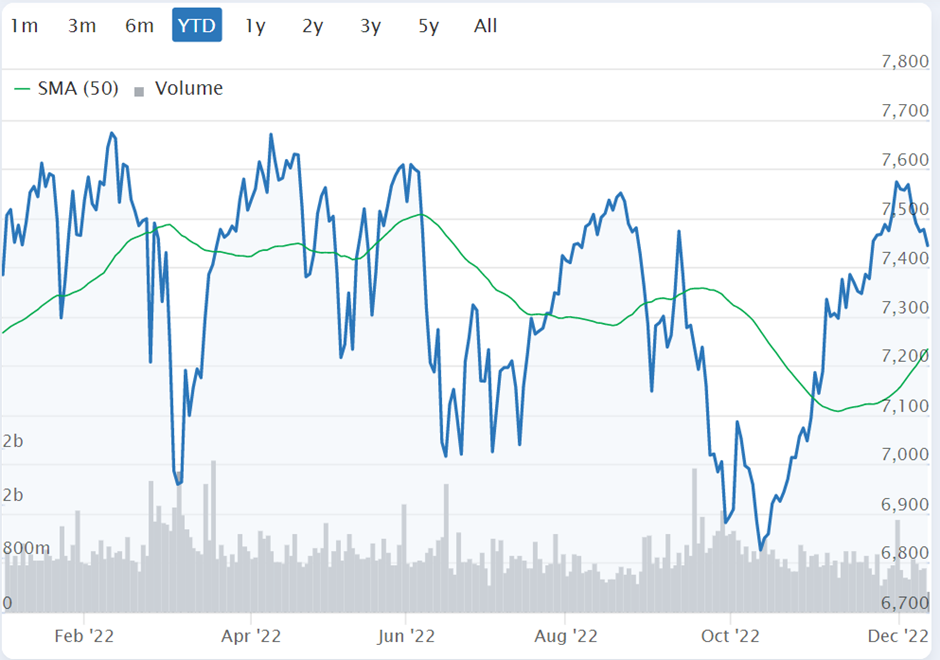
As 2022 nears completion, it will have been a challenging year for many investors. The full drama of the year isn't really captured by the FTSE100, which looks like finishing roughly flat on the year:
No Index is perfect. However, the FTSE100, packed with large cap global banks, mining and oilers, doesn't really reflect the average UK company. The FTSE250 is perhaps a better fit for this:
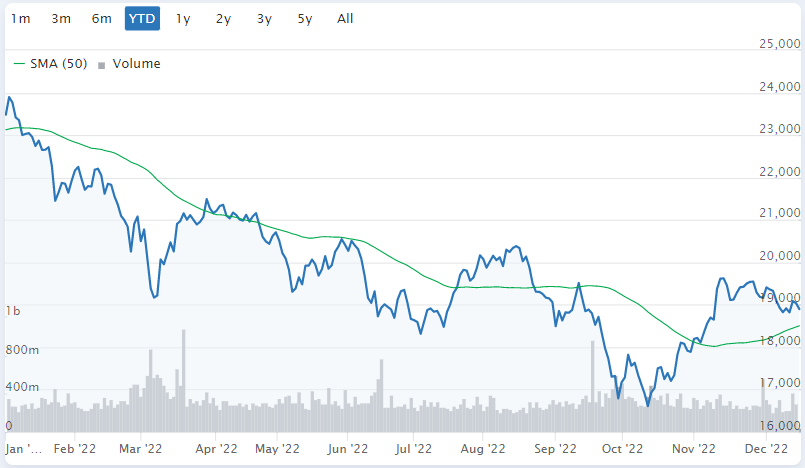
Here the bleaker picture is visible, with these more UK-focussed stocks down around 19%.
When it comes to assessing the performance of Value, I first look at the broader US market since this is the largest in the world and tends to lead global equity markets. Here the Russell 2000 Growth ETF has underperformed the Russell 2000 Value ETF by 8% this year:
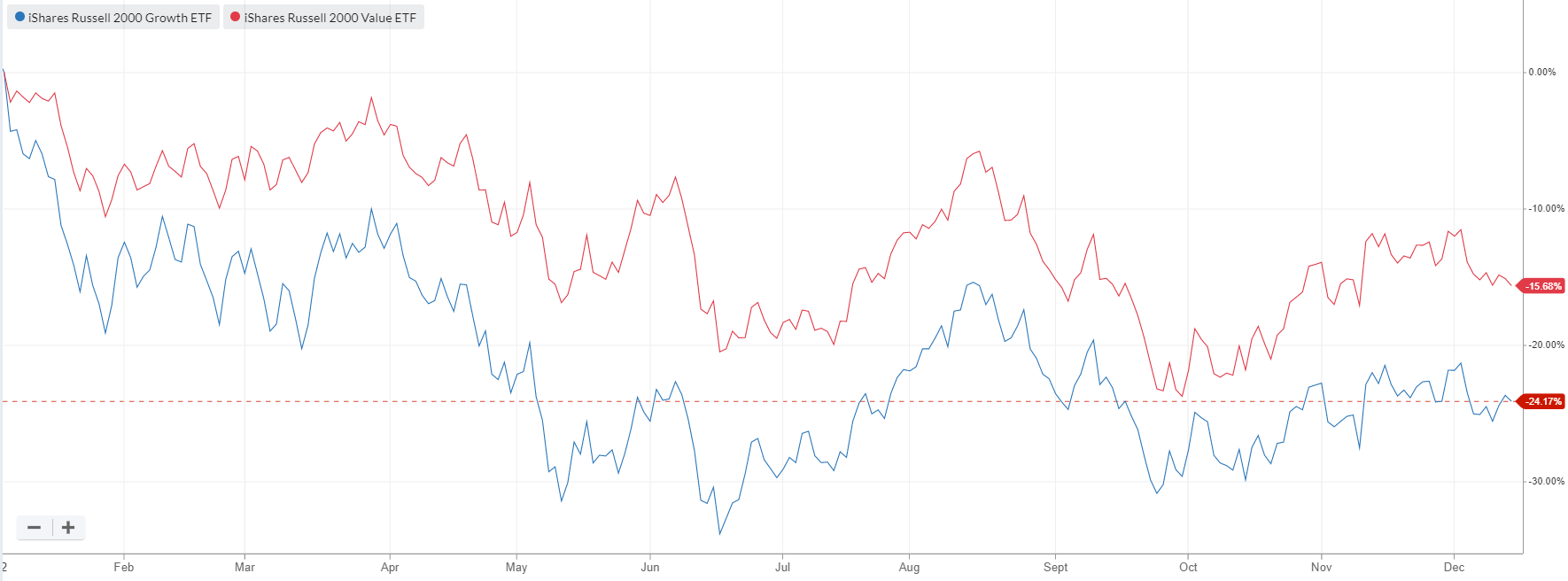
So, this has been a year for the resurgence of Value. However, the Value ETF has not been immune to the weak markets and is down 16%. As the old stock market adage says: "you can't eat relative performance". So, this is unlikely to be a salve for the wounded investor.
Closer to home, the Stockopedia Value Ranks shows a similar story:
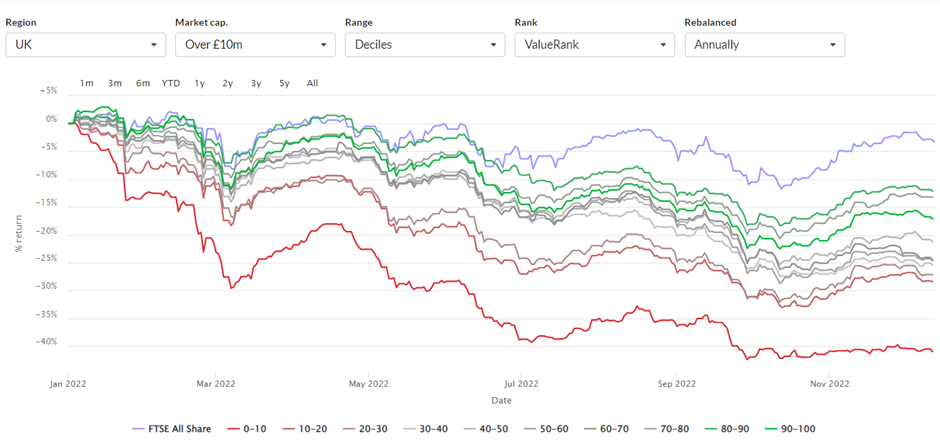
This was not a year to own the most expensive stocks, which are down over 40%. (I'm not sure there is ever a year for this!) However, even the cheapest stocks have underperformed the FTSE All Share Index. So, what is going on? It becomes clear if we look at only the largest of companies:
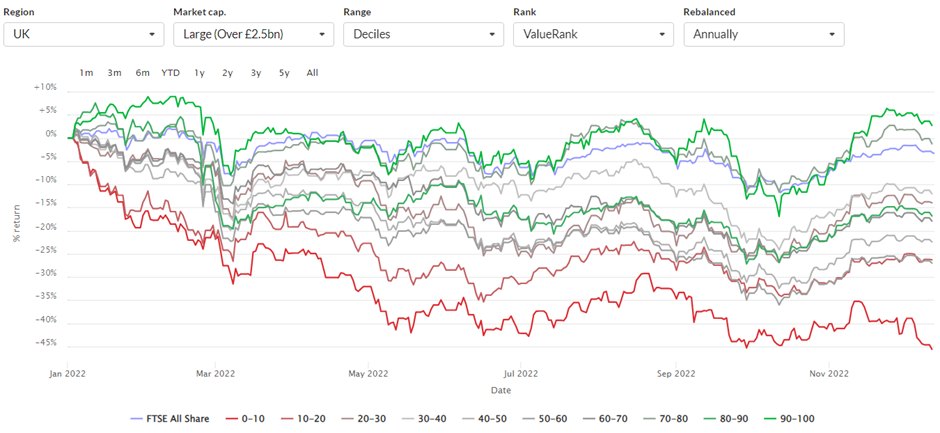
Only amongst companies with a market cap of £2.5bn or more did the cheapest decile of stocks beat the FTSE All Share. (It is even worse for the Quality and Momentum Ranks: none of the equal-weight deciles beat the market-cap weighted All Share Index) So 2022 has really been a year of rotation from large cap growth to large cap value but focused only on very narrow market sectors: commodities, defence and banking. Given that the average individual investor is unlikely to have a competitive advantage in these large cap companies, it is not unsurprising that they may be under-held amongst individual investors leading to underperformance versus the indices.
Inflation and Interest Rates
Of course, one of the biggest drivers of this rotation has been higher inflation and the response from Central Banks in raising interest rates. Commodity production is relatively inelastic in the short term, so prices can rise rapidly when a supply disruption, such as the war in Ukraine, occurs. This generates supranormal profits for existing commodity producers, and their stock prices respond accordingly. It is also obvious that increased defence spending is also good for defence stocks.
Usually, Central Banks like to look through such short-term volatility. However, these events occurred when the world was recovering from the effect of COVID on supply chains and with labour tightness in the market. This means that many workers are demanding higher wages since price inflation is more persistent, leading Central Banks to tighten. As a result, higher interest rates should lead to higher margins for banks, and hence their positive performance this year.
Combined with these industry-specific factors, the market narrative is that low interest rates increase the value of growth stocks since their earnings are further out into the future and will be discounted at a lower rate. Conversely, a higher interest rate environment favours value stocks which may have larger near-term earnings, but those earnings are likely to grow more slowly. While this may be logical, there are a couple of issues with accepting this narrative at face value.
The first is that interest rates were so low because economic growth in the whole economy was weak. Low interest rates are intended to discourage savings and encourage investment in productive assets. While growth stocks may buck that trend to some extent, in that scenario, the whole market should be cheaply priced to reflect the weak economy and, therefore, earnings growth as a whole. It is not clear that we saw this derating.
Secondly, the risk free-rate is only one part of determining the discount rate for earnings. Many of these growth companies are massively risky, with no earnings in the short term and sometimes no sales. So the risk premium investors should demand to invest in a highly uncertain future should be high. If a realistic risk premium is 20%, a drop in the risk-free rate from 2% to zero reduces the discount rate from 22% to 20% and shouldn't significantly impact fair value.
In reality, I think an equally common effect was at work in late 2020 and into 2021 – a growth stock bubble. Goldman Sachs tracks a 'Non-Profitable Tech basket', which consists of non-profitable US-listed companies in innovative industries. Having generated negligible returns from 2014 to 2020, this index increased five-fold between March 2020 and January 2021. When you include other signs, such as meme-stocks, gamma squeezes and NFTs, it seems the signs were there. The low interest rate narrative was added post hoc to justify why such high-risk stocks kept going up. The ARK Innovation ETF, which invests in very similar highly-rated stocks, has shown a similar pattern over the last five years:

This bubble was undoubtedly more severe in the US but impacted UK markets too. Its popping has driven the apparent outperformance of Value vs Growth.
The Outlook for Value
On one level, the outlook for Value never changes. When I introduced my value investing series, I led with the following definition of a value investor:
A value investor is one whose primary reason for investing in a stock is a perceived difference between the fundamental value of the underlying business and the price at which the market currently offers the investor the opportunity to purchase part ownership of that business.
The Value investor believes that the market is often irrational. The power of specific narratives to capture the investing zeitgeist and the presence of behavioural biases in market participants means that individual stocks are not always efficiently priced. However, mean reversion is a powerful force, both in corporate performance and in stock prices. Eventually, the value will out, and this can happen whatever 2023 has in store for the wider market.
While it is foolish to call the bottom of the market (unless you make repeated calls and only mention the one you got right!), it is worth bearing in mind a couple of points:
- Because fund flows drive short-term price movements, markets bottom when everyone is most bearish, and investors have the highest cash balance.
- Market nadirs often involve forced selling. In March 2020, it was risk-parity funds blowing up that led to the forced selling of equities. In October this year, the rapid rise in UK Gilt rates led to liquidity problems at pension funds that were using LDI instruments and they were forced sellers of more liquid positions such as UK equities. There is no guarantee that this particular incident marks the lowest point. However, it is worth bearing in mind that this type of selling often does generate opportunities to pick up stocks at good prices.
- Stock markets tend to be correlated to GDP growth. However, markets are a leading indicator and tend to predict GDP growth around six months forward, not the other way around. So if investors wait for everything to be rosy with the economy, they will likely miss the bargains.
While their investments will certainly not be immune to the vagaries of the wider market, the value investor is unlikely to spend a lot of time predicting inflation, interest rates or if this really is the bottom. Instead, they will focus on buying businesses when they appear cheap during periods of worry and selling them during periods of exuberance. One of the value investor's greatest gifts, which comes about from their disagreeable personality (see my article here for more on this), is the willingness to look stupid in the short term in searching for great long-term returns.
2023 Value Themes
Although I have no idea where the major indices will head in 2023, I do think certain themes will define value investing next year:
1. Small and mid-caps are due to play catchup.
As I showed earlier, the Value resurgence has mainly been a large cap phenomenon driven by commodity prices and interest rates. Small and mid-caps haven't had the performance. However, as this chart from Downing Strategic Micro-Cap Investment Trust (LON:DSM) shows, the valuations amongst the smallest stocks are the most compelling, particularly when you consider that the smallest stocks have also tended to be the fastest growers:

2. It will be a stock-pickers market
The market as a whole, particularly in the US is not particularly cheap. This means multiple compression should work against the indices generating high returns. However, large pockets of value remain for those willing to seek them out.
3. Uncertainty will be high, and it will be hard to stay rational.
In this environment, where the outlook for many companies is highly uncertain, it takes something special to get investors to initiate a new position. In such a scary environment, investors want to feel safe and secure, relying heavily on external voices to provide that reassurance. These can come from many sources, including other investors or tips in newspapers. In such an environment, tips gain additional power as the apparent gravitas that a write-up provides draws in the unsure investor. This can be challenging, as some companies rapidly re-rate simply because a broadsheet newspaper has written a short article about them. In contrast, other stocks languish because well-followed investors haven't noticed them.
As a result, short-term returns are driven mainly by random and hard-to-predict factors. Those who buy purely based on stock tips tend to be the least-informed investors, and such gains tend to be very short-lived (or achieved mainly by the market makers who also read the tip sheets.) However, this doesn't make this randomness any easier to deal with, and it will be difficult to stay rational in the midst of it. When Henry Poor, one of Standard and Poor's founders, was asked about the stock market direction, his answer was, "markets will fluctuate". In a 2023 that will be full of uncertainty, I think investors can be certain of that. The value investor's role is to take advantage of those fluctuations while remaining as rational as possible.
Disclaimer
This is not financial advice. Our content is intended to be used and must be used for information and education purposes only. Please read our disclaimer and terms and conditions to understand our obligations.
8 comments
“markets bottom when everyone is most bearish”. Surely you don’t mean this? Markets bottom out when some contrarians come out of the woodwork and start buying, against the conventional bear wisdom.
Isn’t that when the markets start rising, ie after they have bottomed?
Yes, I do mean this, although it depends on your definition of bearishness. Here I am using the highest amount of cash holdings as a sign that investors are most bearish. If you take the market as a whole, every asset must be owned by someone and what really determines stock prices is the marginal willingness to hold those assets versus cash at the current prices. So peak cash as a whole (at least investible cash, many investors hold cash for other reasons e..g a car purchase, not just they are bearish) is when the markets are at its nadir and is also the most bearish (by this definition).
2022 has been an outstanding year for value oriented investors who looked at price vs value to short unprofitable tech, long energy in late 2021.
I am up 128% this year.
The difficult time was the mid 2020-2021 speculative madness where shorting stocks on valuation got you killed. As you've picked up the continuinh unwinding in 2023 wil be a stock pickers paradise but most valuations are still crazy high - the bear market has at least 12 months to run.
Really helpful article, thank you. I’ve been hanging on to momentum and value strategies now for 18 months with gritted teeth. This article makes me a feel a little less insane and slightly more hopeful.
I do wonder however if COVID has caused some distortion of the metrics people like Stockopedia use.
Many companies had apparently disastrous years in 2020 and 2021 with almost no revenue. Fundamentally, assuming COVID is over, that should be largely ignored but it still makes them look worse than they are and so for someone just following the underlying financials it is distorting where true value appears to be?
Similarly, those stocks like Halfords who did well during COVID looked great value as we came out because the stats don’t recognise the reality that their party is over.
The same could be said for energy stocks right now. They look cheap on the face of it but that’s only because the market maybe assuming that the current energy crisis can’t continue and will at some point end and their profits will return to normal levels.
tres bien mais je pense que nous devrons attendre fin 2024 voir 2025 pour recupérer les pertes de cette annee
Willy De Mot1
Je pense qu’il y a une bonne chance de reprise de marche avant 2024 et peut-etre bientot!
C’est toujours conjectures! Bonne chance.