A Weekly Rebalance Improves NAPS Performance

This is a brief note to show that a weekly rebalance of a NAPS portfolio can improve performance by increasing returns and reducing volatility.
A NAPS (No-Admin Portfolio System) portfolio is initiated at the start of the calendar year with a selection of 20 stocks that Stockopedia deems likely to do well for the year on an equal-weighted buy and hold basis. The 2025 NAPS stocks are:
Metals Exploration (LON:MTL), Serabi Gold (LON:SRB), Currys (LON:CURY), Kingfisher (LON:KGF), M P Evans (LON:MPE), Imperial Brands (LON:IMB), Seplat Energy (LON:SEPL), Shell (LON:SHEL), International Personal Finance (LON:IPF), B.P. Marsh & Partners (LON:BPM), TP Icap (LON:TCAP), Hikma Pharmaceuticals (LON:HIK), Supreme (LON:SUP), Ocean Wilsons Holdings (LON:OCN), Stelrad (LON:SRAD), Journeo (LON:JNEO), MTI Wireless Edge (LON:MWE), Vodafone (LON:VOD) and Yu (LON:YU.). Alliance Pharma is excluded as it has been de-listed.
These are purchased and incorporated into an equally-weighted portfolio at the start of the year 2025.
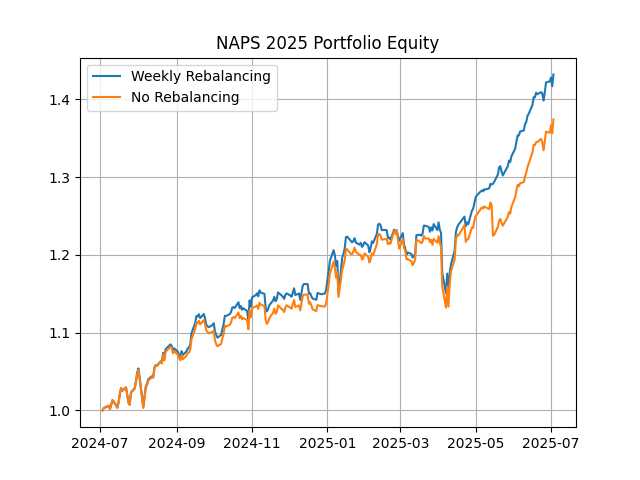
The above graph shows the resulting capital for an equally-weighted 2025 NAPS portfolio with and without weekly rebalancing had one bought the NAPS stocks a year ago. [I know, the stocks were selected in January 2025, but the purchases go back to July 2024. This makes no difference to the conclusion!]. Note that with rebalancing, the portfolio outperforms the unbalanced (buy and hold) one both in terms of a better return and reduced volatility.
Weekly rebalancing may be tedious for those using investment platforms without a rebalance facility. However, Trading 212 does provide an effective rebalance option as and when needed. Simply create a pie comprising the NAPS stocks and assign equal weights of 5% to each of the 20 stocks. It then becomes a trivial exercise to click on the pie's rebalance button on a weekly basis. Voilà! This is supposedly a no-admin system but the modification presented here is trivially implemented.
As always, do your own research (DYOR)!
Disclaimer
This is not financial advice. Our content is intended to be used and must be used for information and education purposes only. Please read our disclaimer and terms and conditions to understand our obligations.
24 comments
Hello Bitbug, I'm assuming that rebalancing every week will increase the transactional costs substantially, therefore there maybe an under performance rather than an over performance.
@bitbug, a bit late to this thread. Simple rebalancing assumes some degree of mean reversion in relative performance (that today’s underperformer will catch up), but equity returns also show momentum over shorter horizons, where recent winners often keep outperforming for a time. Because of that I prefer to let winners drift within tolerance bands rather than forcing strict equal weights every month, which better balances a “buy low/sell high” strategy with the evidence that trends can persist. So I rebalance only when a holding is significantly off‑target, not just because it went up or down a bit that month and even then only trade partially back toward target. I also find that using new money to top up laggards before selling winners focuses the mind on whether it still is a good investment. Could Stockopedia introduce a rebalancing functionality on their portfolios?
Fees destroy this. Is this just a hypothetical exercise or are we actually interested in making money?
Per the article
Trading 212 does provide an effective rebalance option
presumably if one does use modern day broker that can preumbaly be done at minimal fractional cost ? clarity would be useful though in that regard as any costs would soon eat into returns if done frequesntly
I'm afraid I tend to agree. There may be a crossover point, though, where more regular rebalancing is advantageous.
Fascinating! I guess there is a bit of factor drift with monthly / quarterly rebalancing, because financial statements become stale etc. You mitigate factor drift by rebalancing more frequently, because the financial statements are more 'fresh', as it were. That's my hunch...
A few words of caution about T212 — the platform does makes its money by having a greater Buy/Sell spread compared to other platforms as Logical David suggests, and also covers its low FX fees by offering routinely disadvantageous FX rates. It also isn't possible to buy shares in Metals Exploration (LON:MTL), Serabi Gold (LON:SRB), B.P. Marsh & Partners (LON:BPM), Journeo (LON:JNEO), or MTI Wireless Edge (LON:MWE) on the platform. A frustrating start to my NAPS 2025.
T2-1-2 also dosen't give an accurate quote "buy" and failed to execute orders for me on 2 occasions. I like the pie but the pricing is not transparent ( it seems better on sell orders)
Fascinating. But Bitbug can you explain why the rebalanced portfolio performance matched that of the starting NAPS portfolio until May when it started to outperform it?
I always welcome penetrating questions! This, I find it hard to explain. Portfolio rebalancing works best when the mean daily returns of constituent stocks are not too dissimilar and even more so when they aren't correlated. I'd suggest proceeding with caution as more research is needed.
Is the high level hypothesis for this that these are all 'good' stocks (ie high QVM), the SP just takes off at different times/rates - so by top slicing some of the winners as they rise, and moving the balance to 'under-priced' holdings, you are loading up on stocks that haven't hit their SP rise yet (and the benefit of that is larger than the opportunity cost of selling a winner 'too early')?
I don't know if the SP data supports that, or how Metals Exploration (LON:MTL) meteoric rise fits with this theory...
An excellent article Bitbug, a very interesting read and some great follow-up posts from other subscribers.
I am planning to go ahead and run a NAPS portfolio, probably from January and may also incorporate ideas from others like having say a 20% stop loss and reinvesting any proceeds in the next stock on the list.
As others have said, the NAPS and various articles and posts from other subscribers makes a Stocko subscription great value.
Well here we are. If anyone needs convincing that the NAPS system works then look at this. I'm always playing with ideas, and I was convinced the 9 picks for the practice portfolio I made here would cut the mustard. Over the same timescale of Bitbugs, it only managedto achieve a 6.8% gain and that only over the last 3 or 4 weeks. I'm trying to get all of my actual investments under NAPS control.
That's very interesting! I haven't tested, but I'd assume one does need to be very careful with the extra costs. The average spread in the NAPS is 1.2% at the mo and platforms like Interactive Investor or HL will charge on a "per deal" basis depending on your account type. So small rebalances can really add up - and that could eat away at returns.
I keep hearing about Trading212 pies - do they charge on a portfolio trade basis, rather than a per-stock trade basis?
PS - I love a bit of matplotlib.
Yes, I think exploring the charges, particularly stamp duty on UK stocks, would be a wise move. Other than this, T212 is commission free. Fx fees are just 0.15% compared to others which can be 10 times greater!
I don't know whether or not it is true but I've heard that although T212 is commission free when trading, instead the platform makes its profit by having a greater Buy/Sell spread compared to other platforms.
Perhaps someone could enlighten me on this.
David.
When you place an order you don't get told upfront the buy/sell price that you will get. A platform like iWeb provides good transparency, assuming they can do the transaction if they can't then you are not obliged to progress. This is the main downside for T212 and ii both of which I do use to spread my assets across multiple platforms.
Weekly rebalancing in this way needs a commission free platform, such as Trading 212. If your investments are held by a platform that charges a commission on each buy and sell, weekly rebalancing would be prohibitively expensive unless your portfolio is very large.
Just a rough back-of-the-envelope calculation regarding the impact of UK stamp duty at 0.5% on stock buys when weekly rebalancing:
With the same assumptions as above, the weekly cost to the portfolio is 2.5% x 1.2% = 0.03% of the total portfolio value. Again, assuming the portfolio would normally increase by 20% in a year or 0.351% in a week. Reduce this by the costs on the buy/sell spread and you have 0.321% growth per week or 18.13% portfolio growth per year reduced from 20%. So, that's just under a 2% hit!
These rough calculations still appear to favour weekly rebalancing by some margin.
Weekly rebalancing seems to go against the commonly mentioned advice to "let your winners run", which is supposed to take advantage of a stock's price momentum leading to further gains. I suspect that the reason weekly balancing has done well in your data is because high price momentum may have a tendency to predict share price drops in the short term of up to a month and share price rises in the medium term of three months to a year.
Have you compared the bid/offer spreads on Trading 212 to a broker who charges commission. When I compared the spreads of IG (no commission) to Interactive Investors (3.99 commission), I found IG charged a higher spread for 17 out of the 20 shares I picked. The difference seemed to equate to the 3.99 commission level, so are these no commission brokers really letting you trade for free. Also your costs dont make sense. You`ve got 2.5% of portfolio value for both stamp duty and for buys. But what about the selling costs in the weekly rebalance, where there is no stamp duty (cant be 2.5% of portfolio for both). I suspect the costs would be much higher as I feel commission should be taken into account, and you are assuming perfect execution all the time on your trades, but humans make mistakes.
When l compared them to HL the prices were the same. Comparing with II l found them to be similar but did not check that many.
Just checked Eleco (LON:ELCO) both IG and II quote 169p to buy.
Cerillion (LON:CER) is also exactly the same price to buy, 1531.5p
Alumasc (LON:ALU) again exactly the same price 344p to buy.
Solid State (LON:SOLI) same price 182.9p, to buy.
Card Factory (LON:CARD) same 90.81p
Interesting - did you rebalance between the stocks at the start (ie same stocks throughout, just top slicing risers, topping up losers), or repopulate with the latest selection of NAPs stocks each time (ie whole positions changing)?
And I agree, T212 pies make this simple (and commission free).
Just the 2025 NAPS stocks were used throughout, no additions or removals were made. I assumed the NAPS selection for the year is fixed. T212 rebalances by top slicing the rises and topping up the loses and that is how the analysis was done.