AJ Bell - at an inflection point?

I thought I would take up the invitation made by the SCVR team to comment separately on stocks that investors hold or are contemplating buying. Stocks which lack coverage throughout Stockopedia, and which typically don't meet the value category. As a quality and growth investor across the globe, that’s a lot of choices – so here goes! I welcome replies that question my reasoning in the expectation of eliminating some of the bias that inevitably colours my decision-making. If others benefit from the discussion then we are all winners.
I already have exposure to today’s investment theme in the UK and US. However, I don't consider myself qualified to pick the “best” stock against each investment idea. My investment approach instead is to pick a couple of attractive names to represent each niche and geography. I look for secular growth, high margins and returns on capital, strong cash conversion and economic moats based on the stickiness of the service, network effects, intellectual property or strong regulation.
The democratisation of finance is an area of breakneck growth, highly visible in the US with the success of the Robinhood app and bitcoin exchanges like Coinbase. But the stock I am weighing for investment today isn’t a high-growth, high risk newcomer. Rather it’s what I hope will be a quality anchor for the portfolio within this theme – a buy and forget, or “coffee can” stock, if you will.
I’m highlighting Aj Bell (LON:AJB), the investment platform for do-it-yourself investors, with a nod to its counterpart and my existing long term holding, Integrafin Holdings (LON:IHP), whose platform supports financial advisors for the administration of their clients’ portfolios. UK investors will be aware of the impact Hargreaves Landsdown (HL) has made on the landscape of personal finance over the course of the last decade and will see AJ Bell (AJB) in a similar context. The companies and products are similar but distinguished by different charging structures that produce higher operating margins for HL but faster growth for AJB. It’s the feisty, cost-cutting challenger to HL’s once formidable hegemony. Indeed there are many other such challengers, including the soon to IPO interactive Investor. Ultimately, all these platforms grow on the back of increased engagement by the public with investing, coupled – as all investors must hope - with the increase in the value of assets under administration (AUA) as investee companies’ profits expand.
As many investors already understand, platform businesses make particularly attractive investments because of the operating leverage that kicks in with growth. New customers can be added without material extra operating cost and additional revenues flow almost uninterrupted to the bottom line. And, as a platform business, AJB displays spectacular operating numbers which account for its high multiple. ROCE, CROCI and operating margins are in the high 30s to low 40s, while cash conversion averages 100% around a narrow range from 90%-110%. With so much cash spilling out, not only are dividends growing, but the average percentage yield is also expanding.
Nevertheless, this stock is only for those comfortable with paying up for quality. Valuation has been the main barrier to share participation and price appreciation for some time. Relative to HL and IHP, AJB has been too highly rated to consider – even for this investor habituated to valuing unprofitable companies on a price to sales alone. However, whilst always expensive, the remarkable feature of AJB is the lack of volatility for such a high multiple name. Barring a few weeks in March 2020, the stock has been trading in a narrow channel representing only 15% of its value for 30 months since running up from its late 2018 listing. On a technical basis, this is a very bullish pattern. Strong stocks consolidate by moving sideways and growing into their valuations. Not only is low volatility always welcome, but my analysis suggests that an inflection point is nearing and the stock can start to move upwards.
Taking FCF yield as a key valuation metric, and thanks to a recent sell-off on no news, AJB is today priced above 3% for the new financial year commencing this week, a benchmark which none other than Terry Smith considers investable for companies of this quality. And, for the very first time using this same forward metric, AJB is comparably or lower priced than UK quality stalwarts Diploma, Halma, Kainos, Spirax Sarco, all while forecast to grow at a higher rate on the back of powerful market trends.
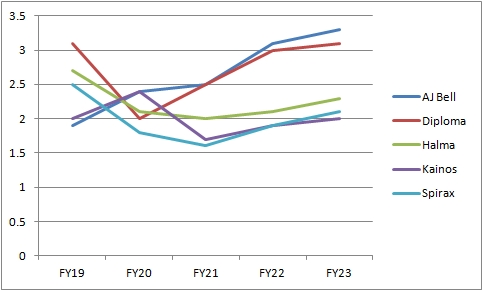
FCF Yield data from Sharepad
It is also more attractively valued on a p/e basis yet enjoys considerably higher margins, leading to superior cash generation with which to make use of those world-class capital returns. So far so good. But how is financial and operational performance?
Recent results for Q3 2021 were positive and well-received by the market with a good spike on announcement to a level now 8% above today’s price, following recent weakness on no news. The platform nature of the enterprise and the high cash conversion make for a strong correlation between the business and its finances. The KPIs to focus on are customer numbers and AUA. Customer growth is up 30% on Q3 2020 but these numbers are lapping the extreme circumstances of the pandemic-induced waterfall crash of March 2020. More confidence-inspiring for statisticians will be the 6.3% sequential gain on Q2 2021. Encouragingly, AUA shows an even better sequential gain of 9% QoQ, demonstrating the multiplier effect of equity market appreciation on top of subscriber growth.
What is the view of the analyst community? On the up. Expensive quality names of this type are never rated at “Strong Buy” owing to analysts' inability to marry the share price to the DCF models of the brokers. And quality investors have become accustomed to ignoring the ratings in favour of years of relatively placid investment waters, at least in the past decade. Nevertheless, analyst sentiment has meaningfully improved a notch in 2021, with price targets averaging £4.41 finally higher than today’s price for the first time, bar March 2020. I have a consistently reliable rule of thumb to apply with quality stocks whose price typically sits above the analyst price targets. If/whenever the SP dips below the PT, you have a buy point with an above average margin of safety – if your thesis is wrong, mean reversion will protect your capital!
What are the risks?
Beyond execution, competition could erode one of margins or growth, if not both. Currently AJB is the cut-price newcomer nibbling at giant HL’s market share, so it could befall the same fate in due course. Investors need to believe in a combination of AJB’s brand equity and the evolution of a rational oligarchy between platforms.
The forthcoming IPO of Interactive Investor could prompt a reassessment of AJB’s valuation and appeal.
The success of the platform relies upon its technical reliability and there have been outages at all the major platforms, usually at times of major stress for their customers, including AJ Bell.
Platforms can be guilty by association with failed asset managers, most notably HL with Woodford, which has been a public relations disaster, to the relative benefit of AJB who dropped the Woodford fund from its recommended list early in the development of the crisis. It is very important to note, however, that the customer drain suffered by HL was not commensurate with the outrage summoned in the press. These platforms are sticky!
The evolution of new asset classes like bitcoin, with their associated, often gamified, trading platforms might provide a bridgehead from which new competition could land and expand within a younger demographic, throttling customer acquisition. I think this is a risk worth watching but will play out slowly in the numbers. The vast majority of investments by value are held by an older demographic focused on traditional portfolios of equities and bonds.
Rising bond yields and/or inflation reduce the value of future cashflows, which in turn impact more richly valued shares disproportionately. Here I’m surprised to note how, over the last 30 months of trading, fluctuations in bond yields have not had a dramatic impact – another indication of strength. Volatility relative to valuation multiple is low - although not negligible. And as the valuation has fallen relative to earnings, so the sensitivity to bond yields has also diminished.
A market crash would dramatically impact the value of AUA. Indeed that occurred in early 2020. But the shares were only impacted to the same degree as the average large-cap and swiftly recovered. A market crash is a threat to ALL equities.
What to do?
Why not just top-up my holding in Integrafin (IHP), which has also dropped to a good buy point? Certainly, I’d encourage anyone to take a position in IHP. It’s a very high quality business with a faster growth rate than AJB and rated at a 10% discount based on EV/EBITDA, 15% lower based on FCF yield. But it is also more volatile and I like to reduce single-stock risk while balancing the volatility of my holdings within each theme. It’s also important to look at expectations. Short term revenue growth forecasts are much lower for AJB at 5% vs 13% for IHP, so the potential for out-performance appears stronger for the former, at least in the near term. And it is my belief that a growing proportion of private investors will ultimately choose to go it alone and eschew the dubious value of an intermediary’s annual fees. While I strive for Alpha across the globe, my wife performs almost as well with a single global ETF on the HL platform, and with lower volatility.
All the above leads me to believe AJB provides a good complement to my existing holding. A conclusion that isn’t prompted by a disconnect in the market valuation or a new launching point for the business. This is simply a matter of picking an opportune moment – recent sell-off, propitious chart technicals, inflection in valuation – to increase exposure to a secular wave on board a business with very attractive characteristics. UK quality investors take note.
All comments are welcome, particularly those to the contrary. Data sources are Refinitiv and Sharepad.
Disclaimer
This is not financial advice. Our content is intended to be used and must be used for information and education purposes only. Please read our disclaimer and terms and conditions to understand our obligations.
11 comments
I would not consider Aj Bell (LON:AJB) as low cost, yes they are a bit cheaper than £HL but some others are far cheaper. Ig Group (LON:IGG) if you trade 3 times or more in the prior month are £3 per transaction and free on US stocks plus 0.5% forex fee. I have moved some of my HL account over to IG. Service from HL has gone downhill over the last few years. Had loads of trouble even moving cash to another platform. I don't really see what Aj Bell (LON:AJB) has to offer. Of other platforms, Jarvis Securities (LON:JIM) gets some good feedback and gets higher Stockopedia ratings.
Robinhood have postponed their UK launch, if that happens it may shake up the market.
I'd avoid all investment platform shares. They trade on high multiples and the fees that they can charge clients (and thus margins) will only go lower due to increasing competition.
You're not wrong and that's why this risk is clearly identified in the note above. The counterpoint is the near 20% pa I've been enjoying on Integrafin Holdings (LON:IHP) for several years - and it's always been expensive!
Hi, I have enjoyed your recent contributions to SCVR as well this write up on Aj Bell (LON:AJB) .
For various reasons (and ignorance), we have retail accounts across various platforms (including Barclays (LON:BARC) , Hargreaves Lansdown (LON:HL.) , Halifax and ii) as well as AJB. Each platform has its advantages and disadvantages which may or may not be significant/relevant to all investors. However, none come close to the low cost but excellent service provided by Charles Schwab for my wife’s US shares.
While this is anecdotal, it is another data point (as Timarr suggests). The biggest drawback to AJB is that it was the slowest in providing tax certificates to validate my annual spreadsheet calculations. Whilst not critical, it did delay submission of my tax return. As such, if and when I consolidate my holdings onto fewer platforms, AJB would not be my first choice. On this basis, I would be tempted to await the ii IPO if I was intending to invest into the ‘best in class’ in this emerging sector.
I was/am quite happy with my principal broker Charles Stanley (LON:CAY) through their online CS Direct service. Even though it’s more expensive than many of the pure online providers I think they seem to set themselves higher customer service standards - possibly due to the bulk of their business being a more traditional private client managed stockbroker service. I’m waiting to see how things change given their imminent takeover by a pure US wealth manager who may look to “de-emphasise” the online business. Happy enough as a shareholder in Charles Stanley (LON:CAY) being taken out at a healthy premium but may in due course have the headache of shifting to a new platform!
Gus.
Hi BnB.
Thanks for the write up. One anecdotal and not especially scientific comment is that Aj Bell (LON:AJB) seem to have come in for a fair bit of criticism from account holders on this site of late. From memory this related to issues with poor customer service and cost. It may be that the silent majority are quite happy and keep quiet about being satisfied but if those speaking here are representative of the customer base in general it’s not a great indicator.
Gus.
Yes. I did see that, which might put paid to anyone joining me on the journey! On the other hand, everyone derides Facebook for one reason or another yet how has that worked out for investors?
I did note at the time that only a few users appear to be happy with their particular provider and that may be a reflection of the more demanding nature of the Stockopedia investor. I couldn’t personally cope with a retail platform but, as I say in the note, my wife and mother do just fine because they rarely trade.
I did note at the time that only a few users appear to be happy with their particular provider and that may be a reflection of the more demanding nature of the Stockopedia investor.
Precisely. Stockopedia subscribers will tend to be at the more demanding end of the private investor spectrum. For the most part, given their requirements, they need to find themselves a proper stockbroker and pay for the privilege rather than expecting a vanilla investing platform to offer them bespoke services for a wholesale price.
Of course, all anecdotes are merely single data points and by the evidence of AJB's numbers most customers are just fine with the service on offer. I bought in the IPO and have been very happy with both the service and the share price performance. The latter has suffered from what John Lee calls "peak drift" - the share price got ahead of itself and has then drifted around aimlessly waiting for the business to catch up but, as you point out, is beginning to look interesting again.
Integrafin Holdings (LON:IHP) is also an excellent choice. As is Facebook. Every popular stock gets grief from time to time, mostly it's not existential although private investors will tend to react as though it is. Therein lies the opportunity.
timarr
In my experience, HL is better than AJ Bell, I have accounts with both of them (for diversification purposes) . Saying all that, IBKR is infinitely better than both of the above although it is definitely not aimed at the generalist investor.
Out of interest, does IKBR levy a custody charge for shares held on its platform - or is it all in the dealing commissions? I can't see any reference to custody charges on the website. I have an account with a leading wealth management bank and from time to time I like to cross-reference their not inconsiderable charges (albeit with very high touch service, oodles of research etc) against what is available for the go-it-alone investor.
Hi BnB, there is no custody charge with IBKR.
If you invest in foreign markets then IBKR is particularly useful because you can set up limit orders (can't do that with HL et al). Also you dodge the expensive ripoff FX fees (as seen with the above brokers) because you have to buy the foreign currency yourself at your specified price before the stock transaction... I have limit sell orders setup for some Russian ruble based stocks and so on for example ...
I've previously bought portfolio insurance (put option protection), the basic brokers don't allow for this of course. One of the smartest things I've ever done it turns out.
IBKR routing systems obviate market maker (frictional) fees so you get better prices vs the above mentioned brokers.
BTW A lot oh the hedge funds use IBKR (via the software API i.e. for programmatic (algo) trading etc).