Any Website Where I Can Plot Price to Sales Against Stock Price Over Time?

For UK stocks, I am looking for a website where I can plot the stock price that would be implied by the minimum and median historical Price to Sales ratio over time. The idea here is to be able to visualize the actual stock price against the range a stock could have traded at - on any given date - based on the median and minimum price to sales ratios for the prior 10 years. This helps to see when a cyclical company is trading near its lows based on historical price to sales.
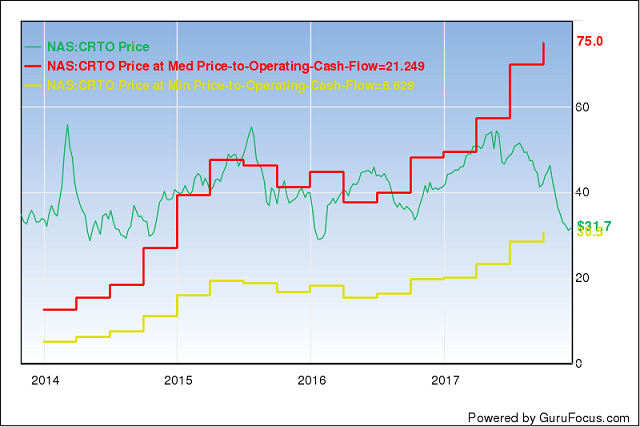
The attached image shows what I get for the US symbol CRTO using the site gurufocus. The green line is the day stock price chart for CRTO. The red line is what the price would have been based on the median price to sales for the last N years. The yellow line is what the price would have been based on the minimum price to sales for the last N years. (By the way, I rejected CRTO for the reason that there is significant speculation that their revenues are potentially fraudulent...so I should not have used them as my example here. See my injection of a similar chart for Amazon in the comments below as a better example.)
I am hoping to find a site that can do this at lower cost than gurufocus can, for UK stocks. Anything out there?
Disclaimer
This is not financial advice. Our content is intended to be used and must be used for information and education purposes only. Please read our disclaimer and terms and conditions to understand our obligations.
13 comments
You can use the Stocko screener to compare P/S (and other ratios) against industry/sector/market medians already. (It doesn't allow you to specify what period the median is computed over, or use the median for the stock itself however.)
I thought you might all enjoy seeing what this technique does to a famous stock like Amazon.com (AMZN in US). I ran it all the way back to the beginning. Note how this technique very brilliantly shows the key points in time where Amazon was a buy. And notice how immediately useful this chart is because it expresses these ideas in *the actual price of the stock*. You clearly see that in 2008/2009 AMZN was trading at a historical low, compared against its historical price to sales ratio. Graphing the PS Ratio alone would make it much more cumbersome. Graphing the implied stock price applying the minimum and median price to sales ratios immediately communicates actionable information.
Note that the recent valuation - while probably insane - reflects their newer AWS business, which is MUCH higher margin than their wholesale pricing retail e-commerce business. That makes it much harder to apply this metric in the last few years since one would expect very different price to sales ratios on businesses with such different operating margins.
Absolutely brilliant.
Hey - charting historical fundamentals and comparing them against valuation metrics like this is definitely on the cards for Stockopedia, it's actually a project I'm working on the foundations of at the moment.
I agree by the way that what you propose is the right way to do it, it's what I have in mind too.
Let me know if you've got any questions about it,
Tom
@Tom-Firth The obvious metrics to chart are price to sales, price to earnings, price to cash flow, and price to book (maybe price to tangible book as well). If you had a way to get the numbers, it would be nice to have a price to AFFO for real estate companies that report cash flow using that non standard metric (in the US that is almost all of the REITs).
What is really important is to chart the minimum, maximum and median values for each of those. You have to establish valuation ranges at each point in time, based on the selected metric.
Notice in the gurufocus chart how they "stairstep" the metric data, because it only changes once per quarter (or once per half year in case of UK). I think seeing the data in a non-smoothed fashion really informs the user about its nature.
Hi pone -
Firstly I like your analysis a lot.
A bit of clarification please. What do you mean by minimum, maximum and median values of metrics? what is the range in days that you have used for your median P/S?
On the subject of Amazon, there are a few analyses I have seen in the past year which show a strong correlation between the share price and the OCF(Operating Cash Flow) going back to the early days. Similar chart to the one you show above.
I second your request to Stocko for the data you have outlined. It would be a very useful addition to the current extensive range of metrics.
@Ramridge the min, max, and median values are calculated on a 10 year average.
Thanks Tom, is it part of the grand redesign or is it something we might see sooner (as we did with Charts and Risk Ratings)? It would be great if it was sooner - even if it isn't as polished as the new system.
All the best, Dave
I also really like this idea, after a bit of digging around I think I found something on Stockopedia's vote features, which looks like a project they may have started on:
http://ideas.stockopedia.com/forums/18977-stockopedia-pro-feedback
Its called 'Allow charting of historical fundamental ratios'
Sean
@smatthews1 I added a pointer back to this conversation in the features idea. I think the way I am proposing it is MUCH more useful. You get to see the implied stock value over a range and compare that to the actual stock price historically. That's a much more fluid was to see where the stock is within a trading range based on a metric such as price to sales.
YCharts and bloomberg terminals do fundamental graphs. Unfortunately one is US focused and not great for the UK and and the other costs £20,000 per year.
I really like this idea and would love to hear that there is a site out there providing this sort of historic data. Lots of ratios are more useful when plotted against time. Another I'd like to see is the number of shares above 200 day moving average over time. You'd think that would provide a decent barometer of market peaks and troughs.
A great way to use this technique is on cyclical companies. If you run this exercise on any of the more-solvent shipping companies (it may be an oxymoron to call any company that buys and uses marine vessels solvent), you clearly see the bottom of the market in 2016, and many of those stocks are eight to 10 baggers in just two years!
I wish I had a way to run the above chart for each of 30 market sectors, just to have a good view on valuation of specific sectors over time.