Asset managers' clients not looking so smart

UK-listed asset managers delivered strong returns in Q4-23 (they have been for well over a year now). But clients are still pulling money out. Flows surely follow strong returns? But when?
[This is not investing advice - please read the disclaimer here.]
Asset managers had a good Q4 of 2023, with most recording solid AUM growth.
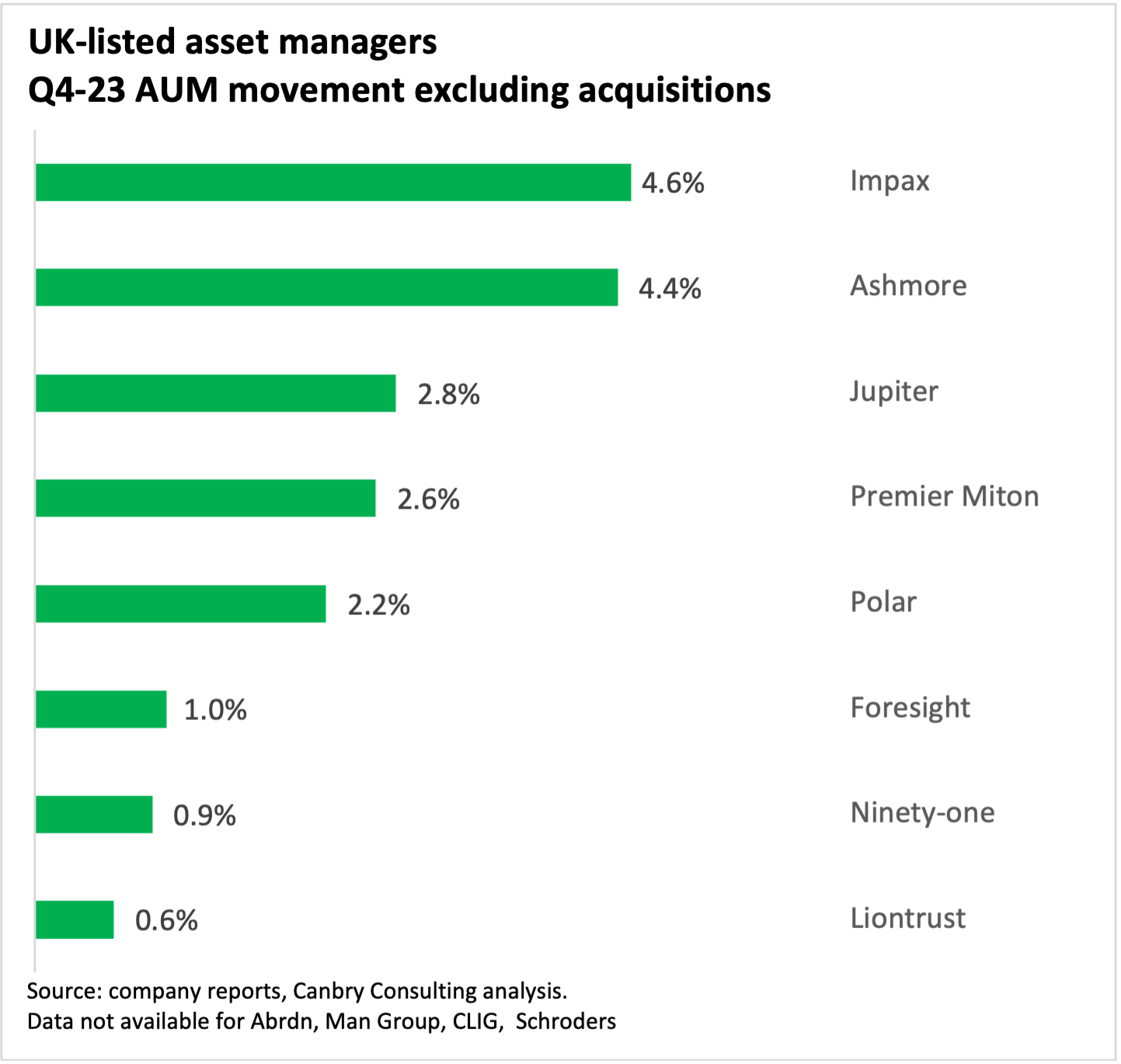
The growth story was however all about market movements and investment returns, with most major indexes sharply up (MSCI AWCI: +11.2%; S&P 500: +11.2%; NASDAQ: +13.6%; FTSE 100: +1.7%).
[Note that returns for the first three indexes above are show in US$ terms, and those UK asset managers reporting AUM in GBP (all except Ashmore in the above chart) would have had a currency headwind on their USD holdings of around 4% in Q4 23 as the GBP/USD rate moved from 1.22 to 1.27 over the quarter.]
Meanwhile, investors remained nervous and continued to withdraw money from asset managers.
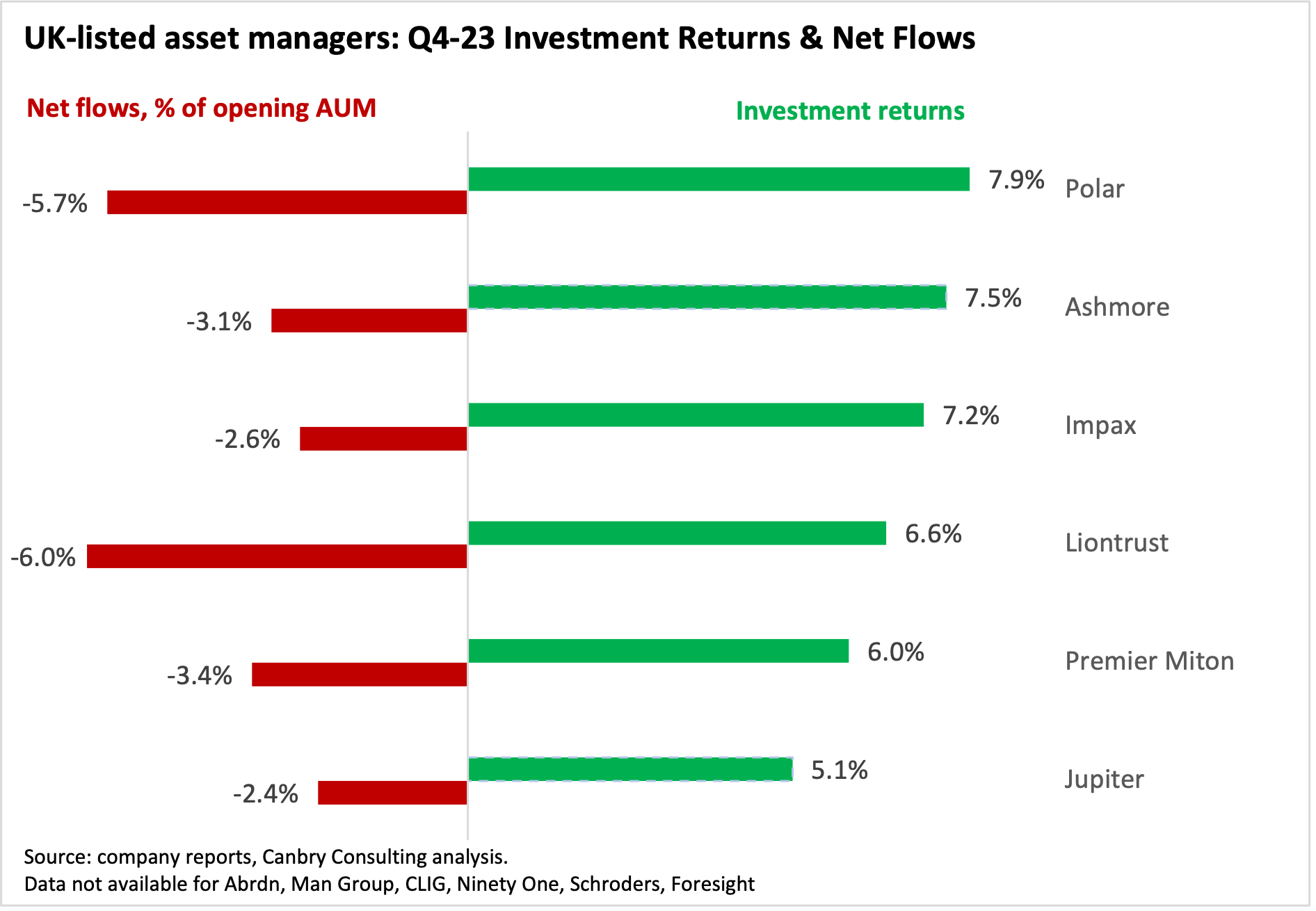
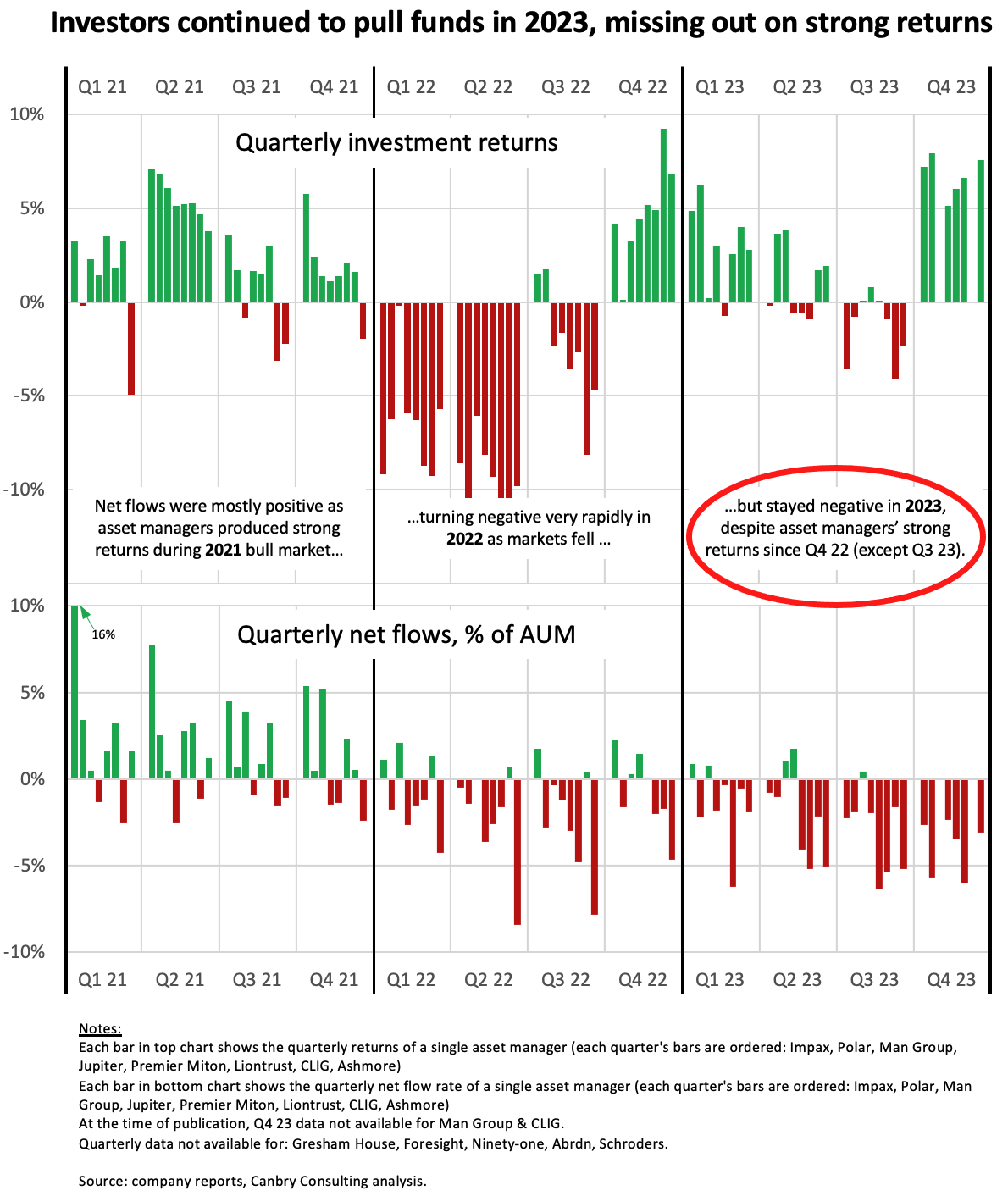
The net withdrawal of funds from most of these asset managers has been going on for two years now, starting in early 2022 (the middle section of the bottom chart in the graphic below) when markets started to tank (the middle section of the top chart in the graphic below).
We don’t know exactly where most of that capital has gone, but it has been widely mooted by asset managers that most of the outflows are asset allocation decisions out of equities and into cash or fixed income assets.
If that is the case, then the timing of recent withdrawals by asset managers’ clients isn’t looking like such a smart decision. They’ve been pulling funds and missed a strong rally. In the top chart below, look at the plethora of green bars to the right of the chart (since Q4 22) indicating mostly positive (and very strong) investment returns (with the exception of Q3 23). And then contrast that to the plethora of red bars in the bottom chart over the same period, indicating quite strong net outflows, and hardly different from the carnage of 2022. There’s a massive mismatch.
History suggests this mismatch doesn’t last for that long. In recent months, I have used the chart below in a few of my Equity Development research notes to highlight the historical trend that after market falls, flows into active funds tend to quickly bounce back and revert to their positive longer-term trend. These active net flow recoveries can be clearly seen after 2008 (financial crisis), 2011 (sovereign debt crisis), and 2018 (multiple factors) – highlighted in red.
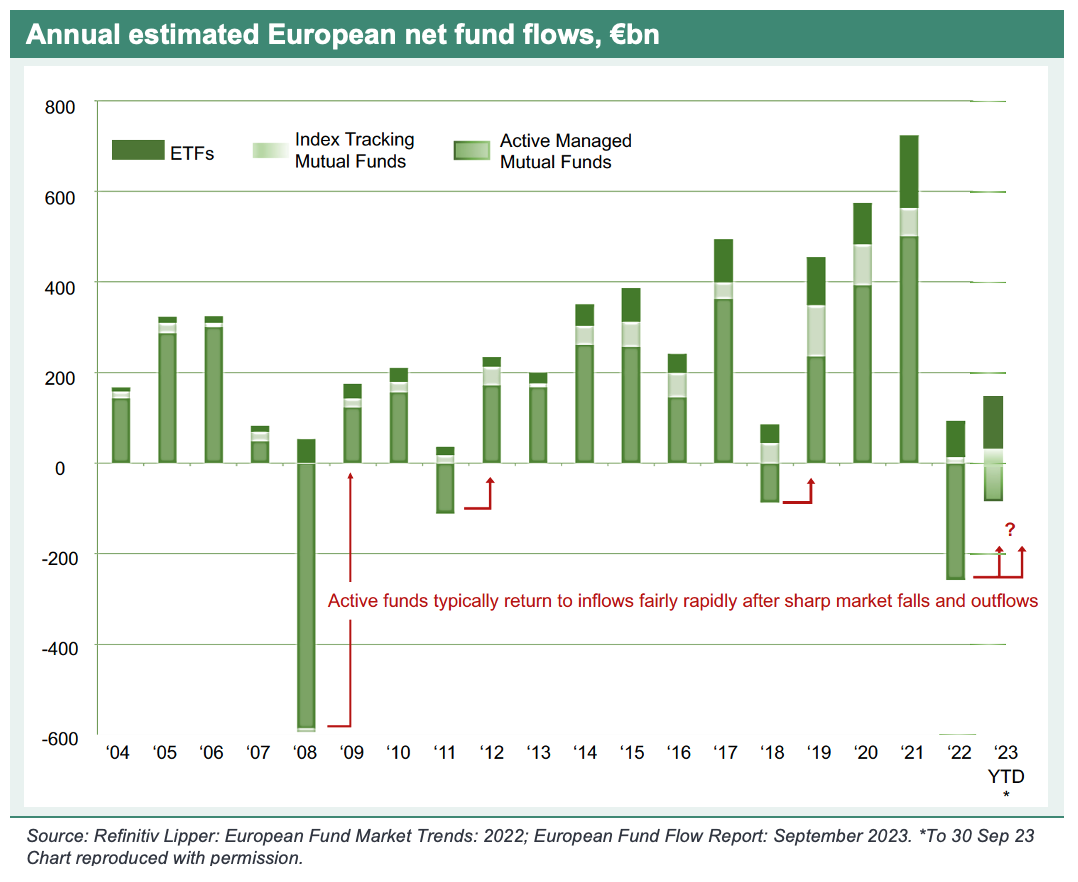
That bounce back into active funds hasn’t happened yet after the 2022 market falls, and appears to be taking longer than usual. Investors seem to be showing more caution than after previous market falls. Perhaps that’s understandable given the enormity of geopolitical uncertainty we face, as well as the uncertainty around inflation and interest rates. But so far, that caution has cost them money.
If markets and asset managers continue to produce good returns, the turnaround in flows is surely just a matter of when, not if? The potential pothole is if markets sink again. That’s not going to help flows.
I am (cautiously) leaning towards an improved net flow situation showing its face soon. And I think Polar Capital CEO Gavin Rochussen provided a sensible outlook in its recent AUM update: "Despite global equity markets rallying in the final quarter (of 2023), the ‘risk-off’ stance by investors resulted in net outflows in the quarter … (but) with peak interest rates in sight and declining inflation rates, investors will, we believe, begin to seek additional exposure to equities.”
Let’s see.
Notes & Disclaimer:
This is not investing advice - please read the disclaimer here.
This post originally appeared in TheInvestors.blog newsletter which aims to provide regular nuggets of analysis for shareholders of asset and wealth management companies. You can subscribe to the newsletter for free here.
Disclosure: At the time of writing, Paul Bryant was a shareholder in a number of companies mentioned in this post. He also covered Impax Asset Management and Polar Capital as an analyst on behalf of Equity Development Limited. Read Equity Development’s research on Impax Asset Management here and Polar Capital here. And please read this link for the terms and conditions of reading Equity Development’s research.
Disclaimer
This is not financial advice. Our content is intended to be used and must be used for information and education purposes only. Please read our disclaimer and terms and conditions to understand our obligations.
4 comments
Thanks Paul. I have bought into 3 fund managers in the last few weeks- maybe a bit early but ... Jupiter Fund Management (LON:JUP) Polar Capital Holdings (LON:POLR) Ninety One (LON:N91) .
Excellent post. I suppose the elephant in the room is passive investing. It is quite likely imo that the people who sold out of actively managed funds end up putting some of their money into passives. So the question is whether active fund management is an industry in structural decline.
Thanks Donald. The passive argument is absolutely relevant for sure. And one we need to watch carefully.
It doesn't look like active is in structural decline (yet?) - even though AUM has declined recently. Passive is just growing faster, but active is also growing (over a few years' time horizon anyway). There was a great post on this on LinkedIn by LEK Consulting (although data is not fully up to date). But still worth a read. https://www.linkedin.com/pulse...
I was initially surprised by how big active was compared to passive (especially in Europe).
Thanks for the update on flows Paul. It's always darkest before dawn!