Be your own New Year tipster

Happy New Year!
As we enter 2024, investors start to look forward to what the next year has in store for the markets. This means that one thing is particularly prevalent at this time of year: tips, where market commentators try to predict which stocks will perform best in the coming year. The problem is that the average tipster is terrible at it. When Stockopedia researched the topic in 2020, they found that:
…the annual share tips from a selection of the most popular UK newspapers and specialist investor magazines tend to be inconsistent and underperform the market (the FTSE All-Share).
Journalist Tips
The Stockopedia research focussed on newspapers and investor magazines, where tips are written by journalists. Following the "City Slickers" scandal in 2005, where journalists were buying shares ahead of tips they wrote, the restrictions on journalists owning shares they write about are strict. In many cases, they are prevented from owning any individual shares. For this reason, the writers of share-tipping columns tend to be relatively inexperienced market participants who are paid for the quality of their story-telling rather than the correctness of their analysis. It is little wonder that these tips tend to underperform the market.
As well as the quality of tips, investors need to consider the sheer quantity, too. For example, take the Midas Column in the Mail on Sunday/This is Money. Typically, this tips two companies each week. So that is roughly 100 UK companies tipped a year. Excluding REITs, Collective Investments and Holding Companies, there are currently 1264 listed UK companies, so this publication alone tips 8% of the UK companies a year. The Telegraph's Questor column appears to be even more prolific, with around 20 tips published per month. That is 19% of UK companies tipped each year! When you add in other major newspapers and specialist publications, it is certainly possible that over 50% of UK stocks are tipped each year. When the majority of UK stocks are tipped somewhere each year, underperforming, rather than simply tracking the market, takes some feat of (negative) skill!
It is certainly possible that not every tipster is equal, and some have skill at stock-picking, whereas most do not. For example, the 2020 Stockopedia study showed that the Investors Chronicle tips beat the FTSE All Share five out of seven years:
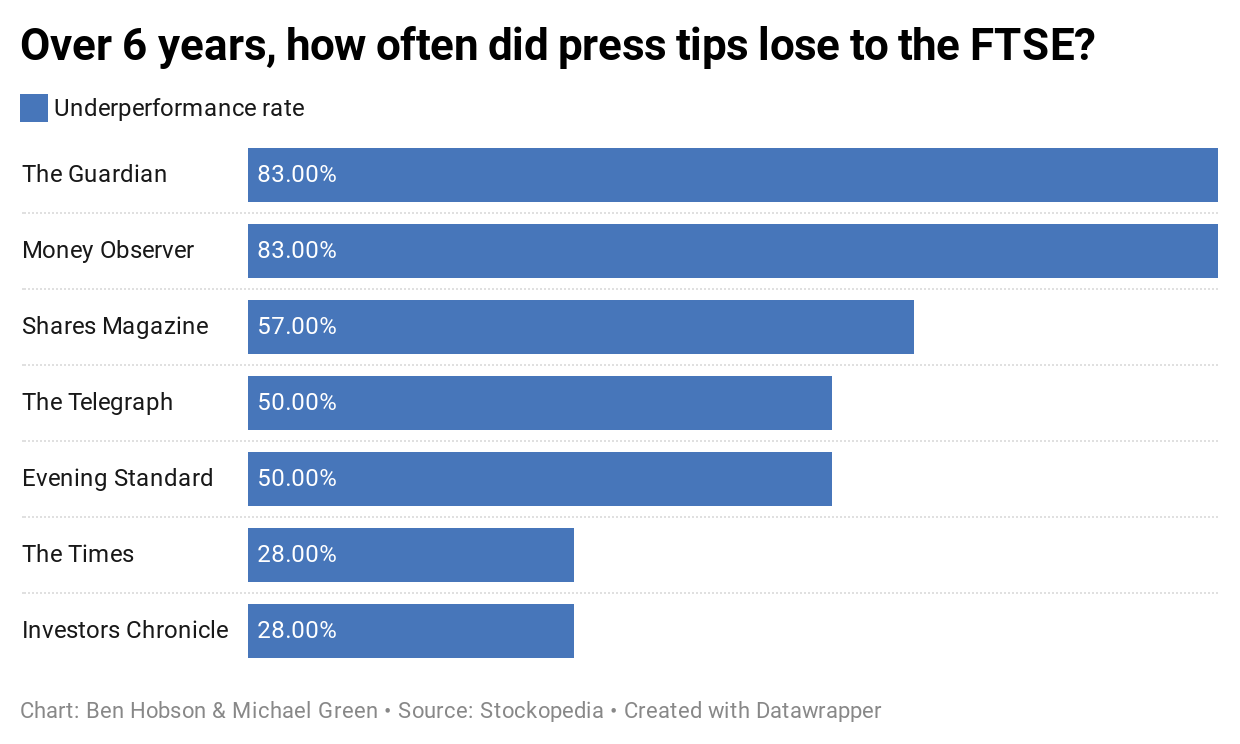
The problem is that the actual compound return of the IC tips over this seven-year period was less than 1% per year. So, although they beat the FTSE All Share, this was a very low bar for an active investor. Especially as the IC tips were likely to be smaller, more risky companies, whose larger spreads may have eroded what little gain there was.
It is well known that popular tipsters can move the market in the short term. Although the long-term record of buying into tips is poor, perhaps the nimble speculator can profit from the spike that a tip may generate. The problem is that the market makers, against whom the majority of investors will be trading against when buying into a tip, also read these publications. They are likely to have marked the offer higher before any opportunity to trade has presented itself. I firmly believe the best course of action if an investor owns a stock that has been tipped, is to sell into any spike in price. Unless the stock is particularly illiquid, investors will almost always have the opportunity to buy back more cheaply once the crowd has moved on to other shiny things.
Investor Tips
It isn't just journalists that take the opportunity to tip stocks at this time of year. Many investors like to make their own predictions. Without the restrictions placed on journalists, these experienced and often very successful investors are worth listening to. They often own the stocks that they list as the ones to watch in 2024. This adds weight to these picks. After all, who would listen to an investor who says, "Here are the twenty best companies to watch for 2024", yet their portfolio consists of 20 completely different stocks? However, balancing this conviction of opinion is the problem of ownership bias.
Ownership Bias - The tendency to overvalue items owned compared with equivalent items that are not owned.
There is a widely replicated experiment that demonstrates how pervasive ownership bias is. Participants are randomly given one of two items of equivalent value. After which, they are given the option of swapping. Statistically, around half the participants should have a preference for the alternative item. In reality, almost no one ends up switching. The reason for the lack of exchanges is revealed when participants are asked to assign monetary values to the items. Participants consistently valued their own items more than 25% higher than the alternative. What is surprising is that the only thing that created the difference was which item the participants had been randomly given.
Ownership bias raises the possibility that investors subconsciously choose stocks as their best picks because they own them rather than because they are objectively the best options. On top of this, it is worth considering that if an investor was still building a position in an illiquid stock, would they reveal this and work against their own interest?
While no one on Stockopedia would propose a stock while they were actively selling, the same cannot be said of other places. Twitter is very much the Wild West when it comes to stock debate. It is not unusual for bullish commentators to be highly selective in their presentation of data and ignore or gloss over any negative points. It would be safest if investors assume that any such posters are so bullish because they are looking to sell the stock, not buy it. As Buffett famously said:
If you've been playing poker for half an hour and you still don't know who the patsy is, you're the patsy.
As well as all these problems, other investors may simply have a different style or risk tolerance to those presenting their ideas. While there may be some great ideas out there, the mindset required to invest in loss-making micro-caps, where investors could easily see the value of their position halve in a week, is certainly not for everyone.
Despite tip-following being an objectively poor idea, it can often be difficult not to be lured onto the rocks by their siren song. Their attraction comes from the idea of a shortcut. Successful investing is difficult, and many are taken by the idea that someone else can do the hard work for them. Similarly, if a writer tips something already owned, we are likely to feel a sense of camaraderie. Sadly, this is more likely to be confirmation bias, only seeking or liking information that reinforces an existing view. So, what can investors do about this?
Create your own Tips
Instead of investing in the tips of others, investors are likely to be better served using this period to generate their own ideas for further research. These are far more likely to be aligned with an investor's preferred style of investing. With the fresh start of a new year in mind, now is the time to check that the best ideas have made it into the portfolio. The Stockopedia screening tools are ideal to help with this endeavour. Here are some screens that have been generated over the last few years, categorised by type of investor.
Quant Investing
Ed's NAPS portfolio demonstrates how to use the StockRanks to build a broad portfolio across different sectors. Again, I would urge quant investors not just to copy Ed's picks but to build their own portfolio using the tools. For example, if I were to use this method, I would choose a more diversified portfolio with a greater number of stocks in order to capture the QVM factors. Although it has gone through a tough couple of years, the long-term track record is good, and for investors who lack the time for individual stock research, this is a great way to invest.
Deep Value Investing
At the heart of deep value investing is buying a business at a discount to the value of the assets that the company owns. I screened for companies trading at a discount to their Tangible Book Value here.
Even more extreme is the Net Net Screen, which I wrote about here. This idea was popularised by Benjamin Graham, who was looking for stocks so cheap that they could close the business and return more than the current market cap simply from realising their current assets.
Earnings, Sales & Cash Flow Value
There are a number of challenges with using Tangible Book Value as a value signal. Hence, many investors these days prefer to look for companies that appear cheap on earnings multiples. I screened for such companies here. It also described some adjustments investors may want to make to get a better picture of the value on offer.
James O'Shaughnessy called Price to Sales the King of Value Factors. I screened for companies trading at a low multiple of their sales here.
Alternatively, some investors call EV/FCF the winning value horse. I looked at this claim here, together with an EV/FCF screen.
Income Investing
Many investors like to use equities to generate income. I looked at some of the myths surrounding income investing here, before using the screening tools to build a relatively safe income portfolio here. I revisited this a year on and decided that a few tweaks may improve this further.
Buffett & Munger Style Quality Investing
Charlie Munger's great revelation to Warren Buffett was that "It's far better to buy a wonderful company at a fair price than a fair company at a wonderful price." I screened for such companies here. As did Roland, with a slightly different approach in this article.
Multibaggers
Ed did a comprehensive webinar on the research into the best-performing stocks here. I looked at a couple of ways to screen for such companies here and here.
Momentum
Ed looked at Momentum as part of the Stockopeda Strategy Map here. I looked at some of the challenges with being a momentum investor, such as avoiding momentum crashes, and knowing when to sell.
Whichever style of style of investor, there should be plenty of ideas generated by the above screens, and with a higher chance of a positive outcome than following a tipster. Happy hunting in 2024!
Disclaimer
This is not financial advice. Our content is intended to be used and must be used for information and education purposes only. Please read our disclaimer and terms and conditions to understand our obligations.

22 comments
The 2020 Stockopedia article concluded .....
The highest hit rates were achieved by The Times and Investors Chronicle, both of which beat the index in 5 out of 7 years.TheTimes achieved the strongest average performance over time, with an average gain to date (end of October 2020) of 20.86% - an impressive performance. The Times also achieved the best one-year performance, with a 126.03% return in 2014.You wouldnt have picked this up from the tone of this article.
One of the things I have wondered about is how the outcome for my largest holdings compared to my smaller holdings. I am going to monitor the outcome this year, and see if my weightings add value or whether I would have been better off with an equal weight portfolio.
This would be a very valuable exercise that may give significant insight into how you invest. However, it may take quite a bit of data to be sure of the impact. Typically, larger holdings should be the less risky stocks. One could easily have a run of good luck where high-risk stocks that are the smaller positions do well and the larger ones lag. This can lead to the conclusion that equal weight is the way to go. However, when you switch to equal weight, this could mean a significant weighting to riskier stocks and sooner or later, that may come back to bite you. You could also track an equal-weight portfolio alongside your real one and see which has the highest Sharpe Ratio, which may give a better idea of whether you would be trading performance for higher volatility or tail risk.
It also depends on the number of holdings. Someone holding 20 stocks should probably be weighting them based on risk-reward. After all, they are already making a big call that these 20 are the best ideas in the market. However, for someone with 100 stocks, then equal weight probably makes more sense.
When researching companies I can get distracted skipping through IC recommendations over time in a company…particularly where a company’s doubling or more in price has been accompanied all the way by repeated ‘Hold’ advice
Aren't the Guardian and Money Observer that same thing - i.e. Observer is effectively the Sunday Guardian - with identical results I suspect it's the same tipster.
Shares Magazine I get free via my AJ Bell / YouInvest SIPP - sometimes useful reading for ideas / themes but like the IC well known to be useless for tips.
The Observer on a Sunday (which is owned by Guardian Newspapers) and Money Observer aren’t connected other than sharing a name. MO is a monthly magazine which I used to subscribe to some years ago and I think it may be connected to Interactive Investor. So the same performance as the Guardian newspaper must just be coincidence. I am a long-time subscriber to the digital edition of the Guardian, and I can’t recall any share tips, so I am a bit puzzled about that.
The figures were based on New Year tips: The Guardian (2014-2019).
Mark, your analysis on the pitfalls of following market tips is enlightening. It underscores the importance of independent research and aligning investment choices with one's own risk tolerance and investment style. The idea of creating personal tips using tools like Stockopedia's screens is a more prudent approach, encouraging investors to take ownership of their decisions rather than relying on the often speculative and biased recommendations of others. This self-driven strategy not only fosters a deeper understanding of one's investments but also aligns more closely with individual financial goals and market perspectives
Tipsters
It would be interesting to see what is the outcome of shares discussed at Mello BASH (Buy, Avoid, Sell or Hold ).
we have had a few disasters here, BOTB, BOHOO, SAGA to mention just three.
These newspaper tipsters are journalists mainly and not investment experts. So presumably they are often relying on information and opinions from Brokers when tipping shares. Also a lot of those journalists are young and starting out on this investment game.
e.g the excellent David Brenchley in the Times and Sunday Times freely admits to this but he’s learning very fast. Yet he has been pilloried in reader comments just because he admitted his lack of experience. Holly Mead is Deputy Money Editor in Sunday Times and admits only recently to have made her first serious investments. And what investment skills has “The Tipster”Lucy Tobin again in the Sunday Times got? Her reasoning is good but again surely based on broker information?
There’s far far superior comment on Stockopedia and sites like Citywire (for Investment Trusts particularly). Competent experienced investors who have learned from many mistakes and mishaps over the years, like many of the posters here, are far better formed than the newspaper tipsters who too many investors take too seriously.
To give a specific example; Michael Walters, the most decent and genuine person we could wish to meet or know, ran a small tipping website until the end of last year, before he at last retired at the age of 83.. He was an excellent Daily Mail Deputy City Editor and earned a great reputation for tipping shares thanks especially to some huge tech winners in the Tech bubble in 1999. His columns were excellent too, so many of his subscribers hung on his every word. Trouble was he was a sucker for blue sky/story shares that nearly anll went wrong, and never got beyond the “story” stage when tipping shares. Proper financial analysis as done by the likes of Paul Scott and Graham Neary here, was never attempted.
Interesting that the left leaning Guardian has the worst record!
They don't actually do tips, so not sure where this data is from.
Well they certainly used to:
https://www.theguardian.com/bu...
Maybe they stopped because they were so bad at it!
Very illuminating, I often use the tips for further Stockpedia screening. Thank you for the analysis
It is my opinion that share tipsters are there to help you learn more about their mentioned companies and that’s where their job starts and ends. They all do an excellent job on the information they provide-an amazing job!
The Telegraph's Questor column appears to be even more prolific, with around 20 tips published per month. That is 19% of UK companies tipped each year! When you add in other major newspapers and specialist publications, it is certainly possible that over 50% of UK stocks are tipped each year. When the majority of UK stocks are tipped somewhere each year, underperforming, rather than simply tracking the market, takes some feat of (negative) skill!
Thats an amazing stat and does show the majority are just going through the motions. Be interesting to know if it's their picks which are hopeless or timing. I suspect their timing is probably even worse.
About as useful as their macro predictions. Was deleting some screenshots yesterday when I can across this gem from Bloomberg, Oct 2022. Not even going for a 99% chance, went all in on 100%. Garbage clickbait.
Very true. The macro forecasts are usually very wrong, an individual share tip is even harder to get right. Unless you are Buffett, diversify.
Touching degree of humility from the ever so pompous and woke Bloomberg…as we used to say in yesteryear’s more environmentally conscious times, “today’s newspaper headline, is tomorrow’s fish and chip wrapping’”.
Great Article. Quick question when we use a particular screen how do determine on Stockopedia when a share qualified for a particular screen
You can't. On the old site on Guru screens, it did say when it qualified and had the history. This has been requested, on screens, recently on another post.
It would also be great if a notification could be given when a share gets newly promoted to a screen. I have half a dozen screens - it's impossible to monitor new entrants without comparing to a screenshot from the last time you checked.
Yes good idea, I agree it is difficult to monitor them. Even with a small number of stocks, on a screen, could be 11 yesterday but then 13 today, but 3 maybe new and one has dropped off. One way is to save the screen or take a screen shot, everyday.