Berkshire Hathaway: five key points from Buffett’s 2019 Shareholder Letter

Berkshire Hathaway released its annual report over the weekend. Warren Buffett doesn’t say much new, but perhaps that is the point... He and Munger have been explicitly telling us for decades how they make their money. It is up to us to apply some of those lessons.
After a false start in textiles, Berkshire found success by growing the “float” of its insurance operations and using that upfront cash to invest in high quality, compounding businesses. These companies earn high returns independently, but the way in which they are brought under Berkshire’s umbrella is itself a source of strength. You might call it a moat - according to Buffett: “Berkshire’s positioning of its “controlled” businesses within a single entity endows it with some important and enduring economic advantages.”
It’s a highly successful model that has seen Berkshire become one of the biggest companies in the world, with a single “A” share worth as much as a house and a market cap of some £433bn.
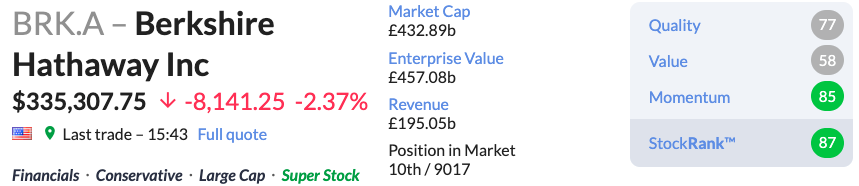
In many ways, Berkshire is the blueprint for quality. Warren Buffett’s annual letters to shareholders are required reading for many.
On the 22nd of February, Buffett’s 2019 Shareholders Letter was published. Here are some key takeaways.
1. Retained earnings: the common stock’s superpower
Compound interest is the eighth wonder of the world. He who understands it, earns it… he who doesn’t… pays it - Albert Einstein
Early on in his career, Buffett transitioned from a value investor to a quality investor. This evolution was prompted in part by serious troubles in his early businesses. In the 2019 letter Buffett says: “When we acquired control of [Berkshire’s original textile business] in early 1965, this beleaguered operation required nearly all of Berkshire’s capital. For some time, therefore, Berkshire’s non-earning textile assets were a huge drag on our overall returns.”
What looked cheap at first ended up consuming vast amounts of capital.
The low returns on capital you often find in “cheap” stocks mean they miss out on a unique characteristic of equities: stocks are the only asset in which a part of your return is reinvested for you. With Berkshire, this is typically invested in operating assets, acquisitions of companies or stakes in listed companies, and share buybacks.
This redeployment of growing capital is an extremely valuable mechanism for compounding gains. Charlie Munger, who is one of the most widely-read people you could hope to meet, describes compound interest as an almost profoundly powerful concept when he says: “Understanding both the power of compound interest and the difficulty of getting it is the heart and soul of understanding a lot of things.”
In Terry Smith’s recent 2019 Fundsmith letter, he uses the S&P 500 to illustrate this point:
Some 80% of the gains in the S&P 500 over the 20th century came not from changes in valuation but from the companies’ earnings and reinvestment of retained capital. If you were a great (and long-lived) value investor who bought the S&P 500 at its low in valuation terms, which was in 1917 when America entered world war one and it was on a P/E of 5.3x, and sold it at its high in valuation terms in 1999 when it was on a P/E of 34x, your annual return during that period would have been 11.6% with dividends reinvested, but only 2.3% p.a. came from the 9 massive increase in P/E and 9.3% (80% of 11.6%) came from the companies’ earnings and reinvesting their retained earnings.
The S&P example is for 500 average large companies. This proportion of your return from the companies’ reinvestment activities is even more extreme when you invest in a good company with a high return on retained capital than in an average company.
It is perhaps no coincidence, then, that Buffett begins his 2019 letter by quoting part of John Maynard Keynes’ review of Edward Smith’s Common Stocks as Long Term Investments:
I have kept until last what is perhaps Mr. Smith’s most important, and is certainly his most novel, point. Well-managed industrial companies do not, as a rule, distribute to the shareholders the whole of their earned profits. In good years, if not in all years, they retain a part of their profits and put them back into the business. Thus there is an element of compound interest operating in favour of a sound industrial investment. Over a period of years, the real value of the property of a sound industrial is increasing at compound interest, quite apart from the dividends paid out to the shareholders.
According to Buffett, compounding returns over a period of years is still the best way of making money in the stock market.
2. Acquisition discipline is key
Berkshire is a company that has built its success on brilliant acquisitions. Its secret here is discipline. Buffett’s acquisition criteria are simple and have stayed fundamentally the same for decades:
We constantly seek to buy new businesses that meet three criteria. First, they must earn good returns on the net tangible capital required in their operation. Second, they must be run by able and honest managers. Finally, they must be available at a sensible price.
Berkshire has not made a major acquisition for three years. This cautious approach has irked some shareholders, but it is one of the key ingredients of Buffett’s success. I would point impatient owners to the excellent “Vice Chairman’s Thoughts” section of a piece called “Berkshire: Past, present and Future”.
Here, Charlie Munger poses and answers a question:
Why did Berkshire’s acquisition of companies outside the insurance business work out so well for Berkshire shareholders when the normal result in such acquisitions is bad for shareholders of the acquirer?
Well, Berkshire, by design, had methodological advantages to supplement its better opportunities. It never had the equivalent of a “department of acquisitions” under pressure to buy. And it never relied on advice from “helpers” sure to be prejudiced in favor of transactions. And Buffett held self-delusion at bay as he underclaimed expertise while he knew better than most corporate executives what worked and what didn’t in business, aided by his long experience as a passive investor. And, finally, even when Berkshire was getting much better opportunities than most others, Buffett often displayed almost inhuman patience and seldom bought. For instance, during his first ten years in control of Berkshire, Buffett saw one business (textiles) move close to death and two new businesses come in, for a net gain of one.
When a Berkshire shareholder complains about the company’s cautious attitude towards acquisitions, it makes you wonder why they hold shares in the first place...
3. Buybacks and why share count matters
One thing Berkshire Hathaway did spend money on in 2019 was its own stock. The company repurchased a record $2.2bn at the end of the year, up from $700m in the previous quarter. That brings the total the company spent on share buybacks to $5bn over the year.
In Buffett’s own words:
Berkshire will buy back its stock only if a) Charlie and I believe that it is selling for less than it is worth and b) the company, upon completing the repurchase, is left with ample cash… In 2019, the Berkshire price/value equation was modestly favorable at times, and we spent $5 billion in repurchasing about 1% of the company... Over time, we want Berkshire’s share count to go down. If the price-to-value discount (as we estimate it) widens, we will likely become more aggressive in purchasing shares.
This final point shows an appreciation of shareholder value that is lost on serial issuers of shares. Checking a company’s share count over time is a great way to gauge how that company treats its shareholders.
4. Devoted management and a distinctive culture
Buffett uses this year’s letter to praise the “skilled and devoted top managers for whom running Berkshire is far more than simply having a high-paying and/or prestigious job” and mentions the importance of the continued “nurturing of a culture that is rare among giant corporations.”
Returning to Munger’s “Vice Chairman’s Thoughts”, he explains how Berkshire created this culture:
Buffett, even when only 34 years old, controlled about 45% of Berkshire’s shares and was completely trusted by all the other big shareholders. He could install whatever system he wanted. And he did so, creating the Berkshire system. Almost every element was chosen because Buffett believed that, under him, it would help maximize Berkshire’s achievement. He was not trying to create a one-type-fits-all system for other corporations.
...In particular, Buffett’s decision to limit his activities to a few kinds and to maximize his attention to them, and to keep doing so for 50 years, was a lollapalooza. Buffett succeeded for the same reason Roger Federer became good at tennis. Buffett was, in effect, using the winning method of the famous basketball coach, John Wooden, who won most regularly after he had learned to assign virtually all playing time to his seven best players. That way, opponents always faced his best players, instead of his second best. And, with the extra playing time, the best players improved more than was normal.
Moreover, by concentrating so much power and authority in the often-long-serving CEOs of important subsidiaries, Buffett was also creating strong Wooden-type effects there. And such effects enhanced the skills of the CEOs and the achievements of the subsidiaries…. He amplified the effects of special managers…
...Then, as the Berkshire system bestowed much-desired autonomy on many subsidiaries and their CEOs, and Berkshire became successful and well known, these outcomes attracted both more and better subsidiaries into Berkshire, and better CEOs as well. And the better subsidiaries and CEOs then required less attention from headquarters, creating what is often called a “virtuous circle.”
This virtuous circle describes another compound effect - not of earnings or share price gains, but of human capital.
5. Equities are still a good (long term) investment
Finally, Buffett ends his piece on a note of optimism for the long term investor:
What we can say is that if something close to current rates should prevail over the coming decades and if corporate tax rates also remain near the low level businesses now enjoy, it is almost certain that equities will over time perform far better than long-term, fixed-rate debt instruments.
That rosy prediction comes with a warning: Anything can happen to stock prices tomorrow. Occasionally, there will be major drops in the market, perhaps of 50% magnitude or even greater... [But] the compounding wonders described by Mr. Smith will make equities the much better long-term choice for the individual who does not use borrowed money and who can control his or her emotions. Others? Beware!
Disclaimer
This is not financial advice. Our content is intended to be used and must be used for information and education purposes only. Please read our disclaimer and terms and conditions to understand our obligations.

12 comments
The hardest thing in Investment is to do the easiest thing. What is the easiest thing to do ? Nothing.
Patience (implied above) combined with Discipline and Knowledge are the key attributes of successful investment - and adumbrated repeatedly by Warren and Charlie in other words. However this is very boring to the inexperienced or uninitiated who subconsciously crave excitement.
No knowledgeable investor says that investment should be exciting. Indeed successful investment should be boring in terms of rare actions interspersed among long periods of inactivity.
Continually watching a computer screen with one's portfolio prices displayed is like a junkie trying to ditch his/her habit watching a dealer distribute drugs to his clients. Tempting and dangerous (sorry Stockopedia).
So maybe a question of someone new to this and starting to build for the future, what is the difference between the A and B shares?
Obviously a whole order of magnitude to purchase them, e.g. I have a chance to get a B share but would have to sell the house, children and most of the pension to get an A...
The B shares are priced at roughly one fiftieth of the A share price and give you ownership of an equivalently smaller proportion of the company. They were created by Buffett in response to an entrepreneurial soul who saw the opportunity to create a unitised version of the A shares - so basically buy a few Berkshire A shares, split them into nominal units and then invite the public to buy the units.
Buffett is resolutely opposed to this kind of behaviour because he wants long-term shareholders not people trading in and out of the stock and a high share price discourages people from such trading. So he responded by creating the B shares which essentially were equivalent to the proposed unitised A shares and, at a stroke, destroyed the business case behind the unitisation.
Since then both Berkshire A and B shares have increased in value more or less in lockstep but no one is foolish enough to spend money attempting to recreate the unit idea because they know that Buffett will wait to the last minute and then create cheap Berkshire C shares.
But in essence there's very little difference between the share classes - it's just that the B shares are a lot cheaper and give you ownership of a lot less of the company. Most of us can't afford the A shares, so the B's are the obvious route into Berkshire Hathaway ownership.
timarr
a humble soul like me is in awe and admiration of the dynamic duo!! Love them both to bits!!
It is indeed a very good time to refer to Warren Buffett. He is like a dog with a bone and encourages us to seek ways to cope with all types of market conditions. Quality shares with a good and dependable dividend are not to be neglected!
A lot of companies underestimate the power of a good share buy-back.
The issue is that many companies buy their stock back only to offer management lucrative options payments..
Enjoyed the article - thanks Jack.
Retained earnings only works for about the 4% of companies that can invest incremental retentions at or above their historical ROE. Only 2% of companies can maintain this pattern for over a decade.
Fahrhb - very interesting observation - I was wondering how you found the companies that fell into the 4% and 2% categories
Strange, I'm a great admirer of Buffett and often refer to "The Intelligent Investor". At the same time, he strikes me as a powerful insider with access to a great deal of information that is not widely known. Moreover, he was in the right place, at the right time and he had the right framework. Starting from scratch today, would he ever reach such great heights? I doubt it.
His strategy has changed considerably over the last 20 years or so, now he has many shares that he said he would never buy such as airlines and technology. He advises people to buy a S&P 500 tracker which seems to perform as well as he fund. Terry Smith maybe a better one to follow, certainly he seems to have outperformed Berkshire Hathaway in the last few years.
I agree and I believe Buffett has acknowledged as much re. favourable stock market timing... I feel his wholesome "Sage of Omaha" image is part truth, part marketing exercise (and a very successful one too)... Very canny operator
A good day to look at the long-term and not become discombobulated by today's gyrations!