Beyond stock picking - a 3D framework for smarter portfolios

We’ve all been there. Picked some great stocks with conviction. Run our winners. Been delighted with the gains. Only to see those gains drain away.
It hurts, it’s galling, and you are left wondering where you went wrong.
Worse than that, by the time it happens you may have started counting on those gains as part of your future planning. How are you going to pay for that big ticket item - that home purchase, a child's education, or an early retirement? It’s very real.
In this piece, I’ll introduce the three mistakes we can all make, and the three solutions.
But first, a personal tale…
An early education
For me, my big lesson came in the global financial crisis. I was young enough to be reckless, but old enough to have known better.
I had a silly amount of my capital riding on two big picks. Both were AIM listed stocks. One was called Renesola (SOLA) - a solar energy company that was absolutely smashing it on sales growth. The other was RC Group (RCG) - a biometrics company. I’m sure some of you remember these stocks.
I’d bought really well. And I’d bought more as they rose. At their peak, I had 50% of my portfolio in RCG, and probably 30% in SOLA. They really were motoring - they had both already tripled. I couldn’t have been more confident.
It was 2007… what could possibly have gone wrong?
The mistakes we all make
There’s an eye-opening academic research paper by Barber and Odean titled “The Behaviour of Individual Investors”. When I first read it I was gobsmacked. It was a mirror of every mistake I’d ever made, and hugely influential in shaping my future mindset.
I’ve thought long and hard about their findings, and grouped them into three themes:
1. We suffer “perverse stock selection”
That quoted phrase is their words. We often pick risky stocks for the wrong reasons.
We often talk about the perils of story stocks at Stockopedia. Stories are how the human mind makes sense of the world, but projecting a hollywood ending onto a share is not rational.
Whether we’re chasing headlines, themes we know a lot about or jumping on a bandwagon so not to miss out. We seem to have a “taste for stocks with lottery-like payoffs”.
But lottery tickets have negative returns!
2. We underdiversify
We buy a share and get to know the theme. The price goes in the right direction, and we buy more. We buy another, benefiting from the same theme.
One highlight from the paper showed that “on average investors hold only four stocks” which tend to be “highly correlated” - i.e. too few stocks in too few sectors.
I ended up in 2007 with a portfolio 80% in Chinese AIM stocks. Hindsight is wonderful isn’t it.
3. We buy and sell recklessly
We’re human. We’re prone to want to do something. This action bias might have helped when we were chased by lions, but in volatile markets it’s an expensive tendency.
It’s so easy to buy and sell these days. A trade is just a thumb press away. But ease of trading does not a disciplined investor make. 20% of investors turn over their portfolio almost three times per year - which is not only hugely costly in terms of transaction and tax costs, but can’t be good for mental health.
Beyond this, we’re terribly prone to hanging onto our losers, and snatching at profits. And even worse, we tend to pull all our capital out of the market at lows, and reinvest at highs.
The 3D framework that solves for these
I’m sure we can all recognise some of these behaviours in our own habits. But as John Templeton once said “If you want to have a better performance than the crowd, you must do something differently from the crowd”.
So in this vein, I propose three dimensions of intelligent investing that can guarantee you invest contrary to the mistakes of most investors.
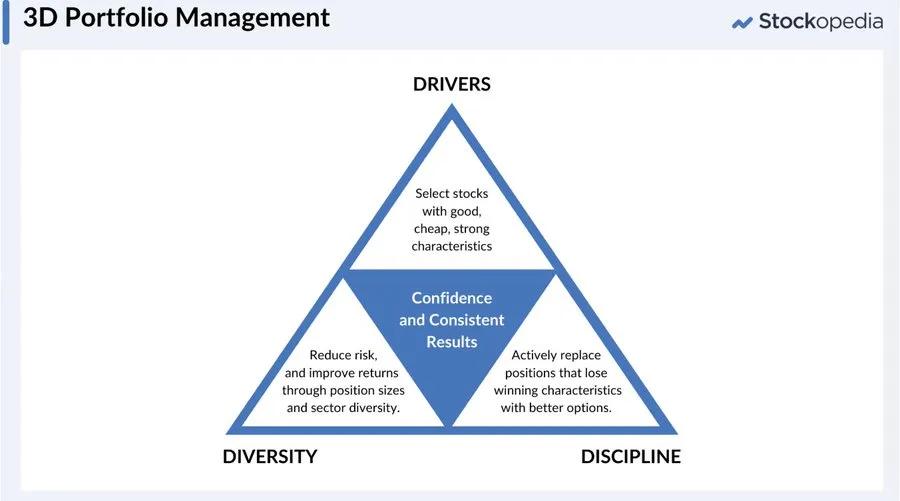
- Invest in stocks that have a genuine tailwind of return Drivers.
- Avoiding pure story stocks is the simple solution to “perverse stock selection”. Focus on shares that have the same fundamental characteristics of past winners.
- That means selecting good quality, inexpensive shares with positive trends.
- These kinds of shares are often ignored by the crowd, even though they consistently outperform the market (on average over the longer term).
- Ensure you have enough Diversity in your portfolio construction.
- In ten years of running the NAPS Portfolio - only 7% of shares owned have ever doubled in a single year. So we don’t diversify just to reduce risk, we diversify to maximise our chance of owning a big winner. These are the stocks that can make a real difference to your portfolio.
- Own at least 14 stocks to give yourself a better chance of holding a multibagger.
- Own stocks across at least 5 (out of 10) sectors, and make sure you own both cyclicals and defensives. Think of your portfolio like a football team - you need strikers and defenders. And be careful going all-in on a favourite theme!
- Be wary of huge positions - you may not be as smart as you think you are. Start with equal weights.
- Pre-commit to buy and sell Discipline.
- Have a plan for every share purchase - a plan actively helps you avoid reactive over-trading and snatching at profits. This includes having a sell plan. Whether that sell plan is based on time (e.g. after a one year holding period - to accrue gains), thresholds (e.g. when value is realised, or the StockRank falls below a certain level), or events (e.g. selling immediately on a profit warning). This webinar is a comprehensive overview of sell rules.
- Only hold for the long term the highest quality securities. Be extremely wary of holding just because you’ve grown familiar with the story. The numbers must back it up. As Jim Slater once said - “you want to be first in the line of disappointed enthusiasts” if something goes wrong.
- Don’t hang onto your losers - have a bias to selling them (using a stop loss, or after a fixed time), or average down (but only if you have genuine insight - which you probably don’t). Doing nothing creates opportunity cost, and can turn a small loss into a big one.
Creating your own set of rules from these principles is part of the fun of investing. There are turnkey approaches, but you have to find a set of rules that fits your own personal circumstances (psychology, capital size, tax status and so on).
Putting the principles to work
I've always been amazed at how extraordinarily powerful the consistent application of simple rules is. We all like to overcomplicate things, and second guess the markets, and make silly decisions at times. Investing really is simple, as Warren Buffett says, but it's not easy.
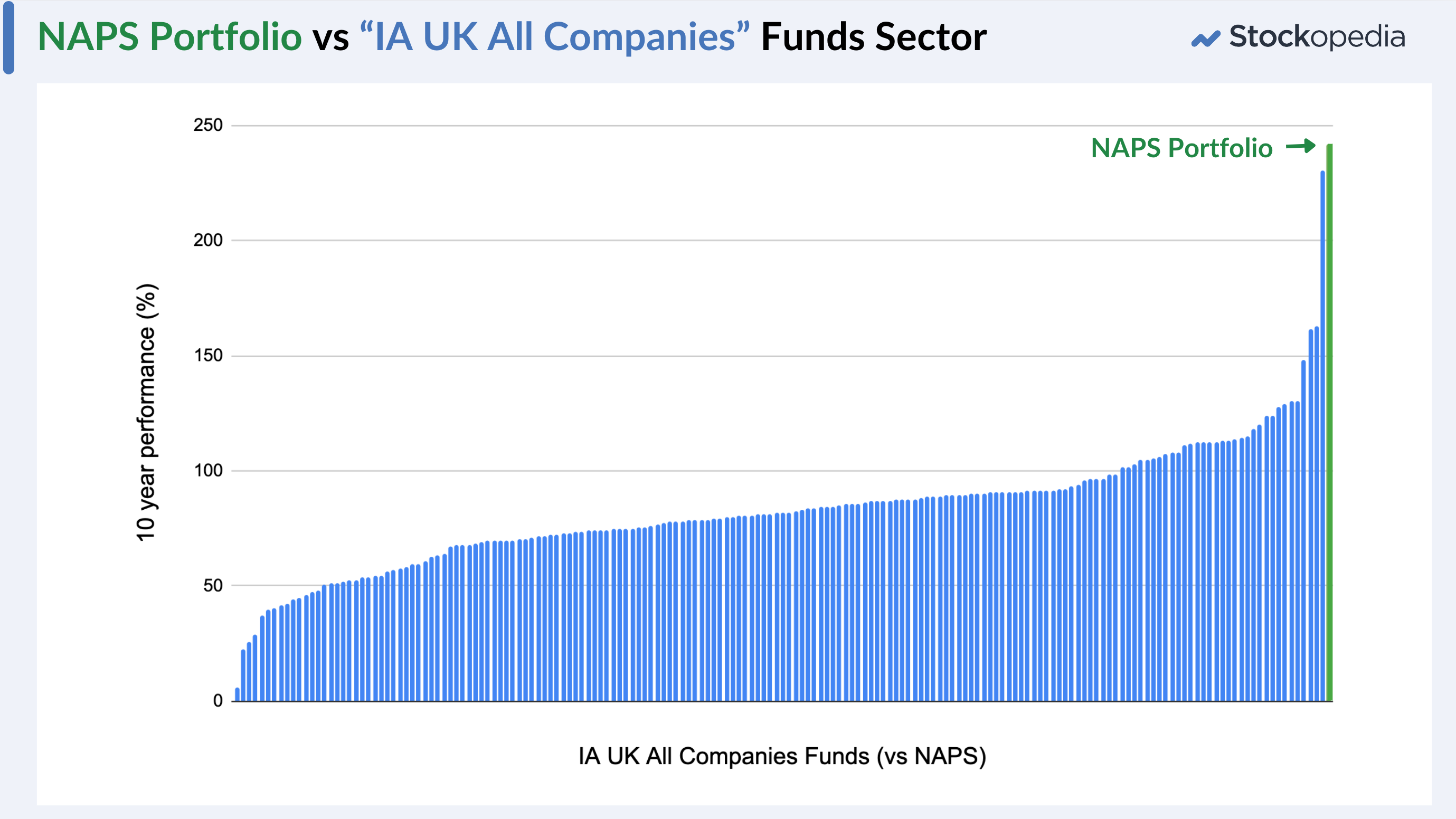
The NAPS Portfolio is a classic case study of using these 3D principles. It’s an equal weighted 20-stock portfolio of the highest quality, value and momentum stocks, two from each sector, refreshed once per year.
I share this chart again from the 10 year review just to reinforce a point - the consistent application of the NAPS rules has outperformed every UK equity fund over a decade.
It's not luck, it's just process.
But I'm a passionate believer that discretionary stock pickers can do even better than the systematic NAPS in their own investing, if they craft their own rules keeping in mind the 3D principles.
In the coming weeks, I'll be running a few webinars on this theme - so please stay tuned for invites.
Meanwhile, I'll leave you with a great quote from Dr Van K Tharp - the late, esteemed investment author, educator and coach:
If you don't have rules, everything you do is a mistake.
Disclaimer
This is not financial advice. Our content is intended to be used and must be used for information and education purposes only. Please read our disclaimer and terms and conditions to understand our obligations.
26 comments
A most useful reminder of what I try to do and consistently fail in execution. The indecision on loss and static performer shares is my enduring fault. The FOMO effect - the fear of missing out on a recovery just after the shares are disposed of!
The 3 dimensional rules largely allude to the fact that a lot of people are probably best fund investigating. I think it is an area under exposed by stocko. It's a great tool for informing fund investigating if they could just add some simple filters.
Investing
Excellent article and have just gone through my whole portfolio and added sell rules to the spreadsheet. Fairly simple really.
The one scenario I am failing to cover is.
Any thoughts appreciated.
I have held Legal & General (LON:LGEN) for 10 years. The share price is currently almost the same as what I paid 10 years ago, and has gone both up and down by 20% or so. However it has consistently paid a high dividend - currently 8.86%. As a pensioner, I find the steady income very useful, and look for share price appreciation elsewhere.
The value of the Pound is a real problem there, inflation robs the dividend on such a time scale. As a pensioner I might be happy to be collecting support regularly and not worry too much about the capital. Living is for now.
That strikes me as sensible investing. I like dividend investing as it about the here and now.
On your dividend stock. Depends on what you want to achieve. 10% p.a. for a decade would give you a robust 2.8 times your initial investment with dividends reinvested. So not to be ignored - one share like this is CAML, another is CSN. Both lousy capital gains more like loss but marvellous income. Also if you are likely to end up paying IHT then the income surplus to your needs can be distributed to say children without any tax effect. Watch out for rising debt, and company warnings.
Another excellent, thought provoking article Ed and I look forward to the webinars (although personally speaking, winter webinars are preferable to summer ones!).
I wanted to pick up on this point, “the consistent application of the NAPS rules has outperformed every UK equity fund over a decade”. A while ago you mentioned the possibility of launching an ETF focused on the NAPs principles. Has this fallen by the wayside or is it still in the works? In asking this, I appreciate the regulatory hurdles might be insurmountable but nonetheless, I thought I’d ask.
Cheers
Simon
From the excellent book by Morgan Housel, Same as Ever: “The irony of good times is they breed complacency and skepticism of warnings. “ This is true for economies, the markets and life in general.
Great article I recognise some of my own flaws in this, which will hopefully help to refine my approach. Really interesting to reference the academic research paper (which I now have to read), is there a resource that gathers academic research regarding investing?
RCG. That rings a bell. Wasn't it a Chinese scam? Plenty of cash (allegedly), which turned out not to be the case.
Towards the end they came up with the idea of putting RFID tags on rocks, of all things.
Well - RCG did have real products.
I do remember how hyped everyone got about the potential "oh my god there will be RFID chips in every supermarket warehouse in the world - think of the total addressable market!"
I bought their biometric fingerprint id security device for my laptop - I may have had it shipped over from Hong Kong. It worked for a while. Then it locked me out of my computer forever. I should have realised that was the sell signal!
The future rhymes with history past.
Oh yes, RCG. What a story stock that one was. You could make a Netflix series out of that stock alone! You're right Ed, they did have a real product. It was an RFID-secured jewelry box, if I remember correctly. It was that sudden realization that finally convinced me to bail out. An expensive mistake, but one of the cheapest lessons I ever learned.
Thanks for a great article.
Whilst we're talking about iffy Chinese companies, one that crossed my radar today is HUTCHMED (China) (LON:HCM) .
Let's see ... it has excessive net cash: $746m. There's nothing "wrong" with a company having a good cash buffer, but it's a feature of Chinese frauds that their cash balances are extreme. Their revenue is only $630m. There is no logical reason why a company would need cash in excess of revenues.
Revenues have been growing at 25% pa. It's nice to see revenue growth, but I'm suspicious when I see such large numbers where there are a number of other red flags.
The company has made operating losses for 9 out of 10 years. Ouch. That's a bad business.
The company has been raising shares by about 6%pa. Why?
Looking at the Stocko balance sheet, it has a lot of "cash and equivalents" (which I'm suspicious of) and "short-term investments". Why does that keep ballooning?
I could probably find some answers in the actual accounts, but I'm lazy. The picture being painted by the summary pretty much tells me it's all bogus. Total account receivable keeps going up, too.
There's very little institutional shareholding. For a £1.9b company, you'd expect more.
The company has been listed since 2006, which is at least something (but not much). I'm surprised it made it this far. The market cap is pretty high, too, which I find a little unusual. All the other Chinese frauds had much smaller market caps.
Oh, and it has a StockRank of 15. Definitely danger territory.
Interesting here also is that Stocko highlights the Earnings Manipulation Risk as "High". Yeah, sounds about right.
Verdict: EXTREME AVOID.
Great Article.
In my SIPP I have 16 holdings - when I set it up (June 2023) they all had an equal value but over time this has changed significantly. My focus was solid income with growth potential and accordingly the yield of the portfolio at purchase was 7.4% but as the share prices have increased this has reduced slightly and is currently running at 6.3%, still acceptable. In approaching two years my return is 32.6% with all dividends reinvested.
I use a buy and hold approach following the general principles of the High Yield Portfolio (HYP) strategy.
I feel they are quite well diversified, the 16 stocks cover 12 Industry Groups) but there is definitely room for adding something else and diversifying further:
I look forward to your webinars, they are always very informative
A very good reminder and I do struggle to stick to my rules.
Where is the like button?
Thanks Ed very informative.
"Don’t hang onto your losers - have a bias to selling them (using a stop loss, or after a fixed time), or average down (but only if you have genuine insight - which you probably don’t).
This part in particular resonates well with me, my success rate at averaging down just wasn't worth the hassle. I've found it much more successful and stressfree to mercilessly cut losers at 15-20% down and not look back.
I have the opposite experience, arbitrary stop losses didn't work for me - especially when market falls were down to Mr. Market rather than any profit warning / company performance. Most of time, the share price rose, or there was a takeover, etc.
I have since implemented averaging down where Mr. Market gives me the opportunity and it's working quite well.
I had to set the stop losses far enough away for this reason. Glad you've found a system which works for you! Hopefully we can both profit nicely
Look one day Boohoo (LON:DEBS) will become a market leader and kick Frasers (LON:FRAS) in the underpants :)
An advantage of losers is you can offset them against capital gains - when/if they turn up.
Thanks, ED. It's extremely helful to be reminded of the things I consistrntly do wrong!
I looked for a "like" button at the end of the article, as a way of showing apprecieation.
Reference to the number of shares in a portfolio: Ed suggests a minimum of 14 and NAPS has 20 - to cover the sectors. Is there a rule to calculate a maximum number to avoid turning the portfolio into a mini tracker fund and inevitably unable to outperform the market?
Lots of research suggest 15 to 20 fives most of the risk reduction from diversification benefits. See the link below for an example of this research. The summary of which was
"All in all, these results demonstrate that effective diversification
depends on portfolio style. For large-cap portfolios, there’s little to
be gained by diversifying beyond 15 stock or so. For small-cap
portfolios, peak diversification is achieved with around 26 stocks. The
same applies for non-dividend portfolios, while growth and value
portfolios need a roughly equal number of stocks to optimally reduce
volatility."
Peak Diversification Paper.
Hope this helps.