Billington Holdings: an undervalued high growth Super Stock?

Billington Holdings (LON:BILN) is a UK-based structural steel and engineering company with activities in the UK and, more recently, Europe. Cyclical it may be, but this small cap Super Stock’s growth over the past five years has been phenomenal. If it can keep this up going forward, then I think today’s share price of 383p could still prove to be a bargain.
Since 2013, the group’s performance has been powered at least in part by a resurgent steel market. According to management, however, it has used these favourable macro conditions to also develop value added, complimentary products and services.
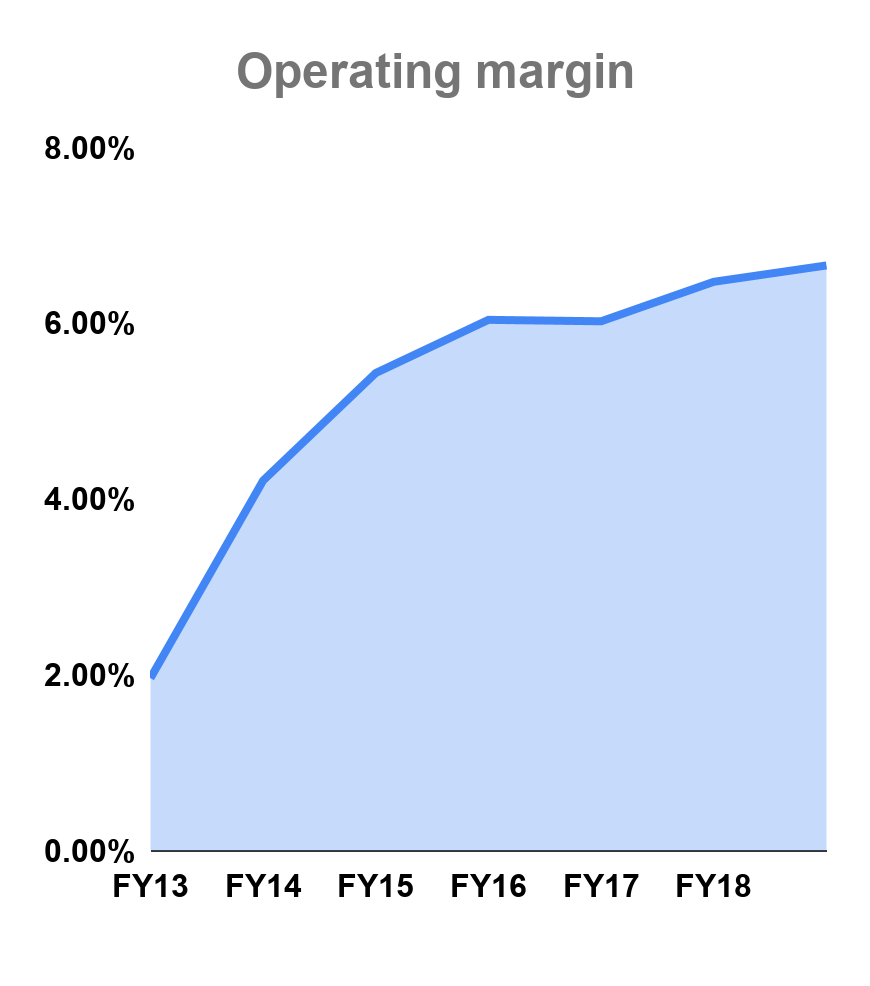
More often than not over this timeframe, Billington has positively surprised the market with its trading updates. The group’s operating margin has increased from 1.9% to 6.5% and revenues have almost doubled. The group’s latest full year trading update says it will once more beat revised market expectations of £78m of revenue and £5.2m of profit.
Billington has an enviable collection of five-year compound annual growth rates (from FY13 through to FY18):
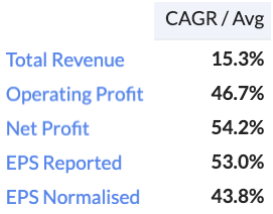
This does show Billington at its absolute best however, capturing its performance right from when it started to benefit from the latest cyclical upswing.
The market is wary of ascribing a standard growth multiple to these shares. Despite its sterling record of growth in recent years, Billington trades on an historic PE ratio of just 12.3 and a forecast PE ratio of 11.
Given this, it is no surprise that Billington has a lot going for it from a factor perspective. It is a Super Stock that rates highly as both a Value-Momentum and a Quality-Momentum play. It qualifies for seven screens across Growth, Momentum, Quality and Value.
This combination of factors, along with its historic rates of growth and a market cap of just £50m suggests there plenty of scope for further earnings growth and multiple expansion.
That said, companies at the top of a cycle do often look cheap on an earnings and sales perspective, only for earnings to decline in the following years. For now, Billington continues to make positive noises about market conditions. More on this in a bit.
Are people harshly discounting a promising growth stock?
Operating structure - can Safety Solutions fuel margin expansion?
Billington splits itself into two operating divisions.
Structural Steel includes Billington Structures and Peter Marshall Steel Stairs. The former tackles steel projects of varying size and complexity and has plants in Barnsley and Bristol. The latter is the leading fabricator of steel staircases for residential, domestic and commercial applications in the UK.
Safety Solutions is made up of easi-edge, which provides safety barriers, and Hoard-It, which makes reusable temporary hoardings.
While Structural Steel is by far the bigger division in terms of revenue, Safety Solutions is much higher margin, and so punches above its weight in terms of contribution to operating profit.
Year-on-year growth in FY18 was encouraging, with the higher margin Safety Solutions division growing at a much quicker rate than Structural Steel.
Structural Steel | |
YoY revenue growth | 3.60% |
YoY operating profit growth | 6.14% |
Safety Solutions | |
YoY revenue growth | 22.58% |
YoY operating profit growth | 254.14% |
At the group level, operating margins have made significant progress. If Safety Solutions continues to outpace Structural Steel, then further margin gains should be expected.
Stomaching cyclicality
The fact that Billington is cyclical is evident in the group’s numbers and management commentary over the years. This, combined with low (albeit improving) margins, means that the group does run the risk of swinging into losses when conditions deteriorate.
This happened in the wake of the 2008 financial crash.
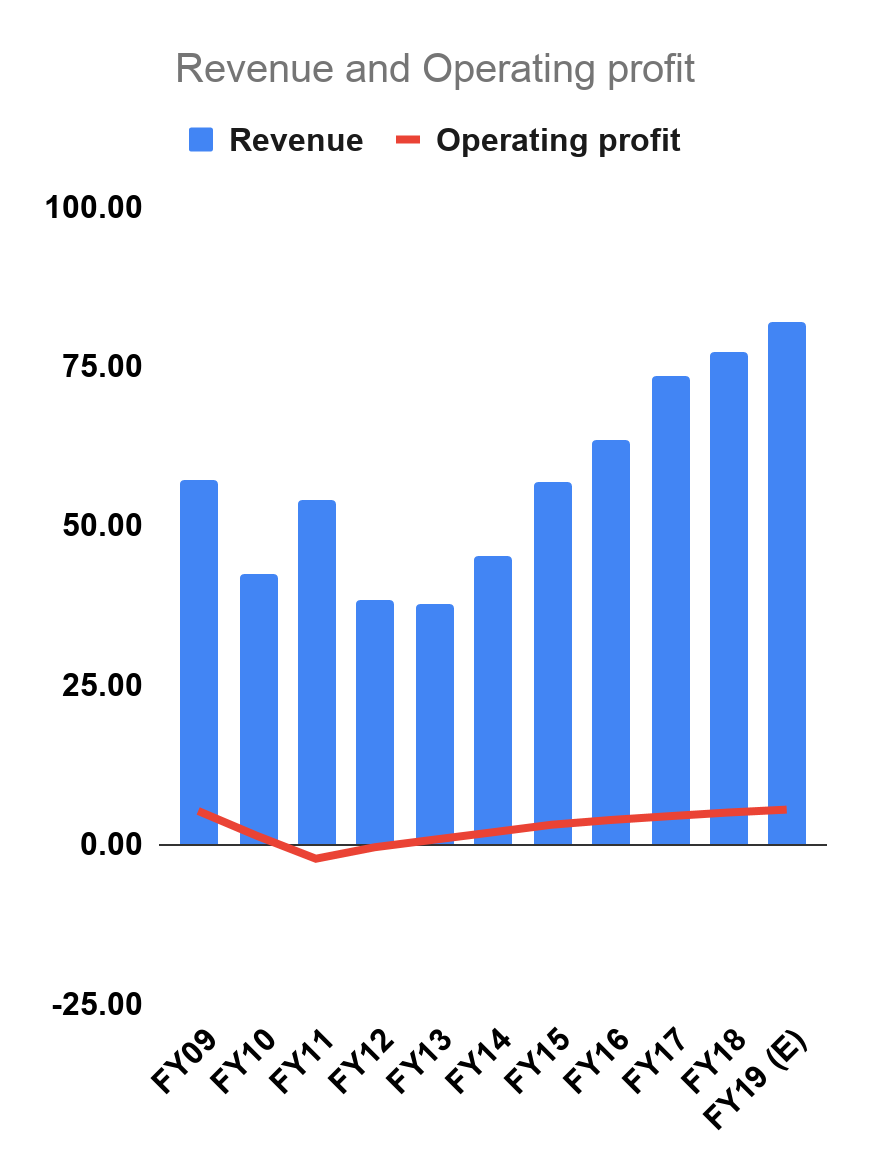
Clearly, FY10 through to FY13 can’t have been much fun for shareholders. Not only did profits collapse but dividends were put on ice as well. This was probably a prudent move at the time but still, not ideal for an investor.
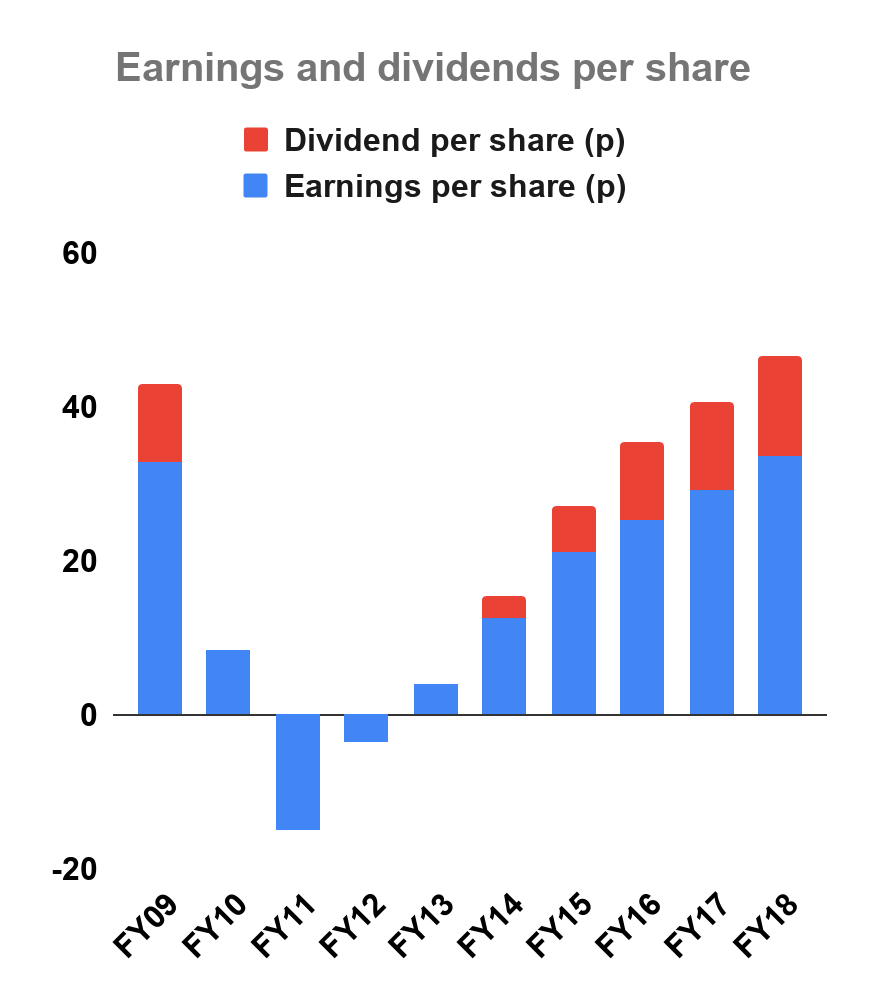
The company may one day face similar conditions. I don’t think cyclicality in itself is a bad thing if the company in question has a strong balance sheet - it can just make us act sub-optimally if we are not prepared for share price volatility. There are plenty of good, cyclical companies that grow over the long term and there will always be investors that prefer a lumpy 15% return to a smooth 12%.
That said, nobody wants to buy right at the top of a cycle just before a multi-year downturn. The FY13 through to FY18 period has been very good indeed. Judging from Billington’s revenue and operating profit figures, we are seven years into a bull run for the UK steel market. That sounds a lot closer to the end than the start.
At the end of 2013, Billington’s share price stood at 100p. After several very good years, those shares are now pushing 400p. Have we missed the boat on this one?
Trading history
The following potted history might provide a useful sense of context in terms of where Billington has come from, where it might go next, and how management fared in terms of anticipating and navigating market conditions.
FY09
Revenue: £57.18m
Operating profit: £5.25m
Operating margin: 9.18%
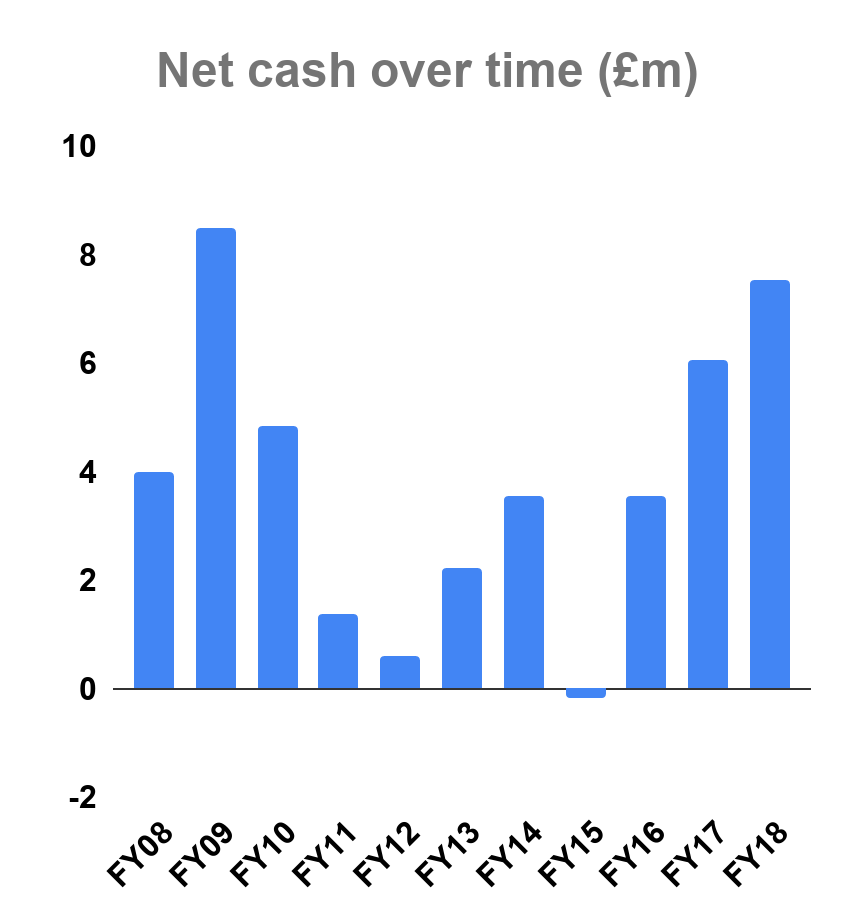
Net cash: £8.49m
At the end of FY09, Billington was wrapping up a series of disposals that would reduce its net pension liabilities by a useful £5.2m. This was prudent - over the next few years, flatlining interest rates and ballooning pension liabilities would cause problems for many.
Management believed that 2010 would be the bottom of the economic cycle for structural steelwork. The group said this, combined with competitor price pressure and predicted raw material increases, would see profits suffer over the next few years.
FY10
Revenue: £42.30m
Operating profit: £1.34m
Operating margin: 3.18%
Net cash: £4.86m
2010 did indeed prove to be an “exceptionally difficult trading environment”. The group managed to grow market share in both Structural Steel and Safety Solutions, however.
A number of major and minor competitors were failing at this point. The group reiterated its belief that it had reached the bottom of the cycle, citing an increasingly positive recovery in the London commercial market from late 2011 onwards.
FY11
Revenue: £53.88m
Operating profit: -£2.24m
Operating margin: n/a
Net cash: £1.38m
Increased revenue was offset by margin erosion in FY11. Cost savings were realised and the group acquired Peter Marshall Stairs after it fell into administration.
FY12
Revenue: £38.17m
Operating profit: -£0.44m
Operating margin: n/a
Net cash: £0.60m
Market conditions remained challenging throughout 2012 although annualised cost savings of nearly £3m led to a significant reduction in losses.
Billington committed more capital to new sectors like rail, energy from waste and put more emphasis on complex structural steel projects. The group commented on a “growing sense of order and stability” entering the structural steelwork sector.
FY13
Revenue: £37.57m
Operating profit: £0.74m
Operating margin: 1.96%
Net cash: £2.21m
Billlington correctly called FY13 as the turning point in the industry, with the market showing signs of improvement during the second half after five years of “extraordinarily difficult” trading environments.
This improving economic environment coincided with a “progressive and sustained improvement over the last three years as a result of the restructuring of [Billington’s] businesses”. The combination of improving conditions and a better company would power Billington’s share price in the years ahead.
FY14
Revenue: £45.10m
Operating profit: £1.90m
Operating margin: 4.21%
Net cash: £3.55m
FY14 was a “substantial improvement” over the previous year and significantly ahead of the original market expectations. A final dividend of 3p was issued - the first dividend payment since 2010. Prospects for the FY15 were positive, with a strong order book.
FY15
Revenue: £56.75m
Operating profit: £3.08m
Operating margin: 5.43%
Net cash: -£0.18m
The Group performed well throughout 2015 and achieved its strongest results for five years (once again, ahead of original market expectations). Growth was broad-based across all divisions. The prospects for 2016 were positive with substantial order books and positive enquiries.
FY16
Revenue: £63.33m
Operating profit: £3.83m
Operating margin: 6.04%
Net cash: £3.54m
Another set of results significantly ahead of the original market expectations.The structural steel business worked at, or near, capacity for most of the year. The group anticipated similar levels of productivity in 2017 thanks to robust order books across the Group and work secured through to the latter part of the year.
FY17
Revenue: £73.52m
Operating profit: £4.43m
Operating margin: 6.02%
Net cash: £6.04m
By March 2017 activity in the wider UK construction market was 31 per cent higher than the lowest point of the last five years. Forecasts indicated that, for the next two years, structural steel consumption in the UK would remain at these levels.
Billington was seeing more opportunities in Europe and the group entered 2018 with good visibility.
FY18
Revenue: £77.27m
Operating profit: £5.00m
Operating margin: 6.47%
Net cash: £7.55m
Another impressive performance with good progress across all divisions. Trading in FY19 also got off to a positive start, with an “unprecedented” forward order book and a “notable increase in European enquiries”.
Outlook
And that takes us through to the current financial year. After a decade of restructuring, cost-cutting, and growth, we arrive at Billington’s latest trading update for the year ending 31 December 2019.
The group is once again set to surpass market expectations in FY19, both in terms of revenue and profit. The CEO says: “the positive momentum, the Company's strong market position and robust and consistent financial performance of the Company leaves it well placed to move forward into 2020 and beyond with confidence.”
The group’s forward order book has gone from strength to strength (source: company HY19 presentation).
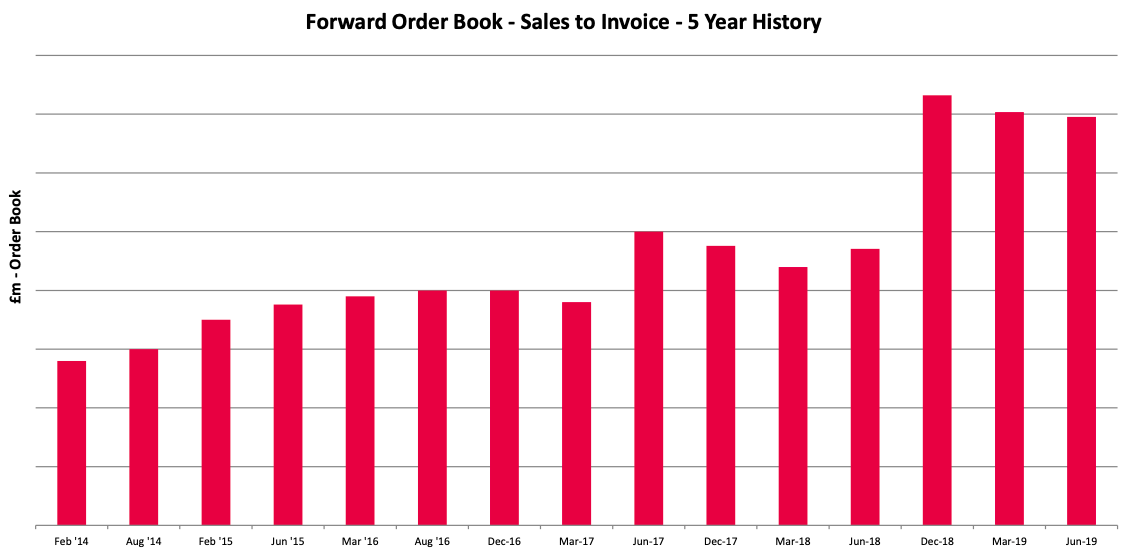
At some point conditions will turn but there appears to be nothing on the horizon for the moment. Over the years, Billington has demonstrated a reasonable aptitude for anticipating how conditions might develop in the short term.
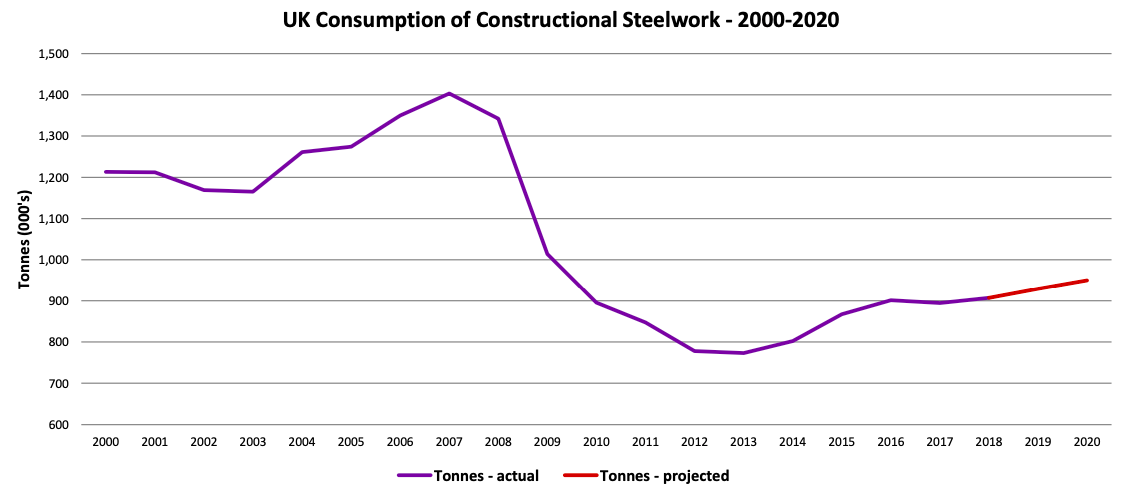
This graph, also taken from the group’s half-year presentation for FY19 shows that UK steel consumption is still around 30% below its peak in 2007 (data source: BCSA / Steel for Life).
The group cites a number of large project opportunities for 2020. It is increasing its dividend, expanding its apprenticeship schemes, and diversifying its businesses. Given its historic growth rates and undemanding valuation, Billington appears to be a promising growth-at-a-reasonable-price (GARP) candidate.
Board and key shareholders
For all this, it is interesting to note that the group’s largest shareholder, Gutenga Investments, has been busy offloading shares.
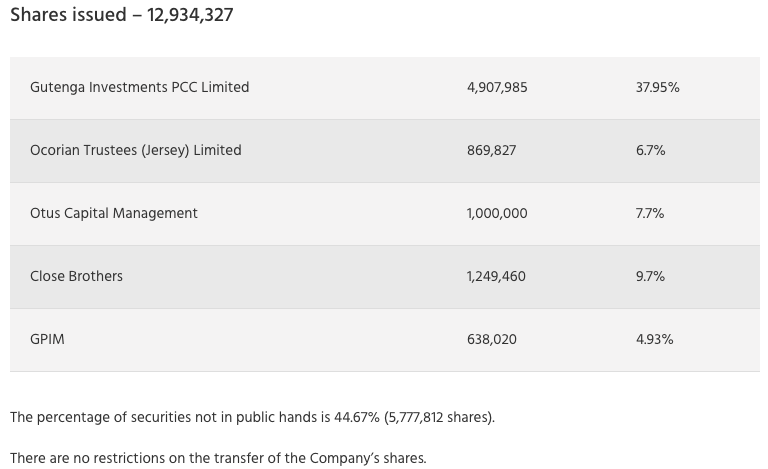
This group actually represents non-executive director Alexander Ospelt, who has been selling shares for a while, as we can see from the Director dealings tab.
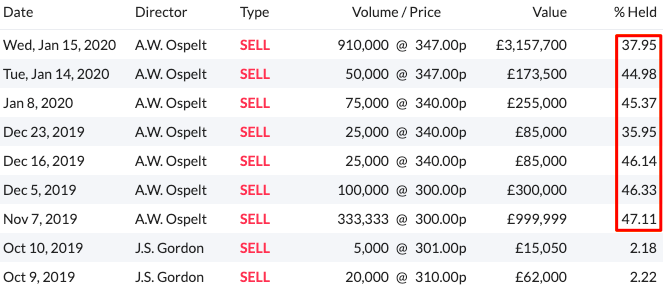
This may be purely to normalise the shareholder register - or it may be in anticipation of tougher times to come. Either way, it is worth keeping an eye on.
Risks
The key risk for Billington is cyclicality. We have gone into this in some detail above. Billington appears to be a well run, straightforward company, but the fact that it is now seven years into a market upswing has to be considered when weighing up a potential entry.
The group also has a defined benefit pension scheme which closed to future accrual in 2011. On an actuarial basis, the company reported assets of £8.2m with liabilities of £6.9m resulting in a surplus of £1.3m as of FY17. Should interest rates fall, this surplus could become a deficit.
Billington’s business model brings a degree of liquidity risk. It has quite a lot of trade receivables and payables along with working capital and capex requirements. Over time, the group has managed this with a current ratio at around the 1.5 mark.
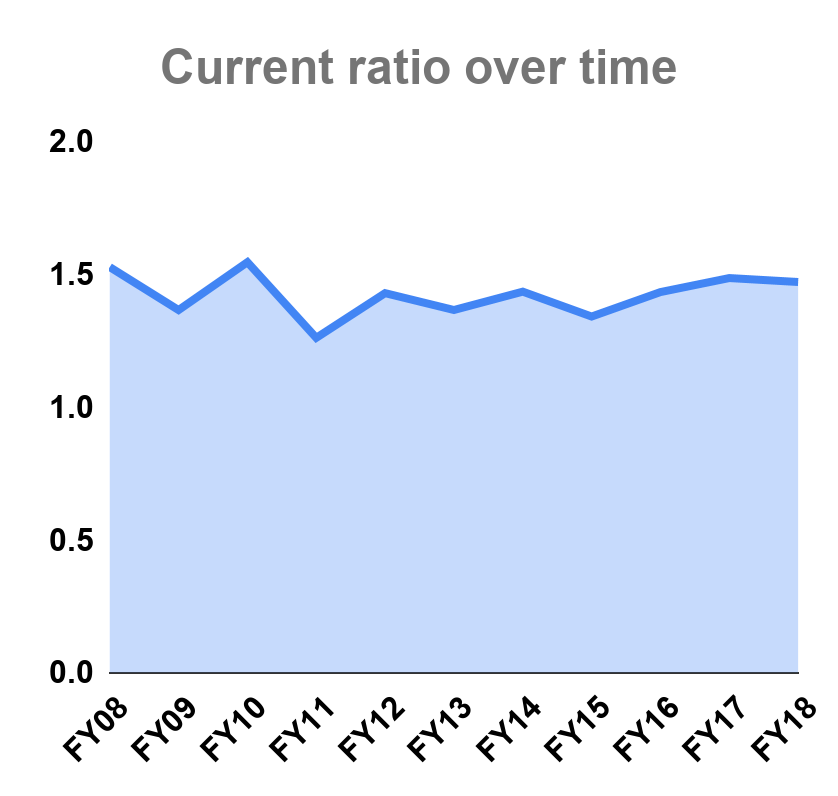
As a contracting company, Billington could suffer steep drops in revenue and profit depending on market conditions - for example, in FY12 revenue fell by nearly 30%.
Thankfully the company has built up a solid net cash position, which can be used to meet working capital requirements. You can see that when the market was less favourable, from FY09 through to FY12, Billington relied heavily on these cash reserves.
Today’s much improved operating margin of 6.5 per cent is still low by the standards of other industries. Some parts of the market are just easier to make money in than others.
Conclusion
Billington’s contract revenues, high working capital requirements, at times significant capital expenditure requirements, pension fund and low operating margins make for a material risk profile.
It strikes me as a prudently run operation, but it needs to be just that. If management policy towards, say, debt changes and the group takes on more long-term obligations, this group carries with it a mix of risks that can be fatal to a company. Given that the steel market has been improving for Billington since 2013, it is also fair to question how much longer favourable conditions might continue.
That said, I have yet to see any macro data that suggests the market is about to turn. The group has commented sensibly on steel market conditions in the past and recent news flow has been very encouraging. FY19 brought an “unprecedented” level of secured work and the company says it is “well placed to move forward into 2020 and beyond with confidence”.
While Billington brings with it real risks that ought to be considered, this small cap has built an excellent track record of growth since 2013 and has developed a useful habit of beating revised market expectations. Given its growth trajectory and factor profile, I feel that market risk is priced in at 11 times forecast earnings and there is plenty of scope for further earnings growth and multiple expansion. I’d be interested to hear from any existing holders or those that have opposing views.
Disclaimer
This is not financial advice. Our content is intended to be used and must be used for information and education purposes only. Please read our disclaimer and terms and conditions to understand our obligations.

17 comments
Good Evening Jack
As discussed on Twitter
https://rhomboid1mf.blogspot.com/2020/01/billington-booming-barnsley-based.html
* hugely biased as I hold loads & like the mgt/company *
Thanks rhomboid, good title!
Anybody interested in Billington Holdings (LON:BILN) should give your blog post a read, it gives a good sense of history of the company and goes into more detail re. the higher margin opportunities it has going forward...
I have held this stock for a couple of years. It has the attraction of a good dividend, and has performed well over the period of my ownership. I recently top sliced my holding to balance my portfolio.
Whilst not much mentioned I believe they have been installing state of the art equipment and maybe taking on work previously performed by others, who have now found it cheaper to use BILN plant for processing steelwork as their own kit has become obsolescent.
I also like the way that the Directors recognise the achievements of their employees, and encourage them to contribute their efforts towards the community. It
appears to be a very happy family.
Mike Miles
Mike: Intrigued by your Billington Holdings (LON:BILN) state of the art equipment comment I have done a bit more desk research on this. Seems they acquired their Shafton milling operation in 2015 and instigated a 5 year computer driven investment programme to reduce Shafton's unit cost and increase capacity. Billingtons may be taking on other competitors steel fabrication work as a consequence, but the Shafton expansion was designed to enhance Billingtons structural division capabilities from 2018 onwards:
Construction Times Sept 17: The (Billington) group said it expects its new steel processing and manufacturing facility at Shafton to become operational in January 2018. Billington said this would give it the ability to “bring previously subcontracted work back in-house”, and would provide increased capacity for its main steelwork business, Billington Structures.
Probably too much to call the Shafton acquisition transformational and metal bashing will always be a highly competitive lower margin business, but the timing and execution of the Shafton investment does appear to have been strategically wise.
I also note that at the end of 2018 Billington's appointed a new chairman, who was the ex CEO of their larger steel work competitor Severfield. Again a canny management move?
Awaiting the end Jan update with interest. As ever please DYOR. Ian
Think you mean the pension scheme is a defined benefit one rather than contribution based. Assuming I am right, your point is still valid though......sorry to be so picky. In all the numbers that you have presented the slow down in the order book would be my main concern with this stock.
The broker WH Ireland has already said ( accessible via Research Tree) that they will re-visit their 2020 forecast after the January trading update..as a holder I expect continued growth as everything points that way..no long to wait
I have noticed several times (not with BILN) that WH Ireland have been "conservative" (some might say slow off the mark) when updating their clients progress. This results in earnings upgrades following significant RNS announcements, rather than on trends.
No, thanks for pointing it out. I've made the edit.
All those director sales put me off. Why sell if you have the prospect of your shares increasing in value? Or is it not as simple as that?
Rusty - if it wasn't for the original size of the holding, it would be much more of a red flag for me. As it is, it's certainly worth investigating further. Billington Holdings (LON:BILN) has a pretty small free float and a holding of over 40% is quite material. Above 30% triggers a cash takeover bid so getting below this 30% threshold would go some way to normalising the shareholder register.
I would like to know how Gutenga came to have such a substantial interest in the company.
Hi Rusty
Gutenga is a family trust with mainly German beneficiaries formed when AMCO founder ex pat German Henry Schill died in 2003 with no children. It is based in Guernsey & is in wind-up mode due to the age of the beneficiaries, it also has a number of other UK construction interests including Tolent Construction...I’ve discussed it’s orderly exit from this Billington position with Luxembourg based representative NED (& lawyer) Dr Ospelt at the last AGM they are v supportive shareholders but want to exit for perfectly rational reasons
I was at Billington’s presentation at the last Mello. Very impressive. Got to speak to the FD afterwards. He’s a man who likes a safe balance sheet. I see no company risk here, so an investment decision for me, is purely down to the future of their markets.
Gutenga selling down is a positive. This was raised at the Mello presentation. Gutenga will continue to sell. Lack of liquidity is a problem for Billington and they want more shareholders on the register.
For me, this is a classic ‘buy on weakness’ stock. Only problem - no weakness.
I notice that estimated EPS growth for 2020 is negative. Does anyone know why this might be? The 2017 report mentioned new opportunities in Europe- are they expecting those opportunities to be affected by Brexit.?
Hi John2. Yes EPS growth for 2020 is negative. This is probably associated with the forecast fall in turnover from £100m to £80m. However, it is worth noting that the company has a history of forecast upgrades. I am hoping that, once the 2019 results are published, it will prompt the analysts to review their forecast s for 2020 turnover and EPS upwards. Also I note that this company does not get much attention from analysts, with only one broker issuing forecasts. Sometimes this can be helpful because a diligent private investor can be one step ahead of the analysts in such a situation.
Thank you that’s a very helpful reply.
Jack - Excellent piece. My own notes below from March 19 which prompted me to buy (and hold) an initial Billington Holdings (LON:BILN) stake.
Structural steel is 84% of sales and Billingtons is the 3rd biggest player next to Severfield. Cyclical construction risk with H1 weighting. Passes Richard Driehaus and Buffettology Historic (consistent) Growth. SR 94, but modest operating margin.
As the time I was impressed with its ability to pass 2 difficult to pass Quality Guru screens and yet have a SR of 94 (good and cheap). Its responded well since the election so I will continue to hold. If I didn't already have a holding I would be buying now because the same screening metrics and outlook pertain.
Good to see an old-fashioned manufacturing business doing so well.
Another insightful analysis. Thank you.